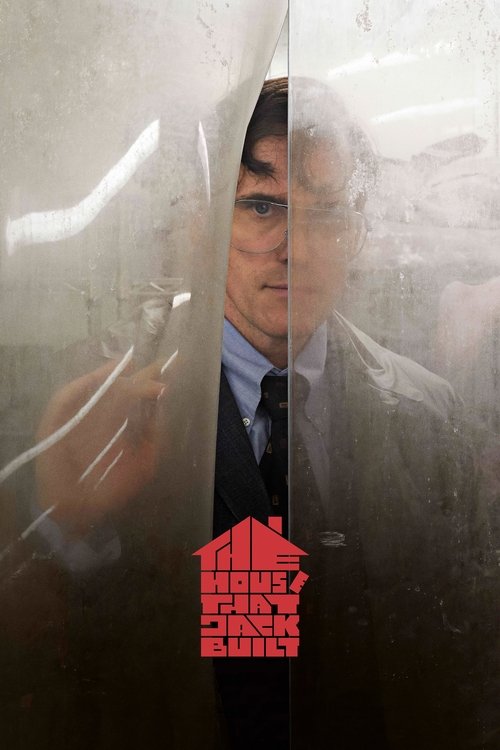
The House That Jack Built
2018 · Lars von Trier
Only for when you're ready to be confronted — this is the far end of challenge viewing, a film to wrestle with rather than enjoy. Reach for it when you want cinema as provocation and have the stomach for it.
What it's about
Over two and a half hours, a failed architect named Jack recounts five 'incidents' from his twelve years as a serial killer in 1970s Washington State, narrating them to an unseen listener whose probing questions frame the journey — a descent, in every sense. Jack insists his murders are works of art; the film watches him build that argument while everything around him testifies against it. It's a portrait of a self-justifying monster, told from inside his own head.
The experience
Punishing, coldly funny, and deliberately hard to sit through — it alternates genuine horror with essayistic digressions on art and cruelty, daring you to stay in the room. You come out shaken and arguing with the film, which is exactly what it wants.
Performances
Matt Dillon is chillingly good as Jack — fussy, vain, and utterly hollow — and Bruno Ganz, as the unseen interlocutor Verge, turns a disembodied voice into the film's conscience.
The craft
Lars von Trier structures the film as a confession punctuated by digressions — art history, architecture, engineering — so that the killer's aesthetic theories and the director's own methods become uncomfortably entangled. It's also a work of startling images, building to a finale of genuinely audacious visual invention.
Why it matters
Von Trier's return to Cannes seven years after being banned, it triggered famous walkouts and became a flashpoint in debates about screen violence and authorial provocation — widely read as the director's most naked act of self-portraiture.
Horror · Serial-killer thriller · New French Extremity & extreme · Art-horror. A killer narrates his murders as works of art: coldly funny, punishing extreme cinema that dares you to stay, ending in a startling descent.
Snapshot
The House That Jack Built is Lars von Trier's serial-killer film reconceived as an essay on art, cruelty, and self-justification. Across a two-and-a-half-hour running time, a Washington State killer named Jack (Matt Dillon) recounts five "incidents" from twelve years of murder to an unseen interlocutor called Verge (Bruno Ganz), whose questions steadily reveal themselves as the prompts of a guide leading Jack down toward hell. The film marked von Trier's return to the Cannes Film Festival in 2018, seven years after he was declared persona non grata for remarks made at the Melancholia press conference. It is at once a genre exercise in the tradition of the intellectual serial-killer picture and a lacerating, deliberately provocative act of authorial self-portraiture, in which the murderer's rhetoric about artistry doubles as a distorted mirror of von Trier's own reputation. Grim, digressive, and openly theoretical, it stands as a coda to the so-called Depression Trilogy and one of the director's most divisive works.
Industry & production
The film was produced by Zentropa, the Danish company von Trier co-founded with Peter Aalbæk Jensen, with Louise Vesth as lead producer — the same production spine that carried Nymphomaniac and Melancholia. It is a multi-national European co-production, drawing on the pan-Scandinavian and Franco-German financing structures typical of von Trier's later career, with international sales handled by TrustNordisk. The nominal setting is the American Pacific Northwest, but the shoot was European; von Trier has long staged "America" from a distance, and here that estrangement is again part of the design rather than an accident of budget.
Its most consequential industrial fact is its festival history. The picture screened out of competition at Cannes in May 2018, an unusually loaded booking given that the festival had banned von Trier in 2011. Widely reported walkouts during the graphic sequences became part of the film's public identity before most audiences had seen it. In the United States, IFC Films handled distribution and mounted a one-night theatrical event of the director's cut before a wider release; that director's cut and an edited R-rated version circulated separately, a distribution split driven by the film's extreme violence. I do not have reliable box-office figures to cite and will not invent them; commercially it performed as a specialized art-house release rather than a wide commercial title.
Technology
The House That Jack Built was shot digitally, consistent with von Trier's practice across the Depression Trilogy. The image is handheld and mobile in the manner the director helped normalize through Dogme 95, but by 2018 the roughness is a stylistic choice layered over high-resolution digital capture rather than a technical constraint. The film's most distinctive "technology" is not a camera but its editorial apparatus: von Trier interpolates archival and found material — documentary footage, photographs, diagrams, and clips from his own back catalog — into the fiction, using digital compositing and montage to build essayistic asides. These inserts (Glenn Gould at the piano, images of Nazi architecture and atrocity, William Blake's engravings, hunting and taxidermy footage) function as a citational database bolted onto the narrative, a technique the digital timeline makes frictionless.
Technique
Cinematography
Manuel Alberto Claro, von Trier's regular cinematographer since Melancholia, shot the film. His camera is restless and intimate, favoring handheld framing, quick reframes, and a documentary proximity to violence that refuses the composed distance of the classical thriller. The palette is largely desaturated and cold — grays, muddy greens, the fluorescent pallor of Jack's storage freezer — punctuated by the harsher registers of the killings. Claro modulates between this naturalistic, jittery observational mode and the highly composed, painterly imagery of the epilogue's descent, so that the film's visual grammar itself charts the movement from grubby true-crime realism toward mythic allegory.
Editing
Editing is central to the film's meaning, not merely its rhythm. Credited to Molly Malene Stensgaard — a longtime von Trier collaborator — with Jacob Secher Schulsinger, the cut is essayistic and associative, repeatedly breaking the diegesis for Verge-and-Jack voiceover interludes illustrated by montage. The killings are staged and cut with a queasy patience, while the interpolated material accelerates into rapid, argumentative sequences. This constant oscillation between story and commentary is the film's defining formal device: the edit stages the argument that Jack (and, self-reflexively, the director) keeps making about whether atrocity can be transmuted into art.
Mise-en-scène / staging
The controlling metaphor is architectural. Jack is a failed architect who dreams of building a house and never can, repeatedly demolishing his attempts; the freezer full of arranged corpses becomes his true construction, and the film's climactic "house" is built from bodies. Von Trier stages the murders as tableaux — a picnic, a domestic dinner, a hunting outing — that curdle domestic ordinariness into horror. Recurrent motifs of cleaning and re-cleaning blood dramatize Jack's compulsions (an evident refraction of von Trier's own well-documented obsessive-compulsive disorder). The staging grows progressively more stylized until the epilogue abandons realism entirely for an underworld of vaults, chasms, and infernal light.
Sound
The film has no conventional score. Its soundtrack is built from pre-existing music deployed as ironic and thematic counterpoint: David Bowie's "Fame" recurs as an accompaniment to montage, and Glenn Gould's recordings of Bach thread through the film as Jack's chosen emblem of genius. Ray Charles's "Hit the Road Jack" supplies a black-comic pun. The near-continuous voiceover dialogue between Jack and Verge is itself a governing sonic structure — the film is, formally, a recorded confession or descent-narrative, and the primacy of that spoken exchange over any orchestral underscore keeps the register argumentative rather than emotional.
Performance
Matt Dillon anchors the film with a performance that is affectless by design — Jack narrates massacre with the flat, self-regarding calm of a man delivering a lecture, and the horror derives from the gap between the atrocity onscreen and the reasonableness of his tone. Bruno Ganz, as the voice of Verge, provides a weary, humane counterweight, skeptical and increasingly mournful; it was among the last roles of his career (Ganz died in early 2019). The supporting cast — including Uma Thurman as an early victim, Siobhan Fallon Hogan, Sofie Gråbøl, Riley Keough as the woman Jack calls "Simple," and Jeremy Davies — plays victims who are given just enough life to make their deaths register, several of them cast in roles that pointedly foreground von Trier's fraught history with the depiction of women's suffering.
Narrative & dramatic mode
The film's structure is its thesis. It is organized as five "incidents" plus an epilogue titled "Katabasis," the Greek term for a descent into the underworld. The framing device is a dialogue: Jack recounts and rationalizes his crimes while Verge interrogates, contextualizes, and occasionally rebuts him. This confessional, retrospective mode allows von Trier to interrupt the narrative constantly for digressive essay-sequences on architecture, wine's "noble rot," Gothic cathedrals, Nazi architecture, William Blake, and the aesthetics of decay. The dramatic mode is therefore closer to the philosophical dialogue or the illustrated lecture than to the suspense thriller; tension is intellectual and moral rather than procedural. Only in the epilogue does allegory take over completely, transforming the case study into a Dantean myth.
Genre & cycle
The House That Jack Built belongs to the lineage of the intellectualized serial-killer film — the tradition in which the murderer is an articulate aesthete and the film an inquiry into evil rather than a whodunit. It converses with Peeping Tom, A Clockwork Orange, Henry: Portrait of a Serial Killer, The Silence of the Lambs, and American Psycho, all films that link violence to art, performance, or connoisseurship. But von Trier bends the cycle toward the art-film essay and the medieval descent-narrative, so the genre framework is finally a vehicle for allegory. It sits alongside his own body of provocations more than within any commercial horror cycle, extending the transgressive extremity of Antichrist into the territory of the crime film.
Authorship & method
The film is unmistakably von Trier's, and its central provocation is autobiographical in a displaced way: Jack's insistence that murder can be art, his grandiosity, his compulsions, and his need to shock all read as a self-implicating caricature of the director's public persona. Von Trier reinforces this by inserting clips from his own filmography — Antichrist, Melancholia, Dogville, Breaking the Waves, Dancer in the Dark, and Nymphomaniac among them — during the epilogue's reckoning, so that Jack's "body of work" is literally von Trier's. The method is confrontational and self-critical at once: the film seems to anticipate and stage the accusation that its maker is a sadist who dresses cruelty as significance.
His key collaborators are largely the team of his late period. Cinematographer Manuel Alberto Claro and editor Molly Malene Stensgaard carry over the visual and rhythmic sensibility of Melancholia and Nymphomaniac. The film notably eschews a composer, so authorship of its sound rests with von Trier's curation of existing music rather than an original score. The screenplay is credited to von Trier, developed from a story idea he shares credit on; where finer details of the writing process are concerned, the public record is thin, and I won't reconstruct it beyond what is established.
Movement / national cinema
Von Trier is the defining figure of modern Danish cinema and the co-author, with Thomas Vinterberg, of the 1995 Dogme 95 manifesto, whose vows of chastity — natural light, handheld camera, no non-diegetic music — reshaped international art cinema. The House That Jack Built is a post-Dogme work: it retains the movement's handheld immediacy and its rejection of an orchestral score while abandoning the manifesto's ascetic rules. As a Zentropa production, it is also an artifact of the specific Danish institutional ecosystem — Zentropa, the Danish Film Institute's funding culture, and the pan-Scandinavian co-production model — that made von Trier's uncompromising cinema economically possible.
Era / period
Made and released in 2018, the film is a product of the late-2010s European auteur cinema, and it cannot be separated from the #MeToo moment into which it arrived. Its graphic violence against women, and von Trier's own contested reputation — including allegations later made public by a former collaborator — made its Cannes premiere a lightning rod for debates about what provocations the culture would still underwrite. The film's self-flagellating structure can be read as von Trier's response to that climate, whether as apologia, confession, or further provocation. It is also, chronologically and thematically, the capstone to the run of despairing films that began with Antichrist in 2009.
Themes
The film's governing theme is the relationship between art and atrocity — the seductive, dangerous claim that suffering can be redeemed or ennobled by aesthetic transformation. Jack elaborates this through analogies to architecture ("some say the material does the work," and the idea that a house, like a life, is built), to wine's noble rot (decay as a condition of beauty), and, most damningly, to Albert Speer's theory of "ruin value" and Nazi architecture, which the film uses to expose the moral bankruptcy of aestheticized destruction. Around this cluster the film gathers its other preoccupations: masculine grandiosity and self-pity; obsessive-compulsion as both affliction and metaphor; the artist's narcissism; and the William Blake opposition of innocence and experience, "The Lamb" and "The Tyger," which frames the question of whether cruelty is intrinsic to creation. The Dantean epilogue turns all of this into a moral judgment — the descent is a damnation.
Reception, canon & influence
Critical reception was sharply polarized, which is the film's most consistent reception fact. The Cannes premiere generated reports of walkouts and a discourse dominated by the violence and by von Trier's return from banishment. Critics split between those who found it a bracing, self-aware meditation on art and evil — praising Dillon's performance and the audacity of the self-citation — and those who read it as juvenile provocation, misogynistic in its imagery and self-indulgent in its digressions. It has not settled into consensus canonical status the way Breaking the Waves or Melancholia have; it is more often discussed as a fascinating, problematic late work.
Its influences run backward to the essay-film and the intellectual serial-killer tradition named above, to Dante's Inferno (Verge is a transparent stand-in for Virgil, and "Katabasis" makes the debt explicit), to William Blake, and to the aesthetic-philosophical writing on architecture and decay the film quotes. Above all it draws on von Trier's own filmography, which it cannibalizes directly. As for its forward influence, the film is recent enough that its legacy is still forming; its clearest function has been to consolidate the "serial killer as self-portrait of the provocateur-artist" and to serve as a reference point in ongoing debates about transgression, authorship, and complicity in art cinema. Any stronger claim about films it has demonstrably shaped would be speculative, and I'll leave it there.
A Deleuzian reading
A man kills a woman in her own house, and then he cleans the floor.
The full Deleuzian reading of The House That Jack Built →
Reception
It premiered at Cannes 2018 to one of the festival's most infamous receptions — mass walkouts and cries of 'disgusting' alongside a standing ovation — and was widely dismissed as empty provocation; since then it's been partly reclaimed as von Trier's most self-lacerating film, a career-long self-portrait disguised as a serial-killer movie.
How The House That Jack Built was received, from release to now →
How to watch The House That Jack Built: what to notice on a first viewing
- Watch what Jack does after a killing, not during. He cleans the floor. He leaves. He comes back and cleans it again. Matt Dillon narrates all of it in the flat, self-regarding calm of a man delivering a lecture on his own work. The voice says composition. The rag says compulsion. The distance between those two claims is the film.
- Notice the ordinary setting each incident starts in. A roadside breakdown, a dinner at home, a picnic, a hunting trip with children. Von Trier uses the plainest containers domestic life offers and then drills through the bottom of each one. The ordinary scene is not a stage for action here. It works as a lid over something else.
- Notice how jittery and close the handheld camera stays. Manuel Alberto Claro keeps reframing, pressing nearer the violence than is comfortable and refusing the composed distance a classical thriller would keep. The color stays desaturated, gray and muddy green. You are never given a safe seat. The style denies you the distance that would let this play as genre.
- Listen for Bowie and Bach with no score in between. There is no composer on this film. Von Trier uses records: Fame across the montages, Glenn Gould's Bach under the murders, Ray Charles for a joke. The talk between Jack and the unseen Verge carries the rest. Nothing in the soundtrack tells you how to feel. Music and image keep giving separate accounts of the same minute.
- Watch the film interrupt itself with photographs and diagrams. Molly Malene Stensgaard cuts in Blake engravings, cathedrals, taxidermy, Nazi architecture, the noble rot of wine. Each break is illustrated argument rather than story, and then the incidents resume. The image arrives as a citation you are asked to check. You end up reading the film as much as watching it.
The whole guide to watching The House That Jack Built, with the keys for a rewatch →
Influences: the films it descends from and the films it influenced
- Peeping Tom (1960) — Founds the killer-as-artist who compiles his murders into a curated body of work and implicates the filmmaker's own gaze — the exact conceit von Trier literalizes when Jack's 'oeuvre' becomes von Trier's own filmography.
- Henry: Portrait of a Serial Killer (1986) — Establishes the affectless, procedural killer shot in grimy desaturated realism; Michael Rooker's blank register is the template for Matt Dillon's emotionally flat Jack.
- Man Bites Dog (1992) — An articulate serial killer lectures the crew on his methods, ballast ratios, and aesthetics in essayistic mockumentary form — the direct model for Jack narrating technique to Verge over illustrative footage.
- A Clockwork Orange (1971) — Pioneers the ironic needle-drop — atrocity choreographed to pre-existing music with no original score's comment — delivered by a self-mythologizing first-person narrator, the sound strategy von Trier reuses wholesale.
- Salò, or the 120 Days of Sodom (1975) — Structures escalating atrocity as a Dantean descent through named circles while forcing the viewer into complicity — the katabasis-as-catalog architecture underlying Jack's five 'incidents' and epilogue.
- M (1931) — The foundational compulsive serial killer put on trial and made to explain himself — the confessional 'account of my compulsion' frame that Jack's dialogue with Verge inherits.
- The Silence of the Lambs (1991) — Codifies the cultured, connoisseur killer who converses about taste and aesthetics as an intellectual equal — Lecter's aesthete-lecturer mode feeding Jack's grandiose art-theory monologues.
- Se7en (1995) — Stages murders as elaborate composed tableaux — crime scenes as authored artworks — in a rain-soaked desaturated palette, the visual grammar of Jack's architectural staging of corpses.
- Natural Born Killers (1994) — Weaponizes essayistic associative montage — intercutting killers with archival, art-historical and media imagery — the editing logic von Trier deploys in the reckoning epilogue's image-collage.
- Breaking the Waves (1996) — Establishes von Trier's chaptered structure with handheld, available-light immediacy; its clip is literally quoted in Jack's epilogue and its Dogme-adjacent camera underlies the film's handheld cinematography.
- Dogville (2003) — Supplies the numbered-chapter, narrator-framed morality-tale structure and the stripped architectural staging; von Trier cannibalizes it directly in the self-citation montage.
- Antichrist (2009) — Sets the late-period confrontational art-and-atrocity mode — handheld grotesque with self-implicating cruelty — and is one of the clips inserted to make Jack's body of work von Trier's own.
- Sick of Myself (2022) — Extends the Nordic affectless satire of the narcissist who converts self-harm into an attention/art project — the provocateur-artist-as-self-portrait consolidated by von Trier, in deadpan register.
- Infinity Pool (2023) — Carries forward the art-cinema-as-self-implicating-provocation, staging transgression and the spectator's complicity in aestheticized atrocity as its explicit subject.
- American Psycho (2000) — A parallel affectless killer-aesthete who delivers deadpan connoisseur monologues on design and music as dark comedy — the same self-satirizing 'murder dressed as significance' register as Jack.
- Funny Games (1997) — Sibling in confrontational, audience-implicating art-house violence that lectures the viewer on their own appetite for atrocity — the complicity-as-craft strategy von Trier shares.
Similar films
- Antichrist (2009) — influence & lineage · same viewing thread · often watched together
- Dogville (2003) — influence & lineage · often watched together
- Funny Games (1997) — influence & lineage
- Man Bites Dog (1992) — influence & lineage
- American Psycho (2000) — influence & lineage · same viewing thread
- Martyrs (2008) — same viewing thread
- The Shining (1980) — often watched together
- The Hunt (2012) — often watched together
All the films related to The House That Jack Built →
Watch it with: curated runs of related films
- Inside the Killer's Head — Watch these when you want the camera on the killer rather than the cops: they rhyme on charm, self-justification and how uncomfortably close each film lets you get.
- Extreme Cinema's Breaking Point — A run of films from the New French Extremity, Asia Extreme and the European art-house provocateurs, all rhyming on the body as the place where grief, desire, revenge and power break open, best watched near each other so you can see how differently each director uses shock.