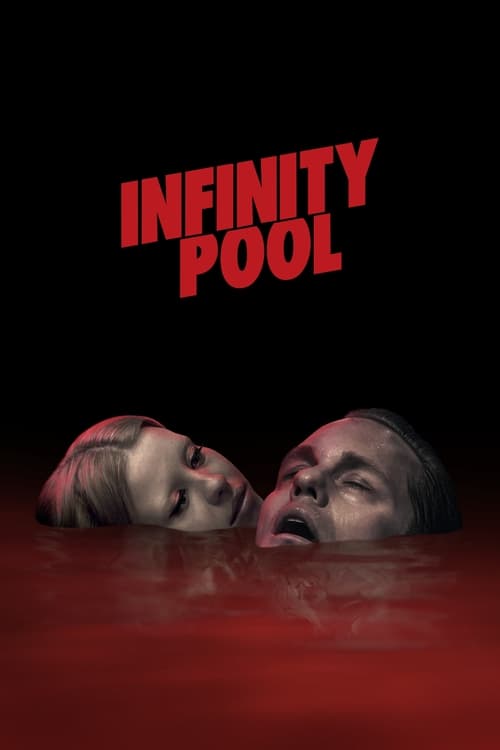
Infinity Pool
2023 · Brandon Cronenberg
When you want something transgressive and midnight-movie wild — a vacation-from-hell film to argue about afterward. Definitely challenge, not comfort: heavy on violence, sex and bad behavior by design.
What it's about
A novelist who hasn't written anything worth reading in years is vacationing with his wealthy wife at a fenced-off luxury resort in a poor island nation. A flirtatious fellow guest who claims to love his book lures them outside the compound, and a road accident leaves him facing the country's death penalty — unless he pays for its strange legal loophole: the state will execute an exact duplicate of him instead, and he must watch. What he does after that, and who he falls in with, is where the horror starts.
The experience
Sleazy, hallucinatory and gleefully nasty — a satire that keeps escalating into orgiastic, drug-smeared delirium. It's funny in a way that curdles, and it means to make you squirm about watching it.
Performances
Mia Goth is the engine — seductive, mocking and genuinely frightening, with a late-film unraveling that's become instantly memorable. Alexander Skarsgård commits totally to playing a hollow man, letting himself be humiliated on screen in ways leading men rarely allow.
The craft
Brandon Cronenberg shoots the resort world in woozy, sun-poisoned colors, with strobing hallucination sequences and prosthetic effects that are grisly without being cheap. The score throbs like a fever. It's built for a big screen and loud speakers, if you can take it.
Why it matters
It cemented Brandon Cronenberg as a distinctive voice in body-adjacent horror rather than just a famous name's son, and became a flashpoint in the wave of eat-the-rich satires for pushing the idea to its most depraved endpoint.
Snapshot
Infinity Pool is Brandon Cronenberg's third feature, after Antiviral (2012) and Possessor (2020). It is a satirical horror film about wealth, impunity and the self, set in Li Tolqa, a fictional resort nation. James Foster (Alexander Skarsgård) is a novelist who has stalled after one poorly received book. He is on holiday with his wife Em (Cleopatra Coleman), whose family money pays for their life. Gabi Bauer (Mia Goth), a woman who says she admires his novel, draws them away from the resort's fenced grounds. On the drive back, James runs over and kills a local man. Under Li Tolqa's law the penalty is death, but foreigners who can pay may have a duplicate of themselves made and executed in their place, and they must watch it happen. The film follows James as he is drawn into Gabi's circle of returning tourists, who use the cloning loophole to commit crimes without consequence. It premiered in the Midnight section of the Sundance Film Festival in January 2023, played as a Berlinale Special the following month, and was released in US theatres by Neon later that January. It drew strong but divided reviews, and Goth's performance was widely singled out. It is now one of the more extreme entries in the early-2020s "eat the rich" cycle, and the film that established Brandon Cronenberg as a voice separate from his father.
Industry & production
Infinity Pool was an international co-production centred on Canada, with Croatia and Hungary as partners. That structure is typical of mid-budget, auteur-led genre filmmaking outside the US studio system. Cronenberg's Canadian producing partners came from the circle around Possessor, including Karen Harnisch's Film Forge and Elevation Pictures, which also handled Canadian distribution. Neon acquired US rights and released the film on 27 January 2023, only days after its Sundance premiere. The quick release was a deliberate strategy: festival attention would carry straight into the theatrical opening.
The film was shot on location in Croatia, whose Adriatic coast stands in for the beaches and resort of Li Tolqa, and in Hungary, where much of the studio and interior work was done. Pre-production and shooting overlapped with the COVID-19 pandemic, and Cronenberg has spoken about the difficulty of mounting an international shoot under those conditions. The detailed production record, including budget figures, has not been widely published, and this account does not estimate them.
The film's release was shaped by its ratings classification. Its sexual and violent content was initially judged too strong for an R rating in the United States. Cronenberg trimmed sexually explicit material, most of it in the drug-fuelled orgy sequence, to secure the R needed for wide release. An uncut version was released later. This repeated what had happened with Possessor, which also circulated in separate rated and "uncut" versions. Those dual versions have become part of how both films are discussed and sold.
Technology
The film's look rests on a deliberate preference for in-camera and practical effects over digital ones. It shares this with Possessor and with the tactile body-horror tradition associated with David Cronenberg. The duplicates, which are the premise's central conceit, are realised mostly through practical means. The cloning is shown as an occult-looking ritual: the subject lies in a pool of red fluid, surrounded by medical-looking apparatus and costumed functionaries. Prosthetic bodies and gore effects carry the violence, and the film lingers on blood, skin and wounds as physical material rather than abstraction.
The hallucinatory passages were built from optical and photographic distortion instead of heavy CGI. These include the drug-induced orgy, a later attack under hallucinogens and the bodily montages around the duplication process. Techniques include strobing, flash cuts, image overlays, mirroring, lens and colour distortion, and inserts of bodily fluids and flesh pushed close to abstraction. Cinematographer Karim Hussain had developed much of this approach on Possessor, where many of the "transition" effects were made physically on set. Infinity Pool pushes the same approach toward a more explicitly psychedelic register. The exact camera and lens specifications are not widely documented in accessible sources and are not assumed here.
Technique
Cinematography
Hussain's photography sets two visual registers against each other. The first is a cool, sunlit, almost brochure-like surface for the resort: wide compositions, clean horizons, bright pools and controlled pastels. The second, which takes over as James descends, is saturated, strobing and textured. The film's most quoted opening image is a slow, inverted, rotating view of the coastline and resort road. The world is literally turned upside down before any story has happened, which announces the film's moral inversion and the disorientation of a tourist who doesn't know where they are.
Hussain often places figures in architecture as if in a display case. The resort's walls, fences and glass separate guests from the country around them, and the frame repeatedly makes those separations visible. In the execution scenes the camera stays stable and almost formal, which makes the violence ceremonial rather than frenzied. In the orgy and hallucination sequences, image stability breaks down altogether.
Editing
James Vandewater also edited Possessor. His cutting here works on two rhythms. The dramatic scenes play out at a measured, often uncomfortable length that lets social embarrassment and menace build. That matters especially in the dinners and conversations with Gabi's group, where status and humiliation are negotiated. The set-piece sequences use a different logic: rapid montage, flash frames, superimposition and associative cutting that run together images of bodies, sex, birth and violence. The orgy sequence is the clearest example. Its editing turns the drug trip into a kind of rebirth, which connects it to the duplication ritual. The montage suggests that pleasure, violence and the making of the self are one continuous process.
Mise-en-scène / staging
Li Tolqa is an invented nation, and the film designs it as a pastiche: vaguely Mediterranean, vaguely post-Soviet, made up of borrowed cultural signs. Its traditional masks are grotesque, carnival-like faces worn at a local festival. Gabi's group later puts them on during their violent sprees, which turns local ritual into tourist costume. The resort is a fortified enclave of luxury surrounded by barbed wire. Outside it is a landscape the guests are told not to enter. The staging keeps returning to that boundary.
The execution scenes are among the film's most distinctive staging. The duplicate is tied to stakes in an open field and killed with a knife by a child, the dead man's son, according to local law. The paying original watches from a few feet away. It is set up as theatre, and the film makes the audience take the same spectator's position the tourists have bought.
Sound
The score is by the Canadian electronic and ambient composer Tim Hecker. It was one of his first feature scores, following his work on Jacob Gentry's Synchronicity? — no: the record here is thin, so this dossier notes only that Hecker came from a significant career in experimental music rather than film scoring. His contribution is texture rather than melody: dense drones, distorted swells and degraded tones that blur into the sound design. The music rarely signals emotion in a conventional way. It works as ambient pressure, an unease under the holiday surface that comes to the front in the hallucinatory sequences. The sound design follows the same pattern, setting the clean ambience of the resort, with its waves, pool water and quiet service, against the harsh, layered textures of the drug and violence scenes.
Performance
Mia Goth's performance as Gabi received the most attention. She starts out seductive, flattering and girlish. Over the course of the film she becomes openly sadistic, and by the third act she is shouting, mocking and infantilising James with a feral, abrasive energy. Critics often called it unhinged in the approving sense. Coming soon after her roles in Ti West's X and Pearl (both 2022), it confirmed her as a leading figure in contemporary genre performance.
Skarsgård plays against his usual physical authority. James is passive, insecure and easily led. The actor's size and handsomeness become a joke on the idea of the masculine lead: James is a man who wants to be dominated, flattered and absolved. The film makes his humiliation literal, culminating in scenes where Gabi treats him as a dog. Cleopatra Coleman gives Em a level, increasingly appalled clarity that serves as the film's moral reference point until she leaves. Thomas Kretschmann plays Detective Thresh, the Li Tolqan police officer who runs the duplication and execution system with cold, bureaucratic courtesy. Jalil Lespert plays Gabi's husband Alban.
Narrative & dramatic mode
The story is a descent narrative organised around repetition. The first act is a satire of manners about rich tourists on holiday and a writer without inspiration. The accident turns it into a legal-procedural nightmare. The first execution, which James watches in horror, then turns it again: he discovers that the experience can be repeated, and that the tourists around him treat it as recreation. From there the film becomes a series of increasingly transgressive episodes: a robbery, assaults, the orgy, and the capture and killing of yet another double.
The philosophical engine is uncertainty about identity. The film never confirms whether the person executed is the duplicate or the original. James, and the audience, cannot be sure that the man who walks away is the "real" one. Gabi uses this doubt as a weapon. The doubles start to feel like stand-ins not just for James's body but for his conscience, his past self and his possible futures. The dramatic mode is cruel satire, closer to black comedy than to the elegiac. Its humiliations are often absurd and its violence is staged with ironic detachment.
The ending refuses catharsis. At the end of the season the tourists fly home. James reaches the airport, then turns back. The last image shows him sitting alone in the rain at the deserted resort. Whether he has stayed out of guilt, paralysis or addiction to the freedom he found is left open.
Genre & cycle
Infinity Pool combines several genres. In science fiction it belongs with doubling and cloning stories: duplication as legal and commodified technology, as in Antiviral's celebrity-cell market. In horror it continues the Canadian body-horror tradition, especially its concern with the body as a site of self-transformation. Its plot also places it in the "tourist in peril" or "holiday gone wrong" film, where Western travellers stray from protected areas into a foreign country imagined as threatening.
It is also part of the early-2020s "eat the rich" satire cycle. This includes Triangle of Sadness (2022), The Menu (2022), Glass Onion (2022) and, on television, The White Lotus (2021–). Like those works it treats the wealthy holiday as a laboratory of class behaviour. It is more extreme than most of them, and more interested in what impunity does to identity than in exposing hypocrisy. Here the rich are not punished; they are made monstrous by the absence of punishment.
Authorship & method
Brandon Cronenberg wrote and directed the film. Across his three features he has kept returning to the same concerns: the body as a commodity, the instability of identity, and technologies that turn the self into something that can be bought, transferred or copied. Antiviral imagined a market in celebrities' diseases. Possessor followed an assassin who inhabits other people's bodies. Infinity Pool proposes a legal system in which consequences can be outsourced to a copy. By Cronenberg's own account in interviews, the premise developed over a long period and was partly prompted by his discomfort with the walled-off logic of all-inclusive resorts.
Cronenberg's method depends on a stable creative team. Karim Hussain, a Canadian cinematographer and filmmaker with roots in the extreme-horror scene of the 1990s and 2000s, shot both Possessor and Infinity Pool. Their shared commitment to practical image-making shapes both films. James Vandewater edited both. Tim Hecker's score marks a new collaboration, in the experimental-ambient direction Cronenberg's soundworlds already favoured.
The comparison with his father, David Cronenberg, is unavoidable, and the son has not avoided it either. The films share an interest in flesh, technology and identity, and in a clinical tone. Critics have also identified differences. Brandon Cronenberg's films are more overtly satirical about class and power. They are more interested in collapsing identity than in the body mutating. And they tend toward the hallucinatory and spectacular more than the elder Cronenberg's often austere, deliberately unglamorous surfaces.
Movement / national cinema
The film is part of English-Canadian genre cinema. That tradition runs from the tax-shelter-era horror of the 1970s, when David Cronenberg made Shivers and Rabid, through the international co-productions that support many Canadian auteurs today. Like many contemporary Canadian art-horror films, it is made with European co-producers and locations and is set nowhere in particular. Its international cast, invented country and transnational financing reflect the global art-house genre market that formed around festivals like Sundance and Berlin and distributors like Neon.
It also belongs to a broader wave of "elevated" or art-house horror. In the 2010s and 2020s, companies such as A24 and Neon positioned genre films by distinctive directors as prestige products. Neon's handling of Infinity Pool placed it alongside other auteur-horror releases in the company's catalogue.
Era / period
Infinity Pool belongs to its moment in several ways. It was conceived and made during and just after the COVID-19 pandemic, when international travel was suddenly fragile and the privileges of the mobile rich were especially visible. It was released in a cultural climate preoccupied with inequality, the impunity of elites and the ethics of tourism. Its satirical cousins made the same years a recognisable cycle. Its interest in duplication and the reproducible self also fits early-2020s anxieties about digital identity, avatars and the copyable person, though the film never makes those connections explicit. It appeared in the same year as a strong run of art-house horror, and Mia Goth's casting tied it directly to the genre-performance moment created by Ti West's X/Pearl films.
Themes
Impunity and wealth. The central conceit literalises the idea that the rich can buy their way out of consequences. In Li Tolqa the law nominally applies to everyone, but money turns punishment into spectacle and then into entertainment. The film's real horror is not the executions themselves but how quickly people come to enjoy them.
Tourism and neo-colonial fantasy. Li Tolqa is invented and deliberately generic. That makes it a mirror for the tourist's imagination: a "dangerous" country that exists to be consumed, whose rituals become costume and whose legal system becomes a service. The local people are kept mostly at the edge of the narrative. Critics disagreed over whether this marginalisation critiques the tourists' view or reproduces it.
Identity and the double. The executions raise an unresolved question: is the survivor still the same person? The doubles stand in for a self that can be discarded, a conscience that can be killed and replaced. James's arc can be read as the gradual execution of his original moral self.
Masculinity, creative failure and submission. James is a blocked writer who depends on his wife's money and is hungry for recognition. Gabi's flattery at the start and her degradation of him later both feed the same need. The film links his creative impotence to his readiness to be remade by whoever offers him an identity.
Spectatorship and complicity. By making the tourists watch their own deaths, the film reflects on its audience. Like the tourists, we have paid to watch violence on a body that is not quite ours.
Reception, canon & influence
Critical reception. The film's Sundance and Berlin screenings and its theatrical release drew mostly positive reviews, though with clear division. Supporters praised the strong premise, the visual bravura of the hallucinatory sequences and, above all, Goth's performance, which was among the most discussed genre performances of the year. Detractors argued that the satire was thinner than the provocation. They felt the second half repeats rather than develops its idea, and that the film's critique of the wealthy is so blunt that it adds little to a well-worn cycle. Many reviewers placed it below Possessor while confirming Cronenberg as a distinctive filmmaker. Its theatrical gross was modest. Its afterlife has largely been on streaming and home video, where the uncut version has added to its reputation as an extreme film.
Influences on the film (backward). The most obvious inheritance is David Cronenberg's body horror: the body and identity reshaped by technology and desire, and the clinical tone of films like Videodrome and Crash. J.G. Ballard is also a frequently cited touchstone. His late novels, such as Cocaine Nights and Super-Cannes, describe enclosed luxury communities whose boredom produces sanctioned violence. Critics have also pointed to the psychedelic, strobing sensory style of Gaspar Noé (Enter the Void), to the masked, ritualised sexuality of Kubrick's Eyes Wide Shut, and to the long literary tradition of the double, from Poe to Dostoevsky. In tone and structure the film also echoes the parable of a society whose comfort depends on sanctioned cruelty, the territory of Le Guin's "The Ones Who Walk Away from Omelas". This is a critical affinity, not a documented source.
Legacy (forward). Only a few years after release, the film's long-term influence cannot yet be measured, and claims about specific films it shaped would be premature. Its effects so far are on careers and on position in the field. It secured Brandon Cronenberg's standing as an auteur in his own right. It extended Mia Goth's run as a defining genre performer of the early 2020s. It also gave the "eat the rich" cycle its most explicit and grotesque example. Together with Possessor, it consolidated a recognisable Brandon Cronenberg mode: practical psychedelic image-making, satire of the commodified self, and identity as something that can be copied, bought and killed. The Sightlines atlas can use that mode as a node in the continuing line of Canadian body horror.
Influences: the films it descends from and the films it influenced
- Shivers (1975) — Shivers sets its body horror in a sealed luxury apartment complex whose sterile amenities give way to a spreading sexual frenzy, the same enclosed-resort-turns-orgiastic structure that Infinity Pool moves to Li Tolqa's walled compound.
- Videodrome (1983) — Videodrome stages hallucination as practical, in-camera body transformation, with Rick Baker's prosthetics, and refuses to separate the protagonist's perception from what is real, a method Brandon Cronenberg carries into James's drugged visions.
- Dead Ringers (1988) — Dead Ringers plays the double as clinical horror, with identical selves shot in a cool, surgical register, the template for Infinity Pool's mirrored double, a copy watched as it dies.
- Crash (1996) — Crash adapts Ballard's affectless, bored elite who find arousal in sanctioned violence, and its detached, glassy performance style and pacing are the tonal model for the Infinity Pool tourists' jaded thrill-seeking.
- Society (1989) — Society's climactic 'shunting', with Screaming Mad George's practical effects, turns the rich literally melting into one another into a grotesque orgy of class predation, an ancestor of Infinity Pool's flesh-melding orgy montage.
- The Wicker Man (1973) — The Wicker Man builds an invented island culture with its own folk iconography and masks, which receives an outsider and leads to a public ritual killing, the pattern behind Li Tolqa's pastiche customs and ceremonial execution of the double.
- Eyes Wide Shut (1999) — Eyes Wide Shut presents the masked orgy as a closed ritual of the wealthy, with the outsider as voyeur, and Infinity Pool directly recalls this in its grotesque traditional masks and the tourists' initiation of James.
- Enter the Void (2009) — Enter the Void's strobing, colour-saturated drug subjectivity and the inverted, floating camera of its point-of-view shots are the most cited source for Karim Hussain's psychedelic sequences and Infinity Pool's upside-down, rotating opening.
- Hostel (2005) — Hostel set up the tourist-in-peril premise in which rich foreigners pay to commit violence abroad without consequence, and Infinity Pool turns that business model into the legal double-execution system.
- Subconscious Cruelty (2000) — In his own underground Québécois extreme film, Hussain developed associative, non-narrative montage of transgressive imagery, the sensibility he brings as cinematographer to Infinity Pool's flash-cut hallucination sequences.
- Beyond the Black Rainbow (2010) — Beyond the Black Rainbow is Canadian genre cinema built on practical, in-camera psychedelic imagery and droning synth texture rather than CGI, a precedent for the analog hallucinatory look of Brandon Cronenberg's films.
- Antiviral (2012) — Brandon Cronenberg's debut first set out his satire of the commodified body, where the rich buy celebrities' cells and diseases, and Infinity Pool extends that into buying a disposable copy of oneself.
- The Substance (2024) — The Substance stretches the commodified-double premise, a purchased copy of the self that its original then hates, into extreme practical prosthetic body horror, carrying the Cronenberg line Infinity Pool renewed into the mid-2020s.
- Possessor (2020) — Possessor has the same core team, Karim Hussain shooting and James Vandewater editing, and pioneered the practical in-camera melting-face and identity-dissolution effects that Infinity Pool repeats in its cloning and drug sequences.
- Climax (2018) — Climax's drug-fuelled communal descent, with rotating, inverted long takes, is the closest model for Infinity Pool's orgy-as-rebirth, where a group high becomes a collective unravelling filmed as sensory overload.
- Midsommar (2019) — Midsommar also invents a closed foreign ritual culture that welcomes tourists, then makes them witnesses to and participants in ceremonial death, ending on a protagonist's ambiguous, unreconciled 'rebirth'.
- Pearl (2022) — Pearl developed Mia Goth's register of manic, wheedling menace that swings from pleading to screaming in a single take, the performance mode she pushes further as Gabi.
- Triangle of Sadness (2022) — Triangle of Sadness is an eat-the-rich satire set in an enclosed luxury holiday, a yacht, where wealthy tourists' impunity breaks down into bodily abjection, a contemporary twin of Infinity Pool's resort satire.
Similar films
- Triangle of Sadness (2022) — influence & lineage · same viewing thread
- Videodrome (1983) — influence & lineage
- Possessor (2020) — influence & lineage
- The Substance (2024) — influence & lineage
- Crash (1996) — influence & lineage
- Eyes Wide Shut (1999) — influence & lineage · same viewing thread
- Blink Twice (2024) — same viewing thread
- Teenage Sex and Death at Camp Miasma (2026) — shared sensibility
All the films related to Infinity Pool →
Watch it with: curated runs of related films
- Elegant Betrayals — Watch these back-to-back for couples and beautiful people whose polished surfaces — a London flat, a Riviera villa, a spies' dinner party — hide a betrayal, a surveillance, and a body, each turning intimacy into a crime scene.
- When Everyone Finally Snaps — A run of films where an ordinary scene — a birthday dinner, a small town, a quiet house, a man at the end of his patience — gets pushed past its breaking point until the whole social order detonates.