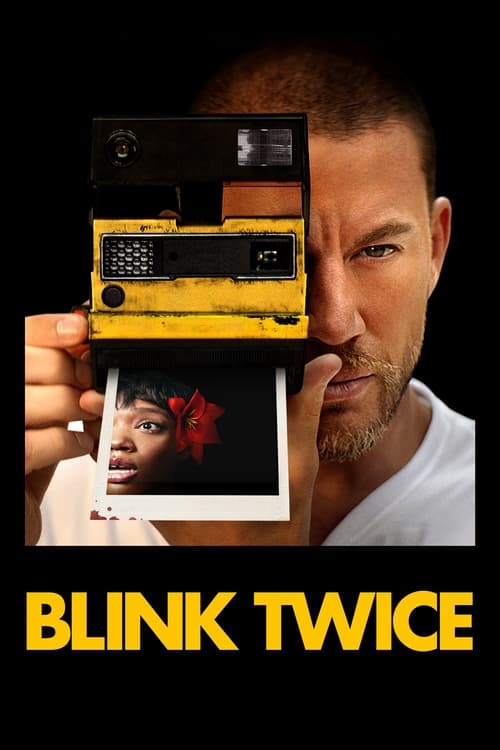
Blink Twice
2024 · Zoë Kravitz
When you want a glossy, wine-in-hand thriller that curdles into something genuinely dark — pick it for a night when you're up for being unsettled, not soothed. This one leaves a bruise; it's a challenge dressed as an indulgence.
What it's about
Frida, a cocktail waitress catering a tech billionaire's gala, catches the eye of the charming Slater King and gets whisked with her best friend to his private island — an endless loop of champagne, perfect dinners, matching white outfits, and golden afternoons. It's paradise, except the days blur together and small details stop adding up. Frida starts pulling at the thread of what this vacation actually is.
The experience
Sun-drenched and seductive at first, then increasingly wrong in ways you can't quite name — the unease accumulates under the luxury until the film turns sharp and brutal. It's a slow tightening that becomes a fist.
Performances
Naomi Ackie carries the film, letting you watch doubt surface through Frida's practiced smile, while Channing Tatum weaponizes his own charm into something quietly chilling.
The craft
Zoë Kravitz's directorial debut is strikingly designed — high-saturation color, pristine villas, ritualized meals — with the visual language of an aspirational Instagram feed deployed as a trap. The editing does sly work, making repetition itself feel sinister, and the production design turns matching outfits and perfume into plot. It looks gorgeous, which is exactly the point.
Why it matters
A high-profile, conversation-starting entry in the recent wave of thrillers skewering the ultra-rich, and it established Kravitz as a filmmaker with a real point of view, not just a famous name behind the camera.
Horror · Psychological horror · Suspense & terror. A sun-drenched island getaway where the champagne flows and the days blur, until glossy unease curdles into something brutal.
Snapshot
Blink Twice is the feature directorial debut of actor Zoë Kravitz, a glossy, high-saturation psychological thriller that weaponizes the vocabulary of the luxury-getaway film against itself. Naomi Ackie plays Frida, a cocktail waitress who — with her friend Jess (Alia Shawkat) — is swept from a fundraising gala onto the private island of tech billionaire Slater King (Channing Tatum). The paradise is engineered to dissolve: champagne, matching white outfits, identical golden days, and a creeping sense that time and memory are not behaving. The film's central mechanism — that the women's recollections are being chemically erased so that abuse can be repeated without consequence — places it squarely in the 2010s–2020s "eat the rich" horror cycle while foregrounding a specifically post-#MeToo argument about memory, complicity, and the machinery of gaslighting. It is a debut of considerable formal control, more assured in its design and tonal management than in the tidiness of its final-act plotting.
Industry & production
The project's most-discussed industrial fact is its title. It was developed and shot under the name Pussy Island, a title Kravitz has said she chose deliberately for its confrontational charge, and it was retitled Blink Twice relatively late in the process — a change widely reported as a marketing and distribution decision to make the film sellable across platforms and territories. The film was produced in association with Channing Tatum and Reid Carolin's Free Association banner, with Bruce Cohen among the producers and Kravitz herself producing; it was released by Amazon MGM Studios in August 2024, positioning it as a mid-budget adult genre title rather than a tentpole.
Two production circumstances are worth noting without over-reading them. First, the film's path from principal photography to release was unusually long for a contemporary thriller — it was shot in the early 2020s and did not reach theaters until 2024 — a gap shaped in part by the broader industry disruptions of the period. Second, Kravitz and Tatum's off-screen relationship began around the production; this is well documented but I would caution against treating it as an interpretive key to the film. On specific budget and box-office figures I will be candid: I do not have reliable numbers to cite, and Blink Twice is best characterized qualitatively as a modestly budgeted studio genre release that drew respectful but not blockbuster returns, rather than pinned to a dollar figure I cannot verify.
A notable distribution-era detail: the film carried a content advisory regarding sexual violence at its outset, reflecting both the subject matter and the heightened sensitivity of studios releasing such material in the post-#MeToo landscape.
Technology
Blink Twice is, at the level of story, a film about technology and the men who own it. Slater King is a tech mogul who has performed a public act of contrition and retreated to reinvent himself — a figure legible against a decade of real founders staging redemption arcs. The island is a closed system of engineered comfort, and the film treats consumer technology (private aviation, curated luxury, the frictionless service economy) as the visible surface of an invisible apparatus of control.
At the level of the profilmic craft, the film is a contemporary digital production whose look leans on saturated color, controlled lighting, and precise grading rather than on ostentatious visual-effects spectacle. Its "technology" is largely photochemical-adjacent digital finishing — the manipulation of color temperature and palette to signal the shift from paradise to menace. The most consequential technological device in the diegesis is chemical rather than electronic: the memory-erasing agent (associated in the film with venom and with the island's flora and scent), which functions as the plot's engine and as its central metaphor for how power edits the record.
Technique
Cinematography
The cinematography — shot by Adam Newport-Berra, whose earlier work (including The Last Black Man in San Francisco and the series Beef) shows a similar feel for expressive color and character-anchored framing — is the film's strongest formal asset. The island is rendered in lush, sun-drenched, almost advertorial imagery: shallow focus, warm skin tones, the visual grammar of a resort brochure. This surface beauty is the point; the film seduces with the same images it will later poison. As the narrative curdles, the palette and light are pushed toward the lurid — reds and unnatural warmth that read first as glamour and then as alarm. Repetition of compositions across the "identical days" quietly cues the audience that something is wrong before the characters can articulate it.
Editing
Editing is central to a film built on erased and looping memory. The cut is asked to do narrative work — to elide, to repeat, and to withhold — so that the audience's experience of missing time mirrors Frida's. I want to be careful here: I am not fully certain of the editor's screen credit and will not assert a name I cannot confirm. What can be said on the evidence of the film itself is that the editorial strategy privileges controlled ambiguity in its first two acts (small discontinuities, gaps that register subliminally) before a more conventional revelatory rhythm in the back half, where the mechanism is explained and the film pivots toward retribution.
Mise-en-scène / staging
Production and costume design carry much of the film's meaning. The matching white outfits, the uniformity of the guests, the recurrent motifs of snakes, perfume, and red — these are staged as a system of visual rhymes that reward a rewatch. The island is a stage set for a fantasy of leisure, and Kravitz stages the ensemble as interchangeable beautiful people whose sameness is itself sinister. The recurring perfume/scent motif is especially well integrated, functioning simultaneously as a naturalistic detail and as the delivery mechanism of the film's central conceit.
Sound
Sound design and music track the film's mood management: the ambient hum of luxury, party music and needle-drops that establish hedonic surface, and a shift toward unease as the sonic environment is destabilized. On the specific music credits I will hedge rather than guess — I do not have a confident enough recollection of the score's authorship to attribute it, and I would rather flag that gap than invent a name. What is clear from the film is that sound is used to sustain the seductive register long past the point where the images have begun to signal danger, deepening the dissonance the film is built on.
Performance
Naomi Ackie anchors the film with a performance that has to modulate from ingratiating openness to dawning horror to hardened resolve, often without dialogue to explain the transitions; she carries the audience's point of view and the film's credibility. Channing Tatum is cannily cast against his affable star persona as Slater King, using charm as camouflage — a performance that depends on the audience's residual goodwill toward him. The supporting ensemble — including Alia Shawkat, Adria Arjona, Christian Slater, Simon Rex, Haley Joel Osment, Kyle MacLachlan, and Geena Davis — is deployed as a gallery of types within the closed social world, with several actors cast to play with or against their established images.
Narrative & dramatic mode
The film operates in the mode of the paranoid thriller crossed with the "trapped in paradise" horror scenario. Its dramatic engine is epistemological: the audience, aligned with Frida, must reconstruct a truth that the environment is actively erasing. This produces a first movement of luxuriant unease, a second of investigation and revelation, and a third of violent reversal. The structure is deliberately disorienting in its early stretches — the looping days and dropped time are a formal analog for the drug's effect — before resolving into a more legible revenge architecture. The back half's turn toward explanation and payback is the most debated aspect of the script: it delivers catharsis but trades some of the earlier ambiguity for mechanism, and it introduces a coda that reframes survival, complicity, and the transfer of power in pointed, discussable terms.
Genre & cycle
Blink Twice belongs unmistakably to the wealth-and-power horror-thriller cycle that gained momentum in the late 2010s and early 2020s — films that stage class and gender critique through genre. Its nearest cousins are the "eat the rich" satires and abduction thrillers of the moment: it shares DNA with Get Out (the invited guest who discovers the hosts' scheme), Midsommar (paradise-as-trap, sun-drenched dread), The Menu and Glass Onion (the billionaire's island, the closed elite), Ready or Not (the ordinary woman versus a moneyed conspiracy), and Promising Young Woman (post-#MeToo rage channeled through stylized genre). Within that cluster, Blink Twice distinguishes itself by making memory the site of the crime — the horror is not only what is done but that the doing is designed to leave no trace.
Authorship & method
As author, Kravitz arrives with the sensibility of an actor-turned-director attentive to performance and to the tactile surface of a world. She co-wrote the screenplay with E.T. Feigenbaum, and the film's authorial signature is a fusion of magazine-glossy image-making with a hard thematic core — beauty as bait. The most important collaborator on the visible evidence is cinematographer Adam Newport-Berra, whose color-forward, character-close style is inseparable from the film's seduce-then-betray strategy. The ensemble casting is itself an authorial choice, with Tatum's persona used as a structural device. On composer and editor I have flagged my uncertainty above and decline to attribute credits I cannot verify; readers consulting the film's official credits should treat those roles as confirmable there rather than from this account.
Movement / national cinema
The film sits within contemporary American studio-adjacent independent-sensibility filmmaking — a mid-budget, star-driven genre picture made with an auteur's control and released through a major distributor. It is not part of a formal movement, but it is legible within a loose contemporary current of genre films by first-time directors (often actors, often from within the American independent and prestige-TV ecosystems) using horror and thriller frameworks for social critique. Its idiom is thoroughly American — Silicon Valley wealth, celebrity redemption culture, the therapeutic language of accountability — even as its island setting abstracts that world into fable.
Era / period
Blink Twice is emphatically a film of its moment: the early-to-mid 2020s, in the long aftermath of #MeToo and amid intense cultural scrutiny of tech billionaires and their public rehabilitations. Its concerns — consent, gaslighting, the institutional erasure of women's testimony, the seductions and dangers of extreme wealth — are period-specific preoccupations, and its genre strategy (using horror to metabolize real anxieties) is characteristic of the era's most-discussed studio thrillers. The delayed release also makes it a minor artifact of the disrupted production landscape of the first half of the decade.
Themes
The film's governing theme is memory as a battleground of power: who gets to remember, whose account survives, and how abuse is perpetuated by controlling the record. Radiating from that core are gaslighting made literal, the complicity that comfort buys, and the commodification of women within an economy of luxury. It interrogates the "reformed" powerful man and the performance of accountability, and it examines solidarity among women as both fragile and essential. Its coda extends the argument into uncomfortable territory about whether justice reproduces the structures it overturns — a question the film poses rather than resolves. Motifs of scent, snakes, and the color red thread these ideas through the film's surface so that theme and design are continuous.
Reception, canon & influence
Critically, Blink Twice was received as a striking, imperfect debut — widely credited for its confident craft, its production and costume design, its color work, and Ackie's and Tatum's performances, while drawing more divided responses to a third act that some found cathartic and pointed and others found schematic relative to its slow-burn opening. Its title change from Pussy Island became a talking point in coverage, as did its explicit engagement with sexual violence and its up-front content advisory.
Looking backward, the film's influences are clear and acknowledged by the comparisons it invites: the social-horror template of Get Out, the sunlit dread of Midsommar, the billionaire's-island satire of The Menu and Glass Onion, and the stylized post-#MeToo revenge register of Promising Young Woman. Looking forward, it is too recent for its legacy to be assessed with confidence, and I will not overstate an influence the historical record cannot yet support. What can be said is that it strengthens an ongoing trend — actors, particularly women, launching directing careers through elevated genre — and that it stands as a notable, debated entry in the wealth-and-power horror cycle whose durability will be measured by the films that follow it. On its longer-term canonical standing, the record is genuinely too thin at this point to call.
Reception
Landed in August 2024 to solid-but-divided reviews — praised as a confident directorial debut, argued over as another glossy #MeToo-era thriller — and its afterlife got tangled up in the real-world Kravitz–Tatum breakup that followed the press tour.
How Blink Twice was received, from release to now →
How to watch Blink Twice: what to notice on a first viewing
- Watch how golden and sun soaked every shot looks. Newport-Berra shoots the island in warm, shallow focus, advertorial light, the visual grammar of a resort brochure rather than a thriller. The film seduces you with beauty before it asks anything of you.
- Notice everyone dressed in matching white outfits. Kravitz stages the guests as a uniform, interchangeable group in identical clothing, so individual identity starts to blur across the group. Sameness among the beautiful people reads as unsettling before anything overtly bad happens.
- Watch Slater King's charm never once waver or crack. Tatum plays the billionaire host as consistently affable and disarming, using the audience's own goodwill toward his screen persona as part of the performance. Charm here works as camouflage, not as a break from tension.
The whole guide to watching Blink Twice, with the keys for a rewatch →
Influences: the films it descends from and the films it influenced
- Get Out (2017) — Its social-horror architecture — gracious hosts whose hospitality is the trap, and a mid-film reveal that forces you to re-read every earlier pleasantry as predation — is the template Kravitz runs on the wealthy island.
- Midsommar (2019) — Supplies the sunlit-dread grammar: horror staged in saturated daylight, ornate production and costume design used as a lure, drug-clouded perceptual unreliability, and a cathartic burn-it-all-down finale.
- Promising Young Woman (2020) — An actress-directed post-#MeToo revenge film that weaponizes a candy-bright pastel palette against its own subject and runs the same tonal bait-and-switch of seductive surface curdling into indictment.
- Rosemary's Baby (1968) — The foundational paranoid thriller of a woman whose account of reality is smoothly denied by charming, powerful men — gaslighting elevated into the film's central formal engine.
- The Stepford Wives (1975) — Men engineering women into pleasant, compliant, memory-stripped versions of themselves inside an insular affluent enclave — the domestication-as-erasure premise Blink Twice literalizes.
- Ex Machina (2014) — The prototype of the tech-billionaire's remote modernist compound where lavish hospitality masks a controlled experiment run on a woman, hosted by a charismatic mogul.
- Eternal Sunshine of the Spotless Mind (2004) — Establishes memory erasure rendered through elliptical, fragmented editing that makes the audience reconstruct suppressed events — the memory-as-power editing logic Kravitz adopts.
- The Menu (2022) — The wealthy lured to a remote, tightly controlled venue governed by ritual and rigid host-versus-guest power dynamics, satire tightening into entrapment.
- Glass Onion (2022) — A tech-billionaire's private-island gathering staged as satire of a hollow 'genius' surrounded by dependent sycophant guests — the exact wealth-island social ecosystem.
- Saltburn (2023) — A sibling in eat-the-rich seduction: a sun-drenched estate of the ultra-rich shot with glossy, magazine-seductive image-making that makes beauty itself the bait.
- Don't Worry Darling (2022) — Another actress-turned-director genre debut about a woman in a manufactured paradise recovering the suppressed memory of the men controlling her, built on retro-saturated design.
- The Invisible Man (2020) — A tech-mogul abuser whose victim is systematically disbelieved — gaslighting thriller that foregrounds the contested reliability of a woman's perception as its structure.
Similar films
- Promising Young Woman (2020) — influence & lineage
- Saltburn (2023) — influence & lineage
- Triangle of Sadness (2022) — influence & lineage
- The Menu (2022) — influence & lineage
- Fresh (2022) — influence & lineage
- Infinity Pool (2023) — same viewing thread
- Gone Girl (2014) — same viewing thread
- The Housemaid (2025) — same viewing thread
All the films related to Blink Twice →
Watch it with: curated runs of related films
- Elegant Betrayals — Watch these back-to-back for couples and beautiful people whose polished surfaces — a London flat, a Riviera villa, a spies' dinner party — hide a betrayal, a surveillance, and a body, each turning intimacy into a crime scene.