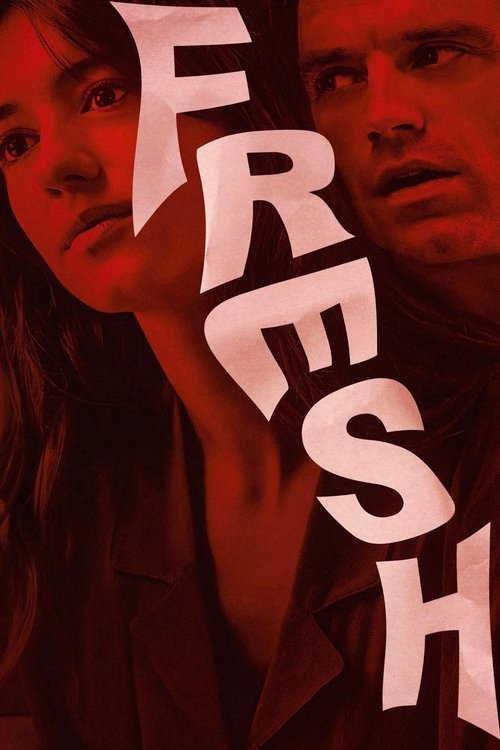
Fresh
2022 · Mimi Cave
For when you're craving a real scare with a wicked grin — ideal for a watch-with-a-friend night where you can yell at the screen. Not one for the squeamish or for anyone about to open a dating app.
What it's about
Noa is exhausted by app dating — the swiping, the small talk, the dates that curdle on contact — when she meets Steve, awkward and charming, in the produce aisle of a grocery store. He's funny, he's normal, and for once a connection feels real, so she says yes to a weekend away. What the weekend turns into is the reason this romantic comedy is filed under horror.
The experience
It plays like a romcom until it very much doesn't — then it's a tense, darkly funny, sometimes stomach-turning thriller that keeps its sense of humor even at its nastiest. You'll squirm, laugh at yourself for laughing, and grip the couch.
Performances
Sebastian Stan is the engine here, weaponizing his charm into something skin-crawling — he's magnetic and repellent in the same breath — while Daisy Edgar-Jones grounds it all with a smart, watchful performance that keeps you rooting hard for Noa.
The craft
Mimi Cave's debut has music-video style in the best sense: needle drops used as dark punchlines, queasy close-ups of food and flesh, and a bold structural gambit that delays the opening credits until the film has fully shown its hand. The sound design will put you off dinner.
Why it matters
A Sundance breakout that became one of the buzziest streaming horror releases of 2022, it sits at the center of the wave of dating-hell horror — films that turn modern romance's red flags into literal ones.
Horror · Serial-killer thriller · Horror comedy & camp · Suspense & terror. A grocery-aisle romcom curdles into a nasty, darkly funny dating-hell thriller with needle drops and queasy close-ups. Go in blind.
Snapshot
Fresh is the feature debut of director Mimi Cave, working from a screenplay by Lauryn Kahn. It stars Daisy Edgar-Jones as Noa, a young woman worn down by the attritional grind of app dating, and Sebastian Stan as Steve, the disarming stranger she meets by chance in a grocery store. The premise the film advertises — a charming meet-cute rescuing a jaded single from digital romance — is a deliberate feint. Roughly half an hour in, after Noa agrees to a weekend getaway, the film reveals that Steve abducts women and butchers them, supplying human flesh to a clientele of wealthy cannibals. The picture then becomes a captivity thriller braided with pitch-black social satire. Premiering at the Sundance Film Festival in January 2022 and distributed by Hulu (with Searchlight Pictures involvement) in the United States, Fresh became one of the more discussed streaming genre releases of its year, praised for its tonal daring and for Stan's against-type casting, and debated for how far its satirical framework could carry its literal horrors.
Industry & production
Fresh is a product of the streaming-era genre economy, in which mid-budget horror-thrillers that might once have received a theatrical run are financed and premiered through festivals and then delivered to subscribers. The film was produced under Adam McKay and Kevin Messick's Hyperobject Industries banner, with Legendary Pictures involved in the production. Searchlight Pictures acquired it and released it on Hulu in the United States on March 4, 2022, following its Sundance premiere in the Midnight section — the festival's traditional home for horror and transgressive genre work.
The involvement of Hyperobject is worth noting for context: McKay's company had positioned itself around satire aimed at contemporary systems and appetites, and Fresh fits that editorial sensibility, using a horror conceit to comment on consumption, gender, and commodification. As a streaming title, Fresh did not report conventional theatrical box-office figures, and viewership data for Hulu originals is not publicly disclosed in a reliable form; any claim about its precise audience size would be speculative, so the record here is genuinely thin. What can be said is that the film functioned as a calling card — a debut feature designed to travel through the festival-to-platform pipeline and to announce its director and its lead performances rather than to chase a wide theatrical gross.
Technology
Fresh was shot and finished digitally, consistent with the standard workflow for a contemporary mid-budget genre production. The film's technological character is less about novel capture tools than about the controlled, high-contrast digital image that has become the house style of a certain strain of elevated horror — clean, saturated, and precisely graded. Detailed public technical documentation of the specific camera and lens packages is limited in the accessible record, and I will not invent particulars; the meaningful point is that the film's look is engineered in the digital color grade as much as on set, with the warm, appetizing palette of food and flesh set against colder domestic interiors.
Technique
Cinematography
The cinematography is by Pawel Pogorzelski, a significant hire whose reputation was built on his collaborations with Ari Aster on Hereditary (2018) and Midsommar (2019). Pogorzelski brings to Fresh a comparable command of symmetry, controlled camera movement, and the horror latent in bright, clean spaces. The film pointedly resists the dim, desaturated look of much genre cinema; instead it renders Steve's home and his food in a seductive, well-lit register that makes the material's cannibal subject queasily appetizing. This is the film's central visual strategy — beauty and appetite as instruments of dread. The camera often frames food preparation with the loving attention of a cooking show, collapsing the distance between culinary pleasure and butchery. Compositions favor balance and containment, so that Noa's captivity reads spatially: she is repeatedly boxed by architecture and framing before she is literally imprisoned.
Editing
The editing, credited to Martin Pensa, is inseparable from the film's most talked-about structural gambit: the delayed title card. Fresh withholds its main title until roughly thirty minutes in, at the exact hinge where the romantic comedy curdles into horror. The extended pre-title stretch lets the film fully inhabit the conventions of a meet-cute romance so that the rupture lands as genuine betrayal — of Noa and of the audience's genre expectations. Elsewhere the cutting deploys ironic juxtaposition, particularly in montage sequences that align sensual imagery with horror, using rhythm and needle-drops to fuse pleasure and revulsion.
Mise-en-scène / staging
The production design draws much of its horror from the ordinary. Steve's home is tasteful, modern, and disarmingly normal — the aesthetic of an affluent bachelor rather than a lair, which makes the concealed apparatus of his trade more disturbing. The staging repeatedly uses domestic rituals — cooking, dining, dressing — as sites of menace, and it foregrounds food throughout: produce, meat, plated meals. This is a film organized around the table and the kitchen, spaces of hospitality repurposed as instruments of predation. Costuming and grooming mark Steve's performance of charm and later his self-satisfaction, while Noa's changing appearance registers her captivity and her strategy of feigned compliance.
Sound
The score is by Alex Somers, a musician associated with atmospheric, texture-forward work. In Fresh the sonic strategy leans on the same ironic doubling as the images: pop and soul needle-drops accompany scenes of horror, and the contrast between buoyant music and monstrous action generates much of the film's queasy comedy. Sound design attends closely to the sensory business of food — the wet, tactile noises of preparation — weaponizing the ordinarily pleasurable acoustics of eating. The record on the film's precise music licensing and sound-mix credits beyond the principal composer is not something I will elaborate without verification.
Performance
The performances carry the film's tonal gamble. Sebastian Stan plays Steve as an extended feat of controlled charm — genuinely likable in the courtship phase, then gliding into a chillingly casual sadism performed as domestic contentment. The role is a deliberate subversion of Stan's matinee-idol image, and much of the film's discomfort comes from how persuasive his early charm is. Daisy Edgar-Jones, coming off her breakthrough in the series Normal People, gives Noa intelligence and interiority; her performance shifts from wary optimism to survival calculation, with the captivity passages built on the exhausting labor of feigned affection. Jonica T. Gibbs plays Noa's friend Mollie, whose subplot provides both an outside vantage on the abduction and the film's most conventional thriller engine of rescue. Charlotte Le Bon appears as Ann, a figure whose relationship to Steve complicates the film's account of complicity.
Narrative & dramatic mode
Fresh is structured as a bait-and-switch, and its dramatic mode is defined by that reversal. The first movement operates in the register of romantic comedy, complete with the fatigue-of-modern-dating premise that the marketing foregrounds. The delayed title card marks the pivot into captivity thriller and horror-satire. From there the film alternates between Noa's confinement — a tense, tactical narrative of a woman managing her captor — and Mollie's investigation on the outside, a parallel track that supplies momentum and eventual convergence. The dramatic irony is thick: the audience knows Steve's nature well before some characters do, and the film mines suspense from Noa's performance of a compliance she does not feel. Tonally the picture holds horror, thriller, and comedy in uneasy suspension, using humor not to relieve the horror but to sharpen its social point.
Genre & cycle
Fresh sits at the intersection of several contemporary cycles. It belongs to the "bad date" or dating-app horror strain, which literalizes the dangers women navigate in modern romantic life. It participates in the cannibalism-as-metaphor tradition, using consumption to figure the commodification of women's bodies and the appetites of the wealthy. And it aligns with the socially-conscious, satirical horror wave that gained prominence after Jordan Peele's Get Out (2017), in which genre mechanics are harnessed to critique — here, gendered predation and a literal market in human flesh standing in for how women are treated as goods. It also carries traces of the captive-and-captor thriller lineage and of comedy-horror hybrids that court laughter and disgust simultaneously. Within the 2020s cycle of cannibal-inflected features exploring desire and consumption, Fresh is a notable, comedically inflected entry.
Authorship & method
As a debut, Fresh is best read as a director-and-writer collaboration inflected by a strong producorial sensibility. Mimi Cave came to the feature from a background that included music-video and short-form work, and her direction shows a music-video fluency in the marriage of image and needle-drop, along with a confident control of tonal shifts. The screenplay by Lauryn Kahn supplies the satirical architecture and the structural feint of the delayed title. The key craft collaborators shape the film's signature: Pogorzelski's appetizing, symmetrical cinematography; Pensa's structurally witty editing; Somers's ironic score; and the production design's insistence on the horror of the tasteful and the normal. The Hyperobject Industries context situates the film within a producer culture oriented toward systemic satire. Cave's method, as evidenced on screen, is one of seduction-then-betrayal: lull the viewer with the pleasures of genre and image, then implicate that pleasure in the horror.
Movement / national cinema
Fresh is an American production and does not belong to a formal film movement. It is most usefully placed within the loose Anglo-American tendency often labeled "elevated horror" or socially-engaged genre filmmaking of the late 2010s and 2020s — a tendency defined less by a manifesto than by shared personnel, festival venues (Sundance Midnight, in this case), and a commitment to using horror for thematic argument. The presence of Pogorzelski links it, at the level of craft lineage, to the A24-associated horror aesthetic even though Fresh itself was distributed through Searchlight and Hulu.
Era / period
The film is emphatically of its moment: the early-2020s streaming era and the culture of app-mediated dating. Its premise depends on the specific textures of contemporary courtship — the swiping, the disappointing dates, the calculus of risk women perform when meeting strangers — and its distribution model, festival premiere to same-year streaming release, is characteristic of how genre films reached audiences in this period. The film also participates in a broader cultural conversation, active in these years, about gendered violence, consent, and the commodification of the body. It is, in short, a period piece about the present, legible as a document of how romance, danger, and consumption were being discussed around 2022.
Themes
The film's governing metaphor equates consumption with the treatment of women as commodities. Steve's literal trade in flesh dramatizes a market that reduces women to bodies to be purchased and consumed, and the wealth of his clientele sharpens the critique into one of class as well as gender — appetite as privilege. Related themes run throughout: the danger and deception embedded in modern dating; the performance of charm as camouflage for predation; and the survival strategy of feigned intimacy, as Noa must simulate desire to stay alive. The film also examines complicity — the ways others enable or normalize predation — and the disturbing proximity of pleasure and violence, staged through food, music, and beauty. Its use of humor is thematic rather than incidental: by making horror funny, the film indicts the casualness with which such consumption is naturalized.
Reception, canon & influence
Critical reception of Fresh was substantial and largely favorable, with particular attention to its tonal audacity, to Sebastian Stan's against-type turn, and to Daisy Edgar-Jones's performance. Reviewers frequently singled out the delayed title card and the film's marriage of appetizing imagery to horrific content as its most distinctive achievements. The most common line of criticism concerned whether the film's satire fully sustained its concept across the full running time, and whether its climax delivered on the sophistication of its setup — a debate about payoff rather than premise. I am characterizing the shape of this reception from the broad critical consensus rather than quoting specific reviews, and I will not attribute particular verdicts or invent scores.
Looking backward, the film's influences are legible. It descends from the cannibal-as-metaphor tradition and from captor-captive thrillers, and it is clearly downstream of the post–Get Out wave of socially-conscious horror that made genre a vehicle for argument. Pogorzelski's involvement carries forward the clean, symmetrical dread of the Aster films. The dating-app horror lineage and comedy-horror hybrids also inform its DNA.
Looking forward, Fresh functioned most importantly as a launch: a debut that established Mimi Cave as a director to watch and confirmed Sebastian Stan's range in a role that reoriented perceptions of his screen persona. Within the 2020s vogue for cannibalism as a metaphor for desire and consumption in contemporary cinema, Fresh stands as a prominent, comedically pitched example, frequently cited in conversations about that cycle. Its longer-term legacy is still consolidating, and it would be premature to overstate a measurable influence on subsequent films; what is clear is its status as a representative and much-discussed artifact of streaming-era genre filmmaking and of horror's turn toward the politics of appetite.
A Deleuzian reading
A cutting board, warm light, hands working.
The full Deleuzian reading of Fresh →
Reception
A buzzy Sundance 2022 debut that dropped on Hulu weeks later and became instant group-chat material; it's since settled in as one of the defining entries in the 2020s 'dating is a horror movie' cycle, still recommended constantly as a first-date litmus test.
How Fresh was received, from release to now →
How to watch Fresh: what to notice on a first viewing
- Watch how appetizing every shot of food looks. Pawel Pogorzelski lights kitchens and meals in a warm, seductive, high-key register instead of the dim, desaturated look most horror reaches for. The camera refuses to disapprove of what it shows you, so you are the one who has to feel uneasy.
- Notice how often the frame boxes Noa inside architecture. Compositions favor tight balance and containment, so Noa is repeatedly framed within doorways and furniture. The framing keeps her small and watched.
- Listen for upbeat pop songs playing under unsettling scenes. Alex Somers sets buoyant needle-drops against moments of dread throughout, so the music never signals danger the way a horror score usually would. The mismatch between what you hear and what you see is where the film's unease actually lives.
- Watch how persuasive Sebastian Stan's early charm really is. Stan plays the opening courtship with genuine, likable warmth, a performance built to work on you as much as on Noa. How much you like him early on is the exact thing the film is measuring.
The whole guide to watching Fresh, with the keys for a rewatch →
Influences: the films it descends from and the films it influenced
- Get Out (2017) — Establishes the post-2017 template Fresh works in: weaponizing a charming, affluent liberal host as predator and deploying a late plot pivot that recodes an ordinary courtship as systematized bodily harvesting-as-argument.
- The Silence of the Lambs (1991) — Codifies the cultured-gourmand cannibal whose refined palate and courtly charm ARE the menace, the fusion of connoisseurship and predation that Stan's Steve inherits wholesale.
- Hereditary (2018) — Cinematographer Pawel Pogorzelski's exacting symmetrical framing and dollhouse containment — bodies boxed and centered in tasteful interiors — is the direct compositional method he carries into Fresh.
- Midsommar (2019) — Again shot by Pogorzelski, it perfects high-key, brightly-lit dread — horror staged in appetizing light rather than shadow — which becomes Fresh's core visual paradox of gorgeous surfaces housing atrocity.
- American Psycho (2000) — Models the satirical fusion of glossy consumerist appetite and violence, the immaculate yuppie predator whose lifestyle-porn aesthetics indict a culture that literally consumes bodies.
- Psycho (1960) — Originates the mid-film structural rug-pull that Fresh's delayed title card formalizes — luring the viewer into one genre (romance) before amputating it and reorienting sympathy and dread.
- Misery (1990) — The captor-captive domestic-imprisonment thriller in which survival depends on feigned compliance and ingratiation toward a genial-then-monstrous keeper — Fresh's second-act engine.
- Gone Girl (2014) — Provides the tonally cool, ironic bait-and-switch that recasts courtship/marriage as mutual predation, plus against-type casting to conceal a monster behind a trusted screen persona.
- 10 Cloverfield Lane (2016) — The domestic-bunker captivity two-hander built on a host who oscillates between hospitable and lethal, forcing the captive into performed docility — Fresh's confinement dynamic in miniature.
- Raw (2016) — Anchors the 2010s–20s cannibalism-as-desire cycle, photographing flesh-eating with sensual, appetite-forward imagery that collapses eating and wanting — Fresh's food-as-erotic-motif kin.
- Promising Young Woman (2020) — Shares the candy-bright, high-key palette and ironic pop needle-drops deployed to gild predatory 'nice-guy' menace, using against-type casting of likable men as concealed abusers.
- Single White Female (1992) — The film takes the 'charming welcome turns into a captive siege' structure and its reciprocal-surveillance setpieces into the dating-app era, keeping the slow build to a chase-and-escape climax in the domestic interior.
- Saltburn (2023) — Extends Fresh's appetite-as-commodification into ornamental high-gloss, rendering possession and consumption of another's body and life as luxuriant, envy-driven ingestion.
- Ready or Not (2019) — The comedy-horror hybrid staging affluent domesticity as a hunting ground, where a bride's in-laws literalize marriage-as-consumption with tonal whiplash between wit and gore.
- Swallow (2019) — Pristine symmetrical framing of immaculate domestic space housing bodily-consumption horror — the tasteful, controlled mise-en-scène as a container for appetite-driven transgression.
- The Menu (2022) — Turns food styling and culinary foley into instruments of dread, plating class satire as haute cuisine — the same appetizing-image/horrific-content marriage and consumption-as-commodification thesis.
- Bones and All (2022) — A contemporaneous entry in the cannibal-as-intimacy cycle, framing flesh-eating as tender coupling and desire — the romantic pole of the same 2022 metaphor Fresh treats satirically.
- Woman of the Hour (2024) — Female-authored thriller dramatizing courtship-as-predation, exploiting a charming man's social camouflage in modern dating — the same critique of how women are appraised and chosen.
- Obsession (2026) — Weaponizes rom-com courtship framing to lull the audience into the predator's charm before the reveal, sharing Obsession's seduce-then-implicate approach to complicit desire.
- Blink Twice (2024) — A charming man's courtship curdling into captivity and predation, with a glossy surface and against-type casting (Sebastian Stan) used exactly as Tatum's persona is here — the affable face as camouflage.
- Companion (2025) — Front-loads a charming romance before revealing the partner as predator, using needle-drop tonal control to hold romance and menace in the same frame — Companion's relationship-horror register.
- Send Help (2026) — Captor/captive two-hander with a charming-villain turn and a literal eat-the-rich premise, whiplashing between rom-com and survival horror.
Similar films
- The Menu (2022) — influence & lineage
- Bones and All (2022) — influence & lineage
- Promising Young Woman (2020) — influence & lineage
- 10 Cloverfield Lane (2016) — influence & lineage · same viewing thread
- Strange Darling (2024) — same viewing thread
- Speak No Evil (2022) — same viewing thread
- Companion (2025) — same viewing thread
- Barbarian (2022) — same viewing thread
All the films related to Fresh →
Watch it with: curated runs of related films
- When Love Gets High-Concept — Watch these when you want a love story with a speculative or absurdist hook — an AI girlfriend, an afterlife way-station, a reanimated corpse, a marriage under siege — comedies that use a wild premise to say something real about coupling.
- Whatever's Wearing That Face — A run of horror-thrillers where the real terror is that you can't trust what a person appears to be — a double, a shapeshifter, a smiling stranger, the one you desire.