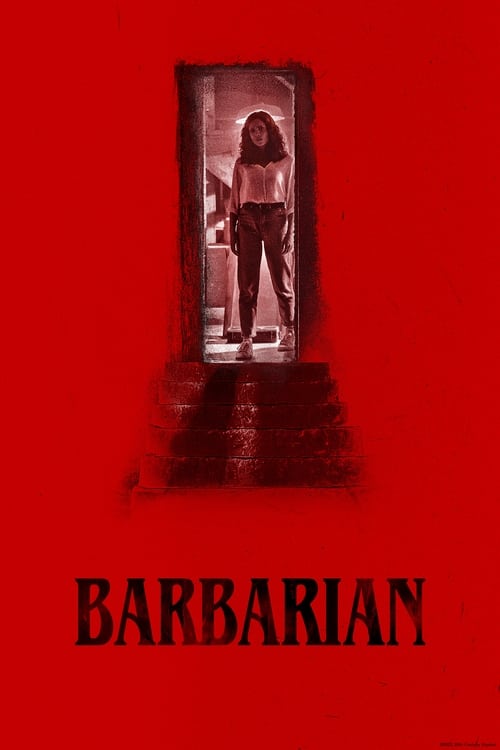
Barbarian
2022 · Zach Cregger
Barbarian's don't-spoil-it marketing and Weapons' blockbuster horror opening made him the name in the "original horror is the last original blockbuster" conversation; studios' bidding war for Weapons was itself reported like a sports trade.
When you're craving a real scare and love being surprised — best watched cold, with friends, ideally knowing nothing. This is challenge-horror, not comfort-horror, but it's a blast.
What it's about
A young woman arrives at her Detroit Airbnb late on a rainy night to find it double-booked — a stranger is already inside. Against her better judgment, she stays. That's the setup, and it's genuinely all you should know: what starts as a nervy will-she-won't-she-trust-him standoff becomes something much stranger, and the house has far more to it than either guest suspects.
The experience
A masterclass in tension with a wicked streak of black comedy — it keeps yanking the rug out, swerving in tone and direction just when you think you've mapped it. You'll spend half the runtime yelling 'don't go down there' and the other half laughing at how brazenly it plays you.
Performances
Georgina Campbell makes an enormously sympathetic anchor, and Bill Skarsgård weaponizes his own unsettling screen presence — the film knows exactly what you assume about him and toys with it.
The craft
Zach Cregger's script is the star: a structure that withholds, misdirects, and reorders information so the audience is never on solid ground. The sound design and the slow camera pushes into dark doorways do heavy lifting — watch it loud, in the dark.
Why it matters
One of the great word-of-mouth horror hits of its decade — the 'go in blind' movie people begged each other not to spoil — and it launched Cregger from comedy into the front rank of horror directors.
Horror · Suspense & terror · Creature feature · Horror comedy & camp. A double-booked rental, a stranger inside: dread in the dark laced with pitch-black comedy and rug-pulls best met cold.
Snapshot
Barbarian is a horror-mystery built almost entirely around the manipulation of audience trust. Its premise is deceptively small: a young woman, Tess (Georgina Campbell), arrives at a rented house in a decayed Detroit neighborhood late at night to find it already occupied by a stranger, Keith (Bill Skarsgård). What begins as a taut two-hander about a woman deciding whether to trust a man in the dark then detonates into something structurally radical — the film abandons its protagonist, jumps to a different character in a different register, and slowly excavates a subterranean nightmare beneath the property. It marked the solo feature-directing debut of Zach Cregger, previously known as a comedian, and became one of the defining word-of-mouth horror successes of its year, prized precisely for how little audiences could safely say about it in advance. Its reputation rests on structure and misdirection as much as on scares.
Industry & production
Barbarian was produced under the New Regency umbrella (Regency Enterprises / Arnon Milchan) in partnership with the horror-focused producers behind the project — the film was developed and financed as a modestly budgeted studio-adjacent genre picture rather than a pure independent, which shaped both its polish and its distribution muscle. It was released by 20th Century Studios, placing it within the Disney corporate family, with theatrical release in September 2022 followed by streaming on Hulu (and HBO Max under prior output arrangements). The exact budget figures reported in trade coverage should be treated cautiously; what is well established is that the film was made inexpensively and returned a substantial multiple of its cost theatrically, becoming a genuine sleeper hit driven by strong word of mouth rather than a large marketing spend. Its commercial profile — small outlay, spoiler-sensitive premise, deliberate under-selling in trailers — became part of its story, and the marketing campaign notably worked to preserve the film's structural surprises rather than reveal them.
Physically, production reportedly took place substantially in Bulgaria (the Sofia-area studio infrastructure long used for cost-effective international shoots), with the film's Detroit setting realized through a combination of location and constructed environments — most importantly the extensive underground tunnel and chamber sets that the story's second half depends on. The Detroit exteriors, whether captured on location or evoked through set dressing, are integral rather than incidental, and I would flag that granular, verified detail on the precise split between Bulgarian sets and any American location work is thinner in the public record than the film's prominence might suggest; the tunnel system is clearly a built environment.
Technology
Barbarian is a conventionally-originated digital production in technological terms — there is no evidence of unusual capture formats, and the film's ambitions are staging and design rather than technological novelty. Its most demanding technical requirement is the sustained control of darkness: much of the second and third acts unfold in near-lightless underground spaces, which places heavy demands on exposure, sensor performance in low light, and the calibrated placement of practical and motivated light sources. The creature ("the Mother," performed by Matthew Patrick Davis) is realized primarily through practical prosthetic and physical-performance means rather than heavy digital replacement, consistent with the contemporary horror preference for tangible, in-camera monstrosity. Where digital tools appear, they serve concealment and enhancement rather than spectacle. This is a film whose technical identity lies in restraint and in the engineering of on-set darkness, not in visual-effects display.
Technique
Cinematography
Shot by Zach Kuperstein — whose earlier work includes the stark black-and-white horror of The Eyes of My Mother (2016) — the cinematography is one of the film's most disciplined elements. The opening sequences are composed to make an ordinary suburban-decay interior feel charged with threat: careful framing withholds and reveals information, keeping the viewer scanning the edges of the frame for danger that may or may not be there. Kuperstein exploits the geometry of doorways, staircases, and hallways to control what the audience knows. As the film descends underground, the visual grammar shifts decisively toward extreme darkness, tight corridors, and the horror-thriller convention of light sources that expose only fragments of space — a flashlight beam, a phone screen — so that the environment itself becomes the source of dread. The camera's willingness to hold and to move slowly into unknown space is a recurring device; the film repeatedly stages the primal horror of a character advancing into a dark opening the audience wishes they would not enter.
Editing
Editing (credited to Joe Murphy) is central to the film's design, because Barbarian's defining formal gamble is temporal and structural: it severs its narrative, leaps to an unrelated character and a comedic register, and later braids the strands together. The cut governs the film's most famous effect — the abandonment of one storyline at a moment of maximum tension to begin another elsewhere — and manages the modulation between sustained suspense and sudden violence. Within scenes, the editing favors patience, letting dread accumulate before release, and the film's comedy is timed with a comedian-director's ear. The macro-structure is essentially an editorial and screenwriting concept executed jointly, and it is the rhythm of information — what is withheld, when the floor drops out — that makes the picture work.
Mise-en-scène / staging
The production design is thematically loaded. The rental house sits amid a landscape of abandonment — a street of derelict, boarded homes — so that the film's horror is grounded in a real geography of American urban decline. The single occupied, tidy house against a ruined block is itself an image of unease. Beneath it, the staging descends through hidden doors into a tunnel system whose scale and squalor register as an architecture of captivity and abuse. The vertical logic — respectable surface, buried horror — is the film's controlling spatial metaphor, and the staging exploits it literally as characters move downward into the truth. Objects and rooms are dressed to encode a history of confinement.
Sound
Sound design does much of the film's suspense work, particularly in the darkness where the image withholds. Off-screen sound — footsteps, movement in adjacent black space, the acoustics of underground rooms — cues fear and directs attention. The score by Anna Drubich supports this economy, deployed to unsettle and to punctuate rather than to over-explain, and the film is comfortable with silence and with quiet ambient dread as much as with musical stings. The interplay of what is heard versus what is seen is essential to the underground sequences.
Performance
The performances are calibrated to the film's shifting registers. Georgina Campbell anchors the opening as a woman performing the constant risk-assessment that the film is partly about — wary, intelligent, neither foolish nor invulnerable. Bill Skarsgård plays Keith along a deliberately ambiguous line, weaponizing the audience's foreknowledge of the actor's association with horror to keep his true nature unreadable. Justin Long's arrival shifts the film's tone toward satire; his character embodies a specific strain of male self-regard, and Long's willingness to play unlikeable is key to the film's thematic turn. Richard Brake contributes a chilling presence in the film's excavated backstory, and Matthew Patrick Davis's physical performance as the Mother grounds the creature in something more pitiable and human than pure monster.
Narrative & dramatic mode
Barbarian is organized as a triptych with an interpolated historical flashback, and its dramatic mode changes with each movement — suspense, then satire, then a descent into the film's buried origin story. Its governing technique is misdirection: the film deliberately builds one set of genre expectations (the woman-alone, is-this-man-dangerous thriller) and then reveals that the real horror lies elsewhere and earlier. The protagonist-switch is a self-conscious echo of the great structural rug-pull of horror history, redistributing audience identification and denying the security of a stable point of view. The narrative withholds its causal history until late, then delivers it as explanation and as indictment, so that the "monster" is recontextualized as the product of a human perpetrator. This is a plot engineered for the experience of not knowing what kind of film one is watching.
Genre & cycle
The film belongs to the post-2010s wave of American horror that pairs genre mechanics with social subtext, but it is notably impure within that cycle — it is as invested in tonal disruption and dark comedy as in dread, reflecting Cregger's comedy background. It sits alongside a lineage of "house that hides horror" pictures and Detroit-set genre films that use the city's ruin as setting and subject. Its blend of suspense, monster horror, and satire, and its refusal to stay in one mode, distinguish it from the more tonally unified "elevated horror" of the same era while still participating in that conversation about horror-as-commentary. Within the 2022 horror landscape it stands with the year's other structurally or conceptually ambitious genre successes as evidence of a market hungry for original, spoiler-driven horror.
Authorship & method
Zach Cregger came to Barbarian from sketch and screen comedy — he was a member of the comedy group The Whitest Kids U' Know — and the film is often read as the surprising pivot of a comic mind into horror. That background is not incidental: the film's control of timing, its tonal whiplash, and its comfort with satire are legible as the work of someone trained in setup-and-payoff. Cregger wrote as well as directed, and the film is fundamentally an authored screenplay-and-structure achievement. He has spoken in interviews about an origin in reading about the warning signs — the small "red flags" — that people, and particularly women, are socially conditioned to ignore, an idea associated with Gavin de Becker's writing on fear and intuition; that concept became the seed of the opening scenario. His key collaborators — cinematographer Zach Kuperstein, composer Anna Drubich, and editor Joe Murphy — executed a vision whose defining features are structural and rhythmic. Cregger's method here is essentially to build a machine of audience expectation and then dismantle it.
Movement / national cinema
Barbarian is an American genre film within the studio-adjacent independent horror economy, even as its physical production leaned on international (reportedly Bulgarian) facilities — a now-common globalized arrangement for cost-controlled American genre cinema. It does not belong to a formal movement, but it is a representative product of the American horror renaissance of the 2010s–2020s, in which relatively cheap, original, socially-attuned horror became both a critical and commercial force. Its Detroit setting ties it specifically to an American strain of urban-decay horror.
Era / period
The film is firmly of its moment — a post-#MeToo, gentrification-conscious early-2020s American horror picture. Its central anxieties (the everyday danger women navigate around men, the readability of predators, the abandonment and exploitation of urban space) are the anxieties of its era, and its marketing strategy of aggressive spoiler-protection reflects a streaming-age release culture in which the surprise itself is the asset. It arrived at a peak of studio and audience appetite for original horror, and its success reinforced that appetite.
Themes
The film's most sustained theme is male violence against women and the social machinery that enables and conceals it. The opening dramatizes the risk-calculus women perform in ordinary encounters; the second movement satirizes a self-absorbed man's obliviousness and entitlement; the buried backstory literalizes predation as a monster manufactured by a human abuser, insisting that the true horror is a man, not a creature. Secondary themes cluster around urban abandonment and decay — the ruined Detroit street as evidence of institutional neglect — and around denial: the film is about what people refuse to see, the warnings ignored, the histories buried beneath respectable surfaces. The Mother figure complicates the monster with pathos, folding a horror of damaged nurture into the film's account of cyclical harm.
Reception, canon & influence
Barbarian was received as one of 2022's standout horror surprises. Critical reception was strongly positive overall, with particular praise for its audacious structure, its tonal daring, and its willingness to subvert expectation; where criticism appeared, it tended to focus on whether the film's satirical and thematic ambitions fully cohered across its abrupt tonal shifts. Its reputation was propelled by word of mouth and by the near-universal insistence among early viewers and critics that it be experienced unspoiled — an unusual case where the discourse itself protected the text.
Looking backward, the film's influences are legible: the mid-film abandonment of a protagonist consciously recalls the foundational structural shock of Psycho; its "captive in the walls" horror and socially-charged suburban dread evoke Wes Craven's The People Under the Stairs; its Detroit home-invasion setting invites comparison with Don't Breathe; and its subterranean-creature terror sits in a lineage of underground horror. These are affinities of tradition and structure rather than documented direct citations, and beyond Cregger's stated interest in the psychology of ignored warning signs, one should be careful not to over-specify his sources.
Looking forward, the film established Zach Cregger as a significant new horror voice and directly propelled his subsequent, higher-profile work in the genre — his later feature Weapons (2025) was greenlit and anticipated substantially on the strength of Barbarian. As a legacy artifact the film is still young, so claims about lasting influence must be provisional: its clearest immediate effect was on Cregger's own career and on reaffirming the commercial viability of original, structurally daring, spoiler-driven horror in the studio ecosystem. Whether its specific formal gambits become a widely imitated model or remain a celebrated one-off is not yet settled by the historical record.
A Deleuzian reading
One house on the block has its lights on.
The full Deleuzian reading of Barbarian →
Reception
A $4.5M September sleeper that nobody saw coming — it topped the box office on pure word-of-mouth in fall 2022, and its stock has only risen since as the film that launched Zach Cregger from sketch-comedy guy to horror's most-hyped new director.
How Barbarian was received, from release to now →
How to watch Barbarian: what to notice on a first viewing
- Notice how many houses on the street are boarded up. Cregger opens on a Detroit block the city stopped maintaining. One house has its lights on and its yard kept. That tidiness against a ruined street is the first thing here that feels wrong. The fear is grounded in a real geography of neglect, so the block is telling you something before anyone speaks.
- Watch Bill Skarsgard's face when he offers Tess something. Every accommodation Keith makes reads two ways at once. Courtesy, or setup. Skarsgard gives you no tell, and casting an actor you already know from horror pushes you toward one reading. You will catch yourself judging him on movies you have seen rather than on anything the scene shows you.
- Watch the doorways Kuperstein holds a beat too long. Kuperstein frames hallways, stairs, and open doors so that you scan the edges of the shot instead of the face in the middle. The camera drifts slowly toward openings you would rather it left alone. Your attention gets trained on what might be just outside the frame, which is where the film keeps its threat.
- Listen for footsteps and movement you cannot see. Off-screen sound does the work when the image gives you nothing. Anna Drubich's score punctuates rather than explains, and long quiet stretches leave room tone and the acoustics of a space to carry the scene. Sound tells you where to be afraid, so the space around the frame becomes more alarming than the space inside it.
- Count the doors and stairways that lead further in. The house keeps offering one more opening. People here tend to advance toward openings instead of backing out of them. Going further into the property is the film's basic movement, so track how far in each person has gone.
The whole guide to watching Barbarian, with the keys for a rewatch →
Influences: the films it descends from and the films it influenced
- Psycho (1960) — Establishes the foundational gambit Barbarian reprises: murder the ostensible protagonist a third of the way in, stranding the audience's allegiance and forcing it to transfer to a new lead mid-narrative.
- The Texas Chain Saw Massacre (1974) — Model for the deformed, feral captive-innocent (Cregger's 'the Mother' descends from Leatherface's family) and for hiding the horror in the domestic understructure of a decaying house.
- The People Under the Stairs (1991) — Directly cited affinity: human captives concealed inside a house's walls and cellar by a monstrous domestic tyrant, weaponizing suburban architecture and class dread as the trap.
- Audition (1999) — Pioneers the tonal rug-pull as structure — a long, genre-neutral first act that hard-pivots into horror, the setup-and-payoff misdirection Cregger builds his whole machine around.
- The Descent (2005) — Blueprint for the vertical-buried horror: descent into black subterranean crawlspaces lit only by limited practical sources, with a humanoid dweller emerging from the dark of the tunnels.
- [REC] (2007) — Refines motivated flashlight/camera-light darkness in which the frame's edge and off-screen space become the threat — the sound-and-light cueing of an unseen creature Kuperstein later deploys in the tunnels.
- From Dusk Till Dawn (1996) — Precedent for the mid-film genre detonation that reboots the movie into a different film entirely, bisecting the runtime so the audience must re-orient to new rules.
- Don't Breathe (2016) — Cited comparison: a dilapidated Detroit-blight house-invasion built on a basement-captivity secret and a predator who navigates the dark better than his prey, mapping single-location urban-abandonment dread.
- Heretic (2024) — Makes a house's concealed architecture the engine of horror, escalating room by revealed room so production design itself delivers the reveals — the same 'the building is the argument' logic Heretic deploys.
- 10 Cloverfield Lane (2016) — Combines an ambiguous male host, a hidden underground captivity space with a 'mother' substitute, and sharp tonal switches between sections. The film's mix of uncertain menace and genre change is broken here into a multi-part structure.
- Weapons (2025) — Cregger's own follow-up scaling up the method: a multi-perspective, chaptered structure using temporal severance across characters to rebuild the same authored engine of expectation and collapse.
- Resident Evil (2026) — Cregger's own basement is the seed's prototype: Kuperstein's slow lateral pans and unmotivated tilts explore a floor plan ahead of the character, and the film's hard structural rupture — abandoning a protagonist mid-story for a new timeline — is the narrative device carried into the mansion.
- Get Out (2017) — The exact parallel authorial pivot — a sketch-comedian applying comic setup-and-payoff timing to horror misdirection and social satire, defining the post-2017 studio horror Cregger writes into.
- Us (2019) — Extends the buried-horror staging into a literal subterranean society living beneath American infrastructure, encoding class violence in the space directly below inhabited ground.
- Parasite (2019) — Shares the signature reveal — a person secretly living in the sealed bunker beneath a house — and uses vertical architecture plus tonal genre-shifting to make built space carry social violence.
- Cabin in the Woods (2012) — Companion in horror-comedy satire that overtly builds and then dismantles the audience's expectation machine, pairing a bright surface with a monstrous below-ground apparatus.
- Malignant (2021) — Matches the audacious tonal whiplash and the practical-creature secret physically hidden inside/behind a body, engineered as a third-act reveal that recontextualizes everything prior.
- X (2022) — American-horror-renaissance contemporary whose antagonist is a decrepit figure staged to elicit pathos rather than pure menace, and who structures terror around a rural property's hidden spaces.
- Strange Darling (2024) — Re-sequences and withholds information to repeatedly upend who the real threat is, the structural rug-pull built on misdirected audience assumption that Strange Darling also executes.
- Obsession (2026) — An internet-native sketch comedian's studio-horror leap built on rug-pull tonal control and mid-film perspective handoffs, the same comedy-to-horror craft migration Barker performs.
- Evil Dead Rise (2023) — Makes the building's architecture the antagonist, weaponizing vertical descent and the unsound domestic structure as the mechanism of dread — a contemporaneous peer in urban-architecture horror.
- Companion (2025) — From the same BoulderLight/Cregger producing team, it shares the house method of perspective handoffs and deliberately withheld information architecture, plus horror and farce played in the same beat.
- Send Help (2026) — Structural tonal-whiplash horror-comedy using subjective camera through confined space and a mid-film swerve that reframes who the antagonist is.
- Cobweb (2023) — From the same 2022–23 cycle of horror about hidden spaces in a house: a hidden basement holds a captive, inbred 'mother' figure, and a deliberate break in pace upends the film's tone partway through.
Similar films
- Don't Breathe (2016) — influence & lineage
- [REC] (2007) — influence & lineage
- Us (2019) — influence & lineage · same viewing thread
- Weapons (2025) — influence & lineage · same viewing thread
- Strange Darling (2024) — same viewing thread
- Speak No Evil (2022) — same viewing thread
- Bring Her Back (2025) — same viewing thread
- Goodnight Mommy (2015) — same viewing thread
All the films related to Barbarian →
Watch it with: curated runs of related films
- Whatever's Wearing That Face — A run of horror-thrillers where the real terror is that you can't trust what a person appears to be — a double, a shapeshifter, a smiling stranger, the one you desire.