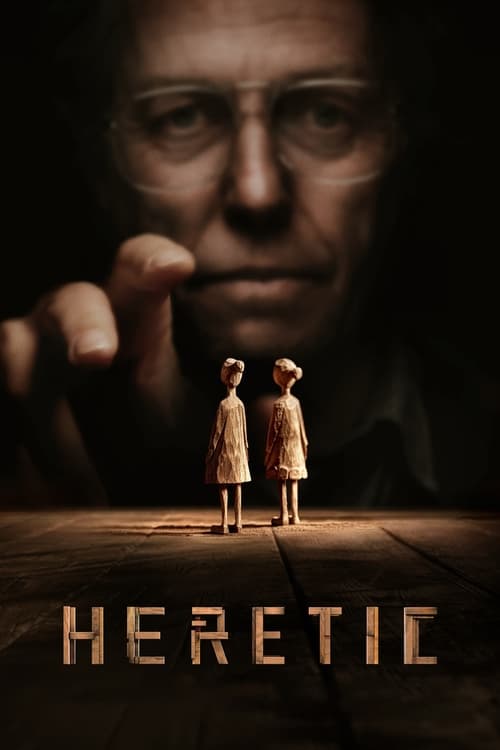
Heretic
2024 · Scott Beck
For when you want a scare that works on your brain — horror you can debate over drinks afterward rather than hide behind a pillow from. Choose it for tension and ideas, not gore.
What it's about
Two young Mormon missionaries, Sister Barnes and Sister Paxton, knock on the door of Mr. Reed, a soft-spoken Englishman who invites them in for pie and conversation. Room by room, his cozy house reveals itself as something else, and a polite doorstep visit becomes a locked-in debate about faith, control, and what belief is actually for — with the two women trying to think their way out.
The experience
A slow-burn chamber piece that runs on talk instead of jump scares — long, articulate, needling conversations where the menace is in the charm. It's claustrophobic and intellectually prickly, and it keeps you arguing with the screen.
Performances
Hugh Grant weaponizes fifty years of charm into something genuinely chilling — his Mr. Reed is funny, courteous, and wrong in ways that sneak up on you. Sophie Thatcher and Chloe East give the missionaries real interior lives, one guarded and sharp, one earnest and underestimated.
The craft
Beck and Woods build the whole film inside one house that keeps disclosing new geometry, and the screenplay does the work most horror leaves to monsters: the theological sparring is the suspense. Sound design and candlelit interiors make the quiet feel dangerous.
Why it matters
One of A24's standout horror hits of 2024, it redefined Hugh Grant's late career as a character actor and pushed the 'talky' theological thriller back into the horror mainstream.
Horror · Psychological horror · Religious horror · Suspense & terror. A slow-burn chamber piece where a charming host's theological debate turns a cozy house into a trap — dread built from talk, not gore.
Snapshot
Heretic is a chamber thriller that stages a theological duel inside a single, slowly revealed house. Two young Latter-day Saint missionaries — Sister Barnes (Sophie Thatcher) and Sister Paxton (Chloe East) — knock on the door of Mr. Reed (Hugh Grant), a soft-spoken Englishman who invites them in, promises his wife is baking pie, and then, room by room, converts a proselytizing visit into an inquisition on the nature of belief itself. The film is credited on this dossier to Scott Beck, but it is in fact the work of the longtime writing-directing partnership of Scott Beck and Bryan Woods, best known for scripting A Quiet Place (2018). Produced and distributed by A24, it premiered at the Toronto International Film Festival in September 2024 and opened theatrically that November. Its signature move is tonal: a horror film that withholds nearly all violence for its first hour, substituting the menace of an argument you cannot win. It became, above all, the vehicle for a late-career reinvention of Hugh Grant as a virtuoso of civilized cruelty.
Industry & production
Heretic sits squarely within the A24 model of mid-budget, auteur-adjacent genre filmmaking — a talk-heavy horror premise that could be marketed on a single face and a single idea. For Beck and Woods it represented a course correction. After the enormous success of their A Quiet Place screenplay, their own directorial efforts — the slasher Haunt (2019) and the Adam Driver science-fiction vehicle 65 (2023) — had been received as competent rather than distinctive. Heretic was the film that established them as filmmakers with a voice, not just concept-merchants, and the critical consensus treated it as their arrival.
Production was compact by design: the film is essentially a single-location piece, shot largely on constructed sets that allow the house to reconfigure itself as a psychological trap. Principal photography took place in British Columbia, Canada, a common arrangement for American independent productions seeking controlled interiors and tax efficiency. The precise budget and final box-office totals should be treated cautiously here; the film was widely reported as a strong performer relative to its modest cost and one of A24's more commercially successful horror releases of its year, but exact figures are best confirmed against the trade record rather than asserted. What is uncontroversial is that the picture's economics were built around confinement — few locations, a small principal cast, and a marketing hook centered on Grant.
Technology
Heretic was shot digitally, and its technological interest lies less in novel hardware than in the disciplined use of contemporary tools to make a static space feel unstable. The specific camera package and lenses are not something to assert without the technical record in hand, and I will not invent them. What can be said is that the film exploits the controllability of modern digital capture — clean low-light interiors, precise color management, and the latitude to hold long, dim single-source compositions — to sustain a claustrophobic naturalism. The house's lighting logic (candlelight, lamplight, the descent into a windowless lower level) is the film's principal "effect," and it depends on digital sensitivity to darkness rather than on any visible spectacle. Practical set construction, not visual effects, does the heavy lifting; the technology is largely invisible, which is the point.
Technique
Cinematography
The film's most consequential craft credit is its cinematographer, Chung Chung-hoon (Chung-hoon Chung), the Korean director of photography who built his reputation with Park Chan-wook — Oldboy, Thirst, Stoker, The Handmaiden — and has since worked in Anglophone cinema on It (2017) and Last Night in Soho. His presence explains a great deal about how Heretic looks. Chung is a formalist of controlled space: symmetrical framings, deliberate lateral and dolly moves, and a painterly command of interior light. In Heretic he treats the house as an architecture of entrapment, using doorways, thresholds, and depth staging to keep the two women visually contained by Reed even when the dialogue is polite. The camera's patience — its willingness to sit inside a conversation — converts theology into suspense. The eventual descent into the home's lower levels lets Chung shift the palette toward darkness and shadow-play, so that the film's visual grammar tracks its argument: the higher rooms of reasoned debate give way to the buried chambers of dogma.
Editing
The editing's central task is rhythm rather than spectacle — modulating long dialogue scenes so that tension accrues without release. Cuts are timed to reaction and hesitation, to the missionaries registering that the exits are gone and the logic is closing. The film generally resists the accelerated cutting of contemporary horror, favoring held shots and controlled reveals; when it does accelerate, in its later movements, the change of pace is felt precisely because the earlier passages were so patient. I do not have a confident editor credit to attribute here and will not invent one; the editorial achievement is best described by its effect — a slow tightening — rather than by a name I cannot verify.
Mise-en-scène / staging
Staging is where Heretic is most obviously the work of writers who think structurally. The house is a designed argument. Its rooms are laid out as stages in Reed's demonstration, and the film's celebrated set piece — a choice between two doors labeled, in effect, "Belief" and "Disbelief" — literalizes the theme as production design. Objects become rhetorical props: a blueberry-pie candle standing in for the promised wife, a game of Monopoly and a Radiohead record deployed as evidence in Reed's lecture on religion as iteration and plagiarism. The staging keeps the two women physically subordinate to Reed's control of space — he governs the doors, the light, the descent — so that the mise-en-scène enacts coercion before any hand is raised.
Sound
Sound design carries much of the dread. In a film built on conversation, silence and small domestic noises — a lock, a shifting house, the muffling of the outside world — do the work that shock cues would do elsewhere. The score, composed by Chris Bacon, tends toward restraint and unease rather than orchestral assault, underscoring the interrogation without overwhelming the words, which are the true instruments of terror. The film's sonic strategy mirrors its visual one: quiet, controlled, and all the more oppressive for withholding.
Performance
This is, first and last, a performance film, and Hugh Grant's Mr. Reed is its engine. Grant weaponizes the very charm that made his romantic-comedy career — the stammering diffidence, the self-deprecating wit, the impeccable manners — turning each into an instrument of predation. It is a continuation of the villain turn he had been developing in Paddington 2, The Gentlemen, and Dungeons & Dragons: Honor Among Thieves, but pushed to its fullest, most malignant expression. Opposite him, Sophie Thatcher (of Yellowjackets and The Boogeyman) and Chloe East (of Spielberg's The Fabelmans) refuse to play the missionaries as naïfs; their Barnes and Paxton hold intellectual and moral ground, and the film's dignity depends on their conviction registering as genuine rather than as setup for a fall. The three-hander's balance — a manipulator who monologues and two women who parry — is what keeps the picture from curdling into a lecture.
Narrative & dramatic mode
The film's dramatic mode is closer to filmed theater than to conventional horror: a chamber piece of escalating dialogue, structured as a Socratic trap. Its engine is not "what will happen" so much as "how far will the argument go," and it advances through the classic mechanics of the drawing-room thriller — hospitality that curdles, exits that vanish, a host whose erudition is the weapon. Reed's rhetoric follows a deliberate arc from comparative-religion seminar (all faiths as iterations of prior faiths) toward a demonstration of what he claims is the "one true religion." The screenplay's ambition is to keep the audience genuinely uncertain whether Reed is a nihilist, a true believer of some perverse creed, or merely a sadist dressing cruelty in philosophy. Where the film has divided viewers is in its final movement, which resolves the debate into more literal horror-thriller mechanics; some found the shift a satisfying escalation, others a diminishment of the ideas the first two acts had so patiently raised.
Genre & cycle
Heretic belongs to two overlapping cycles. The first is the single-location, dialogue-driven confinement thriller — the lineage of Wait Until Dark, Misery, 10 Cloverfield Lane, and the intellectual-duel model of Ex Machina, films in which the room itself is the antagonist and talk is the action. The second is the strand of "elevated horror" associated with A24 and its peers, particularly its subset concerned with religion, faith, and doubt. Within that subset Heretic is unusual for centering its horror not on the supernatural but on apologetics — on the vertigo of having one's faith argued against by someone smarter and better prepared. It is faith-based horror inverted: rather than dramatizing belief under demonic assault, it dramatizes belief under rhetorical assault, which for many viewers is the more modern and more frightening scenario.
Authorship & method
Beck and Woods work as a genuine unit — childhood collaborators from Iowa who write and direct together — and Heretic is best read as an auteurist statement of their method: high-concept premises executed with formal restraint. Their signature, visible already in A Quiet Place, is the reduction of horror to a single governing rule or system that the characters must navigate; here the "system" is Reed's theology and his house. The decisive authorial choice was collaborative casting-against-type (Grant) married to world-class craft partners: Chung Chung-hoon's controlled camera and composer Chris Bacon's restrained score give the writers' talk-heavy script a cinematic body it might otherwise have lacked. The pairing of American genre screenwriters with a cinematographer trained in Park Chan-wook's exacting formalism is, in retrospect, the film's key creative decision. Where I lack confident credits — notably the editor and production designer — I have declined to name them rather than risk error.
Movement / national cinema
The film is American independent cinema of the A24 variety, but its craft DNA is transnational: a Korean cinematographer's sensibility grafted onto a Midwestern American writing team's high-concept horror, physically produced in Canada. It reflects the contemporary reality that "American independent film" is an increasingly global collaboration at the level of craft. Thematically it is deeply American in its subject — the door-to-door Latter-day Saint mission is a distinctly American religious institution — even as its interrogation of belief reaches for a more universal register.
Era / period
Heretic is a document of the mid-2020s. It arrives at the tail of the "elevated horror" cycle, when the mode's tropes were well enough established to be refined and inverted. More pointedly, it speaks to a cultural moment of religious "deconstruction" — the online-inflected phenomenon of believers, and ex-Mormons in particular, publicly re-examining and leaving their faith. Reed's arguments (religion as iteration, control masquerading as revelation) are the arguments of that discourse made flesh, and the film's decision to let its missionaries answer them seriously is what marks it as a post-2020 work rather than a simple anti-religious provocation. It is also a product of the post-pandemic economics that favored contained, low-location productions built around a marketable performance.
Themes
The film's governing theme is control: Reed's thesis is that the "one true religion" is not any creed but the mechanism of control that all creeds share, and the house is his proof. Around this cluster its subordinate concerns — the tension between institutional religion and private faith; belief versus disbelief as a false binary the film both stages and interrogates; the ethics of certainty; the vulnerability of the earnest before the cynical. Crucially, the film treats its missionaries' faith with more respect than Reed does, so that its final sympathies lie less with either "belief" or "disbelief" than with human decency and conviction under pressure. Iteration and originality — the idea that culture, like religion, is endless copying — runs underneath as a metaphysical worry: if everything is a version of something prior, what, if anything, is true?
Reception, canon & influence
Critical reception was strong and centered overwhelmingly on Grant, whose performance was widely praised as among the best of his career and as the definitive statement of his villain era. Reviewers admired the film's nerve in building horror out of theology and its formal control, while a recurring reservation held that the third act's turn toward conventional genre resolution could not fully honor the intellectual stakes the earlier scenes had raised. On balance it was received as one of the more intelligent horror films of its year and a significant step up for its directors.
Its influences run backward to several traditions: the confined intellectual duel of Ex Machina; the cultivated-predator archetype descending from Hannibal Lecter and the drawing-room-thriller host; the religious-doubt cinema of Bergman's Winter Light, Scorsese's Silence, and the theatrical interrogation of Doubt; and the closed-room horror of Saw and Misery, whose architecture of entrapment it rationalizes into a house of ideas. Its forward legacy is, given its recency, genuinely thin and should be described as such rather than overstated: too little time has passed to measure what it will shape. What can be observed already is its role in consolidating Hugh Grant's reinvention as a character actor of menace, in affirming Beck and Woods as directors of substance, and in demonstrating a commercial appetite for horror built on argument rather than gore — a proof of concept whose imitators, if they come, still lie ahead.
A Deleuzian reading
A candle in the front room smells like blueberry pie.
The full Deleuzian reading of Heretic →
Reception
A November 2024 hit for A24 — strong reviews, a big-for-A24 box office run, and a Golden Globe- and BAFTA-nominated Hugh Grant. Barely a year on, the consensus hasn't budged much: brilliant setup, still-contested finish.
How Heretic was received, from release to now →
How to watch Heretic: what to notice on a first viewing
- Watch how doorways and thresholds frame Barnes and Paxton in each room. Chung Chung-hoon keeps placing the two women in depth behind or beside Reed, contained by architecture while the dialogue stays polite. The house's geometry subordinates the women to Reed's control before any hand is raised.
- Notice Hugh Grant's stammer and self-deprecating pauses whenever he offers something. The hesitation recurs at every offer of pie, tea, or explanation, reading simultaneously as courtesy and as calculation. The courtesy is the delivery system; his manners are inseparable from his menace.
- Listen for the lock, the house creaking, small domestic sounds. These tiny sounds replace horror's jump-scare stingers throughout, growing heavier as more rooms and exits close off. Dread builds from atmosphere and silence, not from shock cues.
- Notice how long each conversation runs before the film cuts. Beck and Woods favor held shots and controlled reveals, letting tension accrue rather than release; only later does the pace quicken. The patience makes the eventual escalation land as a real rupture.
The whole guide to watching Heretic, with the keys for a rewatch →
Influences: the films it descends from and the films it influenced
- Ex Machina (2014) — Structures its horror as a controlled interrogation in an isolated architect-designed house, where sequential one-on-one 'sessions' are really tests the captive must decode — the exact Socratic-trap-in-a-lab architecture Heretic inherits.
- The Silence of the Lambs (1991) — Codifies the erudite-predator interview shot in near-direct-address close-up, letting a seductive, hyper-articulate captor control tempo through language — the Lecter template Grant's Reed reworks into a theological version.
- Misery (1990) — Establishes the domestic-captivity thriller where a single antagonist owns every room and exit, turning an ordinary house into a slowly revealed prison — the entrapment blueprint Heretic rationalizes into a 'house of ideas.'
- Saw (2004) — Gives the captor an ideological 'game' with explicit rules and engineered choices, so the physical space is a purpose-built moral apparatus — the rule-system-as-trap logic Heretic dresses in doctrine.
- Rope (1948) — Confines a real-time moral duel to a single apartment where intellectual predators stage an argument as performance, pioneering single-location suspense driven by talk rather than incident.
- Sleuth (1972) — Builds a two-hander of escalating gamesmanship inside a house whose production design (mechanisms, props, rooms) is itself the weapon — the 'production-design-as-argument' two-hander Heretic revives.
- Doubt (2008) — Adapts theater directly to screen as a dialectical interrogation about faith and certainty, where the drama is entirely verbal cross-examination — the filmed-theater, argue-belief mode Heretic runs on.
- Winter Light (1963) — Anchors austere religious-doubt cinema in a clergyman's collapse of belief, using stillness and held frames to make spiritual crisis visual — the doubt-cinema lineage behind Reed's theology.
- Silence (2016) — Stages apostasy as sustained interrogation under duress, dramatizing faith through pressure and argument rather than event — a direct forebear of Heretic's theology-as-torment premise.
- Oldboy (2003) — Chung Chung-hoon's breakthrough with Park established his deep-focus, corridor-of-entrapment compositions and exacting single-source lighting — the formal grammar he brings intact to Heretic's house.
- Stoker (2013) — Chung Chung-hoon renders a menacing domestic interior through controlled depth staging and low, motivated light that makes a home feel predatory — the domestic-dread cinematography he reprises for Heretic.
- A Quiet Place (2018) — Beck and Woods' own signature: reduce horror to one governing rule the characters must obey and navigate — the authorial method Heretic transposes from sound to theology.
- Barbarian (2022) — Makes a house's concealed architecture the engine of horror, escalating room by revealed room so production design itself delivers the reveals — the same 'the building is the argument' logic Heretic deploys.
- Paddington 2 (2017) — The hinge of Grant's late-career reinvention as a preening, theatrical villain, weaponizing his charm into menace — the performance pivot Heretic escalates into full predatory register.
- The Invitation (2015) — Sustains single-location dread as a belief system is slowly disclosed to trapped guests inside a domestic space, dread built from politeness and doctrine rather than violence — Heretic's dinner-party-turned-doctrine sibling.
- Speak No Evil (2022) — Extracts terror from social civility and hospitality turned into a controlling trap, letting a calm host dictate the rules until escape becomes impossible — the weaponized-manners chamber horror alongside Heretic.
- Men (2022) — Extends the Garland lineage of an isolated protagonist besieged inside a single dwelling by an antagonist embodying an ideology, staging argument-as-threat in confined space — a contemporary A24 cousin to Heretic's method.
Similar films
- Barbarian (2022) — influence & lineage · same viewing thread
- Men (2022) — influence & lineage · same viewing thread
- Speak No Evil (2022) — influence & lineage · same viewing thread
- The First Omen (2024) — same viewing thread
- Saint Maud (2020) — same viewing thread
- Leviticus (2026) — same viewing thread
- The Witch (2016) — same viewing thread
- Bring Her Back (2025) — same viewing thread
All the films related to Heretic →
Watch it with: curated runs of related films
- Whatever's Wearing That Face — A run of horror-thrillers where the real terror is that you can't trust what a person appears to be — a double, a shapeshifter, a smiling stranger, the one you desire.
- The Fear of God — A run of horror where faith is the battleground: believers, doubters and zealots meet the devil, damnation and an afterlife that answers back, from Puritan farms and Roman convents to the catacombs under Paris.