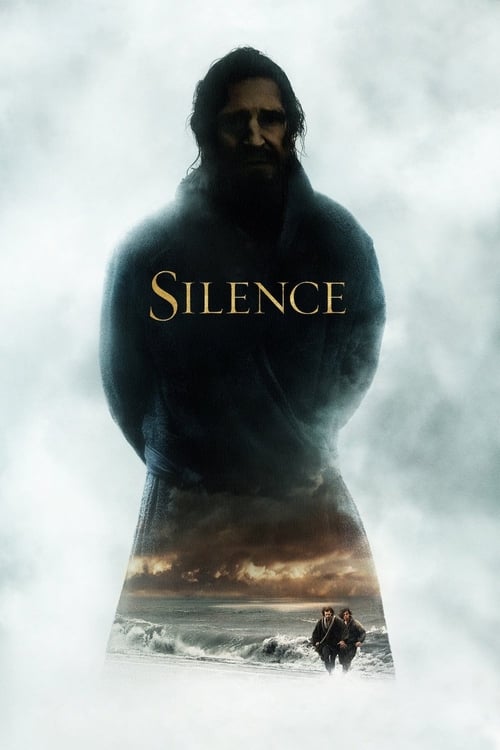
Silence
2016 · Martin Scorsese
For when you want a serious, demanding film to wrestle with — questions of faith, doubt, and conscience with no easy exits. This is a challenge, not a comfort watch; save it for a night when you have the patience and the silence it needs.
What it's about
In the 1630s, two Portuguese Jesuit priests smuggle themselves into Japan, where Christianity is outlawed and brutally suppressed, to find their mentor — rumored to have renounced his faith under torture. Sheltered by villages of hidden believers and hunted by a patient, coolly intelligent inquisitor, the younger priest finds his rescue mission turning into a trial of his own soul, conducted under a heaven that refuses to answer.
The experience
Slow, austere, and quietly harrowing — nearly three hours with almost no music, where the tension comes from moral pressure rather than action. It doesn't ask to be liked; it asks to be sat with, and it stays lodged in you for days.
Performances
Andrew Garfield gives everything to the young priest's unraveling certainty, Adam Driver is startlingly gaunt and fierce in a smaller role, and Issey Ogata is unforgettable as the inquisitor — courtly, amused, and more frightening than any torturer.
The craft
Martin Scorsese strips his style down to mist, mud, and faces, with Rodrigo Prieto's cinematography turning the Japanese coastline into something both beautiful and indifferent. The near-total absence of score makes the sound of surf, insects, and rain carry the film's meaning — it rewards a quiet room and full attention.
Why it matters
Scorsese pursued this adaptation of Shūsaku Endō's novel for roughly a quarter-century, and it stands as the summit of his lifelong films about faith — divisive on release, increasingly regarded as one of his most profound works.
Snapshot
Martin Scorsese's adaptation of Shūsaku Endō's 1966 novel Chinmoku follows two Portuguese Jesuits, Sebastião Rodrigues (Andrew Garfield) and Francisco Garupe (Adam Driver), who smuggle themselves into Tokugawa Japan in the 1630s to find their teacher Cristóvão Ferreira (Liam Neeson), reported to have apostatized under torture. What begins as a rescue mission and a mission of evangelism becomes an extended interrogation of the priest's own faith, conducted by the state and by God's refusal to answer. At 161 minutes, austere, largely scoreless, and structured as a slow narrowing from open landscape to a single cell, Silence is the least ingratiating film of Scorsese's late career and the one he pursued longest — roughly a quarter-century from first reading to release. It arrived in December 2016 to strong but divided reviews, minimal awards traction (a single Academy Award nomination, for cinematography), and a commercial failure that has since been read as a hinge point in how Scorsese finances his work.
Industry & production
Scorsese has consistently dated his encounter with Endō's novel to 1988, when he was given a copy by Paul Moore, the Episcopal bishop of New York, in the aftermath of the controversy surrounding The Last Temptation of Christ; he read it while traveling in Japan, where he was performing as Vincent van Gogh in Akira Kurosawa's Dreams. The project then spent decades in a state familiar to any film that is respected in principle and unfinanceable in practice: rights acquired and re-acquired, casts assembled and dispersed, and a protracted contractual dispute with the Italian producer Vittorio Cecchi Gori over Scorsese's long-standing obligation to deliver the film — a dispute that eventually resolved and left Cecchi Gori among the credited producers.
The film that finally shot in early 2015 was a patchwork international financing package rather than a studio production: Scorsese's own Sikelia Productions with a consortium of independent financiers and sales companies, with Paramount handling U.S. distribution rather than funding the picture outright. Emma Tillinger Koskoff, Irwin Winkler, Barbara De Fina, Randall Emmett and Gastón Pavlovich are among those credited as producers. Reported figures place the budget somewhere in the $40–50 million range and the worldwide theatrical gross at roughly half that or less; the precise numbers vary by source, but the direction is unambiguous — the film did not recover its cost in theaters. It is well documented that Scorsese and the principal cast worked for substantially reduced fees to make the economics viable at all.
Principal photography took place in Taiwan, with production based at studio facilities in Taipei and location work on the island's coasts and mountains standing in for Nagasaki prefecture and the Gotō Islands. The choice was driven by cost, available incentives, and — practically — by the difficulty of finding uninterrupted seventeenth-century coastline in contemporary Japan. The shoot was widely described as physically punishing: mud, rain, cold water, and a compressed schedule.
The release strategy underlined the film's awkward position. Paramount opened it in limited engagements in late December 2016 for awards eligibility and expanded in January 2017, by which point the season's consensus had formed elsewhere. Before the commercial release, Scorsese screened the film in Rome for an audience of Jesuits and met Pope Francis — an unusual pre-release itinerary that signaled, correctly, that the picture's most durable audience would be a religious and academic one rather than a mass one.
Technology
Silence was photographed on 35mm film by Rodrigo Prieto, at a moment when photochemical origination had become a deliberate, argued-for choice rather than a default. Prieto's stated aim was a naturalistic, weathered image built as far as possible from available light — daylight filtered through fog and rain, interiors lit by fire, oil lamp, and the small hard sources of a prison compound. The film sits at the edge of a technological transition in Scorsese's own practice: it precedes the fully digital, VFX-intensive workflows of The Irishman (2019), where Prieto and Scorsese would use digital capture in service of de-aging, and its grain and low-light softness read now as an argument for the older tool.
Digital technology in Silence is largely invisible and infrastructural — set extension, seascape and crowd work, the erasure of modern Taiwan from the edges of frames — rather than expressive. The most consequential technical decisions are subtractive: no score in the conventional sense, no digital sweetening of the soundscape into lushness, comparatively little coverage. It is a film that uses contemporary capability mainly to avoid announcing itself.
Technique
Cinematography
Prieto's work here earned the film's only Oscar nomination, and it is legible as a single sustained idea: the world is enormous and indifferent, and the human figure inside it is small and unanswered. The film's early passages place the priests as specks against fog banks, black volcanic rock, and gray sea; its later passages press in to close-up on faces and on the worn brass of the fumie, the image of Christ that suspects are ordered to trample. The relatively narrow 1.85:1 frame — unusual for a Scorsese period picture of this scale — favors verticality and enclosure over the scope-widescreen sweep the material might have invited.
Two recurring formal gestures carry the theme. The first is the high, detached overhead shot: a vantage above the action that surveys suffering without intervening — a divine point of view formally instantiated and formally mute. The second is the use of natural obscurants — mist, steam, rain, smoke — as a visual synonym for the title. The Unzen hot-springs torture sequence, in which scalding water is ladled onto bound villagers, and the tidal crucifixions in which martyrs are lashed to crosses in the surf and left to the waves, are both shot with an almost documentary patience: long holds, minimal cutting, no score to instruct the viewer how to feel.
Editing
Thelma Schoonmaker, editing her ninth-plus feature for Scorsese, works here against the reflexes the collaboration is famous for. There is no whip-pan bravura, virtually no montage-with-pop-song, and few of the compressive jump cuts that define Goodfellas or The Wolf of Wall Street. Shots are held past the point of comfort; scenes are permitted to end in stillness rather than on a cut motivated by tempo. The architecture is a three-movement descent — clandestine ministry among the hidden Christians of Tomogi and Gotō; capture, imprisonment, and theological disputation; apostasy and its long aftermath — with the pace slowing as the physical space contracts. The most discussed editorial decision is the last one: after Rodrigues's cremation, the camera moves into the coffin to disclose a small crucifix held in his hands, an image with no equivalent in Endō and one that supplies a resolution the novel deliberately withholds.
Mise-en-scène / staging
Dante Ferretti's production design, with Francesca Lo Schiavo's set decoration, builds a world of poverty and damp: the thatched village of Tomogi, the plank cages and mud yards of the magistrate's compound, the exposed shoreline. The staging repeatedly separates the priest from the community he serves — Rodrigues watching from concealment while peasants are killed, or seated apart during interrogations — so that his spiritual crisis is framed as a problem of spectatorship as much as belief. Interrogation scenes are staged with formal Japanese spatial etiquette: seated bodies, fixed distances, translators mediating between languages and cosmologies. The result is that argument, not action, becomes the film's principal physical event.
Sound
The sound design is the film's boldest technical choice. There is no orchestral score. The credited music, by Kim Allen Kluge and Kathryn Kluge, functions as an ambient and textural layer largely derived from and blended with natural sound rather than as thematic underscoring; the sound editorial team includes Scorsese's longtime collaborators Philip Stockton and Eugene Gearty. The film opens on black with the massed drone of cicadas, which is then cut abruptly to nothing — the title enacted as an audio event before a single image resolves. Throughout, the register is insects, wind, surf, rain, breathing, and the specific sound of a foot on metal. Silence in this film is not an absence of sound but an audible presence: the sea keeps going while people die in it.
Performance
Garfield's Rodrigues moves from ardor through vanity to a hollowed-out endurance, a trajectory the performance registers physically — both he and Driver underwent widely reported significant weight loss for the roles. Garfield has spoken about preparing under the guidance of the Jesuit writer James Martin, a consultant on the production, including work with the Spiritual Exercises of Ignatius of Loyola. Neeson's Ferreira, held back for the final third, plays apostasy not as capitulation but as a settled, exhausted argument.
The Japanese cast supplies the film's most distinctive playing. Issey Ogata, a performer known for solo character comedy and for his Emperor Hirohito in Aleksandr Sokurov's The Sun (2005), makes the Inquisitor Inoue Masashige a figure of grotesque, high-pitched courtesy whose reasonableness is more corrosive than any threat. Shin'ya Tsukamoto — himself a major director, of Tetsuo: The Iron Man and Fires on the Plain — plays the martyr Mokichi with a stripped ecstatic simplicity. Yoshi Oida, a longtime member of Peter Brook's company, brings a theatrical economy to Ichizō. Tadanobu Asano's interpreter and Yōsuke Kubozuka's Kichijirō are the film's two great ambiguous presences; Kubozuka in particular turns the serial betrayer who keeps returning to be forgiven into the movie's most theologically loaded character.
Narrative & dramatic mode
The film adopts Endō's epistolary architecture: the first half is narrated by Rodrigues in voiceover drawn from his letters, a device that yields a first-person interiority in the mode of Bresson's Diary of a Country Priest. As Rodrigues's certainty erodes, the narration's authority erodes with it — and in the final movement the film hands narration to an outside observer, a Dutch trader whose flat commercial ledger of the apostate priest's remaining years mirrors Endō's closing documentary appendix. This is a deliberate withdrawal of subjectivity: the film ends by refusing to let us stay inside the man whose interior life it has spent two hours establishing, then partially retracts that refusal with the crucifix in the coffin.
Dramatically, the mode is inquisition rather than adventure. Conflict is verbal and doctrinal; the antagonists are the film's best rhetoricians. Inoue's argument that Christianity is a foreign plant that cannot root in the "swamp" of Japan, and Ferreira's argument that the peasants were never worshipping the Christian God at all but the sun, are given full and unanswered weight. The central mechanism is a torturer's inversion: the priest is not tortured himself: others are tortured until he apostatizes, making his fidelity the instrument of their suffering. Martyrdom, the traditional narrative reward of the missionary story, is withheld as an option.
Genre & cycle
Silence belongs to the missionary film — the lineage that includes The Mission (1986), Black Narcissus (1947), and Rossellini's religious histories — but it inverts the form's usual arc, in which faith is tested and vindicated. It also functions as a jidaigeki made by an outsider, engaging Tokugawa-era iconography and the historical record of the Shimabara Rebellion, the sakoku closure, and the kakure kirishitan who maintained a syncretic underground Catholicism for two centuries. Within Scorsese's own body of work it completes what is commonly described as a faith trilogy with The Last Temptation of Christ (1988) and Kundun (1997), and extends the preoccupation with guilt, penance, and the collision of the sacred with the compromised that runs back through Mean Streets.
Authorship & method
The screenplay is by Jay Cocks and Scorsese, their third produced collaboration after The Age of Innocence and Gangs of New York — a partnership consistently oriented toward literary adaptation and toward historical worlds governed by codes. Their adaptation is unusually faithful in structure and dialogue, with the significant exception of the ending.
The craft team is the mature Scorsese unit operating in a deliberately restrained register: Schoonmaker cutting against her own signature, Ferretti and Lo Schiavo building squalor rather than spectacle, Prieto extending the collaboration begun on The Wolf of Wall Street and continued through The Irishman and Killers of the Flower Moon. The most significant methodological departure is the absence of Scorsese's defining authorial tool — the curated needle-drop, the pop-music commentary track that shapes nearly all his major work. Removing it is the clearest statement the film makes about its own seriousness, and it forced the Kluges' textural sound-work into the space a score would occupy.
Movement / national cinema
Formally, Silence is American auteur cinema in its late-modernist mode, but its production identity is genuinely transnational: a Mexican cinematographer, Italian designers, Taiwanese crews and locations, a Japanese cast, dialogue in English (standing in for Portuguese) and Japanese, financed across several territories. Its aesthetic debts run to postwar Japanese cinema — Mizoguchi's landscapes and moral fatalism, the ghost-story tradition's use of fog and coastline — and to the European transcendental line of Bresson and Dreyer. It also stands in explicit relation to Japanese cinema's own reckoning with this material: Masahiro Shinoda's Chinmoku (1971), scripted with Endō's involvement, remains the principal prior adaptation and a useful comparison, particularly in how each film resolves what the novel leaves open.
Era / period
Two periods matter. The depicted one is the 1630s, the closing phase of Japan's suppression of Christianity, when Ferreira's real apostasy (he took the name Sawano Chūan) and the case of the Italian Jesuit Giuseppe Chiara — the historical figure behind Rodrigues — furnished Endō his material, and when Inoue Masashige's inquisitorial regime shifted policy from producing martyrs to producing recantations.
The production period is equally legible in the film's fate. Silence appeared at the moment when the mid-budget adult drama had effectively lost its theatrical constituency and streaming capital had not yet fully replaced studio capital. Its financial failure is frequently and reasonably cited as context for Scorsese's subsequent turn to Netflix for The Irishman and Apple for Killers of the Flower Moon — a director of unimpeachable standing who could no longer reliably raise money for a serious film from a traditional studio.
Themes
The governing subject is the silence of God under sustained petition — not atheism but unanswered address. Around it the film organizes several linked arguments. First, the distinction between public renunciation and interior belief: the fumie is a bureaucratic device that measures only the foot, and the film's final movement suggests that what it measures may be nothing at all. Second, the vanity of martyrdom: Rodrigues's desire to die well is exposed, by Ferreira and by events, as a form of self-regard purchased with other people's lives. Third, translation and colonialism: the film takes seriously the charge that Christianity arrived attached to Iberian commercial and imperial power, and that "Deus" heard as Dainichi is not a failure of teaching but evidence of an unbridgeable difference. Fourth, betrayal as vocation — Kichijirō, who apostatizes and confesses and apostatizes again, is the film's Judas and, in Endō's theology of weakness, its most representative Christian. The closing dedication to Japanese Christians and their pastors places the film's sympathies with the people who were trampled rather than with the doctrine.
Reception, canon & influence
Critical response in December 2016 and early 2017 was largely admiring and openly strenuous: reviewers routinely described the film as a major, difficult, uningratiating work, praised the cinematography, sound, and the Japanese supporting cast, and split over its length, its expository theological dialogue, and the added final image, which some read as an act of moral generosity and others as a failure of nerve that resolves what Endō deliberately left irresolvable. It placed on many year-end ten-best lists while making almost no impression on the awards circuit — the single cinematography nomination is a notably thin return for a Scorsese film of this scale, and is itself a data point about the picture's reception. Its most engaged constituency proved to be religious and academic readers, for whom the film became a standard companion text to Endō's novel in theology and film courses.
Backward, the film's debts are unusually traceable. Endō's novel is the primary source; Shinoda's 1971 adaptation is the shadow against which Scorsese's ending defines itself. The formal ancestry runs through Bresson's Diary of a Country Priest (the priest's diary as voiceover, faith as physical depletion), Dreyer's late religious films, and Rossellini's The Flowers of St. Francis and history films — Rossellini being a director Scorsese has championed at length in his own documentary work on Italian cinema. Japanese cinema supplies the landscape grammar, and Scorsese's own The Last Temptation of Christ supplies the central provocation: a Christ, or a priest, permitted to be weak.
Forward, the record is still short and should be described as such. The clearest resonance is with the concurrent revival of the crisis-of-faith art film, above all Paul Schrader's First Reformed (2017) — Schrader having written Taxi Driver and The Last Temptation of Christ for Scorsese, and having authored the critical framework, Transcendental Style in Film, that the two pictures jointly reactivated — and with Terrence Malick's A Hidden Life (2019), another long, slow film about conscience under a state that only requires a signature. Within Scorsese's own filmography, Silence inaugurates the late style of The Irishman and Killers of the Flower Moon: long, penitential, unhurried films about complicity and belated reckoning. Scorsese has publicly stated since that he intends to make a film about Jesus, citing Endō's A Life of Jesus as an impetus, following a further meeting with Pope Francis; as of this writing that project remains announced rather than realized. The film's broader industrial legacy — as a case study in what could no longer be financed theatrically — may prove as consequential as its aesthetic one.
A Deleuzian reading
Before there's a picture there's a sound.
The full Deleuzian reading of Silence →
Reception
In 2016 it landed as a respected but under-seen passion project — a box-office flop that got just one Oscar nod (cinematography) after 25+ years of Scorsese trying to make it. Less than a decade on, it's routinely called his late-career masterpiece and the 2010s Scorsese film the culture underrated most.
How Silence was received, from release to now →
How to watch Silence: what to notice on a first viewing
- Listen to the cicadas at the very start, then to the cut. The film opens on black under a wall of insect noise. It does not fade out. It stops dead, and the title appears in the hole the sound leaves. Your ears keep reaching for something that does not come back. The whole subject gets performed before the first image.
- Watch for the high shot looking straight down at the suffering. Scorsese keeps placing the camera above the action, surveying without intervening. The vantage returns through torture, capture, and burial. Nothing in the film says whose it is. A divine point of view gets built out of a camera position, and then it is refused any answer.
- Watch how often mist, steam, rain, or smoke fills the frame. Prieto works from available light through fog and rain, with interiors lit by fire and oil lamp. Something hangs between you and nearly every wide shot. The weather is the title made visible. You keep looking through something at people who are getting no reply.
- Watch where Rodrigues is standing when villagers are punished. The staging keeps putting the priest off to one side, hidden in undergrowth or seated apart at an interrogation. He watches people suffer for a faith he carried to them. His crisis is arranged as a problem of watching, and the blocking puts you in exactly his position.
- Count how long a shot stays after the action inside it ends. Schoonmaker, who cut the whip-pans and pop-song montages of Goodfellas, holds shots here past comfort and lets scenes finish in stillness instead of on a cut driven by tempo. Nothing hurries you to the next thing. Time is left sitting in the shot and you have to stay in it.
The whole guide to watching Silence, with the keys for a rewatch →
Influences: the films it descends from and the films it influenced
- Diary of a Country Priest (1951) — The template of the priest's own written record spoken as voiceover over images of him writing it — Rodrigues's letters function identically — with faith registered as bodily depletion (bread, wine, a failing stomach) rather than as argument.
- The Passion of Joan of Arc (1928) — Interrogation built as sustained shot/reverse between an isolated believer and a semicircle of seated magistrates, culminating in a signature/abjuration — the grammar Scorsese reuses for the fumie and the Inoue examinations.
- Ordet (1955) — Long static takes that hold expository theological dialogue in real time, the camera panning within the room instead of cutting, and no music laid under the decisive spiritual event.
- The Flowers of St. Francis (1950) — Hagiography staged in mud, rain and rough cloth with largely non-professional players in episodic vignettes — the anti-spectacular devotional register Scorsese explicitly championed in My Voyage to Italy and hands to Ferretti and Lo Schiavo as a design brief.
- Winter Light (1963) — A wholly scoreless soundtrack in which the silence of God is carried by ambient weather, footsteps and offscreen room tone occupying the space music would otherwise fill.
- Ugetsu (1953) — The fog-bound boat crossing held in a single drifting long take, mist used as a compositional plane that dissolves depth — the direct model for Prieto's coastal and sea passages.
- Harakiri (1962) — Frontal, symmetrical courtyard compositions in which an official interrogates from a raised platform while the supplicant kneels in gravel — the exact staging vocabulary Issey Ogata's Inoue is placed inside.
- Andrei Rublev (1966) — Episodic historical structure in which the holy man is positioned as helpless spectator to atrocity he witnesses but cannot halt, and answers it with a vow of silence — the priest-as-spectator device and its duration.
- Silence (1971) — The prior Endō-co-scripted adaptation whose ending Scorsese's film defines itself against; its rocky-shore and inquisition-shed geography survives, while Takemitsu's percussive score is precisely what Scorsese strips out.
- The Last Temptation of Christ (1988) — Establishes the permission at the film's center — a divine or consecrated figure allowed to be physically frail and doubting on screen — and the practice of shooting a Holy Land through an unglamorous stand-in landscape.
- Kundun (1997) — Scorsese's first sustained refusal of the needle-drop and of star casting: a non-professional cast performing ritual in its own language, observed with anthropological patience and no pop commentary track.
- The Mission (1986) — Scorsese's Jesuit-martyrdom drama explicitly continues the serious colonial-conscience tradition The Mission revived, foregrounding the same crisis of faith versus institutional and imperial pressure.
- First Reformed (2017) — Schrader directing his own Transcendental Style thesis: boxed-in near-Academy frame, a clergyman's journal as voiceover, withheld score, and a contested transcendent final image that resolves what the text left open.
- A Hidden Life (2019) — Extends the same dramatic engine — a state that needs only a signature, and a conscience that withholds it — across a punishing runtime built from available-light landscape and offscreen correspondence read aloud.
- The Irishman (2019) — Schoonmaker cutting long and unhurried against her own kinetic signature, invisible digital work in service of realism rather than display, and a coda of solitary penance rhyming with the coffin-crucifix shot.
- Killers of the Flower Moon (2023) — Continues the Prieto photochemical partnership and the late-style structure of a weak, complicit protagonist who watches an atrocity he is inside of, with the god's-eye overhead reserved for moral judgment.
- Godland (2022) — A priest sent into a hostile territory as observer-recorder, shot in a boxy near-Academy frame with weather and terrain as antagonist and long scoreless passages in which faith is eroded by physical exhaustion.
- Heretic (2024) — Stages apostasy as sustained interrogation under duress, dramatizing faith through pressure and argument rather than event — a direct forebear of Heretic's theology-as-torment premise.
- Black Robe (1991) — Restricts the frame to a Jesuit's blinkered point of view in a landscape that will not accommodate him, shooting in available light and leaving indigenous-language dialogue subtitled without dramatic cushioning.
- Of Gods and Men (2010) — Martyrdom rendered as slow procedural deliberation among clerics, with diegetic chant deliberately installed in the slot a score would occupy — the same substitution the Kluges' textural sound work performs here.
- The Passion of the Christ (2004) — Makes sustained depiction of bodily martyrdom and faith under torture its central devotional argument, extending the endurance-as-theology logic Passion shares with Scorsese's earlier Christ film.
- Sardar Udham (2021) — Shares the near-silent sound design, durational suffering, and interiorized faith-and-witness restraint, building meaning through endurance and withheld resolution rather than incident.
Similar films
- The Last Temptation of Christ (1988) — influence & lineage · same viewing thread
- A Hidden Life (2019) — influence & lineage · often watched together
- Andrei Rublev (1966) — influence & lineage · often watched together
- Harakiri (1962) — influence & lineage
- Diary of a Country Priest (1951) — influence & lineage
- The Passion of Joan of Arc (1928) — influence & lineage
- Hacksaw Ridge (2016) — same viewing thread · often watched together
- The Gospel According to St. Matthew (1965) — same viewing thread
All the films related to Silence →
Watch it with: curated runs of related films
- The Testing of Faith — Watch these together when you want cinema that puts belief on the rack — devout men pushed to the brink of renouncing everything while their bodies are broken and their souls interrogated.