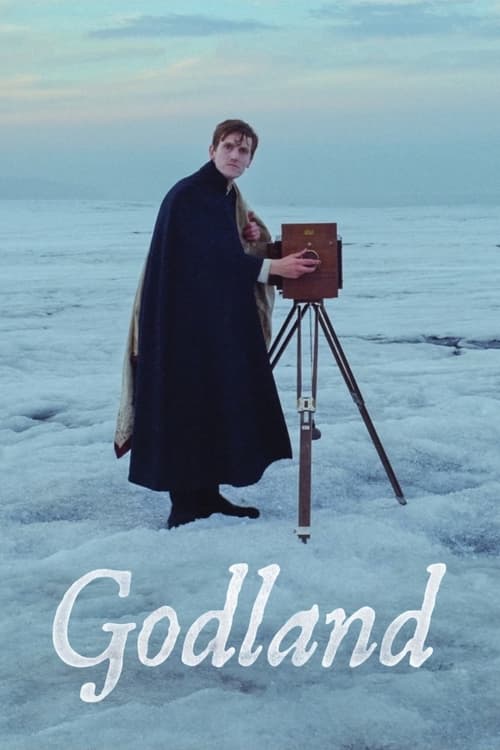
Godland
2022 · Hlynur Pálmason
For when you want to be swallowed by a film — a long, austere epic to surrender an evening to, not background viewing. Choose it when you're craving grandeur and moral weight over comfort.
What it's about
In the late nineteenth century, a young Danish Lutheran priest is sent to a remote corner of Iceland to build a church and photograph the parishioners along the way. The overland trek through rivers, volcanoes, and endless weather is brutal, his Icelandic guide despises him, and the deeper he travels into the landscape, the further he drifts from his mission and his own morality.
The experience
Slow, immense, and quietly menacing — the landscape does as much to you as the story does. It builds a hypnotic rhythm of awe and dread, punctuated by flashes of dark humor and sudden violence, and leaves you unsettled in a way that lingers.
Performances
Elliott Crosset Hove makes the priest's unraveling painfully believable — pious, brittle, and increasingly lost — while Ingvar Sigurdsson's weathered guide gives the film its stubborn, earthy counterweight.
The craft
Shot on 35mm in a boxy, round-cornered frame that echoes antique photographic plates, it turns Iceland's volcanoes, rivers, and fog into something between a character and a judgment. Pálmason's patient long takes and startling time-lapse passages reward the biggest screen you can find; the sound of wind and water is half the experience.
Why it matters
A Cannes Un Certain Regard premiere and Iceland's Oscar submission, it confirmed Hlynur Pálmason as one of the major landscape filmmakers of his generation and became a touchstone of recent Nordic cinema.
Snapshot
Godland — released under two titles, the Danish Vanskabte Land ("misshapen land") and the Icelandic Volaða land ("wretched land") — is Hlynur Pálmason's third feature, a period drama tracing a young Danish Lutheran priest's overland journey across Iceland in the late nineteenth century to erect a church and photograph a people he does not understand. Framed as a fiction reconstructed from a handful of wet-plate photographs, the film is at once a colonial parable, a wilderness ordeal narrative, and a meditation on the camera as an instrument of both witness and possession. Shot on 35mm in a boxed Academy frame with rounded corners that evoke antique photographic plates, it premiered in Un Certain Regard at the 2022 Cannes Film Festival and became Iceland's submission for the Academy Award for Best International Feature. It consolidated Pálmason's standing, alongside a small cohort of Icelandic and Danish filmmakers, as a maker of austere, landscape-driven art cinema in a lineage running back through Tarkovsky, Dreyer, and Herzog.
Industry & production
Godland is a multi-national European co-production, principally Danish and Icelandic, with additional French and Swedish partners — a configuration typical of ambitious Nordic art films that assemble financing across several national funds and public broadcasters. Pálmason, who is Icelandic but trained and long based in Denmark (a graduate of the National Film School of Denmark), works habitually across the two countries, and Godland's bilingual, cross-border authorship is inseparable from its subject: the historical relationship between Denmark and its then-colony Iceland. The production was mounted through the Danish company Snowglobe together with an Icelandic partner, with producers including Katrin Pors, Eva Jakobsen, and Mikkel Jersin among those associated with the film's core team; I would treat the exact roster of co-producers and funders as a matter for the credits rather than paraphrase it in detail here.
The shoot was staged over an unusually extended schedule so that the production could capture genuine seasonal change in the Icelandic landscape — a working method Pálmason has favored, allowing the environment itself to become a collaborator rather than a backdrop dressed to look like different times of year. The runtime is roughly two and a half hours. Precise budget and box-office figures are not something I can state reliably, and I will not invent them; commercially the film performed as an art-house release, reaching audiences chiefly through the festival circuit and specialty distribution rather than wide theatrical play.
Technology
The film's most conspicuous technical decision is its image format. Pálmason and cinematographer Maria von Hausswolff shot on 35mm film in the near-square Academy ratio (1.33:1), and the projected frame is masked with softly rounded corners so that each shot resembles a nineteenth-century wet-collodion plate. This is not decorative pastiche: the priest, Lucas, carries a large-format plate camera as his ostensible reason for being in Iceland, and the film's own imagery is made to rhyme with the photographs he produces, collapsing the distinction between the diegetic apparatus and the movie's own eye. The organizing conceit — announced in an opening card — is that the film reconstructs events from seven wet-plate photographs taken by a Danish priest and discovered later. Pálmason has been candid in interviews that this framing is a fabrication, a poetic license rather than a documented archive; the honest scholarly position is that the "found photographs" are an invented device, and the film should be read as fiction that borrows the authority of the photographic record.
The choice of celluloid over digital, the boxed ratio, and the deliberate mimicry of early photographic chemistry together make Godland a film explicitly about a technology of image-making at the moment that technology was new — the camera as a colonial instrument, slow, heavy, and demanding of its subjects' stillness.
Technique
Cinematography
Maria von Hausswolff's photography is the film's signal achievement. Working within the confining Academy box, she composes for depth and for the smallness of the human figure against Icelandic terrain — coastlines, black-sand expanses, rivers, and volcanic ground. The palette moves from the drenched greens and grays of the crossing to warmer, more settled tones once the church community is reached. Von Hausswolff had shot Pálmason's previous feature, A White, White Day (2019), and the continuity of collaborator is central to the film's controlled, painterly severity. Among the film's celebrated set-pieces are a slow circular pan that surveys the mission settlement and, most famously, a time-lapse of a dead horse decomposing over seasons — a single sustained image that condenses the movie's preoccupation with decay, time, and the indifference of nature.
Editing
Cut by Julius Krebs Damsbo — again a returning collaborator from A White, White Day — the film adopts a patient, durational rhythm, holding shots long past the point where a conventional drama would move on. The editing lets landscape and weather assert their own tempo; ellipses are stark, and the passage of the seasons (enabled by the extended shoot) does much of the narrative work. The rhythm belongs squarely to the tradition of contemplative "slow cinema," where withheld cutting becomes a moral as well as an aesthetic stance.
Mise-en-scène / staging
Pálmason stages the film around a fundamental opposition: the vertical, ordering ambition of the church and the horizontal, resistant sprawl of the land. Human figures are repeatedly dwarfed; interiors are candlelit and cramped against the enormity outside. The construction of the church itself — a wooden structure raised in an unyielding place — functions as the central material metaphor, an imported form imposed on ground that does not want it. Costume and props (the plate camera, ecclesiastical dress, the paraphernalia of the expedition) mark the collision of Danish institutional culture with Icelandic subsistence life.
Sound
Sound is built from the elemental registers of wind, water, and rock, giving the wilderness a near-physical presence. The score is credited to Alex Zhang Hungtai (the musician formerly known as Dirty Beaches), who had also provided music for A White, White Day; his contribution favors dissonance and drone over conventional scoring, deepening the film's unease. Crucially, Godland is a bilingual film in which Danish and Icelandic are mutually unintelligible to their speakers, and the drama of untranslated speech — the priest and his guide unable to understand one another, dependent on a faltering interpreter — is enacted through the soundtrack itself.
Performance
Elliott Crosset Hove plays Lucas, the priest, in a performance of tightening, brittle repression that curdles into contempt and violence as his mission decays; Crosset Hove had led Pálmason's debut feature Winter Brothers (2017), and the collaboration is a long-running one. Opposite him, Ingvar Sigurðsson plays Ragnar, the older Icelandic guide — a weathered, unsentimental presence who becomes the priest's antagonist and, in the film's cruel logic, his moral superior. Sigurðsson, one of Iceland's most distinguished screen actors, had also anchored A White, White Day. The supporting cast includes Vic Carmen Sonne; Pálmason has a practice of casting his own children in his films, and family performers appear here as well, though I would defer to the credits for the exact roles rather than overstate what I can confirm.
Narrative & dramatic mode
The film is structured as a journey followed by an arrival that resolves nothing. The first movement is an ordeal narrative — the arduous overland crossing, complete with a punishing river fording and mounting friction between Lucas and Ragnar — in which the landscape steadily strips the priest of composure and purpose. The second movement, at the settlement, becomes a chamber drama of desire, jealousy, and spiritual failure, as Lucas is drawn into the life of the local Danish settler family. The dramatic mode is tragic and ironic rather than redemptive: the priest who came to photograph and convert instead loses his faith, his mission, and finally his moral footing. Pálmason withholds the consolations of arc and epiphany, letting the story end in a register closer to decomposition than resolution — a structure the horse time-lapse quietly literalizes.
Genre & cycle
Godland sits at the intersection of several traditions: the period colonial drama, the wilderness-survival or expedition film, and the contemplative "slow cinema" of festival art house. Its narrative of a European emissary undone by a landscape and a people he means to master places it in a recognizable modern cycle of revisionist colonial films that turn the conquest narrative inside out, exposing the fragility and cruelty of the civilizing project. Within Nordic cinema specifically, it belongs to a cycle of landscape-forward films in which environment is not setting but antagonist and subject.
Authorship & method
Hlynur Pálmason is the film's writer-director, and Godland extends the concerns of Winter Brothers and A White, White Day: fractured masculinity, grief, obsession, and the human figure measured against a hostile natural world. His method is notably collaborative and continuous — the same cinematographer (Maria von Hausswolff), editor (Julius Krebs Damsbo), composer (Alex Zhang Hungtai), and lead actors recur across his work, giving his filmography the coherence of a repertory. He also works slowly and seasonally, shaping films around the landscape's own transformations and, characteristically, involving his family. The bilingual conception of Godland — two titles, two mutually opaque languages, a Danish-Icelandic split at the level of production as well as story — is itself an authorial signature, encoding Pálmason's own dual national position into the film's form.
Movement / national cinema
The film is a landmark of contemporary Icelandic cinema, which since the 2010s has drawn international attention through directors such as Benedikt Erlingsson (Of Horses and Men, Woman at War), Grímur Hákonarson (Rams), and Rúnar Rúnarsson — a small national cinema disproportionately visible on the festival circuit and marked by dry humor, stark landscape, and existential gravity. Yet Godland is equally a Danish film, made within the strong institutional culture of Danish art cinema, and its subject is precisely the Denmark–Iceland colonial relation. It is best understood as a work of the Nordic art-house tradition straddling both national cinemas rather than belonging cleanly to one.
Era / period
The film is set in the late nineteenth century, when Iceland remained under the Danish crown — a sparsely populated, hard-to-traverse territory administered from Copenhagen. The historical texture of Danish ecclesiastical and colonial authority reaching into remote Icelandic settlement is the ground on which the drama is built. The period is rendered with material specificity — the plate camera, the church-building, the modes of travel — but Pálmason is less interested in historical reconstruction for its own sake than in using the era to stage a timeless collision between institutional faith and untamable place.
Themes
The film's governing themes are colonialism and the violence of translation; faith confronted and defeated by nature; photography as an act of possession, witness, and vanitas; hubris and its punishment; and decay as the natural order to which all human ambition returns. The camera Lucas carries makes the theme of representation explicit — to photograph the Icelanders is to fix and to claim them — while the recurring imagery of rot, weather, and geological time insists that the land will outlast every church, creed, and image imposed upon it. Language runs through all of this: the untranslatable gap between Danish and Icelandic is the film's central metaphor for the impossibility, and the arrogance, of one culture's claim to know another.
Reception, canon & influence
Godland premiered in Un Certain Regard at Cannes in 2022 to strong critical reception and traveled widely on the international festival circuit; it was selected as Iceland's entry for the Academy Award for Best International Feature. Critics consistently praised von Hausswolff's photography and the film's austere formal control, and it featured on a range of year-end critical lists. I will not attribute specific festival prizes or quotations I cannot verify, but the broad picture — a warmly received, prestige art-house success that elevated Pálmason's international profile — is well established.
Its influences run backward to a canon of contemplative and wilderness cinema: Andrei Tarkovsky's durational spirituality, Carl Theodor Dreyer's Nordic austerity and crises of faith, Werner Herzog's studies of European men destroyed by alien landscapes (Aguirre, Fitzcarraldo), and the sensibilities of Béla Tarr and Bruno Dumont. Its self-conscious use of the photographic frame and the "found photograph" conceit connects it to a longer meditation on cinema's descent from still photography.
Forward influence is, at this remove, still taking shape — the film is recent, and a legacy is better observed than predicted. What can be said is that Godland strengthened the international visibility of Icelandic landscape cinema and confirmed Pálmason as a leading figure in a mode of slow, ecologically attuned, historically reflective European filmmaking. Its most likely lasting contribution is as a reference point for films that treat the camera itself as a colonial instrument and the landscape as the true protagonist — a work whose reputation, on current evidence, is ascending rather than settled.
Reception
No flop-to-classic drama here — it premiered in Un Certain Regard at Cannes 2022 to strong reviews and just kept climbing: Iceland's Oscar submission, an Academy shortlist spot, then a Criterion release, all within about a year. It's gone from festival darling to presumptive 2020s-canon entry unusually fast.
How Godland was received, from release to now →
Influences: the films it descends from and the films it influenced
- Ordet (1955) — Supplies the Nordic austerity Godland inherits — frontal, planar staging of a pastor's crisis of faith with the miracle and the doubt held in long, near-static takes.
- Winter Light (1963) — Models the doubting Lutheran clergyman whose vocation curdles in a bleak, indifferent parish, giving Godland its portrait of a priest emptied out by cold and God's silence.
- Andrei Rublev (1966) — Durational spirituality in which unhurried takes let weather and terrain carry metaphysical weight while the believer-artist is physically dwarfed within the frame.
- Aguirre, the Wrath of God (1972) — The European destroyed by an alien wilderness, shot on genuinely hostile terrain so the landscape's resistance registers bodily on cast and camera rather than as set dressing.
- The Emigrants / The New Land (1971) — Scandinavian settler realism shot on Troell's own handheld natural-light camera, treating migration and land-breaking as durational physical hardship.
- Fitzcarraldo (1982) — Centers the film on the obsessive hauling of a heavy European artifact across impassable ground — the template for Godland's priest dragging a disassembled church over Iceland.
- Days of Heaven (1978) — Magic-hour, natural-light cinematography that scales tiny human figures against vast fields and sky — the landscape-figure ratio von Hausswolff extends.
- The Assassination of Jesse James by the Coward Robert Ford (2007) — Period cinematography with vignetted, edge-distorted 'antique lens' framing that mimics 19th-century plate photography — a device Godland literalizes through its wet-plate conceit.
- Silent Light (2007) — Austere durational faith drama built from locked-off wide frames and time-lapse of the natural world, letting cosmic time overshadow human incident.
- The Turin Horse (2011) — Elemental soundscape of relentless wind under a dissonant repeated drone, plus the decaying/dying animal as durational memento mori — echoed in Godland's horse-carcass time-lapse.
- Silence (2016) — A priest sent into a hostile territory as observer-recorder, shot in a boxy near-Academy frame with weather and terrain as antagonist and long scoreless passages in which faith is eroded by physical exhaustion.
- The Love That Remains (2025) — Supplies the direct formal toolkit: boxy Academy ratio with rounded photochemical corners, protracted seasonal shooting that lets landscape decay and rot on camera, and editor Julius Krebs Damsbo, who carries that cutting rhythm forward into this film.
- Meek's Cutoff (2010) — Boxy Academy 1.37 ratio for a journey-western, using the constricted frame to trap settlers inside an overwhelming, illegible landscape.
- Ida (2013) — Academy-ratio framing that pins figures to the bottom or edge of the image beneath a heavy void of sky, staging religious vocation as compositional smallness.
- The Witch (2015) — Settlers marooned in a hostile New World wilderness, shot in near-Academy ratio with natural and candlelit sources and period-faithful diction — the same Dreyer-descended austerity.
- First Cow (2019) — Academy-ratio frontier drama pacing fragile settler enterprise against an implacable wilderness in slow-cinema rhythm, a parallel revisionist-colonial mode.
- A White, White Day (2019) — Pálmason's own repertory method — Ingvar Sigurðsson, von Hausswolff's lens, and a seasonal time-lapse of a lone structure weathering the elements — that Godland directly extends.
- Sound of Falling (2025) — 4:3 boxy aspect ratio and available-light landscape photography, time elapsing in the land and weather across a fixed rural site.
- The Promised Land (2023) — The closest contemporary Northern-Western sibling: painterly low-horizon landscapes on the Nordic heath, elemental wind, and sparse authored austerity relocating frontier mythology to the Old World moor.
Similar films
- Ordet (1955) — influence & lineage
- Aguirre, the Wrath of God (1972) — influence & lineage
- Ida (2013) — influence & lineage
- Andrei Rublev (1966) — influence & lineage · same viewing thread
- The Turin Horse (2011) — influence & lineage · same viewing thread
- The Sacrifice (1986) — same viewing thread
- Shadows of Forgotten Ancestors (1965) — same viewing thread
- The Emigrants (1971) — same viewing thread
All the films related to Godland →
Watch it with: curated runs of related films
- Quiet Lives at the World's Edge — Watch these when you want a life pared down to essentials — someone walking out of society to start from zero, or simply living out their days at the margins.
- Transcendental Style — A run for when you want cinema as prayer — faith, ritual, and the turning of seasons rendered in long takes and painterly stillness, where time itself becomes the subject rather than the story.