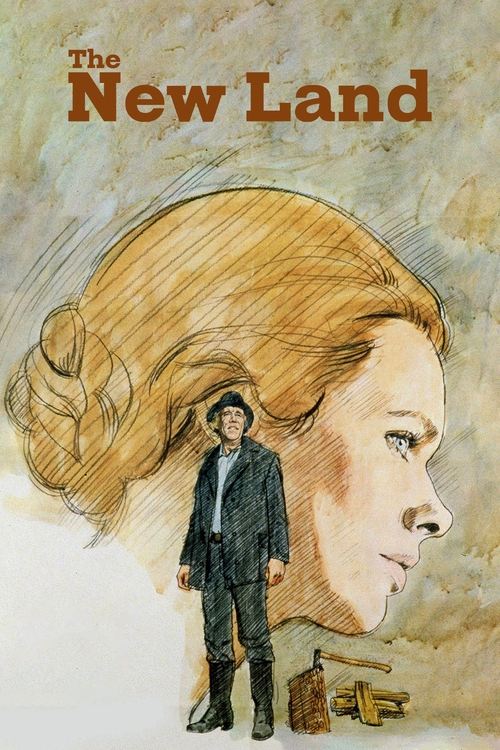
The New Land
1972 · Jan Troell
When you want a big, serious epic to sink into — a long, earthy saga about ordinary people rather than heroes. Best for a night when you have time and patience to give it; it pays that patience back with interest.
What it's about
A Swedish farming couple, having survived the crossing to America, now have to make the land pay. Karl Oskar and Kristina break ground in the Minnesota wilderness in the mid-1800s, raising children and crops through brutal winters, homesickness, and sheer physical grind, while the country around them convulses — gold fever pulling men west to California, war with the Dakota erupting near their door. It's the second half of a two-film epic about emigration, and it asks what the promised land actually costs.
The experience
Slow, physical, and quietly devastating — you feel the weight of every axe swing and every winter. It builds in seasons rather than scenes, and by the end the accumulation of labor, loss, and endurance lands with real force.
Performances
Max von Sydow and Liv Ullmann are extraordinary together — he all stubborn forward drive, she carrying an ache for the home they left that never quite heals. Ullmann's Kristina in particular is one of the great portraits of an immigrant's divided heart.
The craft
Jan Troell shot, edited, and directed, and it shows in the film's handmade intimacy: natural light, weathered faces, frontier life rendered with documentary texture rather than Hollywood gloss. Shot back-to-back with The Emigrants as one sustained production, it has an epic's scale built entirely from small physical truths.
Why it matters
With The Emigrants it forms one of cinema's defining accounts of the immigrant experience — a touchstone for how to film history from the ground up, through labor and family rather than battles and speeches.
Snapshot
The New Land (Nybyggarna) is the second panel of Jan Troell's monumental two-film adaptation of Vilhelm Moberg's novel cycle about Swedish peasants who emigrate to Minnesota in the mid-nineteenth century. Where its predecessor, The Emigrants (Utvandrarna, 1971), traced the departure from a stony Småland parish and the ocean crossing, The New Land follows Karl Oskar Nilsson (Max von Sydow) and Kristina (Liv Ullmann) as they break ground on the American frontier, endure the labor and isolation of homesteading, and are touched by the larger convulsions of their adopted country: the lure of California gold, the U.S.–Dakota War of 1862, and the slow attrition of illness and age. The two films were shot together as a single sustained production and are best understood as one work in two movements — a roughly six-and-a-half-hour settler epic told from the emigrant's, rather than the American mythmaker's, point of view. Troell served not only as director but as his own cinematographer and editor, and the film's authority derives from that near-artisanal control: a tactile, weather-bitten realism applied to material of near-Biblical scope. It stands, with Bergman's work of the same period, as one of the defining achievements of postwar Swedish cinema.
Industry & production
The project originated with producer Bengt Forslund, who co-wrote the screenplay with Troell and shepherded an unusually ambitious undertaking for the Swedish industry. Moberg's four novels — The Emigrants, Unto a Good Land, The Settlers, and The Last Letter Home — were beloved national literature, and adapting the full arc required a scale of financing, location work, and shooting time far beyond the norm for Swedish production of the era. The two films were made in tandem over a lengthy shoot spanning roughly 1969 to 1971, with photography in Sweden and on American locations, including Minnesota, where the historical emigration had in fact concentrated. Casting drew on the reservoir of talent associated with Ingmar Bergman — von Sydow and Ullmann were both Bergman regulars — which lent the films international visibility. Svensk Filmindustri was the anchoring production concern. The films' commercial and critical success abroad, particularly The Emigrants' remarkable run at the American Academy Awards, established the diptych as a landmark export and directly opened Hollywood's door to Troell, who would decamp to make English-language pictures in the mid-1970s. Precise budget and box-office figures for The New Land are not something I can state reliably, and I will not invent them; what is clear is that the production's economics were defined by its two-film structure and its long, location-intensive schedule.
Technology
The New Land is a product of the late-1960s revolution in portable, available-light filmmaking, adapted to the demands of a period epic. Troell, who came to features from documentary and had worked as a schoolteacher and stills photographer, favored lightweight, mobile camera operation and a heavy reliance on natural and practical light — firelight, window light, the flat gray of a Minnesota winter. He made extensive use of long lenses to compress space and to observe faces from a discreet distance, a technique that allowed performers to inhabit scenes without the intrusive apparatus of conventional coverage. The result reads as intimate reportage rather than staged spectacle. This approach was enabled by the faster film stocks and more manageable equipment then coming into wide use, which made it feasible to shoot in genuine interiors and difficult exteriors rather than on controlled sets. The film's period surfaces — timber cabins, hand tools, homespun cloth — are rendered with a documentary attentiveness that owes as much to Troell's photographic eye as to any production-design budget.
Technique
Cinematography
Troell photographed the film himself, and the camerawork is its signature. He works in a register of watchful naturalism: handheld or lightly supported framings that drift and settle rather than lock down, telephoto compositions that isolate a face against a softened field, and a persistent sensitivity to weather and season as dramatic forces. Landscape is never merely backdrop; the flat immensity of the prairie, the burden of snow, the green explosion of a short northern summer, all carry thematic weight. Light is treated as found rather than imposed, and interiors are frequently underlit to the edge of legibility, honoring the darkness of a cabin lit by a single flame. The cumulative effect is a frontier stripped of picturesque grandeur — beautiful, but with a beauty that is indifferent to the humans laboring within it.
Editing
Troell also edited, and the film's rhythm is elliptical and patient. Time is handled in long, accreting passages punctuated by sudden compressions — years of homesteading may pass in a montage of seasonal labor, while a single death is dilated to fill the frame. The cutting favors association and duration over the propulsive continuity of classical narrative; scenes are allowed to breathe past their plot function so that the texture of a life, rather than its incidents, becomes the subject. This editorial patience is inseparable from the film's runtime and its refusal of conventional forward drive.
Mise-en-scène / staging
Staging is grounded in physical labor and the material culture of settlement. Characters are almost always doing something — clearing land, raising walls, birthing children, burying the dead — and the drama emerges from tasks rather than declarations. Troell composes for the dignity and monotony of work, and stages his large historical set-pieces (the Dakota War, Robert's westward journey) with the same unglamorous specificity he brings to a domestic interior, so that history arrives as lived experience rather than pageant.
Sound
The soundtrack is dominated by the ambient world — wind, water, axe-strokes, animals, the polyglot murmur of a frontier where Swedish, English, and other tongues collide. Dialogue is spare and functional. Music is used sparingly rather than as a continuous emotional guide, reserved for moments of transition or elegy; I am not confident enough of the precise scoring credits to attribute them here, and I will not guess. The film's aural signature is restraint: silence and natural sound are allowed to carry scenes that a more conventional epic would underscore.
Performance
The performances are built on interiority and endurance. Von Sydow's Karl Oskar is a study in stubborn, inarticulate strength — a man who answers hardship with more labor and whose grief registers as stillness. Ullmann's Kristina is the film's spiritual center: homesick, devout, tethered by faith to the country she left, and increasingly worn by successive childbirths. Their marriage is conveyed through accumulated small gestures rather than speeches. Eddie Axberg's Robert, Karl Oskar's dreamer brother, supplies the film's tragic counter-melody, his California gold quest ending in disillusion and death. The acting throughout is keyed to Troell's observational camera — under-projected, caught rather than delivered.
Narrative & dramatic mode
The film's mode is the epic of duration: a chronicle that measures its characters against decades rather than acts. Its dramatic engine is not a single conflict but the slow test of survival, faith, and belonging across a lifetime. The structure is episodic and biographical, braiding the central homestead story with excursions into the wider American nineteenth century — the gold rush, the Dakota uprising — that intrude upon the family without ever becoming the family's story. It is a tragedy in the long form, moving inexorably toward loss: Kristina's death, symbolically bound to the astrakhan apple tree grown from seeds carried out of Sweden, and Karl Oskar's aging into solitary endurance. The register is elegiac and unsentimental, refusing both triumphalism and melodrama.
Genre & cycle
Nominally the film is a Western — it concerns the settlement of the American frontier — and it belongs, historically, to the Drama–Western–History cluster. But it is a Western turned inside out. Where the classical American Western mythologizes conquest from the settler-hero's or the gunfighter's vantage, Troell's film observes the frontier from the position of the immigrant laborer for whom America is neither destiny nor adventure but a hard bargain. Its treatment of the Dakota War pointedly declines to render the conflict as savagery-versus-civilization. In this it aligns with the broader revisionist and anti-mythic currents running through frontier cinema in the late 1960s and early 1970s, though it arrives at that skepticism from a distinctly European, and specifically Scandinavian-emigrant, angle rather than an American one. It is less a genre Western than a settler chronicle wearing the frontier's furniture.
Authorship & method
This is auteur cinema in a nearly literal sense. Troell directed, photographed, and edited the film, and co-wrote it with Bengt Forslund — a concentration of craft roles that gives the diptych its uncommon unity of vision. His method fused a documentarian's patience and eye for the concrete with a novelist's command of long-form character. Forslund, as co-writer and producer, was the project's indispensable organizational and adaptive intelligence, negotiating Moberg's dense tetralogy into filmable shape. The two lead performances by von Sydow and Ullmann function as a second axis of authorship, their long association with Bergman feeding a shared Swedish tradition of psychological restraint. Moberg himself, whose novels were grounded in extensive historical and archival research into the real emigration, is the film's originating author in the deepest sense; the fidelity and gravity of Troell's adaptation are in large part a fidelity to Moberg's project of recovering an ordinary people's history. I have deliberately left the composer and certain technical collaborators unnamed rather than risk misattribution.
Movement / national cinema
The film is a pillar of Swedish national cinema at its early-1970s height. It emerged from the same milieu as Bergman's mature work and shared its personnel, but Troell's sensibility diverges sharply from Bergman's chamber-drama interiority: where Bergman turned inward toward metaphysical crisis, Troell turned outward toward landscape, labor, and collective history. The film also participates in a distinctly Swedish reckoning with the mass emigration of the nineteenth century — a national trauma and memory that Moberg's novels had already canonized in literature and that Troell translated into the country's most enduring cinematic monument on the subject. It belongs, too, to a European art-cinema tradition that prized location realism, long duration, and authorial control over the machinery of genre.
Era / period
Made at the turn of the 1970s, the film reflects its moment in both craft and outlook. Technically it embodies the era's embrace of portable, available-light shooting and the collapse of the boundary between documentary and fiction technique. Ideologically, its demythologizing of the American frontier and its sympathy for the dispossessed — settlers and, implicitly, the Dakota alike — chime with the revisionist temper of early-1970s cinema on both sides of the Atlantic. It is also a late flowering of the postwar European art film's confidence that a serious, difficult, hours-long work could command an international audience.
Themes
At its core the film is about the price of the new land. Emigration is figured not as liberation but as a wound that never fully heals: Kristina's incurable homesickness, her clinging to Swedish faith and Swedish apple seeds, dramatizes the immigrant's permanent divided self. Faith and doubt run throughout — Kristina's religion as consolation and as burden — as do labor and the body, the sense that the land must be paid for in flesh and years. The film meditates on assimilation and its limits, on the gulf between the American dream (embodied and destroyed in Robert's gold quest) and the American reality of grinding work. It is finally a film about mortality and endurance: the family measured against the indifferent scale of nature and history, and the quiet heroism of simply lasting.
Reception, canon & influence
The diptych was received internationally as a major achievement, and its American reception was extraordinary for a subtitled film: The Emigrants drew multiple Academy Award nominations across the 1971 and 1972 ceremonies, including recognition in the top categories — a rare distinction for a foreign-language work. The New Land was Sweden's official submission and earned a nomination for Best Foreign Language Film at the 45th Academy Awards (for 1972), an honor it did not win. This visibility carried Troell to Hollywood, where he directed Zandy's Bride (1974) with Hackman and Ullmann and the ill-fated Hurricane (1979) before returning to Sweden and, decades later, to further acclaim with films such as Everlasting Moments.
Looking backward, the film's influences are legible: Moberg's meticulously researched novels as source and conscience; the Swedish realist and documentary traditions in which Troell was formed; and the psychological acting culture of Bergman's ensemble. Looking forward, its legacy is twofold. Within Sweden it became the canonical screen treatment of the emigration and a touchstone of national self-understanding. Internationally it stands as a model of the demythologized frontier film and of total authorial craftsmanship — director-as-cinematographer-as-editor — that later filmmakers drawn to durational, location-grounded historical realism have echoed. Its precise measure of influence on individual later works is hard to document with certainty and I will not overstate it; what is secure is its standing as a canonical Swedish film and one of the enduring cinematic accounts of the immigrant experience.
Reception
Nominated for the Best Foreign Language Film Oscar on release, it then spent decades nearly impossible to see in decent shape outside Sweden — until Criterion's 2016 restoration (paired with The Emigrants) turned it into a genuine rediscovery for a new generation of cinephiles.
How The New Land was received, from release to now →
Influences: the films it descends from and the films it influenced
- Nanook of the North (1922) — Founds the documentary-fiction fusion Troell inherits — restaging real subsistence labor and material culture (shelter-building, hunting) for the camera so that ethnography acquires dramatic shape without a fiction plot.
- Earth (1930) — Treats agrarian labor and the worked land itself as the durational subject, holding on soil, harvest and bodily toil as narrative — the labor-material-culture staging Troell applies to Minnesota homesteading.
- La Terra Trema (1948) — Builds an epic-of-duration from working lives using nonprofessionals and real locations, letting the rhythms of a fishing economy set the film's tempo — neorealism's labor-first structure that underwrites Troell's method.
- The Great Adventure (1953) — The Swedish location-shot, available-light observational tradition that formed Troell — patient telephoto watching of nature and seasonal labor, blurring documentary and fiction in the national school he emerged from.
- Winter Light (1963) — Sven Nykvist's available-light naturalism and the psychological-restraint acting of the von Sydow / Ullmann ensemble that Troell borrowed wholesale for his leads' interiorized, near-wordless performances.
- Days of Heaven (1978) — Magic-hour available light and telephoto compression of migrant field laborers, with an elliptical, duration-driven edit that lets seasons and work — not plot mechanics — carry the film, extending Troell's photographic naturalism.
- The Tree of Wooden Clogs (1978) — Olmi shot and edited it himself — the same one-hand total craft — filming peasant material culture with nonprofessionals in natural light at the unhurried tempo of the agricultural year.
- Heaven's Gate (1980) — An epic-length, demythologized frontier centered on immigrant labor and dispossession, using durational crowd tableaux and Zsigmond's diffused period light to insist on history's weight over western myth.
- The New World (2005) — Available-light, handheld naturalism observing first-contact labor and material encounter ethnographically, cutting elliptically across seasons — the documentary-fiction fusion pushed further into pure observation.
- The Assassination of Jesse James by the Coward Robert Ford (2007) — Roger Deakins's available-light interiors and telephoto/edge-distorted frontier compositions serve a revisionist western of psychological restraint and durational stillness rather than gunplay.
- Everlasting Moments (2008) — Troell's own late return to the method — total authorial craft, available-light period interiors, and working-class material culture rendered with the same undemonstrative restraint decades on.
- Meek's Cutoff (2010) — A revisionist western of endurance built from the labor of the trail — water, oxen, distance — in elliptical real-time duration and flat naturalist light, demythologizing the westward crossing exactly as Troell did.
- The Revenant (2015) — Shot in available light only with handheld naturalism, staging frontier survival, weather and bodily endurance as the film's spine — the extreme end of Troell's location-grounded mortality-and-endurance realism.
- The Promised Land (2023) — The Scandinavian homestead-frontier prototype: settlers breaking untilled ground into geometric order, filmed with documentary attention to the physical toil of wresting a farm from hostile land.
- The Emigrants (1971) — The diptych's first half and literal continuous body of work — identical director-photographer-editor total craft, telephoto compression of figures in landscape, and elliptical duration cutting across years.
- Jeremiah Johnson (1972) — Contemporary demythologized frontier built on location-grounded survival naturalism — weather, provisioning and endurance staged as fact rather than heroism, the same revisionist-western austerity.
- Barry Lyndon (1975) — Natural- and available-light period photography plus long-lens/zoom compression that flattens figures into painterly landscape, sustaining an epic-of-duration measured in a life's slow attrition.
Similar films
- The Emigrants (1971) — influence & lineage · same viewing thread · often watched together
- The New World (2005) — influence & lineage · often watched together
- Earth (1930) — influence & lineage
- The Tree of Wooden Clogs (1978) — influence & lineage · often watched together
- Godland (2022) — same viewing thread
- Paris, Texas (1984) — same viewing thread
- The Grapes of Wrath (1940) — often watched together
- A Hidden Life (2019) — often watched together
All the films related to The New Land →
Watch it with: curated runs of related films
- Quiet Lives at the World's Edge — Watch these when you want a life pared down to essentials — someone walking out of society to start from zero, or simply living out their days at the margins.