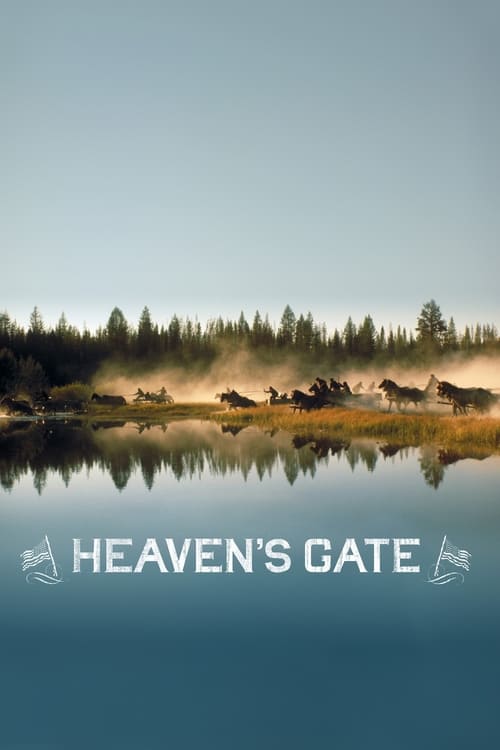
Heaven's Gate
1980 · Michael Cimino
For when you want to disappear into a huge, unhurried epic for an entire evening — a challenge, not a comfort, and best when you're patient enough to let it wash over you.
What it's about
Wyoming, 1890s: a Harvard-educated marshal keeps the peace in a county where wealthy cattle barons have drawn up a death list of the poor European immigrants homesteading on their range. Caught in the middle are the marshal, a hired gun working for the cattlemen, and the local madam both men love. As the ranchers' private army mobilizes, a class war erupts on the open frontier.
The experience
Vast, slow, and immersive — it moves at the pace of a long novel, lingering on dances, crowds, and landscapes until the violence, when it comes, feels enormous. It leaves you somewhere between awe and heartbreak, with the sense of having lived through a lost world.
Performances
Kris Kristofferson anchors the film with a weathered, melancholy stillness, and Christopher Walken gives the hired gun a strange, wounded dignity; Isabelle Huppert brings warmth and grit to the woman between them.
The craft
The period detail is staggering — whole towns built, hundreds of extras, roller-skating dances staged like living paintings — and Vilmos Zsigmond's hazy, dust-and-light cinematography makes the frontier look like a fading memory. It demands the biggest screen you can find; the images are the argument.
Why it matters
Its catastrophic release became Hollywood legend — the flop blamed for sinking a studio and ending the era of director-driven American filmmaking — yet decades of reappraisal have recast it as one of the most ambitious American epics ever attempted.
Snapshot
Heaven's Gate is the most notorious folly in American film history—and, in slow critical rehabilitation, one of its most ambitious. Michael Cimino's epic of the 1892 Johnson County War in Wyoming follows Harvard graduate and frontier marshal James Averill (Kris Kristofferson) as he is caught between a cartel of wealthy cattlemen and the impoverished European immigrants they have condemned to death on a posted list. Made immediately after the Oscar-laden The Deer Hunter (1978), the film became a byword for auteurist excess: a production whose ballooning cost and chaotic shoot are widely credited with bankrupting United Artists in its existing form and helping to end the New Hollywood era of director-driven filmmaking. Its 219-minute première was savaged, the film was withdrawn and recut, and both versions failed commercially. Yet the restored long version—championed especially in Europe and reconstructed for a 2012 Venice screening and Criterion release—reveals a sumptuous, elegiac, formally daring Western whose reputation has steadily risen.
Industry & production
The production is inseparable from the film's meaning in history. Cimino came to the project (originally titled The Johnson County War) with enormous leverage after The Deer Hunter, and United Artists—then run by executives who had themselves broken from the studio system—backed him as a prestige auteur. What followed is among the best-documented production disasters in cinema, principally through Final Cut, the memoir by UA production chief Steven Bach, whose insider account is the standard source for the saga and should be read as one participant's perspective rather than neutral record.
The shoot, centered in Kalispell and Glacier National Park, Montana, became infamous for Cimino's perfectionism: elaborate period sets built, demolished, and rebuilt to satisfy his eye; enormous numbers of takes; reported daily footage far exceeding norms; and a schedule that ran well over plan. Widely cited figures hold that a budget initially around $11–12 million swelled to roughly $44 million—numbers repeated across decades of reporting and traceable largely to Bach and contemporaneous trade coverage; treat the precise totals as well-established estimates rather than audited fact. The overrun, combined with the catastrophic reception, is conventionally linked to Transamerica's decision to sell United Artists to MGM, effectively ending UA's independent existence. The film is thus routinely positioned as the symbolic close of the 1970s "auteur renaissance," after which studios reasserted budgetary control over directors—a tidy historical narrative that the film's later reappraisal complicates but has never dislodged.
Technology
Technologically, Heaven's Gate is a work of analog craft at the furthest reach of pre-digital spectacle. It was shot on 35mm color negative and presented in a widescreen anamorphic format suited to its panoramic landscapes and massed crowds. Its "technology" is essentially the technology of scale: hundreds of extras, livestock, period vehicles, and full standing sets, all captured photochemically with no digital augmentation. The signature achievement is photographic rather than mechanical—an atmosphere of dust, smoke, and filtered light created in-camera and on set rather than in post. The film stands as a late monument to the practical, location-based super-production, the kind of enterprise that the industry would increasingly regard as financially reckless and, later, partly replaceable by visual effects.
Technique
Cinematography
Vilmos Zsigmond's cinematography is the film's most consistently praised element and a defining example of the diffused, "golden" naturalism he had helped pioneer in the 1970s. The images are saturated with atmosphere: backlit dust and smoke, lens flares, low sun, and a pervasive amber haze that lends the frontier a painterly, almost Old Master softness. Zsigmond extensively used filtration, smoke, and exposure techniques (including the deliberate fogging/"flashing" of negative associated with his work) to mute contrast and produce luminous, desaturated highlights. The compositions favor deep, populous tableaux—dancers wheeling across a hall, wagons and riders churning across valleys—shot with a roving, immersive camera. The result is a Western that looks less like the hard-edged classicism of John Ford than like a moving 19th-century genre painting, and the cinematography is frequently cited as the strongest argument for the film's rehabilitation.
Editing
Editing is where Heaven's Gate most divided its audiences. The long version unfolds at a deliberately unhurried, accretive pace, devoting extended screen time to atmosphere and ritual rather than plot mechanics. Several editors worked on the picture across its versions, including Tom Rolf and others credited on the release cuts; the film's history is itself a history of editing, since Cimino withdrew the 219-minute première version and reduced it to roughly 149 minutes for re-release. The shorter cut, intended to rescue the film commercially, is widely judged to have damaged it further by stripping out the very texture that gave the long version its cumulative power. The restored long cut is now generally regarded as the definitive form. The editorial signature is duration as meaning: set pieces are allowed to expand past conventional dramatic economy until immersion itself becomes the point.
Mise-en-scène / staging
The staging is maximalist and densely choreographed. Two sequences anchor the film's reputation as spectacle: a prologue depicting a Harvard graduation ball, with waltzing students circling beneath the trees (filmed in England, at Oxford, standing in for 1870 Harvard), and the great communal scene at the "Heaven's Gate" roller-skating rink, where the immigrant settlement dances and skates in swirling motion. Both are built on real crowds in real spaces, with period costume, props, and music integrated into continuous movement. The climactic battle—immigrants forming a circling, improvised wagon-fortress against the cattlemen's mercenaries in churning dust—extends the same principle to violence. Cimino's mise-en-scène consistently subordinates individual figures to teeming, kinetic communities, so that landscape and crowd become the true subjects.
Sound
The soundscape is rooted in period and folk textures rather than orchestral grandeur. David Mansfield composed the score and appears on screen as a fiddler—memorably playing while roller-skating—binding the music to the diegetic world of the immigrant community. Waltzes, fiddle tunes, and folk-derived material recur, giving the film an intimate, vernacular musical identity at odds with the sweep of its images. Ambient sound—crowds, hooves, wind, gunfire amid dust—reinforces the immersive, populous staging.
Performance
The ensemble is large and uneven by design. Kris Kristofferson plays Averill with a worn, passive melancholy suited to a protagonist increasingly paralyzed by the futility around him. Christopher Walken brings coiled ambiguity to Nathan Champion, the hired enforcer divided against his own employers. Isabelle Huppert, cast as the madam Ella Watson over studio objections—Cimino insisted on her despite her French accent in an American frontier role, a casting choice much debated at the time—gives a vivid, willful performance. John Hurt, Sam Waterston (as the cattlemen's icy front man Frank Canton), Jeff Bridges, Joseph Cotten, Brad Dourif, and a deep supporting cast fill out the world. The performances often serve atmosphere over psychological drive, which contemporaneous critics read as emotional vagueness and later admirers read as elegiac restraint.
Narrative & dramatic mode
The film's dramatic mode is elegiac and observational rather than tightly plotted. It frames a historical atrocity—the cattle barons' death list and the war on immigrant settlers—through a love triangle (Averill, Champion, Ella) that is more atmosphere than engine. Cimino repeatedly chooses mood, ritual, and communal spectacle over momentum, and the central figures tend toward fatalism and inaction. This produces a deliberate diffuseness that hostile critics called incoherent and admirers call a tragic register: the sense of individuals overwhelmed by economic and class forces they cannot redirect. The bracketing structure—a Harvard prologue of privilege and youthful promise, and a late coda of disillusion—turns the whole into a meditation on the betrayal of American ideals across a lifetime.
Genre & cycle
Heaven's Gate belongs to the revisionist Western, the cycle that from the late 1960s onward inverted the genre's myths—reframing settlement as dispossession, lawmen as compromised, and "progress" as organized violence by the propertied. It extends the disillusioned line of McCabe & Mrs. Miller (on which Zsigmond had also shot the wintry, immersive imagery), The Wild Bunch, Little Big Man, and Days of Heaven, sharing their painterly naturalism and anti-mythic politics. But it arrives at the tail of that cycle and pushes its tendencies—duration, atmosphere, ambivalence, scale—to an extreme that the market would not bear. In retrospect it reads as both a culmination of the 1970s revisionist Western and, by virtue of its failure, an unintended epitaph for the prestige Western as a studio proposition.
Authorship & method
This is an auteur film in the most literal and self-destructive sense. Cimino wrote and directed with near-total control, pursuing a personal, painterly vision of the frontier as a corrupt class war, and his method—exhaustive takes, obsessive set construction, the privileging of his own eye over schedule and budget—became the production's undoing and the era's cautionary tale. The collaborators central to the achievement are cinematographer Vilmos Zsigmond, whose diffused light defines the film's look; composer and on-screen fiddler David Mansfield, whose folk-rooted score grounds it in vernacular Americana; editor Tom Rolf among others who shaped its contested versions; and a starry ensemble led by Kristofferson, Walken, and Huppert. The film's authorship is finally a paradox: a singular artistic vision realized at a scale and cost that the system would not survive, making Cimino simultaneously the era's purest auteur and the figure on whom the industry pinned the end of auteur license.
Movement / national cinema
The film is a product of American New Hollywood—the late phase in which a generation of film-school-trained or critically-minded directors briefly commanded studio resources for personal projects. Heaven's Gate sits at that movement's outer edge and is conventionally treated as its breaking point: after it, the conditions that allowed such director-controlled super-productions contracted sharply. Notably, the film's later appreciation has been strongest in European critical culture—French and broader Continental critics in particular have long defended it—so that its rehabilitation reads partly as a European reframing of an American film the American industry had disowned.
Era / period
Heaven's Gate depicts the Gilded Age West of 1890s Wyoming—an era of railroads, immigrant labor, and consolidated capital, in which the Johnson County War pitted established cattle interests against newer settlers. The film treats that historical moment as a parable of American class violence and the gap between democratic promise (the Harvard prologue) and economic reality. As a production, it belongs to the very end of the 1970s/turn-of-the-1980s Hollywood—the hinge at which the permissive auteur economy gave way to the tighter, more commercially disciplined blockbuster era. The film thus carries a double periodicity: a 19th-century subject and a precise, fateful place in late-20th-century industry history.
Themes
Its governing themes are class and dispossession: the organized destruction of the poor and foreign-born by the propertied, sanctioned by political connection and carried out by hired guns. Around this runs a pervasive disillusionment—the corruption of American ideals, the impotence of decent men within unjust systems (Averill's paralysis), and the betrayal of youthful promise tracked from the Harvard ball to the bitter coda. Immigration, community, and ritual recur as the textures of a doomed settler world; love is rendered fragile and incidental against historical force. Underlying everything is a fatalism about progress itself—the sense that what calls itself civilization is, on the frontier, simply violence in service of wealth.
Reception, canon & influence
The contemporary reception was among the most hostile in Hollywood history. The long version's 1980 New York première was met with scathing reviews—Vincent Canby's notorious dismissal in The New York Times set the tone—and Cimino pulled the film, recutting it to roughly 149 minutes for a 1981 re-release that also failed. The commercial collapse, set against the runaway costs, made the title shorthand for auteur hubris and is enshrined as such in Steven Bach's Final Cut. Its influences flowing in are clear: the revisionist Western and the diffused, painterly 1970s naturalism of McCabe & Mrs. Miller and Days of Heaven, filtered through Cimino's epic ambition.
Its legacy is twofold. Industrially, it became the canonical object lesson invoked whenever a production runs out of control, and a marker historians use to date the end of New Hollywood's director-driven economy and the foreclosure of United Artists' independence. Artistically, the film underwent one of cinema's most striking critical reversals: defended for decades by (especially European) critics who prized Zsigmond's imagery and the film's elegiac scale, it was reconstructed at full length for a Venice screening and a subsequent Criterion edition, recasting it for many as a misunderstood masterwork rather than a fiasco. That dual afterlife—catastrophe and rehabilitation—is now inseparable from the film, which survives as both a warning about the cost of unchecked authorship and an argument for the value of the vision that nearly destroyed its makers.
A Deleuzian reading
Start with the rink.
The full Deleuzian reading of Heaven's Gate →
Reception
In 1980 it was the flop that killed United Artists and became shorthand for directorial hubris, yanked from theaters after savage reviews; the 2012 restoration premiered at Venice to acclaim, and it's now widely reappraised as a flawed-but-genuine epic — one of cinema's great redemption arcs.
How Heaven's Gate was received, from release to now →
Influences: the films it descends from and the films it influenced
- McCabe & Mrs. Miller (1971) — Direct model for the diffused, fogged painterly naturalism — Zsigmond shot both, flashing/pre-fogging the negative to mute color into a faded-photograph palette that Cimino scales up to epic size.
- Days of Heaven (1978) — Established the elegiac-observational mode of prairie America shot in magic-hour diffusion with period folk textures, prizing atmosphere and landscape over psychological plot — Cimino borrows its painterly Gilded-Age light wholesale.
- The Wild Bunch (1969) — Founded the revisionist Western's dispossessed-men-against-modernity tragedy and the maximalist multi-camera massacre, the template for Heaven's Gate's chaotic dust-and-blood Johnson County climax.
- Once Upon a Time in the West (1968) — Operatic anamorphic widescreen that lets duration and ritualized landscape carry meaning over narrative economy — Leone's patient long-take grandeur licenses Cimino's editing of duration-as-meaning.
- The Deer Hunter (1978) — Cimino's own prior film established his method — the extended communal set piece (the wedding) staged at real-time length as ethnographic atmosphere, directly prefiguring the roller-rink and Harvard-waltz sequences.
- The Birth of a Nation / Intolerance-scale spectacle — Gance's Napoléon (1927) — Silent-era super-production logic of vast practical crowds and immersive moving-camera scale as an end in itself, the maximalist staging tradition Cimino revives with thousands of extras and built-from-scratch towns.
- Pat Garrett & Billy the Kid (1973) — Revisionist Western whose elegiac mourning of a vanishing frontier and Bob Dylan folk-roots score model the marriage of vernacular American music (Mansfield's fiddle) to slow, observational frontier melancholy.
- The Searchers (1956) — Vilmos Zsigmond's golden-hour landscape cinematography — figures dwarfed in a horizontal frame by open sky, dust, and vast grassland — is a direct inheritance of Hoch's Searchers compositions transposed to Wyoming; Cimino cited Ford explicitly as the compositional model for the film's landscape grammar.
- Greed (1924) — Obsessive location authenticity and runaway length pitched against the studio re-enact, almost beat for beat, the Greed director-versus-commerce disaster as modern myth.
- 1900 (1976) — The other cautionary maximal-auteur epic of class war — cattle barons versus immigrant labor — staged as Zsigmond's dust-and-lamplight painterly tableaux at ruinous scale.
- The Emigrants (1971) — An immigrant-settler epic of vast processual scale, shot by Vilmos Zsigmond in smoky natural light, that inherits Troell's inversion of frontier myth into the collective suffering of newcomers on the land.
- The New Land (1972) — An epic-length, demythologized frontier centered on immigrant labor and dispossession, using durational crowd tableaux and Zsigmond's diffused period light to insist on history's weight over western myth.
- The Hateful Eight (2015) — Roadshow-format Ultra Panavision anamorphic Western that treats expansive widescreen duration and overture/intermission scale as deliberate maximalism, consciously reviving the super-production ambition Heaven's Gate made notorious.
- Heaven's Gate's heir in scale — There Will Be Blood (2007) — Extends the painterly, observational period-Americana epic of capital and dispossession, using landscape, duration and atmosphere-over-psychology to dramatize Gilded-Age class predation.
- The Assassination of Jesse James by the Coward Robert Ford (2007) — Roger Deakins revives diffused, lens-flared, vignetted period light and a hushed elegiac-observational Western pacing scored by folk-rooted strings — the most direct modern continuation of Zsigmond's Heaven's Gate look.
- Days of Heaven's lineage in Malick's The New World (2005) — Carries forward magic-hour diffused naturalism, immersive practical period staging and narrative subordinated to atmosphere and landscape, the same prizing of observed texture over plot mechanics.
- Killers of the Flower Moon (2023) — Large-scale revisionist period epic of frontier class and racial dispossession staged with maximalist practical crowds and an immersive runtime, extending the elegiac historical-reckoning Western Cimino attempted.
- Silverado (1985) — Anamorphic widescreen Western consciously restoring grand frontier vistas and large practical staging after the genre's post-Heaven's-Gate collapse, an attempt to rebuild the epic Western Cimino's failure had foreclosed.
- Train Dreams (2025) — Renders immigrant frontier labor and the violence of capital's 'progress' through dust-and-smoke period authenticity staged at epic landscape scale.
- Gangs of New York (2002) — Cimino's ruinously lavish immigrant-labor-war epic supplies both the western's settling-of-territory logic applied to ethnic gang turf and the model of the over-built, dollied period crowd set.
- The Promised Land (2023) — Epic-scale dramatization of a land-baron's hired violence against homesteaders, the turf-vs-manor class war staged as frontier tragedy that Arcel's heath-settlement conflict directly echoes.
- 1900 (Novecento) (1976) — Contemporaneous European-scale historical epic shot by Storaro with the same painterly grandeur, narrating class war between landed capital and immigrant labor across a vast running time — the explicit Old-World analog to Cimino's American class war.
- Reds (1981) — Same-moment American super-production marrying Vittorio Storaro's diffused naturalist light to a left-political historical canvas, sharing the New Hollywood gamble of personal epic at runaway scale.
- The Long Riders (1980) — Concurrent revisionist Western treating frontier outlawry as social history with slow-motion communal violence and period vernacular music, a leaner sibling working the same elegiac-Western vein.
- Blow Out (1981) — Zsigmond's other 1980-81 showcase — the same cinematographer deploying diffused, color-flared light, demonstrating the negative-flashing aesthetic as a portable authorial signature across genres.
- Once Upon a Time in America (1984) — Another auteur's recut-history casualty — a vast personal epic where duration is structure, butchered by distributors and later restored, sharing Heaven's Gate's twin fate of release-cut catastrophe and full-length rehabilitation.
- The Godfather Part II (1974) — Cimino and Zsigmond directly applied Part II's dual-palette differentiation — warm golden light for an idealized origin (the Harvard commencement prologue) versus cold, diffuse gray for the corrupted present (Wyoming) — extending the technique of using color temperature as moral argument to a period Western epic.
- The Lovers on the Bridge (1991) — The byword for uncompromised, budget-destroying full-scale replica-set construction and commercial catastrophe later redeemed by critical canonization — the exact arc of Carax's film.
Similar films
- McCabe & Mrs. Miller (1971) — influence & lineage
- Pat Garrett & Billy the Kid (1973) — influence & lineage
- Days of Heaven (1978) — influence & lineage
- The Hateful Eight (2015) — influence & lineage
- The Wild Bunch (1969) — influence & lineage
- Silverado (1985) — influence & lineage
- Once Upon a Time in America (1984) — influence & lineage
- Once Upon a Time in the West (1968) — influence & lineage
All the films related to Heaven's Gate →
Watch it with: curated runs of related films
- Mutilated Masterpieces — Watch these monumental silent-era and epic behemoths together — each one butchered by a studio or a censor and only later reclaimed as a monument — when you want cinema at its most ruinous, obsessive, and grand.