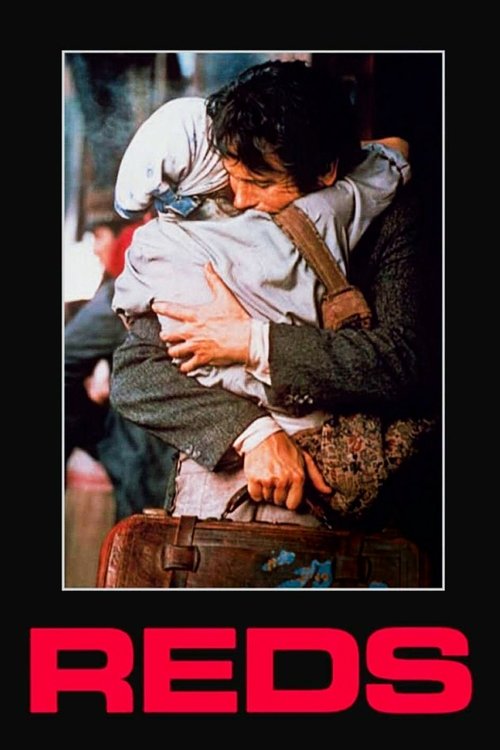
Reds
1981 · Warren Beatty
For when you want a big canvas — history, politics, and a turbulent romance in one long, absorbing sitting. A film to settle in with on a free evening when you want your entertainment to have ideas.
What it's about
John Reed was the American journalist who ran toward the Russian Revolution and wrote the book on it; this is his story, and just as much the story of his stormy romance with writer Louise Bryant. It sweeps from Greenwich Village bohemia — all arguments, art, and free love — to the streets of revolutionary Petrograd, following two people trying to stay in love while trying to change the world. Interwoven throughout, real elderly survivors of the era speak directly to the camera about what they remember.
The experience
A grand, old-fashioned epic with a restless modern conscience — sweeping and romantic one hour, argumentative and bruising the next. At over three hours it's a commitment, but the mix of love story, history, and living memory keeps it alive.
Performances
Warren Beatty and Diane Keaton fight and love with real friction, Maureen Stapleton won an Oscar as the fierce anarchist Emma Goldman, and Jack Nicholson is unexpectedly restrained and wounding as playwright Eugene O'Neill.
The craft
Beatty produced, co-wrote, directed, and starred — a colossal act of will — and the film's masterstroke is cutting the fictional epic against documentary testimony from real 'Witnesses' who lived it. Vittorio Storaro's cinematography gives it a burnished, wintry grandeur that begs for a big screen.
Why it matters
An improbable object — a sympathetic $30-million studio epic about an American communist released in Reagan-era Hollywood — it won Beatty the Best Director Oscar and stands as one of the last of the great director-driven epics.
Snapshot
Reds is Warren Beatty's three-and-a-quarter-hour epic about John Reed, the American radical journalist who chronicled the Bolshevik Revolution in Ten Days That Shook the World and died in Moscow in 1920, buried in the Kremlin Wall. The film braids two registers that rarely meet: a sweeping historical romance — Reed (Beatty) and the writer Louise Bryant (Diane Keaton) carried from Greenwich Village bohemia through Petrograd's revolutionary nights — and a documentary chorus of elderly "Witnesses," real survivors of that era who speak directly to camera. It was Beatty's long-gestating passion project, which he produced, co-wrote, directed, and starred in, and it arrived in December 1981 as one of the more improbable objects in Hollywood history: a sympathetic, $30-million-plus studio film about an American communist, released at the dawn of the Reagan presidency. It drew twelve Academy Award nominations and won three, including Best Director for Beatty. More than four decades on, it remains a singular fusion of David Lean–scale spectacle and self-interrogating, almost essayistic historiography.
Industry & production
Reds was a Paramount Pictures release, greenlit largely on the strength of Beatty's stature following the commercial and critical success of Shampoo (1975) and Heaven Can Wait (1978), the latter of which he co-directed and co-wrote. Beatty's interest in John Reed reached back to the late 1960s; the project's gestation across more than a decade is well documented in broad strokes, though the precise chronology of its scripting is genuinely murky. The credited screenplay is by Beatty and the British Marxist playwright Trevor Griffiths, whose politically rigorous dialogue gave the film its intellectual backbone. It is widely reported that additional writers — among them Elaine May and Robert Towne — contributed uncredited revisions, a common arrangement on Beatty productions; the exact division of labor is not reliably attributable and should be treated as part of the film's contested authorship rather than settled fact.
The production was enormous and logistically punishing. Principal photography ranged across England, Spain, and Finland (the last standing in for revolutionary Russia, as Cold War conditions foreclosed Soviet locations), with a famously protracted shoot and very high shooting ratios — Beatty's perfectionism and his habit of printing many takes are part of the film's lore. The budget, frequently cited in the low-to-mid thirty-million-dollar range, made it one of the costliest films of its moment; I would treat any single dollar figure as approximate. That Paramount financed a flatteringly humane portrait of American radicals — and that the film was reportedly screened at the White House for Ronald Reagan, who is said to have wished aloud for a happier ending — is the kind of irony that has attached itself permanently to the film's reception history.
Technology
Reds is a film of conventional early-1980s 35mm technology deployed with unusual ambition rather than technical novelty. There is no signature gadget here; its innovations are in lighting craft and in structure. The most consequential "technology" is arguably methodological: the Witnesses sequences were captured as straight documentary interviews — talking heads in pooled darkness — and then woven into the fiction. This required a disciplined separation of shooting modes, and Beatty's decision to withhold any on-screen identification of the speakers (no names, no lower-thirds) is a deliberate refusal of the standard documentary apparatus. The choice forces the viewer to weigh testimony on its own terms, foregrounding the unreliability and the poignancy of memory rather than the authority of the labeled expert.
Technique
Cinematography
Vittorio Storaro's photography won the film its Academy Award for Cinematography, and it is the picture's most celebrated technical achievement. Storaro — the Italian master then fresh from Apocalypse Now (1979) — organizes the film around a controlled palette and a dramaturgy of light and shadow. The American and bohemian passages tend toward warmer, lamplit interiors and naturalistic exteriors; the revolutionary Russian material moves toward colder, harder contrasts and, in the crowd and rally scenes, a charged interplay of darkness and flaring illumination. Storaro's career-long theory of color and light as narrative agents is fully operative here: light is not merely descriptive but expressive of political awakening and emotional temperature. The Witnesses, by contrast, are shot in near-blackness, isolated faces emerging from the void — a visual rhyme that sets living memory apart from dramatized history.
Editing
The film was edited by Dede Allen and Craig McKay. Allen — one of American cinema's most important editors, associated with the rhythmic modernism of Bonnie and Clyde (1967) and Dog Day Afternoon (1975) — was central to solving the film's fundamental structural problem: how to interleave documentary testimony with a continuous romantic-historical narrative without rupturing either. The Witnesses are used as punctuation, counterpoint, and ironic commentary, sometimes confirming and sometimes contradicting the dramatized action. The cutting also has to manage massive crowd sequences and the escalating momentum of the Petrograd material; the celebrated montage in which the revolution surges forward — frequently scored to "The Internationale" — is a high point of the editing's capacity to convert mass action into emotional crescendo.
Mise-en-scène / staging
Production design and staging move from the cluttered intimacy of Provincetown and Greenwich Village — cramped flats, theater spaces, salons thick with talk — to the vast public theater of revolution. Beatty stages the Village radicals as a milieu of argument, where politics is conducted in living rooms and meeting halls, and then opens the frame outward into the streets, trains, and congress halls of Russia. The contrast is deliberate: private rooms where ideas are debated versus public squares where they are enacted (and betrayed). Crowd staging in the revolutionary scenes aims for scale and verisimilitude rather than choreographed spectacle for its own sake.
Sound
The score is credited to Stephen Sondheim and Dave Grusin, an unusual pairing — Sondheim the Broadway composer-lyricist contributing thematic and song material (including "Goodbye for Now"), Grusin handling much of the dramatic scoring. Diegetic and ideological music does heavy lifting: "The Internationale" recurs as the revolution's anthem, and period songs anchor the American milieu. The Witnesses introduce a distinctive aural texture — frail, hesitant, sometimes overlapping voices that contrast sharply with the orchestral sweep of the drama, again separating the registers of memory and reenactment.
Performance
Beatty's Reed is romantic and driven, an idealist whose ardor curdles into disillusion as he collides with the machinery of Comintern bureaucracy. Diane Keaton's Louise Bryant is the film's most demanding role and arguably its center of gravity — her performance charts a woman's struggle for independent identity inside a relationship and a movement that both presume to define her. Jack Nicholson plays the playwright Eugene O'Neill with a banked, melancholy restraint quite unlike his more flamboyant register. Maureen Stapleton won the Academy Award for Best Supporting Actress as the anarchist Emma Goldman, bringing a hard-won, weary clarity to the film's critique of the revolution's authoritarian turn. The supporting ensemble is notably literate: the novelist Jerzy Kosinski plays the Bolshevik official Grigory Zinoviev, with Edward Herrmann as Max Eastman, Paul Sorvino as Louis Fraina, and Gene Hackman in a smaller role.
Narrative & dramatic mode
Reds operates in two simultaneous modes. The dominant one is a large-scale historical-romantic biography, organized around the Reed–Bryant relationship and structured in two movements (the film is formally divided, with an intermission in its roadshow presentation). The second is documentary: the Witnesses — figures including Henry Miller, Rebecca West, Adela Rogers St. Johns, Will Durant, and the comedian George Jessel, among many others — recall, misremember, and disagree about Reed, Bryant, and the period. This framing makes the film implicitly about historiography itself: the gap between lived event and later testimony, the fallibility of memory, the way a life congeals into legend. The dramatic mode is thus reflexive without being coldly Brechtian; the romance pulls the viewer in even as the Witnesses keep insisting that the truth is partial and contested.
Genre & cycle
The film belongs to the lineage of the historical epic — the David Lean tradition of intimate lives set against world-historical upheaval, with Doctor Zhivago (1965) the obvious comparison given the shared revolutionary backdrop. But Reds complicates the genre from within: where the classical epic offers spectacle as immersion, Reds repeatedly interrupts its own spectacle with documentary doubt. It also sits within the cycle of ambitious, personal, auteur-driven studio pictures of the 1970s–early 1980s — the era when figures like Coppola, Cimino, and Beatty could command vast resources for idiosyncratic visions. Heaven's Gate (1980), released the year before, is the cautionary twin: another expensive, politically charged American epic, though Reds avoided that film's catastrophic fate.
Authorship & method
Reds is the fullest expression of Beatty as a total author: producer, co-writer, director, and star, exercising control at every level. His method — exhaustive takes, sustained development, the assembling of formidable collaborators — is inseparable from the result. The key collaborators are essential to that authorship rather than incidental to it: Trevor Griffiths, whose Marxist seriousness shaped the screenplay's political texture; Vittorio Storaro, whose color-and-light dramaturgy gives the film its expressive spine; Dede Allen (with Craig McKay), whose editing solved its structural gamble; and Stephen Sondheim with Dave Grusin on music. The Witnesses device is Beatty's signature methodological invention here — an act of authorship that subordinates his own dramatization to the corrective murmur of living memory. The film's politics are genuinely Beatty's: a left-romantic American who admires Reed's idealism while refusing to whitewash the revolution's descent into bureaucratic coercion, embodied in Reed's clashes with Zinoviev and in Emma Goldman's disillusionment.
Movement / national cinema
Reds is firmly a product of American studio filmmaking, but it is in dialogue with traditions beyond Hollywood. Storaro imports a European art-cinema sensibility about light as meaning. Griffiths brings the committed political theater of the British left. And the film's subject and structure gesture toward the great Soviet revolutionary cinema — Eisenstein's October (1928) above all — even as Reds pointedly declines Eisensteinian montage-as-agitprop in favor of a skeptical, memory-haunted account. It is, in effect, an American film looking back at the revolution that Soviet cinema mythologized, and quietly questioning that myth.
Era / period
The film is doubly periodized. Its setting spans roughly 1915–1920: the Village radical scene, American entry into the First World War, the suppression of dissent, and the Bolshevik seizure of power. Its production and release belong to 1981 — the cusp of the Reagan era and a hardening of Cold War rhetoric. The friction between these two moments is the film's animating context. To make an empathetic film about American communists at precisely this juncture was a pointed act; Reds implicitly argues for recovering a buried tradition of native American radicalism at the very moment that tradition was most politically out of season.
Themes
The central themes are the collision of private love and public commitment; the tension between revolutionary idealism and revolutionary practice; and the unreliability of historical memory. The Reed–Bryant romance dramatizes how a movement that promises liberation can nonetheless subordinate the individual — and how Bryant's pursuit of autonomy strains against both her partner and the cause. Reed's arc traces idealism meeting bureaucracy: his dawning recognition that the Comintern would manage, distort, and instrumentalize the very revolution he had celebrated. Emma Goldman voices the film's anarchist critique of centralized power. And the Witnesses thread a meta-theme throughout — that the past survives only as fallible testimony, and that even a life as documented as Reed's dissolves, finally, into disagreement and forgetting.
Reception, canon & influence
Critically, Reds was received as a major, ambitious achievement, and it converted that esteem into twelve Academy Award nominations and three wins: Best Director (Beatty), Best Cinematography (Storaro), and Best Supporting Actress (Stapleton). Its commercial performance was more equivocal — a costly film whose returns were respectable rather than triumphant, and whose precise financial accounting I would not assert with confidence. Its influences run backward to the Lean epic and to Doctor Zhivago for the template of love amid revolution, to Soviet montage cinema as both reference and foil, and to the committed political theater of its writers. Looking forward, its most distinctive legacy is the mainstreaming of its documentary device — the integration of unlabeled, direct-address Witnesses into a dramatic feature, a strategy that anticipates the hybrid, testimony-laced docudramas and the talking-head idioms that later proliferated (the device is sometimes invoked as a forerunner of techniques associated with mockumentary and hybrid-form storytelling, though Reds deploys it in earnest). More broadly, the film stands as a high-water mark of the personal studio epic — proof that, for a brief window, an American star could marshal enormous resources to make a serious, formally adventurous film about the losing side of history. Its enduring reputation rests on that audacity, on Storaro's images, and on its rare willingness to love its idealists while refusing to lie about what became of their dream.
A Deleuzian reading
An old face surfaces out of pure black.
The full Deleuzian reading of Reds →
Reception
A $35M pro-communist epic bankrolled by Paramount just as Reagan took office, it earned 12 Oscar nominations and Beatty the Best Director win — then famously lost Best Picture to Chariots of Fire, a result film fans have been re-litigating ever since. Today it's cherished as one of the last true old-Hollywood epics, the 'they literally could not make this now' movie.
How Reds was received, from release to now →
Influences: the films it descends from and the films it influenced
- Doctor Zhivago (1965) — Supplies the template Reds reworks: an intimate love story staged against the churn of the Russian Revolution, with private passion and public upheaval cross-cut so the personal romance carries the weight of the historical.
- Lawrence of Arabia (1962) — Models the star-driven personal epic built around an ambivalent idealist on the losing edge of history, marshaling huge studio resources and location scale to serve one charismatic, finally defeated protagonist.
- October: Ten Days That Shook the World (1928) — Serves as Reds' explicit Soviet-montage reference and foil — it dramatizes the very revolution Reed reported, and its agitational intercutting of crowds and Winter Palace is what Reds' montage-crescendo answers to.
- Battleship Potemkin (1925) — Source of the accelerating rhythmic montage of revolutionary mass action that Dede Allen restages in Reds' crescendo cutting, building emotion through editing tempo rather than coverage.
- Citizen Kane (1941) — Pioneers reconstructing a man through fragmentary, sometimes contradictory witness testimony plus faux-newsreel — the reflexive-historiography of competing memory that Reds literalizes with its living Witnesses.
- The Conformist (1970) — Establishes Storaro's color-and-light dramaturgy — chiaroscuro and color-coded political/psychological states — the expressive-color grammar he then brings to Reds.
- Bonnie and Clyde (1967) — Establishes Dede Allen's elliptical, rhythm-led editing and Beatty's producer-star model of the personal studio picture — both the cutter and the authorship method Reds is built on.
- The Man Who Would Be King (1975) — Beatty's survivor-witness frame narrative device — real historical figures narrating the heroic story from its diminished present-tense aftermath — creates precisely the ironic distance between adventure and tragedy that Carnehan's broken frame provides: the audience holds the heroic arc and its human cost simultaneously, never permitted the adventure's full romance.
- A Special Day (1977) — Interleaves documentary witnesses and archival texture with historical fiction, extending Scola's strategy of anchoring an intimate story inside a verifiable documentary record of its era.
- 1900 (1976) — Braids intimate biography into a revolutionary historical sweep under Storaro's cinematography, directly extending 1900's marriage of private psychology to political history.
- Gandhi (1982) — The other early-'80s personal-crusade historical epic — a decades-in-the-making star-vehicle biopic of an idealist swept up in revolutionary politics, sharing Reds' Oscar-prestige epic mode.
- Zelig (1983) — Directly extends Reds' Witnesses device into mock-documentary, using fabricated talking-head testimony and fictional-figure-in-archival-history compositing where Reds used real witnesses in earnest.
- When Harry Met Sally... (1989) — Lifts Reds' interspersed direct-address 'witnesses' as a structural rhythm — the documentary-style couple interviews punctuating the narrative descend straight from Beatty's device.
- JFK (1991) — Carries forward reflexive historiography as form, blending documentary texture, archival and recreated footage, and aggressive montage to argue a contested history rather than merely illustrate it.
- Forrest Gump (1994) — Mainstreams the hybrid impulse Reds opened, inserting a fictional protagonist into authentic historical footage so a personal story reads as eyewitness to real history.
- The Last Emperor (1987) — A Storaro-shot historical epic about a figure swept up and finally discarded by revolution, applying the same color dramaturgy to the losing side of history that Reds champions.
- Nixon (1995) — Beatty interweaves on-camera testimony from real historical witnesses with dramatic reconstruction, pioneering the hybrid documentary-fiction mode for political biography — the sustained tension between archival authenticity and dramatic invention — that Stone adopts for Nixon without Beatty's explicit interview device but with the same epistemological stakes.
- The Trial of the Chicago 7 (2020) — The historical-political ensemble docudrama that intercuts staged period drama with documentary 'witness' testimony, blending record and reconstruction in service of a leftist-dissent narrative.
- 24 Hour Party People (2002) — Interpolates real surviving witnesses into a dramatized history, the documentary-into-fiction move echoed by casting actual Factory participants (Mark E. Smith, Howard Devoto, et al.) in cameo alongside their fictional counterparts.
- Bugsy (1991) — Beatty's prior long-gestating passion project about a charismatic, self-mythologizing idealist — the producer-star-as-auteur method and period-reconstruction prestige Bugsy directly repeats.
- She's Gotta Have It (1986) — Cuts documentary-style witness testimonials into dramatic narrative, the testimonial-montage device Lee folds into Nola's chorus of speakers.
- C'mon C'mon (2021) — Non-actor 'witness' interviews shot documentary-style and inter-cut with the fiction — the structural braid of real testimony and staged story that Mills adopts with actual children.
- Apocalypse Now (1979) — Immediately precedes Reds in Storaro's career and shows his theory of saturated, motivated source-light as expressive force, the same painterly color control Reds inherits.
- 1900 (Novecento) (1976) — A Storaro-shot, decades-spanning leftist political epic that romanticizes radical commitment while refusing to sentimentalize it — the same marriage of Marxist seriousness and lush image-making Reds attempts.
- Bound for Glory (1976) — An American studio biopic of a leftist folk idealist (Woody Guthrie) that, like Reds, lyricizes radical commitment while documenting hardship, a near-contemporary attempt at the same prestige-leftist register.
- Heaven's Gate (1980) — Same-moment American super-production marrying Vittorio Storaro's diffused naturalist light to a left-political historical canvas, sharing the New Hollywood gamble of personal epic at runaway scale.
- The Life and Death of Colonel Blimp (1943) — Charts a committed man's life across turbulent decades of history, framing the personal against national-political upheaval with an epic retrospective structure akin to Blimp's era-spanning chronicle.
Similar films
- Doctor Zhivago (1965) — influence & lineage
- Battleship Potemkin (1925) — influence & lineage
- The Red and the White (1967) — shared sensibility
- La Commune (Paris, 1871) (2003) — shared sensibility
- On the Waterfront (1954) — shared sensibility
- Out of Africa (1985) — shared sensibility
- 1900 (1976) — shared sensibility
- Platoon (1986) — shared sensibility
All the films related to Reds →