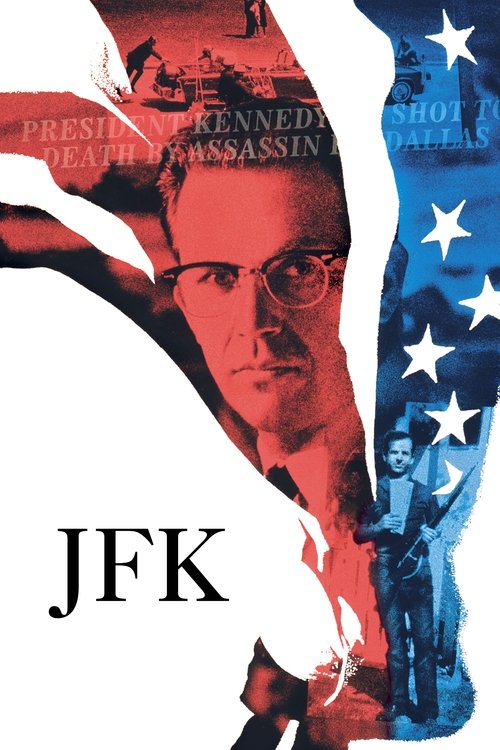
JFK
1991 · Oliver Stone
For when you want to be swallowed whole by a big, obsessive movie — a long evening, full attention, and an appetite for conspiracy and argument. More adrenaline than comfort; you'll come out wanting to read everything about it.
What it's about
New Orleans district attorney Jim Garrison reopens the question of who killed President Kennedy, mounting the only prosecution ever brought in connection with the assassination. What starts as a local lead spirals into a years-long obsession that consumes his office and his family, as he assembles witnesses, timelines, and frame-by-frame film analysis into a case that the government insists doesn't exist. It's a courtroom drama, a paranoid thriller, and a full-throated argument about American power all at once.
The experience
Three-plus hours that move like ninety minutes — a torrent of faces, flashbacks, and archival footage cut at a velocity that was radical in 1991 and still feels electric. It's gripping and exhausting in the best way, and whether or not you buy the theory, it leaves you arguing with the screen.
Performances
Kevin Costner anchors the storm as Garrison, decency slowly hardening into obsession, and the supporting cast is an embarrassment of riches — Gary Oldman uncanny as Lee Harvey Oswald, Tommy Lee Jones silkily evasive as Clay Shaw, and Donald Sutherland delivering a mid-film monologue that's become legendary as a piece of pure sustained storytelling.
The craft
The editing is the star: Stone and his team weave 35mm, 16mm, 8mm, black-and-white, and newsreel into one nervous stream, so that speculation and record blur together — which is exactly the point and exactly the controversy. It won Oscars for its cinematography and editing, and John Williams's twitchy, drum-driven score keeps the whole machine humming.
Why it matters
It caused a genuine national uproar, helped push Congress to pass a law releasing sealed assassination records, and its rapid-collage style reshaped how thrillers, and eventually everything else, got cut. It remains the reference point for movies about American conspiracy.
Snapshot
JFK is Oliver Stone's epic, formally aggressive procedural about the only criminal prosecution ever brought in connection with the assassination of President John F. Kennedy — the New Orleans case mounted by District Attorney Jim Garrison against local businessman Clay Shaw. Adapting Garrison's memoir On the Trail of the Assassins and Jim Marrs's Crossfire, Stone uses the investigation as a spine on which to hang a sprawling counter-history of November 22, 1963, arguing that Kennedy was killed by a conspiracy reaching into elements of the intelligence and defense establishment and that the Warren Commission's lone-gunman finding was a cover story. More than its thesis, the film is remembered for its method: a torrential, multi-format collage that fuses dramatization, reconstruction, and archival material into a single nervous stream. It is at once a courtroom drama, a paranoid thriller, and an essay-film, and it became one of the most publicly contested American movies of its era — credited with helping spur the passage of the JFK Records Act. Running roughly three hours (longer in its later director's cut), it remains the definitive example of Stone's "vertical editing" and his conviction that history is a fight over images.
Industry & production
JFK was a major studio production, financed and released by Warner Bros. with co-financing arrangements, and produced by Stone with A. Kitman Ho. It arrived at the crest of Stone's commercial and critical ascendancy: coming off Platoon (1986), Wall Street (1987), Born on the Fourth of July (1989), and The Doors (1991), he had the leverage to mount an expensive, three-hour, R-rated film built around a dense political argument and an enormous ensemble. The budget was substantial for the period (commonly reported in the $40 million range; treat any single figure with caution). The casting strategy was itself a production logic: Kevin Costner, then at the height of his Dances with Wolves fame, anchored the film as Garrison to lend a Capraesque, trustworthy-American center, while dozens of recognizable actors — Tommy Lee Jones, Joe Pesci, Gary Oldman, Sissy Spacek, Kevin Bacon, Donald Sutherland, Jack Lemmon, Walter Matthau, Ed Asner, John Candy, Michael Rooker, Brian Doyle-Murray — were deployed in roles large and small, several in cameo, so that familiar faces could orient the viewer inside an overwhelming flow of information.
The production drew intense controversy before release. Drafts of the screenplay leaked and prompted prominent attacks in the press (including in The Washington Post and from columnists and former officials) charging that Stone was distorting history and rehabilitating the discredited Garrison prosecution, which had ended in Shaw's swift acquittal in 1969. Stone and his collaborators responded by publishing an annotated version of the screenplay with extensive source citations — an unusual defensive apparatus that reframed the film as an argument to be footnoted rather than a closed dramatization. Shooting included location work in Dallas (notably Dealey Plaza and the surrounding streets) and New Orleans, with meticulous period reconstruction of the assassination geography.
Technology
Technologically, JFK is defined by its omnivorous mixing of capture formats. Stone and cinematographer Robert Richardson shot and incorporated 35mm, Super 16mm, 8mm and Super 8mm film, black-and-white and color stocks, still photographs, and video, intercutting these original elements with genuine archival material — newsreel, television, and above all Abraham Zapruder's 8mm home movie of the motorcade. The aim was to erase the boundary between the authentic document and the staged reconstruction so that the viewer could no longer be sure, frame to frame, what was "real." This required reverse-engineering the look of period amateur and broadcast footage: degrading and matching grain, frame rates, and contrast so that newly shot black-and-white "reenactments" would sit seamlessly beside actual 1960s images. The Zapruder film, long sequestered and then famous, is used both as evidence and as the film's emotional and rhetorical climax. The whole project is a demonstration of how analog image technologies carry different truth-claims, and how editing can put those claims into collision.
Technique
Cinematography
Robert Richardson's photography — which won the Academy Award for Best Cinematography — is among the most influential of the 1990s. His signature top-light, the hot overhead source that blows out the upper frame into a halo, recurs throughout, but the larger achievement is textural range. Richardson modulates between the warm, classical, slightly nostalgic register of Garrison's home and office and the harsh, fragmented, documentary-style imagery of the conspiracy reconstructions. He shoots the dramatized "what really happened" passages in scratchy black-and-white and grainy color to mimic surveillance, newsreel, and home-movie footage, then cuts them against pristine 35mm. The result is a cinematography organized not around a stable point of view but around the question of which images can be trusted.
Editing
Editing is the film's true authoring instrument, and JFK won the Academy Award for Best Film Editing for Joe Hutshing and Pietro Scalia. The cutting is famously dense — thousands of shots, many held for a fraction of a second — assembling history out of shards. Stone and his editors developed a technique sometimes described as "vertical" editing: rather than advancing linearly, the cut layers and reiterates, returning obsessively to the motorcade, splicing imagined and documented versions of the same instant, and intercutting testimony with illustrative fragments so that exposition becomes kinetic. The bravura set pieces — Donald Sutherland's "X" delivering a torrent of black-ops backstory on a Washington bench, and the climactic courtroom recitation of the Zapruder frames ("back, and to the left") — work because the editing converts dialogue-heavy material into propulsive montage. It is one of the most important demonstrations in American cinema that editing can be the carrier of argument, not merely of continuity.
Mise-en-scène / staging
Staging alternates between the institutional realism of Garrison's investigation — cluttered offices, courtrooms, diners, the period-correct streets of Dealey Plaza — and the abstracted, evidentiary space of the reconstructions, where figures are often rendered as silhouettes, hands, or partial views to preserve ambiguity. Dealey Plaza is treated almost architecturally, mapped and re-mapped from multiple vantages (the grassy knoll, the Book Depository, the underpass) so the geography itself becomes an argument about sightlines and crossfire. Period production and costume design are exact, but the staging consistently subordinates realist illusion to the rhetorical needs of the case.
Sound
The sound design is as layered as the image, weaving radio broadcasts, news audio, overlapping voices, gunshots, and ambient documentary noise into a near-continuous texture; the film was Oscar-nominated for its sound work. John Williams's score — also Oscar-nominated — is unusually restrained and percussive for the composer, built around a martial snare-drum pulse and somber brass and strings that lend the procedural momentum and elegiac weight without tipping into bombast. The drum motif, in particular, threads the film's investigative drive together.
Performance
Costner's Garrison is a deliberately plain, upright presence — a moral anchor whose steadiness offsets the surrounding hysteria of information. Around him the ensemble supplies color and menace in concentrated bursts: Tommy Lee Jones (Oscar-nominated for Supporting Actor) as the elusive Clay Shaw, Joe Pesci as the twitchy David Ferrie, Gary Oldman in an eerily exact impersonation of Lee Harvey Oswald, Kevin Bacon as a composite prisoner-informant, and Donald Sutherland as the spectral "X." The casting of beloved character actors (Lemmon, Matthau, Candy) in supporting and cameo roles is itself a performance strategy, using audience familiarity as a navigational aid through a labyrinthine narrative.
Narrative & dramatic mode
Formally, JFK fuses the investigative-procedural (the dogged D.A. assembling a case against institutional resistance) with the conspiracy thriller of the 1970s and the essay-film. Its dramatic engine is classical — a hero pursuing truth at mounting personal and professional cost, culminating in a courtroom summation — but its texture is anything but linear. The film proceeds by accretion and recursion, returning again and again to the same November afternoon, offering competing reconstructions, and folding hours of exposition into montage. The mode is fundamentally rhetorical: the audience is positioned as a jury, and the film's structure mimics the building of a legal-historical brief, with the final courtroom address functioning as both narrative climax and direct address to the viewer.
Genre & cycle
JFK sits at the intersection of the political conspiracy thriller, the courtroom drama, and the historical epic. It explicitly inherits the paranoid cycle of the post-Watergate 1970s — The Parallax View, Three Days of the Condor, All the President's Men, Executive Action — that treated American power as opaque and lethal. Within Stone's own filmography it forms, with Nixon (1995) and W. (2008), a loose trilogy on the American presidency and the machinery of power, and it extends the political-historical project of Platoon and Born on the Fourth of July. It also helped define a 1990s cycle of "assassination" and secret-history films and television preoccupied with the limits of official truth.
Authorship & method
JFK is a quintessential Oliver Stone film: combative, maximalist, morally certain, and formally experimental in the service of a political thesis. Stone's method here is to overwhelm — to bury the viewer in data and imagery until the cumulative weight enforces conviction — and to treat cinema as a counter-archive capable of contesting the official record. He co-wrote the screenplay with Zachary Sklar (who had edited Garrison's memoir), basing it on Garrison's On the Trail of the Assassins and Jim Marrs's Crossfire. The film is inseparable from its key collaborators: Robert Richardson, whose camera supplied the visual grammar of multi-format truth-collision; editors Joe Hutshing and Pietro Scalia, who realized the "vertical" cutting that is the film's argument; and composer John Williams, whose disciplined martial score binds the whole. The partnership with Richardson, which ran across most of Stone's signature work, is one of the defining director–cinematographer collaborations of the period.
Movement / national cinema
The film belongs to mainstream American studio cinema, but to its dissident, politically engaged wing — the lineage of socially confrontational Hollywood filmmaking that runs from the New Hollywood of the 1970s into the auteur-driven studio pictures of the late 1980s and early 1990s. Stone is among the few directors of the era to use blockbuster resources for explicitly oppositional historical argument. JFK is also a landmark in a distinctly American mode: the cinematic interrogation of the nation's founding traumas and the relationship between the citizen and the secret state.
Era / period
Released in December 1991, JFK is a product of a specific moment — the end of the Cold War, the immediate aftermath of the Gulf War, and a surge of public reckoning with the secret history of the postwar national-security state. Its preoccupation with hidden power and official deception resonated with early-1990s anxieties even as it reached back to relitigate 1963. The film's anger about the unaccountability of intelligence agencies and the militarization of American policy reflects its post-Vietnam, post-Iran-Contra context as much as its ostensible subject.
Themes
The film's central themes are the contested ownership of historical truth; the gap between official narrative and lived reality; the corrupting reach of the national-security state; and the burden borne by the individual who insists on asking forbidden questions. It is preoccupied with images as evidence — what a photograph or a home movie can and cannot prove — and with the act of looking itself, repeatedly anatomizing the Zapruder frames as if the truth might be squeezed from them. Loss of innocence, both personal and national, runs throughout: Stone frames the assassination as the moment the postwar American social contract was broken. Above all the film is about epistemology — how a society decides what happened — and it is candid, in its own paratexts, that it offers a "counter-myth" rather than a settled finding.
Reception, canon & influence
JFK was a critical and commercial success and a genuine cultural event, but a polarizing one. It earned eight Academy Award nominations — including Best Picture, Best Director, Best Supporting Actor (Tommy Lee Jones), Best Adapted Screenplay, Best Original Score, and Best Sound — and won two, for Robert Richardson's cinematography and for Hutshing and Scalia's editing. Reviews split sharply: many critics praised its formal audacity and sheer cinematic force while others, alongside historians, journalists, and former government figures, condemned its conspiracism and its sympathetic portrait of Garrison, whose real prosecution had collapsed in 1969. The controversy was not incidental to the film's significance: the public pressure it generated is widely credited with helping prompt Congress to pass the President John F. Kennedy Assassination Records Collection Act of 1992, leading to the declassification of large volumes of government files — a rare instance of a movie measurably altering public policy.
Looking backward, the film's influences are clear: the 1970s paranoia thrillers and Executive Action; the documentary and newsreel traditions whose textures it appropriates; and the long argument over the Warren Commission carried on by researchers like Garrison and Marrs. Looking forward, its impact is twofold. Aesthetically, its multi-format, hyper-cut "vertical" style and Richardson's blown-out, mixed-stock look were enormously influential across 1990s and 2000s cinema, advertising, music video, and television, normalizing the collage of formats and the integration of faux-archival imagery into dramatic storytelling. Culturally, it became the reference point for cinematic conspiracy narrative and for debates about the ethics of dramatizing contested history — invoked in nearly every subsequent argument about "based on a true story" filmmaking. Stone himself extended the project decades later with documentary work revisiting the case. Whatever one concludes about its claims, JFK endures as a master class in editing-as-argument and as the most consequential demonstration of how a film can intervene in the historical record it depicts.
A Deleuzian reading
Start with a frame you can't place.
The full Deleuzian reading of JFK →
Reception
Attacked before it even opened — journalists and historians were denouncing it off a leaked draft script months ahead of release — yet it was a hit, landed 8 Oscar nominations, and is now studied as a landmark of editing even by people who reject every word of its thesis.
How JFK was received, from release to now →
Influences: the films it descends from and the films it influenced
- October: Ten Days That Shook the World (1928) — Originates the dialectical/intellectual montage where the collision of non-continuous shots generates an argument rather than story — the direct grammar of JFK's 'vertical editing.'
- Citizen Kane (1941) — Embeds a faux-newsreel ('News on the March') inside fiction and builds the whole film as an investigation into a dead man assembled from conflicting testimony.
- Rashomon (1950) — Dramatizes contested truth by restaging the same violent event in mutually incompatible reenactments, refusing a single authoritative image of what happened.
- Night and Fog (1955) — Pioneers the essay-film that interleaves archival footage with present-tense camera to mount a moral-historical argument directly at the viewer.
- The Battle of Algiers (1966) — Manufactures newsreel-grain, handheld faux-documentary texture so that staged political history reads as captured fact — the faux-archival technique JFK appropriates.
- Z (1969) — Establishes the docudrama reconstruction of a political assassination through rapid montage and flash-cut fragments of witness memory.
- Medium Cool (1969) — Fuses real documentary footage of political violence with staged fiction, blurring the seam between recorded event and dramatization.
- Executive Action (1973) — Dramatizes the JFK assassination itself via conspiracy reconstruction cut against archival and Zapruder-style imagery — the explicit model JFK extends.
- The Parallax View (1974) — Codifies the 70s paranoia-thriller frame: a lone investigator dwarfed in the composition by an unseen, unaccountable conspiratorial apparatus.
- All the President's Men (1976) — Makes the accumulation of documentary procedure — files, phone logs, sourcing — the dramatic engine, the investigative scaffolding Garrison's case rides on.
- Battleship Potemkin (1925) — Stone and editor Pietro Scalia deploy dialectical montage as historical-political argument — intercutting archival footage, dramatic reconstruction, and found imagery so the juxtaposition itself constitutes the evidentiary claim — directly inheriting Eisenstein's model of editing as rhetorical proof rather than narrative continuity.
- The Manchurian Candidate (1962) — Stone's rapid-cut collage of formats — 8mm, 16mm, 35mm, black-and-white, color, newsreel, reconstruction — performs the same epistemological disorientation as Frankenheimer's nightmare editing, making the viewer experience the investigator's inability to stabilize evidence as a formal condition of the film itself.
- Natural Born Killers (1994) — Pushes JFK's mixed-stock, multi-format hyper-cut collage to saturation, making format-switching the primary expressive register.
- Nixon (1995) — Reapplies the same faux-archival 'counter-archive' method and vertical cutting to another piece of contested American political history.
- Zodiac (2007) — Extends the document-driven obsessive investigation where evidence accumulates exhaustively yet never resolves into a single provable truth.
- The Big Short (2015) — Adopts essay-film direct address plus archival collage and montage-as-argument to turn a polemic into propulsive cinema.
- Vice (2018) — Applies multi-format collage and editing-as-argument to recent contested political history, inheriting Stone's images-as-evidence rhetoric.
- JFK Revisited: Through the Looking Glass (2021) — Stone literally extends the project as documentary, doubling down on the images-as-evidence and faux-archival montage that drove the original.
- Enemy of the State (1998) — Stone and Robert Richardson's grammar of mixed-gauge stocks—16mm archival footage, Super-8, video surveillance, and 35mm principal photography intercut to construct a paranoid institutional epistemology—is the immediate formal model for Dan Mindel and Tony Scott's syntactic mixing of surveillance image formats as truth-claim markers.
- Oppenheimer (2023) — Stone's multi-strand montage intercutting courtroom testimony with dramatized reconstruction and newsreel footage — making epistemological uncertainty the film's formal subject — is the direct editing ancestor of Oppenheimer's triple-perspective structure, each timeline's visual grammar encoding a different claim on historical truth.
- Spy Game (2001) — Pioneers the information-dense montage that braids multiple film stocks and timeframes through fragmentary cross-cutting — the editorial vocabulary Scott repurposes for the nested flashback.
- In the Line of Fire (1993) — Reactivates Kennedy-assassination iconography and the manipulation of Dealey Plaza archival imagery, the cultural ground ITLOF's Dallas backstory and digital inserts stand on.
- The Trial of the Chicago 7 (2020) — The courtroom-anchored docudrama that intercuts trial testimony with reconstructed and archival footage and deliberately mixes film stocks and textures — a precedent for the stylistic bifurcation between trial and flashback.
- The Attorney (2013) — Stages the climactic courtroom oration as a mobilization of historical-political argument into emotional crescendo, and pioneers the docudrama built around a real figure refashioned into an exemplary moral spokesman.
- The Thin Blue Line (1988) — Repeats and varies stylized reenactments of a killing to interrogate contradictory testimony, treating reconstruction as evidentiary argument.
- Casino (1995) — Carries Robert Richardson's signature top-light, blown-out highlights and restless format-mixing into another epic built on layered voiceover and montage.
- Malcolm X (1992) — Stone developed documentary-dramatic hybrid editing — archival footage, reenacted newsreel grain, and fictional dramatic reconstruction interlocked as political argument about state violence against its own citizens — in the same production season Lee was making Malcolm X; both films insert actual footage of real violence to collapse the period drama's historical distance into the viewer's present.
- The Doors (1991) — Shot by Richardson in overlapping production with The Doors, JFK shares the identical formal grammar: mixed-film-stock paranoid documentary texture, rapid archival-footage montage intercut with reconstruction, and optical printing technology to layer testimonial fragments — both films developing Stone and Richardson's maximalist historical-spectacle method simultaneously and cross-pollinating technique.
- The Baader Meinhof Complex (2008) — Stone's interleaving of staged reenactment with archival and newsreel texture to fuse documentary authority with dramatization — the archival-framing device the Complex deploys.
- Born on the Fourth of July (1989) — Extends the Richardson halation and Kovic-era kinetic montage into the political-investigation biopic, scaling the myth-versus-reality dialectic from one veteran's body to the national mythos.
- Man on Fire (2004) — Its rapid associative montage, splicing film stocks and formats to externalize memory and obsession, prefigures Scott's fragmentary cutting as a tool for subjective recall rather than plot delivery.
- Thirteen Days (2000) — Pioneered the integration of period broadcast and newsreel material with dramatized scenes, and the dual-register photochemical switching between archival-grade and dramatic textures that Lesnie systematizes.
- A Few Good Men (1992) — Robert Richardson's glossy, morally-legible lighting and his architectural tightening toward a climactic verbal summation in court is the same cinematographic surface he supplies here.
- Forrest Gump (1994) — Intercuts fabricated footage with real archival material to insert invented moments into the documentary record of American history — a contemporaneous experiment in the archival-blending Gump perfected.
- The Aviator (2004) — Robert Richardson's signature top-light (hot overhead key isolating faces in pooled brightness) developed here is carried directly into The Aviator's expressionist lighting grammar.
- In the Name of the Father (1993) — Deploys the same temporal-compression editing and paranoid memory-frame flashbacks building to a courtroom climax where withheld evidence is dramatically unveiled — the exact device Sheridan compresses history into.
Similar films
- Nixon (1995) — influence & lineage
- Z (1969) — influence & lineage
- The Thin Blue Line (1988) — influence & lineage
- Natural Born Killers (1994) — influence & lineage
- Casino (1995) — influence & lineage
- All the President's Men (1976) — influence & lineage
- The Parallax View (1974) — influence & lineage
- The Conversation (1974) — often watched together
All the films related to JFK →