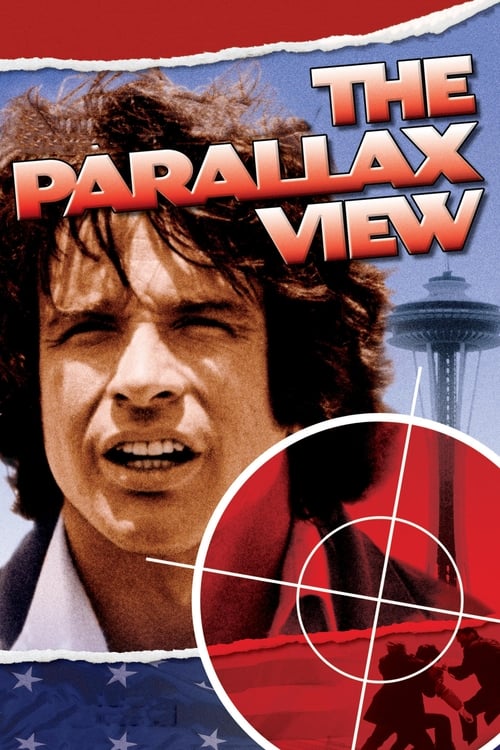
The Parallax View
1974 · Alan J. Pakula
For when you're in a distrustful mood and want a thriller that takes your paranoia seriously — a challenge, not a comfort watch, best late at night when the news has left you uneasy.
What it's about
A cocky Seattle reporter starts digging into a senator's assassination after witnesses to the killing begin dying off one by one. His trail leads to the Parallax Corporation, a private outfit that seems to recruit and groom political assassins — and the deeper he burrows into it, the less certain it is who's playing whom.
The experience
Cold, quiet, and steadily suffocating — the dread comes less from chases than from architecture, silence, and the feeling of being watched from very far away. It moves like a thriller but lands like a warning, and it doesn't hand you the comfort most mysteries do.
Performances
Warren Beatty plays the reporter with a swagger that curdles into fear as he realizes how far out of his depth he is — a movie star deliberately shrunk against forces bigger than any hero.
The craft
Alan J. Pakula and cinematographer Gordon Willis frame people as tiny figures in vast, gleaming modern spaces — dams, convention halls, empty corridors — so the paranoia is built into every shot. Its centerpiece is a legendary montage sequence, a corporate brainwashing film-within-the-film that says more with images and music than pages of dialogue could. It rewards a big screen, where all that engineered emptiness can really loom.
Why it matters
Released weeks before Nixon resigned, it bottled the Watergate era's distrust and became the dark heart of Pakula's paranoia trilogy, setting the template for conspiracy thrillers ever since.
Snapshot
The Parallax View is the central panel of Alan J. Pakula's informal "paranoia trilogy," bracketed by Klute (1971) and All the President's Men (1976). Released in June 1974, weeks before Richard Nixon's resignation, the film tracks reporter Joe Frady (Warren Beatty) as he pursues the shadowy Parallax Corporation — a private entity that recruits, conditions, and deploys political assassins — only to be annihilated by the very machinery he tried to expose. It is one of the most formally ambitious and ideologically uncompromising Hollywood films of the decade: a conspiracy thriller that refuses the consolation of the solved mystery, ending instead with institutional power reaffirming its lie before a congressional commission. Where most genre films promise the restoration of order, The Parallax View insists that the disorder is the order.
Industry & production
Paramount Pictures released the film under Pakula's own production banner. It arrived at the height of New Hollywood's confidence that studio resources could be deployed in the service of genuinely subversive material — a confidence enabled by the commercial and critical success of films like Chinatown, The Conversation, and The Godfather in the same narrow window. The project was adapted from a novel (the source novel's authorship is less widely documented in standard film histories than the screenplay's development; the record on this is thin) by screenwriters David Giler and Lorenzo Semple Jr. Semple was a Hollywood fixture whose tonal range ran from the deliberately campy Batman television series (1966) to the taut Three Days of the Condor (1975), co-written the following year. His touch on The Parallax View leans harder toward satirical unease than toward camp: the Parallax Corporation's bureaucratic apparatus is rendered with an almost mundane plausibility that makes it more frightening than any grotesque villain could be.
Warren Beatty, already established as a producer-actor with serious commercial leverage after Bonnie and Clyde (1967), brought the project to Pakula. The collaboration gave Beatty a role that worked against his star image: rather than the charismatic agent of change, Frady is reactive, often hapless, ultimately disposable. The casting is itself an act of ideological argument.
Technology
Gordon Willis shot the film in Panavision anamorphic (2.39:1), a format that gave him the wide horizontal canvas he would exploit to radical effect throughout. Willis — who had already worked with Pakula on Klute and was then in the early stages of his work on The Godfather — used Panavision lenses and controlled light to an extreme degree. He was notorious among studio executives for refusing to add fill light even when images approached the threshold of printable exposure, a practice that earned him the nickname "The Prince of Darkness." The widescreen frame allowed Willis to place characters in the lower third or far corners of compositions, devoting the majority of the image to institutional architecture — corridors, dams, convention halls, loading docks — that dwarfs the human figure and visually pre-argues the film's thesis.
Technique
Cinematography
Willis's visual strategy in The Parallax View is one of systematic dehumanization. Characters are repeatedly filmed at extreme distance, from overhead, or from angles that obscure their faces, denying the audience the conventional intimacy between viewer and protagonist that classical Hollywood cinematography is designed to produce. The opening assassination sequence — set at a fundraising event atop a tall civic tower (shot at a Seattle-area location designed to evoke but not duplicate the Space Needle) — is filmed with a cold, observational distance that anticipates the Zapruder film's quality of evidence rather than story.
The film's most celebrated formal set-piece is the Parallax Corporation's psychological recruitment test, in which Frady sits in a darkened room watching a screen as a five-minute montage of images floods past him. This sequence — designed to identify potential assassins through their psychological responses — is a genuine experiment in the ideological life of images. Assembled from still photographs and archival footage, it juxtaposes "LOVE," "MOTHER," "HOME," "COUNTRY," and "GOD" with imagery that alternately affirms and corrupts those concepts, interspersing domestic wholesomeness with violence, heroism with atrocity, patriotism with threat. Willis shoots Beatty watching the screen in profile, in shadow, returning the film's gaze back onto the audience: we are also watching images; we are also being tested.
Throughout the film, Willis uses the widescreen frame as a trap rather than an invitation. Frady is consistently peripheral, dwarfed, or caught in lines of sight that suggest surveillance. The architectural settings — impersonal corporate corridors, the empty cavern of a political rally venue, the vertiginous geometry of a dam — function as visual arguments about the scale of institutional power relative to the individual.
Editing
The editing (John W. Wheeler is credited as editor) operates in two distinct registers. The conventional thriller material — Frady's investigations, his confrontations with witnesses — is cut with standard continuity efficiency. But the Parallax test sequence abandons continuity entirely, functioning as a film-within-the-film governed by its own associative logic. The rapid cutting of that sequence — images flashing at subliminal speed before resolving into slightly longer held frames — mimics the operation of propaganda itself: repetition, juxtaposition, and rhythm doing what argument cannot. The sequence stands as one of the most formally self-conscious passages in 1970s American cinema.
Mise-en-scène / staging
Pakula's staging consistently positions Frady as object rather than subject. The film's environments are selected and arranged to suggest a world not built for human inhabitation: convention centers with their acres of empty floor, the exposed infrastructure of industrial America, the anonymous corridors of the Parallax Corporation itself. Pakula and Willis repeatedly stage encounters in deep space, with characters separated by vast distances within the frame, so that conversation itself becomes an act of crossing hostile territory.
The final sequence — in which Frady, having infiltrated a political rally and positioned himself to expose the real assassin, is instead shot and framed as the perpetrator — is staged with a cruel spatial efficiency. The cover-up has already been arranged before Frady arrives; the architecture of the conspiracy has pre-determined his position. The final shot of the blue-ribbon commission announcing that the assassin acted alone is held long enough to function as a statement rather than a scene.
Sound
Michael Small's score uses a chamber-music sparseness rather than the orchestral sweep of conventional thriller scoring. Small, who had also scored Klute, employs small gestures — isolated piano notes, woodwind dissonance, passages of near-silence — to create a sense of ambient dread rather than punctuated shock. The film is also notable for its use of silence: the Parallax test sequence is accompanied only by music (no dialogue, no ambient sound) in a way that further isolates it as a formal event distinct from the surrounding film. Sound design throughout uses the acoustic properties of large empty spaces — the reverb of institutional corridors, the ambient hum of machinery — to reinforce the architecture's dehumanizing quality.
Performance
Beatty's performance is the film's most consistently underestimated element. Against the type of the tenacious investigative journalist, he plays Frady as someone always slightly behind events, whose charm and resourcefulness are perpetually insufficient to the scale of the forces he's encountering. There is something genuinely passive in Beatty's physicality here that works against his star presence: Frady is a man who believes in individual agency, and the film systematically destroys that belief. Paula Prentiss appears in the early scenes as a fellow journalist whose warning initiates the plot; her performance registers genuine terror in a way that contextualizes the horror Frady never quite allows himself to feel. Hume Cronyn appears in a supporting role as Frady's editor, providing one of the film's few points of apparent institutional trustworthiness — a trustworthiness the film ultimately implicates.
Narrative & dramatic mode
The film works as a procedural until its procedural logic collapses. The first act follows familiar thriller grammar: a mystery, a skeptical hero who gradually becomes convinced, the acquisition of clues. But the second and third acts progressively reveal that the conventional thriller's promise — that investigation leads to exposure, exposure leads to justice — is precisely the fantasy the Parallax Corporation relies upon. Frady's investigation is not only fruitless; it is the instrument of his destruction. The conspiracy has anticipated him. By following the clues, he has walked into the frame.
This narrative structure — in which the thriller's generic machinery is turned against the protagonist — was genuinely novel in Hollywood terms and remains the film's most radical formal gesture.
Genre & cycle
The Parallax View belongs to the cycle of American paranoia thrillers that flourished between approximately 1971 and 1976, a cycle that also includes Klute, The Conversation (Coppola, 1974), Chinatown (Polanski, 1974), Three Days of the Condor (Pollack, 1975), and All the President's Men (Pakula, 1976). The cycle was enabled by a specific historical conjunction: the Kennedy and King assassinations, the Vietnam War, Watergate, COINTELPRO, and the general delegitimation of American institutions created an audience primed to believe that the official story was a lie.
Within this cycle, The Parallax View occupies an extreme position. Where All the President's Men ends with the system working — however slowly, however incompletely — The Parallax View ends with the system working perfectly, as designed, in the service of its own perpetuation.
Authorship & method
Alan J. Pakula trained as a producer, working with Robert Mulligan on films including To Kill a Mockingbird (1962) before directing. His directorial style is notable for its restraint and its sustained interest in institutional power as a site of psychological horror rather than melodrama. The paranoia trilogy represents the mature statement of this preoccupation.
The collaboration between Pakula and Gordon Willis across Klute and The Parallax View constitutes one of the decisive director-cinematographer partnerships of the New Hollywood period. Willis's visual radicalism — his willingness to underexpose, to deny legibility, to work against the audience's desire for clarity — was precisely matched to Pakula's thematic concerns. Their shared instinct was to refuse the visual conventions that signify trustworthiness and legibility in classical Hollywood, replacing them with a visual grammar of obscurity and threat.
Michael Small's contribution as composer across multiple Pakula films established a sonic signature for the paranoia thriller: chamber-scaled, dissonant, deeply uneasy without the manipulation of conventional thriller scoring.
Movement / national cinema
The film belongs unambiguously to New Hollywood, the period (roughly 1967–1977) in which a generation of American filmmakers — enabled by the collapse of the studio system's traditional production model, the influence of European art cinema, and the loosening of censorship — pursued personal, formally experimental, and ideologically challenging work within the commercial framework. The Parallax View also absorbs the influence of European political cinema, particularly Costa-Gavras's Z (1969), which demonstrated that the political conspiracy thriller could function as both popular entertainment and serious political analysis.
Era / period
The film is saturated with the specific historical anxiety of the early 1970s United States. Released months before Nixon's resignation, it drew on more than a decade of accumulated political trauma: the Kennedy assassinations (1963, 1968), the King assassination (1968), the Warren Commission's contested findings, the revelation of CIA domestic operations, and the ongoing Vietnam War. It was made and consumed by an audience for whom the idea that powerful private institutions operated outside democratic accountability had been confirmed by recent events.
The title's meaning — "parallax" refers to the apparent displacement of an object when viewed from different positions — functions as the film's epistemological thesis: what you see depends entirely on where you stand, and those who control vantage points control reality.
Themes
The film's central preoccupation is the relationship between institutional power and individual legibility. The Parallax Corporation is terrifying not because it is foreign or overtly evil but because it is entirely domestic, corporate, and procedural. It does not hate its recruits or its targets; it processes them. The assassination of political figures is not presented as ideological but as service rendered within a market — a chilling anticipation of what later theorists would call the privatization of violence.
The Parallax View also meditates on the specific vulnerability of journalism as an investigative instrument. Frady is a reporter; the tools of his trade — skepticism, source cultivation, the accumulation of evidence — are turned systematically against him. The film implicitly argues that investigative journalism, conceived as the individual confronting institutional power, is insufficient to the scale of the forces it confronts. This is the argument that All the President's Men will revisit, and partly rebut, two years later.
The film's treatment of American iconography — particularly visible in the Parallax test sequence — constitutes an analysis of how nationalist ideology is assembled and deployed. The rapid montage of the test sequence does not simply illustrate American violence; it argues that the American mythological vocabulary (family, God, country, heroism) is structurally indistinguishable from the vocabulary of murderous fanaticism. The film suggests that the political assassin is not an aberration but an American type.
Reception, canon & influence
Backward influences. The most direct formal precursor is John Frankenheimer's The Manchurian Candidate (1962), which similarly depicted the recruitment and conditioning of a political assassin within an institutional framework, and which used the montage capabilities of cinema to render subjective psychological manipulation. Costa-Gavras's Z (1969) demonstrated that the European political thriller's methods were available to Hollywood; its direct-address treatment of assassination conspiracy as ongoing present-tense horror rather than historical curiosity was absorbed by the entire American paranoia cycle. The traditions of film noir — particularly its treatment of the investigator destroyed by the case — provide a deeper structural ancestor.
Critical reception. The film received serious critical engagement on release, with particular attention to Gordon Willis's cinematography and the film's formal radicalism. Vincent Canby's review in the New York Times recognized the film's deliberate refusal of conventional thriller satisfactions. Over time, critical assessment has risen steadily; the film is now consistently cited among the essential American films of the decade.
Forward legacy. The Parallax View's influence on subsequent conspiracy cinema is pervasive, though often unacknowledged. Its model of the conspiracy that cannot be defeated — that in fact grows stronger through attempted exposure — is visible in Oliver Stone's JFK (1991), though Stone's film substitutes operatic accumulation for Pakula's spare dread. The institutional paranoia of the 1990s X-Files cycle, as well as later conspiracy thrillers from Michael Clayton (2007) to Sorry to Bother You (2018), inherit its basic architecture: the individual investigator facing a system that has anticipated every move.
More specifically, the film's Parallax test sequence has attracted sustained attention from scholars of film form and ideology. Its analysis of the image-as-weapon, and its implication of the film audience within that analysis, anticipates the theoretical concerns of apparatus theory and later work on cinema's relationship to ideology. It remains one of the most formally self-aware sequences in American commercial cinema.
The film's ending — a commission announcing that the lone assassin acted without accomplices, while the audience knows the opposite — retains its force across decades because it proposes no corrective and offers no exit. The last thing The Parallax View shows us is the official lie being accepted, and the film simply stops. That refusal to resolve remains, more than fifty years on, the most honest thing about it.
A Deleuzian reading
A man sits alone in a dark room.
The full Deleuzian reading of The Parallax View →
Reception
Buried in the summer of 1974 — mixed reviews, modest box office, and the misfortune of sharing a year with Chinatown and The Conversation — it's since been canonized as the coldest, purest entry in Pakula's 'paranoia trilogy,' capped by a Criterion release in 2021.
How The Parallax View was received, from release to now →
Influences: the films it descends from and the films it influenced
- The Manchurian Candidate (1962) — The brainwashing-sequence montage — images cut against their denotative logic to produce perceptual destabilization in the viewer — is the direct formal precursor to the Parallax test; both films deploy the film-within-film device as an ideological weapon that implicates the audience inside the conditioning apparatus rather than positioning them safely outside it.
- Z (1969) — The procedural investigation that terminates in the official exoneration of the conspirators and the prosecution of the investigators — procedural collapse as structural principle and anti-cathartic ending as political statement — is the model the entire Watergate paranoia cycle, and Pakula's film most precisely, absorbed and translated from European political cinema into American commercial form.
- Klute (1971) — The first Pakula-Willis deployment of extreme underexposure and top-lit deep-space staging to render surveillance and institutional threat as a visual grammar — the shooter-in-the-dark framing of Donald Sutherland's apartment sequences establishes the cinematographic language that The Parallax View extends and radicalizes into scenes where faces simply go black.
- Blow-Up (1966) — The investigator whose photographic enlargements dissolve the evidence of a crime rather than clarifying it — procedural collapse as epistemological condition rather than plot failure — establishes the template Pakula adopts: the protagonist's professional skills are adequate to detect the conspiracy but structurally incapable of proving or stopping it.
- Touch of Evil (1958) — Welles's wide-angle deep-focus staging within architectural corridors that literally enclose and diminish figures — the motel sequences, the office interiors — is the direct technical ancestor of Willis's dehumanizing framing; both cinematographers use architecture to perform institutional argument, making the spaces themselves the antagonists before any character acts.
- The Trial (1962) — Welles's rendering of bureaucratic space as labyrinthine architecture through which the protagonist moves without purchase — the vast halls, the clerks in tiers, the corridors that open onto further corridors — establishes the staging vocabulary of architecture-as-argument that Pakula translates into the Parallax Corporation's glass towers and the Senate hearing room's closing doors.
- Point Blank (1967) — The lone protagonist's procedural assault on a criminal institutional apparatus that simply absorbs his violence and continues operating — the Organization cannot be destroyed because it has no center — is the structural model for Pakula's conspiracy that grows stronger through attempted exposure; Lee Marvin's stunned, against-type performance of incomprehension before institutional power prefigures Warren Beatty's Frady.
- North by Northwest (1959) — Gordon Willis's telephoto staging in open civic spaces — the Seahawks stadium assassination conducted at distance in full afternoon light — extends NxNW's formal innovation of high-key menace: threat made more terrifying by visibility than by shadow, inverting the shadow-and-enclosure conventions of thriller cinematography.
- The Spy Who Came In from the Cold (1965) — Gordon Willis's extreme-ratio underlit cinematography — figures as dark shapes against bright institutional voids — translates Oswald Morris's high-contrast expressionism into the American paranoid mode, where architectural openness becomes as threatening as Ritt's closed corridors.
- Seconds (1966) — Inherits the surveillance-montage and faceless-corporation menace, with a shadowy organization remaking identities for profit.
- State of Siege (1972) — Uses thriller suspense mechanics to expose an institutional assassination apparatus, consolidating the 1970s conspiracy-exposé template State of Siege helped codify.
- Seven Days in May (1964) — Gordon Willis's composition-in-depth and frames-within-frames dwarf the lone investigator inside monolithic institutional architecture — the spatial vocabulary of power Frankenheimer borrowed from Kane, now weaponized for 70s conspiracy paranoia.
- All the President's Men (1976) — Pakula and Willis carry the deep-space staging and dehumanizing framing directly into the Watergate journalism thriller — the underground parking garage as institutional-acoustics set piece, the wide overhead shot of Woodward and Bernstein dwarfed by the Library of Congress card catalog as architecture-as-argument — applying the same visual grammar of obscurity and threat to the one Watergate story where the journalists win.
- JFK (1991) — Stone extends the Parallax test's subliminal montage into full operatic accumulation — the evidence sequences mix formats, film stocks, periods, and fabricated reconstructions exactly as the Parallax filmstrip mixed images against their denotative meanings, but substitutes prosecutorial rhetoric for Pakula's spare dread; the commission that announces the official lie at the end of The Parallax View becomes Stone's explicit subject, the Warren Report held up as the Parallax Corporation's final product.
- Michael Clayton (2007) — The institutional apparatus that has pre-anticipated every move of the investigating insider — Gilroy stages glass-walled corporate offices as spaces of total visibility-as-vulnerability, architecture-as-argument in which the protagonist's exposure is structural rather than contingent; the anti-cathartic procedural collapse where the protagonist's nominal victory requires institutional betrayal rather than accountability inherits Pakula's refusal to offer systemic remedy.
- Zodiac (2007) — Procedural collapse as formal subject — the investigation that cannot reach resolution becomes the film's explicit content rather than a tonal register; Fincher's deep-space digital staging within newspaper morgues and police interiors inherits the Pakula-Willis institutional acoustics, and the anti-cathartic ending that withholds closure is defended as formal honesty rather than narrative failure, precisely the defense Pakula's critics had to make for The Parallax View.
- Sorry to Bother You (2018) — The film-within-film device as ideological weapon — the horse-people video that Cassius discovers inside WorryFree's compound implicates the viewer in the corporate conditioning apparatus exactly as the Parallax test implicates the cinema audience; the conspiracy that grows stronger through attempted exposure and the protagonist whose procedural investigation reveals a system that has already incorporated the revelation are direct structural inheritances.
- Disclosure Day (2026) — Gordon Willis's deep, legible widescreen compositions dwarf the lone investigator within institutional architecture, the staging vocabulary the seed borrows for its conspiracy-thriller distrust.
- Munich (2005) — Pakula's convention of filming protagonists as if they are already under surveillance — wide-angle framings that place figures at the edge of institutional space rather than at its center — and his descent narrative in which investigation becomes self-destruction directly supply Munich with its visual-political grammar of a man consumed by the apparatus he trusted.
- The China Syndrome (1979) — Pakula's wide-angle staging of corporate architecture visually overpowering the investigator-protagonist — most explicit in the Corporation's headquarters sequences — is the direct formal model for Bridges's staging of Godell dwarfed within the plant's control-room geometry, making institutional space itself a visual antagonist that requires no editorial emphasis.
- The Game (1997) — The mid-film audiovisual 'test' sequence — a constructed montage designed to psychologically profile the protagonist as he watches it — is the direct structural ancestor of CRS's elaborately staged, personalized simulation; both films turn being-tested into an epistemological trap the viewer cannot see out of.
- The Bourne Identity (2002) — The convergent conspiracy structure—a protagonist who investigates only to find himself already ensnared—and Gordon Willis's underlit, claustrophobic framing established the visual and narrative grammar of post-Watergate institutional paranoia that Gilroy's screenplay directly channels.
- Shooter (2007) — The institutional-impunity ending as formal device: a conspiracy so embedded in governmental and corporate power that exposure changes nothing, with the investigator left powerless before a committee that closes ranks — Shooter's cynical Senate-hearing resolution is a direct formal descendant of this move.
- Enemy of the State (1998) — Pakula's extreme wide-angle compositions that dwarf the protagonist within governmental architecture—Senate hearing rooms, stadium concourses, institutional lobbies—establish the panopticon-proscenium staging grammar that Scott's production design inherits for its NSA operations centers and DC interiors.
- The Conversation (1974) — Institutional acoustics as primary dramatic material — Harry Caul's surveillance apparatus turned against him, his professional auditory precision revealing the conspiracy he cannot un-hear — mirrors Pakula's use of the Senate hearing chamber's echo and the convention center's PA system; both films end with the investigator dismantling his own environment in a search that finds nothing, anti-cathartic closure as formal statement.
- Chinatown (1974) — The investigator destroyed by the case in anamorphic widescreen — John Alonzo's sun-bleached Los Angeles compositions place Gittes in exposed, legible space, the inverse of Willis's obscuring shadow, but both cinematographic strategies perform the same argument: the protagonist is visible to the apparatus while the apparatus remains hidden; both films end with the conspiracy's absolute victory and the investigator's impotence.
- Night Moves (1975) — Anti-cathartic procedural collapse as formal principle — the detective's anamorphic-widescreen investigation leads into a conspiracy whose full dimensions he cannot map; the final image of the powerboat circling in an inescapable pattern is the visual correlative of The Parallax View's commission announcement, both endings proposing the conspiracy's self-perpetuation as the only resolution available.
- Three Days of the Condor (1975) — The CIA analyst who discovers an extra-institutional conspiracy operating within his own apparatus — the empty office building where his colleagues have been executed used as architecture-as-threat, space rendered dangerous by what it withholds — and the ambiguous non-resolution where the protagonist's exposure of the conspiracy to the press may not save him, institutional accountability replaced by institutional performance.
- Clear and Present Danger (1994) — Ancestor of paranoid framing where power is rendered as architecture — figures dwarfed by monumental interiors and conference-room geometry — a staging grammar CAPD reuses for the Oval Office and White House corridors.
- The Bourne Legacy (2012) — Pakula's paranoid framing of the individual dwarfed by an opaque institution — the conspiracy-thriller grammar of figures isolated within vast cold interiors that Gilroy and Elswit restage as agency war-rooms.
- Marathon Man (1976) — Shares Michael Small's authorship and the cycle's lone-figure-versus-faceless-organization paranoia, with suspense built on the dread of convergence withheld until too late.
- The Stepford Wives (1975) — Contemporaneous Pakula/Michael Small conspiracy picture sharing Stepford's dread of an unseen organization and the decade's cold, minimalist scoring idiom.
- One Way or Another (1976) — Cinema-of-paranoia visual scheme dwarfing the individual inside vast architectural voids, the conspiracy rendered as oppressive built space rather than exposition.
Similar films
- The Conversation (1974) — influence & lineage · same viewing thread
- Point Blank (1967) — influence & lineage · same viewing thread
- All the President's Men (1976) — influence & lineage
- Klute (1971) — influence & lineage
- Three Days of the Condor (1975) — influence & lineage
- JFK (1991) — influence & lineage
- The Manchurian Candidate (1962) — influence & lineage
- Zodiac (2007) — influence & lineage
All the films related to The Parallax View →
Watch it with: curated runs of related films
- The Paranoid and the Obsessed — A run of stylish thrillers about lone men consumed by a hidden pattern, a betrayal, or a truth they can't stop chasing — each staged with more virtuosity than the plot strictly needs.