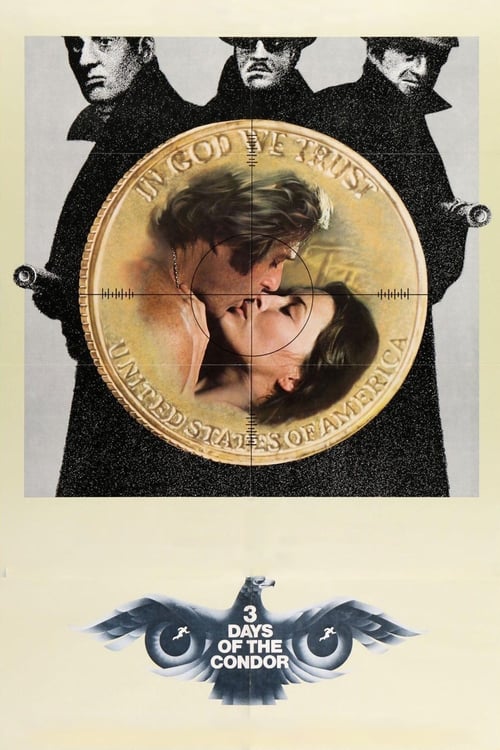
Three Days of the Condor
1975 · Sydney Pollack
For when you want a grown-up thriller that trusts you to keep up — more nerves and suspicion than car chases. A comfortable watch on the surface, but it leaves a cold aftertaste about who's really in charge.
What it's about
Joe Turner reads books for the CIA — novels, journals, foreign pulp — scanning them for leaked secrets from a quiet brownstone office in New York. He steps out to pick up lunch and comes back to find everyone he works with shot dead. With no field training and no idea who ordered it, he grabs a stranger off the street and goes underground, trying to stay alive long enough to figure out which part of his own agency wants him gone.
The experience
Tense in a low, constant hum rather than a loud one — you spend the whole film looking over Turner's shoulder with him. It's smart, brisk, and quietly chilling, with a bleak wintry loneliness under the chase.
Performances
Robert Redford makes ordinary intelligence heroic — a man thinking his way out of a death sentence in real time — while Faye Dunaway gives the hostage-turned-ally real prickliness and sadness, and Max von Sydow is unforgettable as a courtly, philosophical assassin.
The craft
Sydney Pollack shoots wintry mid-70s Manhattan and Washington like enemy territory — phone booths, alleys, office corridors, all of it suddenly unsafe. The film moves with lean, unfussy efficiency, and its refusal to tie things up neatly is the boldest choice in it.
Why it matters
Released the same year Congress was publicly investigating the CIA, it caught America's post-Watergate distrust of its own institutions dead-on and became one of the defining conspiracy thrillers of the decade.
Snapshot
Three Days of the Condor is a political paranoia thriller in which a mid-level CIA literary analyst — code-named Condor — returns from lunch to find every colleague in his New York cell murdered. Played by Robert Redford at the peak of his stardom, Joe Turner spends the next seventy-two hours outrunning an invisible assassin (Max von Sydow), evading his own agency, and forcing a reluctant stranger (Faye Dunaway) into uneasy complicity. The film closes not on a resolution but on a question — Turner has handed the story of a rogue CIA oil-procurement operation to the New York Times, and his superior (Cliff Robertson) asks, coolly, whether he thinks they'll print it. The frame cuts before an answer arrives. That open ending, arriving the same year the Church Committee was televising its CIA hearings, gave Three Days of the Condor a purchase on the American political imagination that outlasted its original run.
Industry & production
The film adapts James Grady's debut novel Six Days of the Condor (1974), compressing the action by half at the insistence of the production. Paramount Pictures financed and distributed the picture; Dino De Laurentiis served as producer alongside Stanley Schneider, with Robert Redford's production vehicle Wildwood Enterprises also attached — an arrangement typical of star-driven New Hollywood deals that gave talent meaningful creative leverage.
The screenplay credit went to Lorenzo Semple Jr. and David Rayfiel. Semple brought experience with pop-paranoia form — he had written the campy Batman television series and contributed to Richard Fleischer's The New Centurions — but his sensibility was genre-savvy rather than ideologically pointed. Rayfiel, a close and long-standing collaborator of Pollack's who worked on several of the director's films in varying degrees of credit, is generally understood to have shaped the more ruminative and character-specific material, including the ambiguous Turner–Hale relationship. The production shot extensively on location in New York City, a choice that was economically pragmatic, aesthetically deliberate, and thematically loaded: this is a film about the surveillance state set in the city whose density makes surveillance omnipresent and personal privacy precarious.
Technology
Cinematographer Owen Roizman shot the film in 35mm using anamorphic Panavision optics, the widescreen format allowing him to isolate figures in wide urban compositions and to stage two-shots that preserve depth and spatial separation between characters whose trust is never stable. Roizman was arguably the preeminent location cinematographer of the New York 1970s school: he had shot The French Connection (1971), The Exorcist (1973), and The Taking of Pelham One Two Three (1974) in the years immediately preceding, and each of those films made New York's built environment an active dramatic element rather than backdrop.
His approach to available or near-available light — augmented rather than replaced by artificial sources — gave interiors a damp, wintry flatness consistent with the film's emotional temperature. Filtration is restrained; there is no warmth to the palette that might soften the institutional coldness of what Turner is discovering. The technological choices are in service of a consistent anti-glamour aesthetic: even Redford, then one of the most photographed faces in American cinema, is lit without the soft-key halos that accompanied his other work.
Technique
Cinematography
Roizman composes the New York sequences with an eye for containment: brownstone staircases, phone booths, service entrances, and the narrow sightlines of Manhattan streets become a labyrinth rather than a location. The opening sequence — the American Literary Historical Society, the CIA's unwitting cover, bustling with the ordinary rhythms of a workplace — is shot with an ease and warmth that makes the subsequent massacre more viscerally wrong. When Turner returns to find the bodies, Roizman holds wide and still; the carnage is not staged for shock cuts but for a slow, dreadful inventory. Wide-angle lenses make the rooms feel simultaneously ordinary and inescapable.
Editing
The editing establishes and sustains a double rhythm: passages of procedural patience punctuated by sudden violence. The film trusts silence and duration in a way that distinguishes it from later, more kinetic iterations of the conspiracy thriller. Cross-cutting is used economically — Pollack is more interested in character reaction than in parallel-action tension-building — and the result is a film that feels studied rather than frenetic, closer in pacing to the European political thrillers of Costa-Gavras than to the genre product that would follow in its wake.
Mise-en-scène / staging
Pollack's staging characteristically centers the actors. The film is built on two-character confrontations — Turner and Kathy Hale in the Brooklyn apartment, Turner and Higgins in the Sherry-Netherland, Turner and Joubert at a succession of carefully neutral meeting points — and the director uses space to express power: who controls the room, who controls access to the door. The scene in which Joubert delivers a hired killing in broad street daylight is staged with an almost bureaucratic efficiency, using the ordinary foot traffic of New York as both cover and ironic counterpoint to the clinical act.
Sound
Dave Grusin's score is jazz-adjacent and percussive — urban nervous-system music rather than orchestral signaling. Grusin had been developing his film scoring practice through the early 1970s and would go on to a long association with Pollack. Here, the score underscores anxiety without announcing it; it complements rather than directs the viewer's emotional response. Equally notable is what the soundtrack does not do: ambient New York sound — traffic, pedestrian noise, the specific acoustic texture of a phone booth call — is given room to establish place and unease on its own terms.
Performance
Redford modulates between two frequencies: an initial bookish diffidence (Turner reads, he is not a field agent, he is startled by sudden noise) and an emergent, adaptive competence that never quite tips into the superhuman. The performance depends on legibility: we need to believe that this man is improvising under lethal pressure, and Redford keeps the fear visible under the solutions. Faye Dunaway plays Kathy Hale with a disciplined ambivalence — the character's capitulation to her kidnapper was contentious at the time and has been more extensively critiqued since, but Dunaway resists making Kathy passive; she maintains an interior watchfulness that makes the character's complicity feel chosen rather than simply surrendered. Cliff Robertson underplays Higgins to the point of opacity, which is exactly correct — the character's smooth danger is entirely in what he does not say. Max von Sydow's Joubert is the film's most formally composed creation: a Continental professional who operates by codes entirely alien to the American institutional world he is temporarily inhabiting. Von Sydow brings to the role the moral weight and philosophical remove of his work with Ingmar Bergman, and the effect is of a figure from a different and older kind of European thriller briefly occupying the same frame as an American genre film.
Narrative & dramatic mode
The film operates in what might be called the paranoid procedural mode: a classical quest narrative (who did this, and why) conducted within an institution that cannot be trusted to provide answers. Turner's problem is epistemological before it is physical — he does not know the shape of the conspiracy he is inside. The narrative withholds information from the protagonist and audience in parallel, then releases it incrementally, so that the revelation of a CIA oil-security operation as the motive for the massacre arrives as at once satisfying and deeply troubling. The thriller's usual satisfaction — the conspirators are exposed and punished — is suspended in favor of something more unresolved: the exposure is handed to a newspaper, and whether the newspaper will act, and whether action would make any difference, is left open. This open ending is not a failure of resolution but its own kind of genre statement.
Genre & cycle
Three Days of the Condor belongs to the most productive cycle of the American political paranoia film, a grouping that includes Alan Pakula's Klute (1971), The Parallax View (1974), and All the President's Men (1976), as well as Roman Polanski's Chinatown (1974) — films that share a structural conviction that American institutions are corrupt, that the corruption reaches upward without ceiling, and that individual resistance is at best partial and at worst futile. The cycle is importantly distinct from the spy thriller tradition from which it draws vocabulary: where the Cold War spy film (Mission: Impossible, the early Bond series) posited a reliable state apparatus defending freedom from external threat, the paranoia film identifies the threat as internal and institutional. The enemy is not the Soviet Union but Langley, not a foreign government but a sub-committee operating off any visible ledger.
The film is also in productive conversation with the roman policier tradition of French political cinema — the Costa-Gavras films Z (1969) and The Confession (1970) are plausible precursors — and with the European assassin-professional thriller, a connection embodied casting choice as much as influence.
Authorship & method
Sydney Pollack is a director whose authorship is more evident in tone and actor management than in a consistent visual signature, which has sometimes led critics to underestimate his control of material. He was trained in the Actor's Studio tradition — he began as an actor, and worked as an acting teacher before moving to television direction in the early 1960s — and his films are characteristically performance-centered, built on intimate human relationships that exist in tension with large historical or institutional forces. His collaboration with Robert Redford was among the most consistent of the New Hollywood period, spanning Jeremiah Johnson (1972), The Way We Were (1973), Three Days of the Condor, and later Out of Africa (1985); each film is a different genre vehicle, and Pollack's skill is adapting his method to the genre's demands without abandoning his interest in psychological complexity.
Owen Roizman's contribution is substantive: the film's visual identity — its cold palette, its location authenticity, its refusal of compositional beauty for its own sake — is Roizman's grammar as much as Pollack's. David Rayfiel's contribution to the script, though difficult to precisely demarcate from the Semple material, is likely responsible for the film's more inward passages and its ambiguous romantic subplot.
Movement / national cinema
Three Days of the Condor is a canonical New Hollywood picture, produced during the decade in which the major studios ceded significant creative authority to directors and stars, enabling a body of films with political content and formal ambition that would not have been possible under the classical studio system. The film is part of the specifically New York strand of New Hollywood — alongside The French Connection, Serpico (1973), Dog Day Afternoon (1975), and Taxi Driver (1976) — that used the city's post-fiscal-crisis grime and density as a moral and aesthetic resource. New York in 1975 was bankrupt and deteriorating, and its buildings and streets carry that weight in films of this period in ways that cannot be replicated in studio reconstruction.
Era / period
The film arrived in September 1975 during the most concentrated period of the American institutional crisis: Nixon had resigned the previous August; the Church Committee had begun its hearings in January 1975 and was producing revelations about CIA assassination programs and domestic surveillance operations (COINTELPRO, Operation CHAOS) through the year; the fall of Saigon had occurred in April. The film's central conceit — that the CIA was operating a secret sub-operation to plan the seizure of Middle Eastern oil fields in anticipation of a future energy crisis — was, for its first audiences, not a counterfactual but an extrapolation. The film neither explains nor condemns the oil operation at length; it assumes its audience understands that this is the kind of thing that happens, and builds its horror from that assumption.
Themes
The film's central thematic concern is the gap between institutional purpose and institutional practice: the CIA exists, in theory, to protect American citizens; in practice, it operates beyond oversight, serves interests that have nothing to do with citizens, and eliminates its own employees to protect those interests. Turner's specific identity as a reader — he works in a literary research unit, his job is to read novels looking for operational ideas — makes him an emblem of intelligence as a concept (the accumulation and interpretation of knowledge) in contrast to the agency as a bureaucratic machine.
A second theme is complicity: Kathy Hale is coerced into sheltering Turner and gradually becomes his collaborator, a dynamic that the film presents as a form of seduction — moral as well as physical — that raises uncomfortable questions about consent and about the degree to which ordinary people become complicit in the actions of those who compel their participation. The film does not resolve this question in Kathy's favor, and the discomfort is structural, not incidental.
Finally, there is the theme of journalism and democratic accountability — the New York Times ending — which the film treats with neither cynicism nor optimism but with a conditional hope that depends entirely on institutional courage that may or may not exist. This suspension is the film's most durable contribution to political cinema.
Reception, canon & influence
Three Days of the Condor was commercially successful on release and received largely positive critical attention, though it was not among the most celebrated films of its year in terms of awards recognition. Its reputation has been sustained by retrospective critical assessment of the 1970s paranoia cycle as a coherent and significant body of American filmmaking, and by its continued relevance as a template for the institutional thriller.
The film draws on a tradition of influences that include Alfred Hitchcock's wrong-man thrillers (North by Northwest in particular, whose lone protagonist outrunning institutional power while pursued across American geography the film both cites and critiques), the European political thriller of Costa-Gavras, and the French assassin film in the tradition of Jean-Pierre Melville. It also inherits from the hard-boiled American tradition: Turner, like the classic private detective, is a solitary figure whose investigation produces truth but not justice.
Its forward influence is extensive. The rogue-analyst-on-the-run premise — a mid-level intelligence employee who discovers the conspiracy is inside the house — became one of the durable templates of the genre, surfacing in Enemy of the State (1998), the Jason Bourne series (beginning 2002), and, most explicitly, in the Russo Brothers' Captain America: The Winter Soldier (2014), which engages directly with the film's imagery and political logic as a conscious act of genre homage. The film's open ending, with its refusal to confirm that democratic institutions will function, became a model for the politically pessimistic conclusion, distinguishing the conspiracy thriller from the spy adventure in formal as well as ideological terms.
Subsequent scholarship has engaged critically with the film's treatment of the Kathy Hale relationship, reading the Stockholm syndrome dynamic as a symptom of broader New Hollywood ambivalence about female agency — a limitation of the film's politics that sits in productive tension with the genuinely radical pessimism of its institutional critique. That the film can sustain both kinds of reading — as a landmark of political cinema and as a document of its era's unexamined assumptions — is part of what makes it a dossier-worthy object.
A Deleuzian reading
He goes out the back for lunch.
The full Deleuzian reading of Three Days of the Condor →
Reception
A solid hit in 1975 that critics treated as a slick star-vehicle thriller, it's since been canonized as a pillar of the decade's paranoid-conspiracy cycle alongside The Parallax View and The Conversation — helped by how uncannily its release coincided with the real Church Committee revelations about the CIA.
How Three Days of the Condor was received, from release to now →
Influences: the films it descends from and the films it influenced
- North by Northwest (1959) — Pollack directly adopts Hitchcock's wrong-man-on-the-run structure — the lone civilian protagonist who outmaneuvers institutional pursuit through improvisational intelligence rather than trained tradecraft — but darkens the template: where Thornhill is vindicated by the state, Turner is left at its mercy, a formal inversion that defines the paranoia cycle's departure from the Hitchcock model.
- Z (1969) — Costa-Gavras's procedural technique — building institutional conspiracy through the accumulation of bureaucratic micro-detail rather than action setpieces — is the direct formal model for Condor's CIA plotting sequences; the film also inherits Z's politically pessimistic open ending that withholds judicial resolution, the structural choice that distinguishes the political thriller from the spy adventure.
- Le Samouraï (1967) — The Joubert character is constructed entirely on Melville's template: the professional assassin as a figure of urban ritualism who moves through institutional space with geometric economy and minimal affect; Melville's staging grammar — held long shots, restricted performance, the city as chessboard — governs every scene featuring the hitman.
- The French Connection (1971) — Owen Roizman shot both films; his available-light, anti-glamour New York location grammar — cold blue-gray palette, handheld intimacy in tight interiors, location sound mixed hot — is a direct craft inheritance carried four years forward; Condor's visual identity is inseparable from the cinematographic vocabulary Roizman developed on this film.
- Klute (1971) — Gordon Willis's paranoid New York visual grammar — deep-shadow compositions, available-light apartment interiors that make space feel surveilled and constricted — established the cinematographic register that Roizman explicitly responds to in Condor; Pakula also developed the technique of embedding intimate two-person performance within institutional threat, which Pollack uses throughout.
- The Manchurian Candidate (1962) — Pollack inherits Manchurian's structural revelation that the protagonist is an unwitting instrument in an institutional conspiracy that dwarfs him — extending the brainwashed-agent premise into a scenario where the CIA itself is the handler and the hero its most recent candidate.
- The Spy Who Came In from the Cold (1965) — The film's narrative architecture replicates Ritt's structural irony exactly: the protagonist's institutional loyalty is the mechanism of his betrayal, and the revelation that his handlers are his hunters mirrors Leamas's discovery that the operation he served was the operation designed against him.
- Foreign Correspondent (1940) — Analyst-as-amateur-spy thrust into professional intelligence jeopardy with urban architecture staged as obstacle terrain — Foreign Correspondent's amateur-in-the-machine formula transposed into Cold War institutional geography and bureaucratic paranoia.
- The 39 Steps (1935) — The paranoid wrong-man thriller updated — an ordinary man hunted by both his own agency and assassins, forming an uneasy alliance with a woman, structured as a continuous flight under suspicion.
- Seven Days in May (1964) — The core arc of an individual discovering institutional rot and being hunted by hidden centers of power becomes the template, played as procedural paranoia within the intelligence bureaucracy.
- The Day of the Jackal (1973) — Carries forward the seventies conspiracy cycle's location realism and methodical cat-and-mouse pursuit between an exposed individual and an impersonal apparatus.
- The Ipcress File (1965) — Inherits the morally weary, agency-betrayed analyst navigating internal treachery, the procedural-mystery-meets-internal-betrayal plot Ipcress pioneered.
- Enemy of the State (1998) — Scott's film directly extends Condor's rogue-analyst-on-the-run template — the civilian with institutional knowledge who becomes a target of the surveillance apparatus — updating it for the digital surveillance era; the epistemological structure (protagonist piecing together the conspiracy from inside it while being watched) and the institutional critique of intelligence overreach are inherited formally from Condor.
- The Bourne Identity (2002) — The adaptive competence performance mode — the trained professional whose skills must be improvised against the institution that created him — is a direct extension of Turner's character grammar; the Bourne franchise inherits Condor's procedural construction of institutional pursuit and its premise that the analyst's knowledge is the weapon that makes him a target.
- Michael Clayton (2007) — Gilroy's corporate-institutional thriller extends Condor's staging grammar: procedural patience as the primary mode, the lone competent figure inside a powerful institution who discovers its criminality, and an open moral resolution that refuses catharsis; the deliberate suppression of conventional thriller kinetics in favor of dialogue-driven procedural accumulation is a formal inheritance from Pollack's template.
- Captain America: The Winter Soldier (2014) — The Russo Brothers structured the HYDRA-inside-SHIELD plot as a conscious formal homage to Condor's CIA-conspiracy-within-itself premise, citing the original film directly in production interviews; the specific staging grammar — institutional spaces that reveal their corruption through spatial logic, the elevator as arena of institutional betrayal — transposes Condor's political architecture into the superhero blockbuster form.
- Tinker Tailor Soldier Spy (2011) — Alfredson extends Condor's procedural patience and anti-glamour aesthetic into post-Cold War intelligence cinema: the cold desaturated palette, the ambient location sound mixed against sparse scoring, and the epistemological quest conducted through institutional archives and memory — each a direct elaboration of formal strategies Condor established — make this the European art-film inflection of Pollack's template.
- Disclosure Day (2026) — Defines the whistleblower-on-the-run template: an insider hunted by his own intelligence agency after stumbling onto a buried truth, the exact chase logic the seed adopts.
- The Bourne Ultimatum (2007) — The procedural architecture of a CIA analyst hunted by his own agency's enforcement apparatus, using tradecraft details — dead drops, cover identities, protocol violations — as the primary suspense machinery, is the direct narrative template for Bourne's institutional-antagonist plot.
- Shooter (2007) — The wronged intelligence operative framed by his own agency: improvised survival using professional skills, the unlikely civilian ally, and going public as the only route to exoneration — Shooter's entire wronged-man-conspiracy architecture maps onto this structure beat for beat.
- Argo (2012) — The Pakula-adjacent formula of a competent professional isolated within a hostile institutional system, deploying procedural intelligence rather than physical force as the primary suspense mechanism against an unnamed state adversary.
- Zero Dark Thirty (2012) — Pollack established the CIA as opaque institutional architecture where moral complicity is embedded in operational procedure rather than individual villainy — a structural inheritance Bigelow retains while stripping away genre resolution.
- Syriana (2005) — Template for the CIA-insider thriller built from procedural intelligence-agency texture, supplying the genre register for the Bob Barnes (Robert Baer) strand.
- Spy Game (2001) — Redford's casting as a CIA man hunted by his own agency is imported wholesale — Spy Game weaponizes that paranoia-thriller iconography so the audience reads Muir, from frame one, as someone the institution will quietly expend.
- Serpico (1973) — The lone honest professional inside a corrupt institution is staged in both films through accumulation of procedural pressure rather than dramatic confrontation; Lumet's anti-glamour New York location shooting — available light in precinct corridors and street-level interiors — runs parallel to Roizman's grammar in Condor, both films treating institutional texture as a form of political argument.
- The Conversation (1974) — Both films use the epistemological quest structure where the protagonist's professional expertise generates knowledge he cannot act on without consequences; Coppola's specific innovation — foregrounding ambient location sound as a form of paranoid attention rather than subordinating it to score — is audible in Condor's sound design, which treats New York's ambient texture as an index of institutional exposure.
- The Parallax View (1974) — The closest formal companion in the paranoia cycle; Pakula's device of the open ending where institutional conspiracy is confirmed rather than defeated — the final coup de grace delivered by the institution itself — is the direct precedent for Condor's unresolved New York Times gambit; both films make the form of the ending the primary political statement.
- Night Moves (1975) — Penn's epistemological quest that concludes in the protagonist's literal inability to comprehend what he has discovered runs parallel to Turner's situation: both films use the private-investigator or analyst structure to produce knowledge that cannot be converted into action or justice; the available-light aesthetic and the formal pessimism about individual agency against systemic force are coordinated.
- All the President's Men (1976) — Procedural patience — phone calls, file requests, dead ends, institutional obstruction — as the primary dramatic mode; Pakula's staging of documentation and bureaucratic space (parking garages, newsrooms, library stacks) as thriller arenas develops the same formal strategy that Condor uses for CIA procedures; both films refuse action-film resolution in favor of institutional indictment through accumulated evidence.
- Clear and Present Danger (1994) — Ancestor of the lone insider discovering an off-the-books operation run by his own agency, using methodical document/file detective work rather than gunplay to expose institutional rot.
- The Bourne Legacy (2012) — The foundational hunted-analyst-on-the-run template: an agency expendable discovers his own program wants him erased, the post-Watergate ancestor of Legacy's dependency-and-disposability and bureaucratic-erasure themes.
- Absence of Malice (1981) — Pollack and cinematographer Owen Roizman's own prior collaboration establishing the naturalistic, available-light paranoia thriller built on two-character verbal duels that Absence of Malice refines into newsroom and prosecutor confrontations.
- Marathon Man (1976) — The innocent insider hunted by his own apparatus, sharing the cycle's distrust of intelligence agencies and the protagonist who must improvise survival without grasping the full design.
- I... for Icarus (1979) — Same lone-man-versus-agency structure and telephoto urban surveillance, where the protagonist's competence only deepens his isolation against an institution that anticipates him.
Similar films
- The Conversation (1974) — influence & lineage
- The Parallax View (1974) — influence & lineage
- All the President's Men (1976) — influence & lineage
- North by Northwest (1959) — influence & lineage
- Captain America: The Winter Soldier (2014) — influence & lineage
- Enemy of the State (1998) — influence & lineage · same viewing thread
- Spy Game (2001) — same viewing thread
- Seven Days in May (1964) — shared sensibility
All the films related to Three Days of the Condor →
Watch it with: curated runs of related films
- Inside the Security State — A run of modern espionage and national-security thrillers — globe-trotting spycraft, submarine brinkmanship, and the paper trail behind the black sites — where operatives and investigators race secretive institutions and catastrophic clocks.