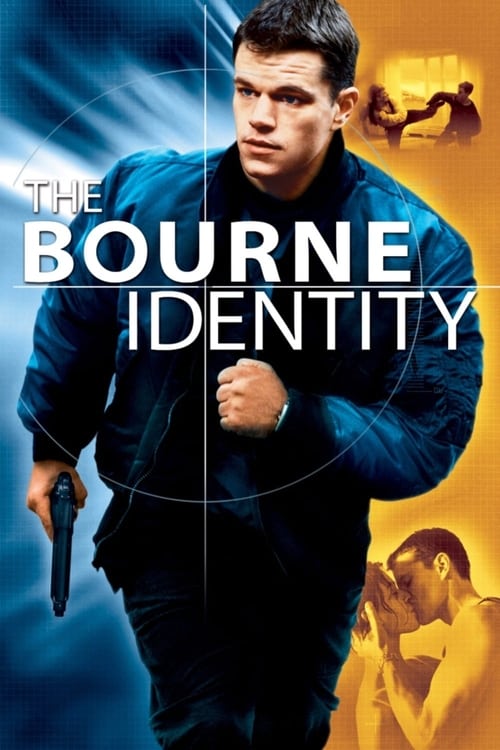
The Bourne Identity
2002 · Doug Liman
When you want a smart, propulsive thriller that grips without exhausting you — the kind you put on when 'good action movie' and 'actually good movie' need to be the same thing.
What it's about
A man is pulled from the Mediterranean with two bullets in his back and no memory of who he is. The only clue is a Swiss bank account number embedded under his skin, which leads to a safe-deposit box full of passports, cash, and a gun. As he pieces together his identity across Europe with a broke drifter named Marie, he discovers he has the reflexes and instincts of a trained killer — and that people keep trying to kill him before he can learn why.
The experience
Tense but human-scaled — the fights are fast and startling, the pursuit is constant, yet the film keeps returning to the quiet dread of a man frightened by his own skills. It moves like a thriller and lands like a mystery about yourself.
Performances
Matt Damon rebuilt his career here by playing the deadliest man in the room as anxious and watchful rather than cool, and Franka Potente grounds the film as the ordinary person swept into his orbit.
The craft
Doug Liman shoots wintry European cities like real places, not postcards, and stages combat as close, practical, and over in seconds. The famous Paris car chase in a battered Mini is a model of geography and momentum. It's action filmmaking that trusts clarity over spectacle.
Why it matters
It dismantled the tuxedo-and-gadgets spy formula and replaced it with paranoia and consequence, redrawing the genre's center of gravity — including for the franchise it was implicitly answering — for the next two decades.
Snapshot
A wounded man is pulled from the Mediterranean with two bullets in his back and no memory of who he is. A Swiss bank account number embedded in a laser capsule beneath his skin leads him to a safe-deposit box, multiple passports, bundled cash, and a Heckler & Koch pistol — a kit that suggests a life he cannot recall. The Bourne Identity is the film that dismantled the postwar spy-movie grammar and replaced it with something rawer, more paranoid, and more human. Its protagonist does not enjoy his skills; he is frightened by them. In remaking the espionage thriller around absence, confusion, and the ethical weight of trained violence, the film redrew the genre's center of gravity for the following two decades.
Industry & production
Robert Ludlum published his novel The Bourne Identity in 1980, and it was adapted once before as a 1988 ABC television movie starring Richard Chamberlain. Universal Pictures developed a feature film version through much of the 1990s before the project landed with director Doug Liman and producer Frank Marshall (of Kennedy/Marshall). The screenplay was written by Tony Gilroy and William Blake Herron, working from Ludlum's premise while largely discarding his specific Cold War plotting in favor of a post-Cold War, post-millennium conspiracy framework. Liman brought with him the production company Hypnotic, which he co-founded, and carried creative authority into territory he had not previously occupied: Swingers (1996) and Go (1999) were low-budget American indie works; this was a studio-financed European action film budgeted in the neighborhood of sixty to seventy million dollars.
Production was shot primarily on location across Europe — Paris, Zurich, and Prague (standing in for various locales) — lending the film a geographic texture that period Hollywood spy films rarely achieved. The production was troubled. Accounts consistently describe strained relations between Liman and Universal, with early cuts of the film judged unsatisfactory by the studio. Extensive reshoots and editorial revision followed, and the final film is considerably different in structure and tone from what was initially assembled. Saar Klein, the editor, worked with Liman through this protracted process. That the film emerged coherent, and in many respects artistically distinguished, testifies to what was salvaged in post-production rather than what was planned from the start. Matt Damon, already established by Good Will Hunting (1997) and Steven Soderbergh's Ocean's Eleven (2001), was cast against the muscular action-star type as Bourne — a deliberate counter-programming decision that proved central to the film's register.
Technology
The Bourne Identity was among the early major studio productions to make full use of digital intermediate (DI) color grading in post-production, employing that pipeline to achieve a slightly desaturated, high-contrast look that distinguishes it from the warmer or more bombastic palette of 1990s action cinema. The visual processing reinforces the film's mood — cold European light, institutional grays, flesh tones stripped of glamour. This color language would become a template widely imitated across the decade. The film was shot on 35mm but the DI workflow allowed frame-by-frame manipulation of the image in ways that traditional photochemical finishing could not achieve as economically. Sound design emphasized the physicality of combat — impacts, breath, environmental acoustics — rather than heightened movie-physics effects, a choice consistent with the film's broader aesthetic logic.
Technique
Cinematography
Oliver Wood shot The Bourne Identity with an approach that synthesized documentary and classical modes. The film employs handheld camerawork extensively but not uniformly: surveillance sequences and moments of urban anonymity are rendered with restless, searching movement, while the film's few moments of relative stillness — Jason and Marie's early exchanges in her apartment, the lakeside conversation with the Professor — carry a different visual temperature. Wood did not construct action on the rigid axis of classical Hollywood coverage; he built it around the camera as a presence that discovers rather than records. This gives the fights and chases an immediacy that was then unusual in American studio filmmaking. The Paris car chase, executed with a Mini Cooper through narrow streets, was photographed with several cameras including low-mounted and follow rigs, giving it tactile, spatial specificity. The film reads what became known as "shaky-cam" not as stylistic tic but as epistemological condition: the camera cannot get ahead of what Bourne knows, so it cannot get ahead of events.
Editing
Saar Klein's editing is the film's most consequential formal decision. The action sequences are cut fast — sometimes extremely fast, with individual cuts held for only a few frames — but the cutting is spatially motivated rather than arbitrary. Klein and Liman built the stairwell fight in the Treadstone safe house from a premise that Bourne must use whatever the environment offers: a pen, a rolled magazine, a body's own momentum. The editing serves this logic. Each cut transitions to the next improvised weapon or repositioning rather than to a conventional coverage angle. The larger structure of the film is compact; the running time (roughly 119 minutes) feels shorter because the editing maintains pressure on narrative information. The film's troubled post-production history means that what Klein ultimately assembled was shaped by diagnostic reediting — cutting away from sequences that did not work — and the efficiency of the final cut may owe something to that reduction.
Mise-en-scène / staging
Liman's staging in The Bourne Identity is defined by functional austerity. The Paris apartment shared by Bourne and Marie is cluttered with the particulars of a working young woman's life; the Treadstone operations center is a nondescript surveillance room that looks like an office rather than a command-and-control fantasy. These choices follow from the film's core premise: tradecraft and institutional violence exist in ordinary space. The stairwell fight — shot in what is essentially a vertical corridor — demonstrates Liman's choreographic intelligence: a constrained geography forces both character and director to work with limitation, and the resulting sequence has a spatial coherence that opens fights rarely achieve. The Zurich bank, the Gare du Nord sequence, the Paris traffic — all are rendered as places people actually inhabit rather than as backdrop. Production designer Dan Weil's work and location choices emphasize this.
Sound
John Powell's score operates at the intersection of electronic texture and lean orchestral writing, with percussion given unusual prominence. The main Bourne theme is propulsive but spare — a rhythmic cell that drives without overwhelming. Powell avoids the brass grandeur of the Bond tradition and the neo-noir jazziness of 1970s conspiracy thrillers, finding instead a sound that reads as contemporary nervous system: efficient, surveillant, never quite at rest. The score's relationship to the image is muscular rather than illustrative; it accelerates the film rather than commenting on it. Sound design elsewhere in the film prioritizes physical reality: the ambient noise of European cities, the specific acoustics of small rooms and stairwells, the unromantic sounds of actual impact.
Performance
Matt Damon's performance is the film's argumentative center. Bourne is not coolly competent in the Bond manner; he is frightened by his own competence and troubled by what his body knows without his consent. Damon plays the amnesiac condition not as convenient plot mechanics but as genuine psychological wound — the scenes in which Bourne methodically inventories his own skills (counting exits, profiling strangers at a café, analyzing sight lines without choosing to) are among the film's most precise, and Damon delivers them with a quality of alarmed self-observation. Franka Potente as Marie brings warmth and a naturalistic quality that resists the glamour-adjunct role the genre typically assigns to female leads. The pairing grounds the film's emotional logic: this is not a romance but an emergency compact, and Potente plays it that way. Chris Cooper's Conklin is bureaucratic menace rather than theatrical villainy, and Brian Cox's Ward Abbott introduces the institutional cynicism that will become the franchise's recurring antagonist-type.
Narrative & dramatic mode
The film deploys an amnesiac protagonist as a structural device that forces the narrative's exposition into the present tense. Bourne does not know what the audience slowly discovers; both viewer and character are discovering him simultaneously. This conceit, familiar from noir (most directly from the tradition inaugurated by Cornell Woolrich and adapted through films like Mirage, 1965), is here updated into institutional paranoia: the machinery hunting Bourne is not criminal but governmental, and the threat is not murder-for-hire but state-sanctioned targeted killing. The film's dramatic mode is thus the conspiracy thriller — in which the protagonist's safety depends on understanding a structure he is inside — fused with the identity crisis narrative. Bourne's question is not only "who is trying to kill me?" but "who am I?" and these two questions share an answer. The film is structured as a gradual convergence of those tracks.
Genre & cycle
The Bourne Identity belongs to the cycle of revisionist spy films that emerged in the late 1990s and early 2000s as the Cold War framework that had sustained the genre became historically unavailable. The Bond franchise had addressed this by lurching through tonal experiments; Liman's film addressed it by shifting genre registers entirely — away from fantasy adventure and toward the post-Watergate paranoia thriller that Sydney Pollack, Alan Pakula, and Costa-Gavras had developed in the 1970s. Its direct generic ancestors are Three Days of the Condor (Pollack, 1975), The Parallax View (Pakula, 1974), and to a lesser degree The Day of the Jackal (Zinnemann, 1973) — films in which the intelligence apparatus is the antagonist and the protagonist survives by wit and lateral thinking rather than technological superiority. The Bourne Identity is also, in its action sequences, a direct inheritor of John Frankenheimer's Ronin (1998), which had demonstrated that European location-based car chases and practical stunt work could generate more kinetic excitement than CGI enhancement.
Authorship & method
Doug Liman came to the project as an independent sensibility: his prior films were character-driven, improvisational-feeling, and built on naturalistic performance above genre mechanics. He brought to The Bourne Identity a cinematographic restlessness that had been appropriate to Swingers's night-world aesthetics but here became action grammar. Liman's contribution to the finished film is genuinely difficult to assess given the post-production complications, but the visual and tonal signature — the refusal of spy-movie fantasy in favor of something grittier and more spatially honest — is consistent with what he'd done before.
Tony Gilroy, who would go on to write all three subsequent Bourne films before directing Michael Clayton (2007) and Bourne Legacy (2012), was the screenplay's primary architect. His version of Ludlum's premise is notably stripped of the novel's 1970s geopolitical machinery; what Gilroy retained is the psychological premise (a man rediscovering himself through crisis) and the institutional antagonism (a government program that has lost control of its own asset). Gilroy's instinct for institutional cynicism and characters who are complicit in systems they partly deplore runs through the entire franchise.
Oliver Wood (cinematographer) had worked in television and on lower-budget features before this film; his subsequent career was shaped substantially by the Bourne aesthetic he helped create. John Powell (composer), whose subsequent work includes animated-film scores of considerable commercial success, built here what became the franchise's sonic identity. Saar Klein (editor) did not continue with the franchise's sequels, which were handed to Christopher Rouse under Paul Greengrass — the change in editorial style between the first film and its successors is one of the franchise's notable formal discontinuities.
Movement / national cinema
The Bourne Identity is an American studio production in the fullest sense — Universal financed, Hollywood cast, genre-genre product — but its production culture is emphatically European. The decision to shoot on actual European locations rather than backlot facsimiles places it within a tradition of American filmmakers using European space to achieve a texture of authenticity: the same logic that sent William Friedkin to Marseille for The French Connection (1971) and Roman Polanski to London for The Tenant (1976). Prague's dense architectural fabric and Paris's street specificity become characters. The film does not romanticize European space in the tourist register; it reads the continent as a working geography of tradecraft, transit, and institutional opacity. This distinguishes it from Bond's postcard Europe and aligns it more closely with the location-drenched, unglamorous espionage world of John le Carré adaptations.
Era / period
The film entered production before the attacks of September 11, 2001, and was released in June 2002, by which point its central anxieties — about rogue state programs, unaccountable assassination networks, surveillance infrastructure deployed against individuals without judicial oversight — had acquired a very different cultural resonance. The film's premise, in which the CIA operates a program of targeted killing conducted outside normal command accountability, read in 2002 not as Cold War history but as present-tense possibility. The post-9/11 context amplified the film's thematic weight considerably and helps account for the depth of audience identification with Bourne's position: a figure who discovers he was complicit in institutional violence and chooses disengagement. The early 2000s more broadly saw a shift in blockbuster aesthetics toward "gritty realism" — a move away from the ironic self-awareness of late-1990s genre films and toward something that wanted to be taken seriously. The Bourne Identity was among the earlier and more successful entries in this recalibration.
Themes
Identity is the film's explicit subject, and it operates at multiple levels simultaneously. Bourne's amnesia is a literalization of the film's central question — what is the self when stripped of memory, and is identity constituted by history or by action in the present? The film's answer is quietly unsettling: Bourne's body knows what his mind does not, and what his body knows is how to injure and kill efficiently. His professional competence is divorced from his conscious self, which means that the film poses the problem of agency in unusually stark terms. Is a trained killer still accountable when he cannot remember training?
Running through this is a critique of institutional loyalty: Treadstone was a program Bourne chose to enter, but the film suggests that choice was made under conditions he can no longer evaluate, and that the institution has no loyalty reciprocating what it demanded from him. The theme of the state as antagonist — of official power operating lethally against individuals who have become inconvenient — places the film in direct conversation with the post-Watergate tradition, updating it from Nixon-era scandal to the post-Cold War bureaucratic landscape.
The film also engages, more quietly, with a redefinition of action-film masculinity. Bourne is not invulnerable; he is concussed, cold, confused, and frightened. He weeps. His relationship with Marie is built on gratitude and mutual vulnerability rather than seduction. The film's emotional texture centers on his distress rather than his prowess, which made it substantially different from its genre contemporaries.
Reception, canon & influence
Critical reception at the time of release was broadly positive but not uniformly enthusiastic; some reviewers found the European location work and narrative economy admirable while others were uncertain about Damon as action lead. The film performed well commercially and generated enough momentum to greenlight a franchise, though precise figures are not reproduced here.
Influences on the film run primarily through the paranoia-thriller tradition: Pakula's Parallax View and Pollack's Condor are the most direct formal ancestors. Frankenheimer's Ronin provided the model for location-based European action. The Bond franchise, implicitly, is the tradition being argued against — and the argument is made through systematic inversion of its conventions. The cinéma vérité tradition, particularly the handheld work in films like The Battle of Algiers (Pontecorvo, 1966), and the New Hollywood's assimilation of that tradition in the 1970s, inform the cinematographic choices. Among fight-film traditions, the film draws on the practical, improvisational close-quarters combat style that distinguished it from both the martial arts spectacle of Hong Kong action and the operatic choreography of The Matrix (1999).
Legacy is substantial and largely uncontested. The two Paul Greengrass sequels — The Bourne Supremacy (2004) and The Bourne Ultimatum (2007) — built on the foundation of this film to develop an even more radical editorial style (Greengrass's technique with Christopher Rouse pushed the cutting rate further), and together the trilogy constitutes one of the more coherent franchise projects in contemporary Hollywood. More broadly, The Bourne Identity's influence on the spy genre is direct and documented: producers of Casino Royale (Campbell, 2006) explicitly cited the Bourne franchise as the model for the Bond reboot with Daniel Craig, and Craig's Bond borrowed Bourne's psychological interiority, physical vulnerability, and moral ambivalence. Beyond the spy genre, the film's action aesthetic filtered widely into the decade's action filmmaking — its influence is visible in films as distinct as Captain America: The Winter Soldier (Russo Brothers, 2014), in the "grounded" superhero turn, and in the general drift of studio action films toward handheld camerawork, fast cutting, and location authenticity. The ambivalence about this inheritance is reasonable: the film's intelligent use of kinetic cinematography generated, in less disciplined hands, a decade of incoherent shaky-cam action filmmaking in which spatial disorientation was mistaken for excitement. That the original manages visceral energy and spatial legibility simultaneously is something its imitators frequently failed to replicate.
A Deleuzian reading
He doesn't know his name, but he knows the room.
The full Deleuzian reading of The Bourne Identity →
Reception
A hit on release in 2002 but treated as a solid mid-budget thriller rather than an event; it's since been reappraised as the film that rewired the modern action-spy genre — the one Bond had to answer with Casino Royale. Its famously troubled production (delays, reshoots, studio clashes) is now part of the legend of how good it turned out.
How The Bourne Identity was received, from release to now →
Influences: the films it descends from and the films it influenced
- The Manchurian Candidate (1962) — Establishes the conditioned/amnesiac operative structure: Raymond Shaw's horror at his own programd actions is the direct template for Bourne's alarmed self-observation of trained reflexes he cannot consciously recall authorizing.
- The Spy Who Came in from the Cold (1965) — Oswald Morris's high-contrast, near-colorless cinematography of cold European locations and the institutional-betrayal premise—protagonist used and discarded by his own service—establish the revisionist-spy aesthetic and moral framework Bourne systematically inherits.
- Point Blank (1967) — Walker's stripped-down engagement with institutional machinery—a man seeking to reclaim himself from a system that used him—and the staging austerity of functional, depopulated spaces establish the aesthetic and thematic grammar Liman applies to Bourne's Treadstone sequences.
- Le Samouraï (1967) — Melville's principle of staging the professional world through what is absent—minimalist rooms, withheld emotion, comportment as the only legible interiority—is the direct model for Liman's functional austerity in Bourne's safe house and apartment sequences.
- The French Connection (1971) — Owen Roizman's handheld cinematography in pursuit sequences—camera as physical participant that discovers rather than records—established the discovery-mode methodology Oliver Wood systematized; the elevated train chase is the prototype for treating the camera as a body in spatial jeopardy.
- The Parallax View (1974) — The convergent conspiracy structure—a protagonist who investigates only to find himself already ensnared—and Gordon Willis's underlit, claustrophobic framing established the visual and narrative grammar of post-Watergate institutional paranoia that Gilroy's screenplay directly channels.
- Three Days of the Condor (1975) — The structural premise of a CIA analyst who discovers his own organization is hunting him—and who takes a woman captive who becomes an ally—is the direct narrative template for Bourne's convergent-identity-conspiracy and the functional logic of the Marie relationship.
- Ronin (1998) — The Paris car chase sequences in Bourne directly inherit Ronin's practical-stunt methodology: cameras mounted on vehicles, real Paris streets driven at speed, zero CGI augmentation, and a philosophy that danger must be photographed rather than constructed digitally.
- Traffic (2000) — The first major American studio film to use digital intermediate color grading as a primary narrative tool—extreme hue manipulation coded to story geography—demonstrating the DI pipeline that Liman and Wood adopted for Bourne's institutional-gray desaturation.
- The 39 Steps (1935) — Carries the double-chase architecture and precarious-innocence premise into modern action, with a protagonist pursued by state and criminal forces and a reluctant female companion drawn into the flight.
- Go (1999) — Liman carries Go's restless handheld, momentum-first camera directly into the franchise, turning the small-budget kinetic style into the industry-altering template for modern shaky-cam action.
- The Bourne Supremacy (2004) — Greengrass radicalized Bourne's handheld discovery mode by making the camera's physical presence unmistakable: the Goa opening and Moscow car chase extend the methodology into full kinetic fragmentation where image instability becomes an epistemological condition rather than a stylistic option.
- Casino Royale (2006) — The Bond franchise's explicit structural response to Bourne: stripped of gadgetry and irony in favor of physical vulnerability, grounded combat staging, and Craig's alarmed, self-questioning performance mode—a wholesale adoption of Bourne's revisionist-spy grammar applied to a legacy property.
- United 93 (2006) — Greengrass transferred Bourne's discovery-mode cinematography and spatially-motivated fast cutting to documentary reconstruction, demonstrating the methodology could achieve tragic weight outside genre action—the confined-geography choreography of the cabin interior is formally continuous with Bourne's stairwell fight.
- Hanna (2011) — A trained-from-birth operative discovering her own constructed nature across European locations, with the Chemical Brothers' percussion score functioning as a direct heir to John Powell's rhythmic-impact approach on the Bourne series.
- Haywire (2011) — Soderbergh cast MMA fighter Gina Carano to achieve physical-impact sound design through actual bodily contact—no augmented foley—a systematic extension of Bourne's principle that combat must register materially rather than cinematically.
- Sicario (2015) — Sheridan's screenplay applies Gilroy's institutional-cynicism methodology—agencies pursuing goals orthogonal to stated mandates, a protagonist operationalized without being told the real mission—while Deakins' high-contrast desaturation extends the Bourne DI palette into the cartel-war context.
- Atomic Blonde (2017) — The stairwell fight sequence explicitly invokes Bourne's spatially-motivated confined-geography combat logic—each cut to the next improvised use of the environment, fatigue accumulating across the take—while the European Cold War identity-conspiracy structure inherits Bourne's convergent-paranoia narrative grammar.
- Shooter (2007) — The rogue operative framed by his own handlers, with Doug Liman's desaturated digital intermediate palette and the conspiracy-thriller architecture of a skilled professional dismantling the institutional apparatus that betrayed him — Shooter adopts both the visual grammar and the wronged-operative narrative logic wholesale.
- Edge of Tomorrow (2014) — Liman developed his camera-tracks-competence method here — handheld coverage that registers a protagonist's growing mastery through increasingly fluid, legible action staging — and carried it directly into EoT; the technique of calibrating camera behavior to the character's current skill level is a continuity of Liman's authorship across both films.
- Mission: Impossible III (2006) — Models the post-Bourne grounded operative whose emotional stakes hinge on a domestic anchor (the lover/civilian), the template for III's marriage-versus-mission spine.
- Safe House (2012) — Originated the post-Cold-War rogue-asset-on-the-run template and Oliver Wood's desaturated, vérité spy look that Safe House inherits as its default visual identity.
- The Berlin File (2013) — Pioneered the grounded close-quarters fight built from improvised domestic weapons and economical takedowns, the realist hand-to-hand idiom Ryoo adopts over wushu flourish.
- Spy Game (2001) — Produced simultaneously and sharing Gilroy-parallel institutional cynicism—the CIA as an organization that sacrifices its operatives for bureaucratic convenience—but executed through Scott's baroque multi-camera fragmentation rather than Liman's functional austerity.
- Mission: Impossible (1996) — Shares M:I's post-Cold-War spy-paranoia and amnesiac-betrayal structure, but answers De Palma's classical suspense staging with handheld immediacy — a deliberate counter-grammar to the same genre problem.
- The Sum of All Fears (2002) — Same-year sibling reinventing the post-Cold-War espionage everyman with institutional-neutral, documentary-leaning realism — the competing 2002 template for the intelligence thriller.
- The Bourne Legacy (2012) — Established the franchise's handheld, available-light realism and the trained-agent-improvising-with-found-objects fight grammar that Legacy inherits wholesale, down to Moby's 'Extreme Ways' as the recurring end-credit signature.
Similar films
- The Bourne Supremacy (2004) — influence & lineage · same viewing thread
- Ronin (1998) — influence & lineage · same viewing thread
- Casino Royale (2006) — influence & lineage
- The Bourne Ultimatum (2007) — same viewing thread
- Nikita (1990) — same viewing thread
- Jason Bourne (2016) — shared sensibility
- The Bourne Legacy (2012) — shared sensibility
- Memento (2000) — shared sensibility
All the films related to The Bourne Identity →
Watch it with: curated runs of related films
- The Silent Professional — A run of lethal loners who move through the world with monkish economy — watch them back to back for pure, terse competence under pressure and men who just want to disappear.