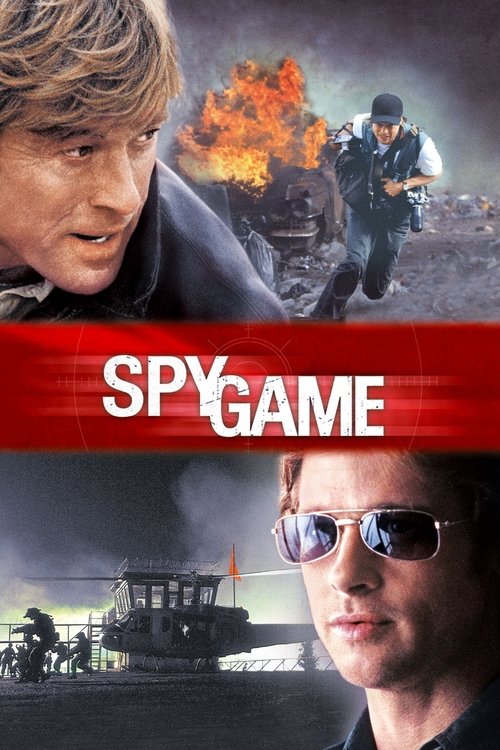
Spy Game
2001 · Tony Scott
When you want a smart, kinetic Friday-night thriller — clever without being homework, tense without being grim. Reach for it when you're in the mood to watch a pro outmaneuver an entire institution using nothing but a phone and his wits.
What it's about
On the morning of his retirement, veteran CIA officer Nathan Muir learns that his former protégé Tom Bishop has been captured on an unauthorized operation in China and will be executed within twenty-four hours — and that the Agency, protecting a delicate trade deal with Beijing, plans to let him die. Muir spends his last day at Langley stalling an internal debriefing while quietly working the system to save him. Woven through that ticking clock is the whole history of the two men: recruitment in Vietnam, apprenticeship in Cold War Berlin and Beirut, and the betrayal that split them apart.
The experience
A propulsive, restless thriller that somehow doubles as a mentor-and-protégé character study — you're leaning forward for the clock and staying for the friendship. It's slick and fast-cut but genuinely smart about how spies actually work: the tension comes from conversation, misdirection, and paperwork as much as gunfire.
Performances
Robert Redford is at his craftiest — an old lion running rings around bureaucrats twenty years younger — and Brad Pitt gives Bishop real idealistic heat, so the flashbacks feel like watching a conscience being built and then bruised.
The craft
Tony Scott's signature style at full tilt: saturated color, restless camera, aggressive cutting between the real-time countdown at Langley and decades of flashback across Vietnam, Berlin, and Beirut — and the structure never loses you. The globe-hopping texture and dense sound mix reward a big screen and good speakers.
Why it matters
One of the defining pairings of Redford and Pitt — the old-school star and his heir apparent — and a high-water mark for Tony Scott's brand of glossy, muscular studio thriller, arriving just as the spy genre pivoted into a grittier post-9/11 mode.
Snapshot
Spy Game is a procedural espionage thriller built as a duel against the clock and against memory. On the morning of his retirement from the CIA, veteran case officer Nathan Muir (Robert Redford) learns that his estranged protégé, Tom Bishop (Brad Pitt), has been captured during an unauthorized operation in China and is scheduled for execution within twenty-four hours — and that the Agency, fearing the collapse of a delicate trade rapprochement with Beijing, intends to disown him. The film unfolds across that single day at Langley, where Muir slow-walks an internal debriefing while quietly engineering a rescue the institution has forbidden. Interleaved with this real-time present (set in 1991) is the long flashback history of the two men: Muir's recruitment of Bishop as an Army sniper in Vietnam, his tradecraft apprenticeship in Cold War Berlin, and the Beirut operation where their partnership fractured over a woman and over competing definitions of loyalty. Directed by Tony Scott at the height of his hyper-stylized late period, the picture marries a movie-star generational pairing — the iconic 1970s leading man mentoring the iconic 1990s one — to a kinetic, information-saturated form. It is at once a glossy two-hander and a film about institutions that spend human beings as currency.
Industry & production
Spy Game was produced by Beacon Pictures (Marc Abraham and Douglas Wick among the producing figures) and distributed by Universal Pictures, opening in the United States in November 2001. It arrived as a star-driven adult thriller of a kind the major studios still routinely financed at the turn of the millennium, before the franchise economy narrowed that space. The central commercial proposition was the casting: Robert Redford, whose own star image is inseparable from 1970s paranoia cinema (Three Days of the Condor, All the President's Men), opposite Brad Pitt, then among the most bankable actors of his generation. The pairing is itself a piece of industrial meaning — a literal passing of the torch staged as a recruitment-and-betrayal narrative.
The release date proved consequential. The film opened roughly two months after the September 11 attacks, into a culture suddenly and intensely preoccupied with intelligence failure, with the moral conduct of clandestine services, and with the costs of expendability. A breezy entertainment about the CIA's willingness to abandon its own operatives landed in an altered atmosphere; the picture's commercial performance was respectable rather than spectacular, and the specifics of its box-office returns I won't quote precisely, as I cannot verify exact figures. What is clear is that Spy Game belongs to a moment when the spy thriller was about to be remade — the same window that produced the first Jason Bourne film the following year.
Technology
The film was shot photochemically on 35mm, and much of its distinctive look is the product of laboratory and optical processes rather than digital ones, consistent with Scott's working methods at the time. The hallmark techniques — step-printing (skip-frame and double-printing to create stuttering, smeared motion), heavy color timing toward bleached, monochromatic palettes keyed to each locale, flash frames and grain — were achieved through in-camera choices and the lab. Title cards and on-screen text (locations, dates, countdown-to-execution time stamps) are integrated graphically to keep the audience oriented across a structure that constantly cuts between continents and decades. The countdown device — the running clock toward Bishop's scheduled execution — is the film's organizing temporal technology, a ticking-clock superimposed on a narrative that otherwise moves freely through time.
Technique
Cinematography
Dan Mindel, who had shot Enemy of the State (1998) for Scott, photographs Spy Game in the director's mature idiom: long telephoto lenses that compress space and isolate figures within busy frames, restless handheld and crane movement, and a relentless coverage strategy that gives the editor an abundance of angles. The signature gesture is the assignment of a distinct chromatic and textural signature to each time-and-place: the Vietnam and Beirut sequences run hot, grainy and amber; Cold War Berlin is rendered in cold blues and grays; the Langley present is a controlled corporate palette of glass, fluorescents and conference-room neutrality. This is expressive geography as much as design — the audience reads location and era instantly from color temperature. Mindel's camera rarely rests; even dialogue scenes are shot with the slightly destabilized, documentary-adjacent energy that became Scott's late trademark.
Editing
The film's editing is its most aggressive formal feature. The cutting is fast, fragmentary, and associative, frequently splintering a single action into multiple overlapping fragments and threading the present-day debrief into the flashbacks so that past and present comment on each other in near-continuous cross-cut. The countdown clock makes the editing thematically loaded: every cut is, implicitly, time draining away. The flashback architecture — three major operations (Vietnam, Berlin, Beirut) nested inside one real-time day — is held together almost entirely in the cutting room, and the picture's coherence under such density is a genuine editorial achievement. (Tony Scott's pictures of this period were cut by collaborators including Christian Wagner and Chris Lebenzon; I'd attribute the specific credit cautiously rather than misstate it.)
Mise-en-scène / staging
Scott stages the present-day frame as a chamber piece of bureaucratic warfare: a long table, a roomful of mid-level officials, telephones and faxes, and Muir reading the room and manipulating procedure. Against this static institutional space, the flashbacks deliver the genre's physical spectacle — rooftops, marketplaces, a sniper's perch, the textures of war-zone Beirut and a divided Berlin. The contrast is structural: the older man fights with paperwork and bluff in a sealed room while the remembered field operations supply movement and danger. Production design distinguishes the eras through period detail, vehicles and communications technology, reinforcing the editing's chronological signposting.
Sound
Harry Gregson-Williams's score is propulsive and percussive, blending orchestral writing with electronic pulse and rhythmic loops — a sound that drives the momentum and underlines the countdown. The sound design layers radio chatter, surveillance audio, ambient war-zone noise and the clipped cadences of tradecraft communication, so that the film's auditory texture is itself about information moving through channels. Music and cutting are tightly synchronized, the score functioning less as emotional underscore than as a metronome for the plot's accelerating clock.
Performance
The film rests on the contrast between its two leads. Redford plays Muir as a man of practiced surfaces — wry, controlled, perpetually three moves ahead, his warmth weaponized as a tool of manipulation. It is a performance built on withholding, and on the audience's accumulated memory of Redford's own screen history. Pitt's Bishop is the idealist who keeps colliding with the job's amorality, more openly emotional and more easily wounded; the arc of his disillusionment is the moral engine of the flashbacks. Catherine McCormack, as the aid worker Elizabeth Hadley whose entanglement with Bishop precipitates the rupture with Muir, carries the film's argument about whether private loyalty can survive inside the clandestine life. The supporting players in the Langley sequences function largely as institutional types — the bureaucrats weighing one man's life against policy.
Narrative & dramatic mode
The dramatic engine is dual: a real-time rescue thriller (can Muir save Bishop within the day, and outwit his own employer?) braided with a memory-play that reconstructs how mentor and protégé arrived at this point. The flashback structure is essentially detective-like in reverse — the present-day interrogation pretends to be about extracting Muir's knowledge for the Agency's benefit, while Muir uses the very act of recounting the past to buy time and lay the groundwork for his covert intervention. The film thus dramatizes the gap between the story a spy tells and the operation he is running underneath it; narration itself becomes tradecraft. The mode is classical in its clarity of stakes and ticking-clock construction, but modernist in its temporal fragmentation. Its emotional payoff turns on a withheld reveal about how far Muir is willing to go, recasting the ostensibly cynical mentor as the film's moral actor.
Genre & cycle
Spy Game sits at the intersection of the Cold War espionage tradition and the post–Cold War, globalized action-thriller. It inherits from the morally ambivalent spy fiction of the le Carré lineage — the theme of agents betrayed by their own services, the bureaucratic coldness of the trade — but delivers it through the high-velocity Hollywood action grammar Scott helped codify. It belongs to a turn-of-the-millennium cycle of CIA-centered pictures preoccupied with institutional betrayal and the ethics of intelligence work, and it sits chronologically just before the genre's reinvention by the Bourne films, whose handheld, ground-level realism would soon make Scott's glossy maximalism feel like the end of an era rather than the start of one. Within Scott's own filmography it is a companion piece to Enemy of the State, sharing surveillance-state anxieties and a fascination with information as both weapon and texture.
Authorship & method
Tony Scott directs Spy Game in the fully developed version of the style that distinguished him from the cleaner classicism of his early hits (Top Gun, Days of Thunder) and from his brother Ridley's more painterly compositions. By 2001 Scott had committed to a restless, processed, information-dense aesthetic — step-printing, saturated-then-bleached color, telephoto compression, hyperactive cutting — that he would push to near-abstraction in his subsequent films (Man on Fire, Domino, Déjà Vu). Spy Game is one of the more disciplined applications of that method, because its three-tiered time structure imposes a clarifying logic on the stylistic excess. His key collaborators here are recognizably part of his repertory company: cinematographer Dan Mindel, fresh from Enemy of the State, and composer Harry Gregson-Williams, who became one of Scott's most frequent musical partners across the 2000s. The screenplay is credited to Michael Frost Beckner and David Arata, working from Beckner's story; its principal authorial contribution is the nested flashback architecture and the late-film moral inversion that reframes Muir. The synthesis of these elements — Mindel's geographically coded images, Gregson-Williams's pulse, the propulsive cutting, and the two stars' contrasting registers — is unmistakably Scott's, an action filmmaker applying spectacle technique to a fundamentally talky, structural story.
Movement / national cinema
The film is a product of mainstream American studio filmmaking, but it is interestingly transatlantic in sensibility. Tony Scott emerged, like Ridley, from the British advertising world (Ridley Scott Associates), and that commercial-image background underlies the brothers' shared fluency with surface, texture and montage. Spy Game applies that polished, internationalist visual language to a global canvas — Vietnam, Berlin, Beirut, Beijing, Washington — reflecting Hollywood's turn-of-the-century habit of staging American power across a borderless map. It is not affiliated with any art-cinema movement; its lineage is the commercial high-style action film, a transatlantic studio idiom rather than a national one.
Era / period
The film is doubly period-bound. Its present-day frame is set in 1991, in the immediate aftermath of the Cold War and against the backdrop of post-Tiananmen tensions with China, which motivates the geopolitical caution that makes Bishop expendable. Its flashbacks reach back across the late Cold War — Vietnam in the mid-1970s, Berlin before the Wall's fall, Beirut in the 1980s — so the film is partly a survey of the clandestine theaters of that whole epoch. But it was made and released in 2001, and its sensibility is firmly of the late-1990s/early-2000s thriller. The collision between its Cold War subject matter and its post-9/11 release moment is the most historically charged thing about it: a film about discarding an intelligence asset, arriving precisely when American audiences had become acutely conscious of what intelligence services do and fail to do.
Themes
The governing theme is institutional expendability — the truth that the organization will sacrifice the individual the moment he becomes a liability, and that loyalty inside such a system is structurally one-directional. Around this orbit several others: mentorship as a form of manipulation and inheritance (Muir makes Bishop in his own image, then must decide whether to honor or override the cold pragmatism he taught him); the conflict between professional detachment and human attachment, crystallized in the Beirut storyline where Bishop's personal loyalty to Elizabeth violates the rules Muir lives by; and the nature of information, identity and performance — the spy as someone whose every relationship is partly an operation, whose storytelling is itself a maneuver. The film's final movement argues, against its own cynical surface, that the deepest tradecraft can be turned to an act of loyalty — that Muir's lifetime of manipulation is redeemed by deploying it, one last time, to save a man the system wants dead.
Reception, canon & influence
Critically, Spy Game was received as a slick, well-crafted, star-powered entertainment — admired for the Redford–Pitt chemistry and the confidence of its construction, while drawing the recurring reservation that attended Scott's work of this period: that the relentless stylization and frenetic cutting can hold genuine feeling at arm's length, prioritizing momentum and surface over depth. Reviews frequently noted the pleasure of watching Redford, the genre's old hand, mentor Pitt both within the fiction and as a matter of star lineage. I'd characterize the reception as broadly favorable rather than rapturous; for specific aggregate scores or quotations I'd defer to the record rather than reconstruct them from memory.
Looking backward, the film draws on the morally disenchanted spy tradition associated with John le Carré and on the 1970s American paranoia thriller — a lineage Redford's casting invokes directly, given Three Days of the Condor's portrait of a CIA that turns on its own. Its flashback-driven, time-jumping construction belongs to a broader turn-of-the-millennium fashion for fractured chronology. Stylistically it is the culmination of techniques Scott had been refining since True Romance and Crimson Tide and had intensified in Enemy of the State.
Looking forward, Spy Game sits at a hinge point in the spy genre. Within a year, The Bourne Identity (2002) would inaugurate a grittier, handheld, ground-level realism that quickly became the dominant register for screen espionage, somewhat dating Scott's glossier maximalism. Yet Scott's own influence on the form of the 2000s action film — the processed color, the assaultive cutting, the information-dense frame — proved pervasive, visible across action and television aesthetics of the decade and carried forward by the directors and craftspeople who absorbed his methods. The film's enduring place is less as a canonical landmark than as a representative and unusually well-disciplined specimen of Tony Scott's distinctive late style, and as a poignant artifact of the precise moment — late 2001 — when the culture's relationship to its intelligence services was being rewritten beneath the picture's feet.
A Deleuzian reading
Start with the clock.
The full Deleuzian reading of Spy Game →
Reception
A mid-tier performer when it landed in the jittery post-9/11 November of 2001, Spy Game has ridden the great Tony Scott reappraisal — since his death in 2012, it's regularly reclaimed as one of his sharpest, most disciplined films rather than just a slick star vehicle.
How Spy Game was received, from release to now →
Influences: the films it descends from and the films it influenced
- Three Days of the Condor (1975) — Redford's casting as a CIA man hunted by his own agency is imported wholesale — Spy Game weaponizes that paranoia-thriller iconography so the audience reads Muir, from frame one, as someone the institution will quietly expend.
- The Spy Who Came in from the Cold (1965) — Le Carré's bookkeeping of agents as expendable currency — the asset knowingly traded away — supplies the moral arithmetic behind the film's late inversion of Muir's loyalties.
- The Parallax View (1974) — Establishes the bureaucratic-conspiracy chamber piece where dread is carried by hearing rooms, dossiers and clocks rather than gunplay — the lineage of Spy Game's real-time interrogation frame.
- The Conversation (1974) — Codifies surveillance as both subject and sensory grammar — wiretaps, intercepts and re-scanned recordings as texture — the template for Spy Game's eavesdropping sound design.
- All the President's Men (1976) — Gordon Willis's telephoto compression flattening figures against institutional architecture, plus the patient assembly of fragments into a picture, prefigures Spy Game's long-lens spycraft procedural.
- JFK (1991) — Pioneers the information-dense montage that braids multiple film stocks and timeframes through fragmentary cross-cutting — the editorial vocabulary Scott repurposes for the nested flashback.
- Natural Born Killers (1994) — Normalizes step-printing and saturated-then-degraded processed imagery as expressive register, the exact textural toolkit Scott would adopt and discipline by 2001.
- True Romance (1993) — Scott's first sustained break from Top Gun classicism into nonlinear sympathy and lyrical saturation — the early laboratory for the maximalist style Spy Game perfects.
- Crimson Tide (1995) — A talky, two-men-in-a-chamber moral standoff dressed in spectacle technique — proof of Scott's method of applying an action director's grammar to a fundamentally structural, dialogue-driven story.
- Enemy of the State (1998) — Dan Mindel's cinematography and the satellite/intercept-screen surveillance apparatus carry directly into Spy Game's information-dense, geographically coded frame.
- The Bourne Supremacy (2004) — Inherits Scott's assaultive cutting and surveillance tradecraft but swaps glossy telephoto for handheld vérité — the grittier register that displaced and dated Scott's maximalism.
- Man on Fire (2004) — Pushes Spy Game's step-printing, on-screen subtitle graphics and fragmentary cross-cutting toward near-abstraction, the style freed from the clarifying discipline of a three-tiered structure.
- Déjà Vu (2006) — Literalizes the surveillance texture and nested-time construction into the plot itself — an apparatus that watches and replays the past becomes the narrative engine.
- Syriana (2005) — Extends the geographically labeled, color-coded multi-strand espionage map while making the institution's casual expendability of its own operatives the central theme.
- Tinker Tailor Soldier Spy (2011) — Returns the genre to the bureaucratic chamber piece and dramatizes mentorship-as-betrayal within an agency hierarchy — the le Carré moral architecture Spy Game gestures toward, played without the stylization.
- The Limey (1999) — Shares the turn-of-millennium vogue for cutting memory as associative, fragmentary flashback rather than linear exposition — chronology shattered and reassembled emotionally.
- Out of Sight (1998) — Builds romance through a nested flashback architecture punctuated by freeze-frames and step-printed accents, the same time-jumping construction Spy Game uses to thread the Muir–Bishop bond.
- 24 (2001) — Premiering the same season, it makes the real-time frame, ticking clock and split-screen information density the default grammar of screen espionage — a parallel evolution of Spy Game's countdown structure.
- The Bourne Identity (2002) — Produced simultaneously and sharing Gilroy-parallel institutional cynicism—the CIA as an organization that sacrifices its operatives for bureaucratic convenience—but executed through Scott's baroque multi-camera fragmentation rather than Liman's functional austerity.
- Clear and Present Danger (1994) — Descendant that extends the agency-procedural — a real-time briefing-room race against the clock where paperwork, deniability, and a sanctioned-then-abandoned operative are the engine of suspense.
Similar films
- Three Days of the Condor (1975) — influence & lineage · same viewing thread
- Enemy of the State (1998) — influence & lineage · same viewing thread
- Tinker Tailor Soldier Spy (2011) — influence & lineage
- The Spy Who Came In from the Cold (1965) — influence & lineage
- Syriana (2005) — influence & lineage
- The Bourne Supremacy (2004) — influence & lineage
- Déjà Vu (2006) — influence & lineage · same viewing thread
- Crimson Tide (1995) — influence & lineage · same viewing thread
All the films related to Spy Game →
Watch it with: curated runs of related films
- Inside the Security State — A run of modern espionage and national-security thrillers — globe-trotting spycraft, submarine brinkmanship, and the paper trail behind the black sites — where operatives and investigators race secretive institutions and catastrophic clocks.