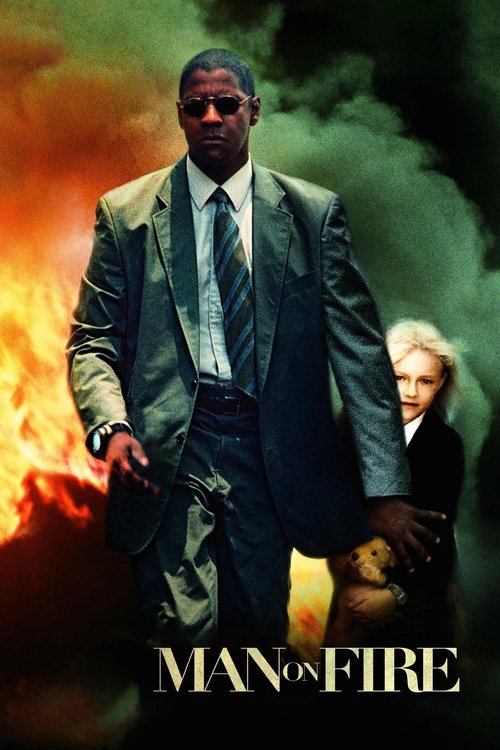
Man on Fire
2004 · Tony Scott
When you want a revenge movie with an actual heart — something that makes you care before it lets you rage. Not a casual watch; reach for it when you're up for intensity.
What it's about
In a Mexico City gripped by a kidnapping epidemic, a burnt-out ex-CIA operative — drinking heavily and barely holding himself together — takes a bodyguard job he doesn't want: protecting the ten-year-old daughter of a wealthy family. The girl chips away at his armor, and an unlikely, genuinely moving bond forms. Then she is taken, and the film becomes something else entirely: a man with nothing left to lose, working methodically through everyone responsible.
The experience
Two movies in one — a tender, patient character piece that earns real feeling, then a furious, sensory-overload revenge machine. The style is aggressive: jittery cuts, scorched colors, subtitles that slam onto the screen. It's punishing and cathartic in equal measure, and it wrings you out.
Performances
Denzel Washington gives the film its soul, playing self-loathing and slow-thawing warmth with equal conviction before shifting into cold, terrifying purpose. Dakota Fanning, still a child, holds the screen opposite him and makes the bond believable — the whole film rests on their chemistry, and it holds.
The craft
Tony Scott shatters conventional action grammar on purpose — hand-cranked cameras, layered exposures, editing that mimics a fractured mind — so the style itself feels like grief and fury. It's a maximalist sensory experience that demands good speakers and full attention.
Why it matters
The high-water mark of Tony Scott's late, radical style and one of the defining Denzel Washington collaborations — its hyper-stylized visual language echoed through action filmmaking for the next decade.
Snapshot
Man on Fire is Tony Scott's most aggressive fusion of pulp revenge melodrama and avant-garde formal violence — a film in which the grammar of the action thriller is deliberately shattered to mimic the broken interior of its protagonist. Adapted from A.J. Quinnell's 1980 novel by screenwriter Brian Helgeland, it stars Denzel Washington as John Creasy, a burnt-out former CIA/Force Recon operative who takes a bodyguard job protecting Pita Ramos (Dakota Fanning), the young daughter of a wealthy Mexico City family. The film falls cleanly into two movements: a slow, tender relationship drama in which the suicidal, alcoholic Creasy is humanized by the child, and a scorched-earth revenge campaign after her kidnapping. It marked the second collaboration between Scott and Washington (after Crimson Tide, 1995) and is the picture in which Scott's late, hyper-stylized manner — saturated color, subliminal cutting, on-screen typography, step-printing — fully crystallized. Critically divisive on release for its length and brutality, it has since become a touchstone for its tonal audacity and a landmark in Washington's gallery of avenging-father roles.
Industry & production
The film was produced and distributed through 20th Century Fox, with Scott and Lucas Foster among the producing principals (Scott's Scott Free banner being central to his output of the period). Quinnell's novel had already been filmed once, in 1987, by Élie Chouraqui with Scott Glenn as Creasy and Joe Pesci in support — a French-Italian co-production set on the Italian Riviera that made little impact. Scott's version is best understood as a wholesale relocation and reinvention rather than a remake of that film: the action moves from Italy to Mexico City, anchoring the story in the very real wave of kidnappings-for-ransom that plagued Mexico and other Latin American capitals in the late 1990s and early 2000s. This grounding is not incidental — the film opens with a statistical title card framing the epidemic, lending its lurid revenge fantasy a documentary alibi.
Production was based largely in and around Mexico City, and the city itself functions as a character: its scale, its corruption, its class stratification between gated wealth and street-level menace. Casting reinforced the regional specificity — Mexican and Latin American performers including Giancarlo Giannini (as a journalist), Rachel Ticotin, and the singer-actor Marc Anthony populate the supporting roles, alongside Radha Mitchell and Marc Anthony as Pita's parents, Christopher Walken as Creasy's old comrade Rayburn, and Mickey Rourke as a compromised attorney. Reliable budget and gross figures should be treated with some caution, but the film was a sizable studio production that performed solidly at the box office and well above its costs — I won't cite a precise number I can't verify.
Technology
Man on Fire is a transitional artifact in the shift from photochemical to digital-inflected image-making. It was shot on 35mm film but its visual identity is overwhelmingly a product of aggressive post-production: a digital intermediate-era color grade pushing extreme saturation and split-toned palettes (Creasy's pre-redemption world bled of warmth, the revenge sequences scorched in oranges and bruised blues), combined with optical and digital manipulation of frame rate and exposure. The most conspicuous technological signature is its integration of typography directly into the image — subtitles for Spanish dialogue do not sit passively at the bottom of the frame but slide, enlarge, jitter, and emphasize words as graphic elements. This treatment of text as kinetic design anticipated a broader 2000s trend of motion-graphic title and subtitle work and is among the film's most imitated devices. The picture's reliance on the DI to build mood from manipulated film stock places it firmly in the moment when the timing suite became a primary authorial instrument.
Technique
Cinematography
The cinematography is credited to Paul Cameron. The shooting style is restless and handheld-leaning, favoring long lenses, shallow focus, smeared backgrounds, and a near-constant sense of instability. Cameron and Scott build the first half on a relatively warmer, more legible register to sell the Creasy-Pita bond, then escalate into a fractured visual scheme for the revenge half. The film's "look" cannot be fully separated from its editing and grade, since exposure flicker, blown highlights, and color shifts are deployed shot-to-shot rather than scene-to-scene. The result is an image that feels perpetually agitated — the camera registering the world the way a hypervigilant, half-drunk soldier might.
Editing
Editing, by Christian Wagner, is the film's signature technique and the engine of its style. Scott and Wagner deploy step-printing, repeated and stuttered frames, jump cuts, ramping, flash inserts, and graphic-match collisions that fragment continuous action into shards. Dialogue scenes are sometimes recut against themselves; violent set-pieces dissolve into near-abstraction. The cutting is explicitly subjective — it externalizes Creasy's dissociation, his alcoholic blur, and later his vengeful tunnel vision. This is montage as psychology rather than as mere kineticism, distinguishing it from conventional action coverage. The approach is continuous with what Scott would push even further in Domino (2005) and refine in Déjà Vu (2006), and it remains the most debated aspect of the film: detractors found it exhausting and incoherent, admirers read it as expressionist first-person cinema.
Mise-en-scène / staging
Staging exploits the vertical and horizontal extremes of Mexico City — penthouse interiors and pools above, choked streets and improvised criminal lairs below. The film stages intimacy and atrocity with the same density of texture: cluttered, lived-in frames, religious iconography, water motifs (the swimming pool where Pita trains as a competitive swimmer becomes a recurring emotional anchor). The revenge sequences are staged as procedural torture and interrogation, escalating in cruelty, with Creasy moving up a chain of culpability. The mise-en-scène consistently juxtaposes Catholic imagery against violence, framing Creasy's campaign as both damnation and a perverse sacrament.
Sound
Harry Gregson-Williams's score is eclectic and genre-crossing, mixing orchestral, electronic, and Latin-inflected textures, with source music woven through the Mexico City setting. The sound design participates in the fragmentation: dialogue, ambient noise, and music are layered and ruptured in step with the cutting, sometimes dropping out or distorting to mark Creasy's altered states. Lyrical interludes (including vocal tracks) accompany the Creasy-Pita material, sharpening the contrast between the film's tender and savage halves.
Performance
Washington's Creasy is a study in contained ruin — minimal, interior, physically heavy with self-disgust in the early scenes, then frighteningly methodical once unleashed. He underplays the sentiment and overpowers the violence, anchoring the film's tonal swings. Dakota Fanning, then a child actor of unusual poise, supplies the warmth that makes the second half's fury legible; the chemistry between the two is the load-bearing element of the entire structure. Walken delivers a single memorable monologue-driven scene as Rayburn that has been widely quoted for its framing of Creasy as "an artist" of death. The supporting ensemble — Giannini, Ticotin, Rourke, Mitchell, Anthony — fills out a morally compromised social world.
Narrative & dramatic mode
The narrative mode is bifurcated melodrama-into-revenge-tragedy. The first act operates as an intimate two-hander about a dead man brought back to life by a child's affection — a redemption arc complete with literal religious questioning (Creasy reads scripture, doubts grace). The hinge is Pita's kidnapping, after which the film converts into a linear vengeance machine, organized by on-screen chapter logic that announces Creasy's campaign. Crucially, the emotional investment built in the first half is what licenses the brutality of the second; the film withholds catharsis and complicates the revenge with a late revelation about the conspiracy and Pita's fate that recasts the bloodshed as both meaningful and futile. The dramatic register is operatic and unironic — sincerity pushed to the edge of pulp.
Genre & cycle
Man on Fire sits at the intersection of the bodyguard drama, the kidnapping thriller, and the revenge film, with strong inheritance from the vigilante cycle (Death Wish, Taxi Driver's rescue-of-a-girl motif) and the lone-warrior protector archetype. It belongs to a 2000s cycle of grief-and-vengeance action films built around a competent man dismantling a criminal network, and it is a clear precursor to the "skilled older man avenges the harmed innocent" formula that Taken (2008) would commercialize and that the Equalizer films — also starring Washington, also a former-operative-as-avenger — would later franchise. Within Scott's own filmography it belongs to his run of muscular, star-driven studio thrillers, but it is the one where genre is most subordinated to style.
Authorship & method
Tony Scott's authorship here is inseparable from craft collaboration, but the controlling sensibility is his: the maximalist visual rhetoric, the willingness to subordinate narrative clarity to sensation and subjectivity, the fusion of advertising-honed image-making with operatic emotion. Man on Fire is often cited as the film where Scott decisively broke from the glossy classicism of Top Gun and Crimson Tide toward the radical fragmentation of his final decade. The key collaborators form a recurring late-Scott unit: cinematographer Paul Cameron, editor Christian Wagner, and composer Harry Gregson-Williams (a frequent Scott collaborator) all helped define this manner. Screenwriter Brian Helgeland — an Oscar winner for L.A. Confidential — supplied the adaptation, relocating Quinnell's plot and structuring the two-part architecture. Above all the film cements the Scott-Washington partnership, the most productive director-star relationship of either man's later career, spanning five features and built on Washington's ability to ground Scott's stylistic excess in human gravity.
Movement / national cinema
The film is a product of Hollywood studio filmmaking, not of any national-cinema movement, but its formal vocabulary participates in the post-MTV, post-advertising aesthetic that Scott (a veteran of commercials, like his brother Ridley) helped pioneer and that flowered in early-2000s American genre cinema. Its Mexico City setting and substantial use of Mexican locations, talent, and a Spanish-language register give it a cross-border texture, though it remains an outsider's portrait — a Hollywood film about Mexico rather than a work of Mexican cinema. It can be read alongside the early-2000s international attention to Mexican urban crime narratives, without belonging to that national wave.
Era / period
Man on Fire is emphatically a film of the mid-2000s. Its anxieties — kidnapping, institutional corruption, the powerlessness of wealth against organized crime — channel post-9/11-era preoccupations with security, vengeance, and the morally licensed violence of a wronged protector, even though its specific subject is Latin American crime rather than terrorism. Formally it is a document of the digital-intermediate moment, when color grading and digital post let filmmakers rebuild the image after the fact. It also captures a transitional point in the action genre, just before the Bourne films' handheld realism and the later Taken template would reset audience expectations for the avenging-everyman thriller.
Themes
The film's governing themes are redemption and grace, paternal love, and the inseparability of violence from both salvation and damnation. Creasy is introduced as a man who has lost faith — in God, in himself, in his own survival — and the child's love restores a reason to live precisely so that the film can take it away and weaponize the resulting grief. Religion is foregrounded: scripture, Catholic iconography, and the explicit question of whether God can forgive a killer run throughout. Other persistent strands include class and corruption (the rot reaching into the family, the police, the legal system); the professional's craft turned toward death (Rayburn's framing of Creasy as an artist); and sacrifice as the final form of love. The ending insists that vengeance, however thorough, cannot resurrect the dead — only self-sacrifice approaches grace.
Reception, canon & influence
Critical reception on release was sharply divided. Detractors objected to the film's length, its escalating sadism, and especially the disorienting editing, which some reviewers found gimmicky or incoherent; others praised Washington's performance, the Washington-Fanning relationship, and the sheer conviction of Scott's style. Audiences responded more warmly than many critics, and the film performed well commercially. Over time, critical estimation has risen, with the picture increasingly read as a key text of Scott's radical late period rather than as an action film that overreached.
Looking backward, the film draws on Quinnell's novel and the 1987 Chouraqui adaptation for its plot skeleton; on the vigilante and revenge traditions (the wronged protector, the rescue of an innocent girl) running through 1970s American cinema; and on Scott's own background in commercials and his earlier, glossier studio work, which it both extends and detonates. Its formal experiments connect to a wider early-2000s embrace of fragmented, graphic-heavy editing.
Looking forward, Man on Fire shaped several currents at once. It is a recognized stylistic forerunner of the protector-avenger blockbuster formula popularized by Taken and franchised in Washington's own The Equalizer films, extending his screen identity as a righteous instrument of violence. Its kinetic editing and on-screen typography influenced later action and trailer aesthetics and the broader treatment of subtitles as expressive design. And within auteur studies it has become central to the reappraisal of Tony Scott — particularly after his death in 2012 — as a genuine formal innovator whose late films, beginning here and running through Domino and Déjà Vu, pushed mainstream American cinema toward an expressionism rarely attempted at the studio scale.
A Deleuzian reading
Watch Creasy's face before anything is done to it.
The full Deleuzian reading of Man on Fire →
Reception
Critics in 2004 were split — many found Tony Scott's hyper-caffeinated editing and floating subtitles exhausting, even as audiences turned it into a solid hit. Since Scott's death in 2012 it's been thoroughly reappraised, becoming a centerpiece of the 'vulgar auteurism' case for late Tony Scott as a genuine stylist rather than a vandal.
How Man on Fire was received, from release to now →
Influences: the films it descends from and the films it influenced
- True Romance (1993) — Scott's direct evolution of the True Romance amber-blue saturation and multi-camera approach using digital tools: the photochemical color palette pushed into bleach-bypass processing and the cutting rhythm extended by subtitle-text-as-edit devices unavailable in the earlier photochemical-only workflow.
- Spy Game (2001) — Pushes Spy Game's step-printing, on-screen subtitle graphics and fragmentary cross-cutting toward near-abstraction, the style freed from the clarifying discipline of a three-tiered structure.
- Léon: The Professional (1994) — Reanimates the deadly-protector/imperiled-girl bond (Creasy and Pita) with the lethal bodyguard's tenderness toward a child driving the revenge structure straight out of Léon.
- Revenge (1990) — The mature restatement of the same problem: Mexico shot with untranslated Spanish and burned-in typographic subtitling, an avenger dismantling a hospitality network from inside, and an ending that recovers the woman but not the man — Revenge's revenge-without-restitution, finally solved formally.
- Déjà Vu (2006) — Extends the Scott-Washington unit and the digital-intermediate subjectivity, building its surveillance-time conceit out of the same impressionistic montage that rendered Creasy's perception.
- The Equalizer (2014) — Directly extends Washington's Man on Fire screen identity as a righteous, methodical instrument of redemptive violence avenging an exploited young woman.
- Star Trek (2009) — Cinematographer Daniel Mindel developed his lens-flare anamorphic grammar — deliberately introduced optical aberrations as expressive tools rather than technical errors to be corrected — working with Tony Scott here; Star Trek 2009 inherits that identical physical texture.
- Kneecap (2024) — Pioneered animated, expressive on-screen subtitle typography as an active design element rather than passive translation — the technique Kneecap extends to render Irish speech as visual texture.
- Deliver Us from Evil (2020) — The child-rescue-abroad template of dismantling a kidnapping network node by node in a non-Anglophone city — inherited as premise but formally rebuked, since Hong replaces Scott's step-printing and subtitle collage with continuity coverage and clean spatial legibility.
- Man on Fire (1987) — Supplies the literal plot skeleton Helgeland reworks — the burned-out bodyguard, the kidnapped girl, the bifurcated protection-then-vengeance architecture that becomes Scott's explicit two-part structure.
- Taxi Driver (1976) — Establishes the template Creasy inherits: the damaged loner who launders self-disgust into a redemptive bloodbath to rescue an innocent girl, with the climactic carnage staged as quasi-religious expiation rather than genre payoff.
- The Searchers (1956) — Donates the abduction-and-obsessive-rescue quest architecture — the protector's monomaniacal search organizing the whole back half — that underwrites the film's second-movement vengeance structure.
- Chungking Express (1994) — Christopher Doyle's step-printing — dropping frames so motion smears into stuttered, time-stretched blur — is the exact technique Scott and Wagner repurpose for Creasy's drunken/wounded subjectivity.
- Natural Born Killers (1994) — Pioneers the maximalist mixed-format assault — jump cuts, exposure shifts, intercut stocks and graphics rendering a deranged interior state — that Man on Fire transplants from satire into the revenge thriller.
- JFK (1991) — Its rapid associative montage, splicing film stocks and formats to externalize memory and obsession, prefigures Scott's fragmentary cutting as a tool for subjective recall rather than plot delivery.
- Requiem for a Dream (2000) — The hip-hop montage — micro-bursts of cuts compressing a subjective physiological/emotional state into rhythmic shorthand — is the contemporaneous sibling grammar Scott adopts for Creasy's intoxication and pain.
- Saving Private Ryan (1998) — Janusz Kamiński's altered-shutter-angle photography — stripping motion blur to create staccato, flickering combat realism — is the ancestor of Man on Fire's exposure-flicker and strobing handheld violence.
- The Hunger (1983) — Scott's own debut, where commercial-honed image-making (smoke, backlight, fragmented sensual cutting) first announced the advertising-to-cinema expressionism that Man on Fire detonates into full radicalism.
- Domino (2005) — The immediate descendant that pushes Man on Fire's bleach-bypass grade, frame-dropping, exposure flicker and on-screen typography past legibility, confirming the late-Scott method as a deliberate program.
- Taken (2008) — Lifts the protector-avenger blueprint wholesale — skilled guardian, kidnapped girl, methodical torture-and-kill rampage — franchising the formula Man on Fire crystallized.
- Crank (2006) — Inherits the hyperkinetic post-MTV grammar — on-screen kinetic typography, ramped speeds, jolting jump cuts as continuous assault — that Man on Fire normalized for studio action.
Similar films
- The Equalizer (2014) — influence & lineage
- Déjà Vu (2006) — influence & lineage
- The Bourne Supremacy (2004) — influence & lineage
- Safe House (2012) — shared sensibility
- The Furious (2026) — shared sensibility
- Face/Off (1997) — shared sensibility
- The Man from Nowhere (2010) — shared sensibility
- Body of Lies (2008) — shared sensibility