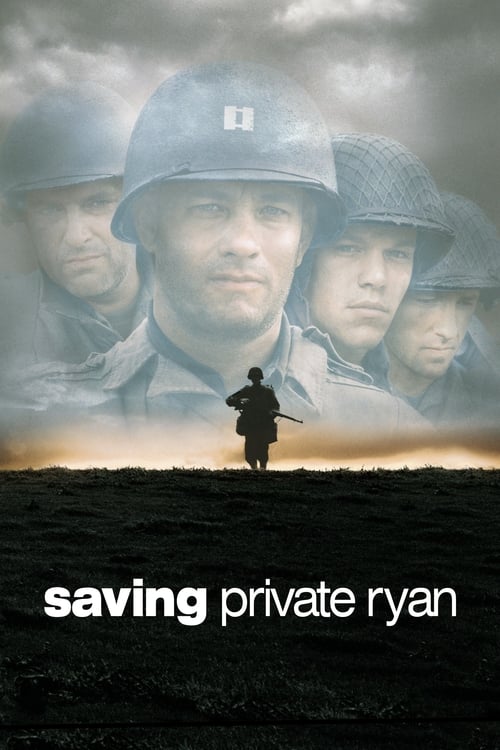
Saving Private Ryan
1998 · Steven Spielberg
For when you want to be put through something — a serious, demanding evening that earns its emotion rather than a comfort watch. Reach for it when you're ready to sit with questions about duty and what a life is worth.
What it's about
June 1944: as Allied troops storm the beaches of Normandy, word reaches the Army that three brothers from one family have been killed in action within days of each other — and a fourth is somewhere behind German lines. Captain John Miller and a squad of seven Rangers are ordered to go find Private James Ryan and bring him home. The mission sounds simple and humane on paper; on the ground it means marching eight men through a war zone to save one, and every soldier in the squad has an opinion about that math.
The experience
It opens with a stretch of combat so relentless and disorienting you come out the other side shaken, then settles into something quieter and sadder — long marches, gallows humor, sudden violence. It's grueling and moving in equal measure, and it stays with you.
Performances
Tom Hanks anchors the film as Miller, playing courage as exhaustion and quiet self-control — a schoolteacher's decency under unbearable pressure. Matt Damon, arriving late, makes Ryan more than an abstraction, and the squad around Hanks feels like real men, not types.
The craft
The Omaha Beach sequence rewrote the rules for filming combat: handheld cameras in the surf, desaturated color, sound that drops out and roars back, chaos staged with terrifying clarity. The whole film has that newsreel immediacy — you feel sand, water, and concussion. It demands the biggest screen and best speakers you can give it.
Why it matters
It changed how war has been filmed ever since — nearly every combat sequence made after 1998 answers to it — and it drove a wave of renewed public attention to the WWII generation.
Snapshot
A squad of eight U.S. Army Rangers, led by Captain John Miller (Tom Hanks), is dispatched into German-held Normandy in July 1944 to locate and extract Private James Francis Ryan (Matt Damon), whose three brothers have been killed in action within days of each other. The mission is framed as a humanitarian gesture by the Army Chief of Staff, citing precedent in the Sullivan and Niland cases; it becomes, for Miller and his men, an occasion to examine what sacrifice means and what a life is worth. The film opens and closes in the present day, at the American cemetery at Colleville-sur-Mer, where an elderly veteran — whose identity is withheld until the final scene — moves among the white crosses. Between those bookends sits one of the most sustained acts of cinematic violence in the sound era: roughly twenty-seven minutes of the D-Day landing at Omaha Beach, a sequence that redefined what audiences and filmmakers believed was representable on a mainstream screen.
Industry & production
Saving Private Ryan was produced by DreamWorks Pictures and Paramount Pictures, with Amblin Entertainment. DreamWorks, which Spielberg had co-founded with Jeffrey Katzenberg and David Geffen in 1994, was still a young studio seeking to establish itself as a prestige producer; the film functioned simultaneously as a commercial tentpole and a signature artistic statement. The screenplay was written by Robert Rodat, who had been developing the project independently. Rodat drew on historical research into the "sole survivor" policies that emerged from the losses of the Sullivan brothers and the Niland brothers — four Iowa siblings of whom two (Preston and Edward Niland) died on D-Day and a third (Robert) was believed dead in Burma (he survived as a prisoner of war); the fourth, Frederick Niland, was repatriated under War Department policy. The script was not adapted from any single published source, though it circulated during a period of renewed popular interest in the WWII generation, partly stoked by Tom Brokaw's forthcoming book. Spielberg assembled his core crew from prior collaborations: cinematographer Janusz Kamiński, editor Michael Kahn, and composer John Williams, all of whom had worked with him on Schindler's List (1993). Technical advisor Dale Dye, a Marine veteran and veteran Hollywood consultant, drilled the principal cast for ten days before principal photography began, subjecting them to simulated combat conditions, sleep deprivation, and weapons handling — a method Dye had used on Platoon (1986). Tom Hanks underwent the same regimen as the rest of the ensemble. Principal photography took place largely in the United Kingdom and Ireland; the Omaha Beach sequence was filmed at Curracloe Beach in County Wexford, Ireland, with the assistance of the Irish Army, which supplied approximately one thousand extras. The sequence took roughly three weeks to shoot.
Technology
The Omaha Beach sequence represents a deliberate fusion of documentary and industrial filmmaking at a scale few productions had attempted. Kamiński used multiple cameras simultaneously — sometimes as many as four — loaded with Kodak Vision film stock. To undercut the polish of conventional cinematography, he had the protective coatings stripped from several lenses, reducing contrast and introducing a veiled, slightly flared quality that evoked period newsreel footage without directly imitating it. More consequentially, he adjusted the shutter angle on many shots to approximately 45 degrees, well below the standard 180 degrees. The narrower shutter angle reduces the duration of each exposure, shortening motion blur and producing the staccato, strobing visual rhythm that defines the beach sequence: movement appears fractured, soldiers seem to jerk rather than flow, chaos is rendered literally in the optics. This technique had been used in still photography and documentary film, but its sustained application in a large-scale Hollywood production was novel and immediately influential. The film also underwent photochemical processing — a bleach bypass or skip-bleach technique — that partially retains the silver in the print, reducing color saturation and boosting contrast. The result is a palette that reads as drained, almost monochromatic in the battle sequences, pushing the film toward newsreel tonality without the anachronism of shooting in black-and-white.
Technique
Cinematography
Kamiński's camera work throughout is aggressively corporeal. During combat, the camera is handheld and shoulder-mounted, placed at body level, often mid-crowd, using the human frame as an obstacle and a shield — so that the viewer's line of sight is constantly broken by the bodies of soldiers, by spray, by debris. Long lenses compress space; wide lenses distort limbs in foreground. In the beach sequence Kamiński refuses the conventional grammar of spatial orientation: there is no establishing shot that clarifies the geography of the battle, no master that tells us where the emplacements are relative to the waterline. Disorientation is structural. The quieter inland sequences use different registers — steadier frames, more considered compositions — producing a rhythm in which calm is never fully trustworthy. Kamiński won his second Academy Award for Cinematography for the film, having previously won for Schindler's List.
Editing
Michael Kahn's editing of the Omaha sequence is among the most studied in contemporary cinema. The cuts are sometimes extremely rapid, sometimes deliberately elongated; the rhythm is arrhythmic, which mirrors shellshock. Conventional action-editing logic — the cutaway to the shooter before showing the victim, the eyeline match that orients the viewer — is frequently suspended. Soldiers die in the middle of shots, peripherally, without the rhetorical emphasis of a death cut. The film's editing in the framing device and the interior scenes of the rescue mission is more conventional, giving the viewer purchase between the immersive combat passages.
Mise-en-scène / staging
Spielberg reportedly declined to storyboard the beach sequence, instructing Kamiński and his camera operators to respond to staged action rather than follow a predetermined shooting script. Whether this is entirely accurate or a production myth is difficult to verify, but the staging bears the marks of controlled improvisation: extras were given general instructions about movement and took their own paths through action, and cameras responded. The physical scale — real waves, real sand, real weather, hundreds of bodies — imposed its own logic. The sequence stages carnage with an almost clinical thoroughness: limbs separated from bodies, intestines visible through wounds, deafened soldiers moving through the action in a state of dissociation. The mise-en-scène consistently refuses heroic framing. Death is not aestheticized into sacrifice; it is shown as sudden, random, and often absurd.
Sound
The sound design, overseen by Gary Rydstrom (who won Academy Awards for both Best Sound and Best Sound Effects Editing), is the equal of the cinematography in its formal ambition. The beach sequence uses a moment of subjective audio — Captain Miller is briefly concussed, and the soundtrack shifts into a muffled, underwater register, the roar of battle retreating behind a high-frequency ring. This switch into Miller's subjective experience, and back out of it, is one of the earliest sustained uses of diegetic POV sound in a mainstream Hollywood war film. The broader soundscape is constructed from layered, directional elements: the whip-crack of bullets passing the camera, the wet sound of impacts in flesh, the ambient bellowing of LST engines. Rydstrom worked with a sound team to record and create weapons sounds that felt materially specific — distinguishing German and American small arms acoustically in ways that affect the audience's spatial comprehension of the battle even when the image is too chaotic to orient.
Performance
Spielberg cast against the conventional heroic register. Tom Hanks plays Miller as a man who is hiding, not performing, his authority — taciturn, quietly frightened, self-withholding. The film teases out Miller's civilian identity (a schoolteacher from Pennsylvania) as a kind of dramatic reveal across the narrative, suggesting that the war has made the civilian self inaccessible even to himself. The ensemble — Edward Burns, Barry Pepper, Giovanni Ribisi, Adam Goldberg, Vin Diesel, Jeremy Davies, Tom Sizemore — is differentiated by type (the cynical, the devout, the intellectual, the reluctant) but the performances resist caricature. Jeremy Davies's Corporal Upham, who freezes at the film's crisis point, became one of the more discussed performances in the film because it refuses the conventional arc of the coward-redeemed: Upham's eventual act of violence reads as a collapse rather than a recovery.
Narrative & dramatic mode
The film is structured as a quest narrative that knows it may be pointless. The soldiers openly debate whether the mission makes sense — whether one life justifies the probable deaths of several — and the film does not resolve this debate with a clean argument. Miller's position ("it's the math") is pragmatic rather than moral; Private Reiben's objection is visceral and unanswerable. The rescue of Ryan is accomplished, but at such cost that the ending — the elderly Ryan asking his wife whether he has been a good man, whether he has "earned" what was spent on him — frames the entire film as a meditation on survivor's guilt and the impossibility of accounting for sacrificial death. The framing device, with its flag-lit cemetery and weeping veteran, has attracted criticism as a retreat into sentiment after the severity of the middle sections; it has also been read as a necessary structural irony, placing the viewer in the position of the survivor, asking whether any monument or ceremony is adequate.
Genre & cycle
Saving Private Ryan belongs to the WWII combat film, a genre with deep roots in American studio production: from the wartime films of William Wellman (The Story of G.I. Joe, 1945) and John Huston through the epic reconstructions of the 1960s (The Longest Day, 1962; The Battle of the Bulge, 1965) and into the Vietnam-inflected revisionism that restructured the genre in the 1970s and 1980s. The film sits at a specific historical node: it draws on the anti-heroic, psychologically scarred soldier of post-Vietnam war cinema (Apocalypse Now, Platoon, Full Metal Jacket) while reinvesting in the moral coherence of the "Good War" — the WWII frame in which American violence is positioned as necessary and legitimate. This has made it a productive and contested text. Scholars have debated whether the film's formal severity (its refusal to glamorize the body in death) ultimately subverts or reinforces the patriotic machinery of its ending. The film helped trigger a WWII cycle in American film and television that extended well into the 2000s, and it revived the "platoon film" — small-unit ensemble, cross-sectional American cast, combat episodically structured — as a commercially viable and critically respectable form.
Authorship & method
Spielberg had approached WWII material before — the internment camp of Empire of the Sun (1987), the Holocaust of Schindler's List (1993) — but Saving Private Ryan was his first engagement with American combat. His method here departs from his earlier populist mode: he deliberately suppresses his characteristic camera movement (the sweeping cranes, the visual rhyming shots) in the combat sequences, forcing himself and Kamiński into a more reactive, observer posture. The result is formally unlike most of his other work. Janusz Kamiński had been Spielberg's director of photography since Hook (1991) and Schindler's List (1993); his visual vocabulary — high-contrast monochrome on Schindler's List, the desaturated, lens-modified aesthetic of Ryan — defined the look of Spielberg's serious-register work through the decade. John Williams's score is, by his own standards, extremely spare: a slow, elegiac theme anchored by solo instruments, without the motivic density of his adventure scores. The restraint is conspicuous from a composer of his profile and signals how Spielberg directed him. Michael Kahn had edited Spielberg's films since Close Encounters of the Third Kind (1977); his collaboration on Ryan's montage-heavy battle sequences extended a partnership that is among the longest in American film. Robert Rodat's screenplay provides the film's moral architecture, though Spielberg's decisions about what to show and how long to sustain it determine the film's actual meaning more than the dialogue.
Movement / national cinema
Saving Private Ryan is unambiguously a product of American commercial filmmaking, operating within the industrial system of Hollywood at the height of its late-twentieth-century global dominance. At the same time it draws on European formal traditions: the Italian neorealist insistence on location, non-idealizing photography, and the physical fact of the body; the French New Wave inheritance of handheld immediacy; the work of cinematographers like Raoul Coutard, who embedded similar destabilizing techniques in fiction narratives. Samuel Fuller's low-budget combat films of the early 1950s — The Steel Helmet (1951), Fixed Bayonets (1951) — offered an earlier American precedent for the grunt's-eye refusal of heroic distance, and The Big Red One (1980) provided a template for the episodic, fragmentary platoon film. The film's most direct formal debt is to wartime and immediate postwar documentary: John Ford and Gregg Toland's The Battle of Midway (1942), John Huston's The Battle of San Pietro (1945), which used precisely the low-angle, chaotic combat photography that Kamiński systematized into a fiction-film grammar fifty years later.
Era / period
The film arrives in 1998, at the intersection of several cultural vectors. The WWII generation was visibly aging and beginning to be institutionally memorialized — Brokaw's The Greatest Generation appeared the same year. The Cold War had ended without a successor clarity about American military purpose, and the 1990s had seen American military intervention in the Gulf, Somalia, and the Balkans under conditions of public ambivalence. The film's investment in a war of unambiguous moral necessity arrived as a kind of retrospective anchor. Technically it appeared at the threshold of the digital turn in cinematography: it used photochemical, optical techniques to destabilize the cinematic image at the precise moment when digital tools were beginning to offer alternative paths to the same effects. It also appeared in the period of DreamWorks' establishment, and its success — it grossed substantially on a reported budget of approximately seventy million dollars — confirmed the studio's viability.
Themes
The film's central preoccupation is the exchange rate of lives: whether the logic of sacrifice can be made to cohere, and whether survival can be "earned" by subsequent conduct. This is explored through the rescue mission's framing debate and most directly in the final exchange between the aged Ryan and his wife. Beneath this runs a sustained interest in dissociation — in what war does to the civilian self, how identity becomes inaccessible under sustained violence, and whether men can return from combat to who they were. The film is also, unusually for its genre, concerned with the failure of nerve: Upham's paralysis and eventual act are the most extended treatment of moral failure in the film, but the cowardice and self-preservation impulses circulate throughout the ensemble. The opening and closing cemetery sequences raise a question the film cannot and does not answer: what does memory owe the dead, and what does any ceremony accomplish?
Reception, canon & influence
Critical reception was overwhelmingly positive on release. Roger Ebert called the Omaha Beach sequence one of the most devastating sustained passages in cinema history, and many major critics identified the film as the most significant American war film since Apocalypse Now. It received eleven Academy Award nominations and won five: Best Director, Best Cinematography, Best Film Editing, Best Sound, and Best Sound Effects Editing. It lost Best Picture to Shakespeare in Love, a result that generated controversy at the time and has continued to be cited as an anomalous Academy decision. The AFI included it in its 100 Years...100 Movies list in both the original 1998 poll and the 2007 updated edition.
The films that most visibly influenced Ryan include The Battle of San Pietro (Huston, 1945), Rossellini's wartime neorealist films, the Fuller combat pictures, Francis Ford Coppola's Apocalypse Now (1979), Oliver Stone's Platoon (1986), and Stanley Kubrick's Full Metal Jacket (1987). The latter two in particular established the psychic damage of the combat soldier as the genre's central subject; Ryan inherits that tradition while redirecting it toward the WWII frame and scaling it to blockbuster production resources.
Its forward influence has been extensive and in some domains definitive. The film directly triggered Steven Spielberg and Tom Hanks's Band of Brothers (2001) HBO miniseries, which extended the platoon structure and desaturated visual grammar into a prestige television format and helped establish the template for the subsequent decade of serious American war television. Ridley Scott's Black Hawk Down (2001) is the most direct formal inheritor in theatrical film: it applies Ryan's handheld, multi-camera, desaturated, spatially disorienting methodology to a different conflict with almost programmatic fidelity. Mel Gibson's We Were Soldiers (2002), Paul Greengrass's United 93 (2006), Kathryn Bigelow's The Hurt Locker (2008), Peter Berg's Lone Survivor (2013), and Mel Gibson's Hacksaw Ridge (2016) all register the film's influence on combat staging and visual style to varying degrees. Sam Mendes's 1917 (2019) explicitly distances itself from the Ryan methodology — choosing long-take choreography over montage disorientation — in a way that only makes sense as a response to the dominant template Ryan established.
Beyond theatrical film, the film's formal innovations migrated rapidly into interactive media. The Medal of Honor video game series (1999) was explicitly developed with Spielberg's involvement and designed to replicate the experiential quality of the Omaha sequence in a player-controlled form; the Call of Duty franchise, originating in 2003, extended this aesthetic throughout a decade of the industry's most commercially successful games. The film is also credited, alongside Tom Brokaw's concurrent cultural work, with helping catalyze the creation of the National World War II Museum in New Orleans, which opened in 2000.
The film's critical status has been stable if not uncomplicated. Its formal achievements — particularly Kamiński's cinematography and the sound design — are consistently acknowledged in scholarly and industry accounts of late-twentieth-century filmmaking. Its ideological content, specifically the question of whether its formal severity constitutes a genuine anti-war argument or whether the patriotic machinery of its ending recuperates the violence into a heroic narrative, has been a sustained topic in film studies. This debate remains open, which is itself a sign of the film's durability as an object of analysis.
A Deleuzian reading
The ramp drops.
The full Deleuzian reading of Saving Private Ryan →
Reception
An event movie from day one — the Omaha Beach opening was instantly hailed as a landmark — but its legacy is forever tangled up with losing Best Picture to Shakespeare in Love, still cited as one of the great Oscar injustices. Decades on, the consensus has settled: the opening is untouchable, even among those cooler on the rest.
How Saving Private Ryan was received, from release to now →
Influences: the films it descends from and the films it influenced
- The Battle of San Pietro (1945) — Kamiński explicitly studied Huston's documentary when designing the Omaha sequence: the handheld camera placed at ground level among actual combatants, constant occlusion by bodies and debris, and refusal of any orienting master shot are the direct formal precursors of SPR's body-level grammar — Huston invented the visual syntax; Kamiński industrialized it.
- All Quiet on the Western Front (1930) — Milestone established both the framing-device structure and the unresolved 'is one life worth its cost' moral question that SPR inherits: the elderly-veteran-among-graves closing gesture and the refusal to provide the viewer a justifying answer are structural echoes of All Quiet's anti-memorial argument, transplanting the WWI precedent into WWII.
- Paths of Glory (1957) — Kubrick's tracking shot through the Ant Hill trenches — camera at soldier-chest level, moving laterally through compressed, chaotic space without establishing the front's geography — is the formal ancestor of Kamiński's body-level traversal of Omaha Beach; both films also share the anti-heroic register in which command orders men to die for a calculus the film refuses to endorse.
- The Longest Day (1962) — SPR's visual grammar is constructed as an adversarial response to this film: where The Longest Day uses classical establishing shots, strategic maps, and heroically framed group compositions to orient the D-Day viewer, Kamiński's refusal of any master shot, desaturated palette, and strobed motion constitute a systematic inversion of every formal choice this film made.
- Apocalypse Now (1979) — The Do Lung Bridge sequence is the direct Hollywood precedent for SPR's multi-camera chaos: Coppola and Bill Butler stripped lens coatings, used simultaneous cameras in firefight conditions, and refused spatial orientation to render combat as sensory breakdown rather than choreography — the technical three-move bundle (stripped lenses, multi-cam, refused geography) that Kamiński formalized.
- Das Boot (1981) — Petersen's sustained-immersion approach, in which diegetic sound — pinging sonar, groaning hull, directional depth charges — carries the emotional burden without orchestral score, directly prefigures SPR's decision to strip the Omaha sequence of John Williams's music and let Gary Rydstrom's directional weapons differentiation and tinnitus-wash design do the affective work.
- Come and See (1985) — Klimov established the diegetic POV audio technique that SPR's Miller-concussion scene directly inherits: when Flyora is deafened by artillery, the soundtrack is filtered through his damaged hearing — muffled, tinnitus-laden, directionally collapsed — and SPR reproduces this exact technique, including the gradual phased return of diegetic sound, as the film's key subjective sound device.
- Platoon (1986) — Technical advisor Dale Dye ran identical pre-production military conditioning programs on both films — ten days of forced marches, weapons drill, sleep deprivation, and simulated combat — producing the specific non-theatrical exhaustion and physical comportment in both casts that distinguishes the performance register from studio-era war films; the anti-heroic ensemble structure flows from Stone and Dye's method directly into SPR.
- Full Metal Jacket (1987) — Kubrick's Hue City sequence is the immediate formal precedent for SPR's unstoryboarded combat staging: Kubrick allowed the camera operators to respond to the action rather than following a shot list, used multiple cameras simultaneously in confined rubble space, and cut arrhythmically so that deaths arrive without rhetorical preparation — all three strategies that Spielberg and Kamiński adopted and scaled up.
- Braveheart (1995) — Kamiński's Omaha Beach cinematography — handheld camera thrust into the assault, desaturated near-monochrome palette, deliberate spatial disorientation — develops the immersive battle-chaos aesthetic Toll pioneered in Braveheart's Stirling sequence into a systematic formal program for WWII combat.
- Seven Samurai (1954) — Spielberg's multiple simultaneous cameras in the Omaha Beach landing produce the same unrepeatable spontaneous combat performance that Kurosawa achieved with his long telephoto multi-camera rig; the rain-mud-gray visual texture of the sequence and the ensemble-of-specialists mission structure both descend directly from Seven Samurai's combat grammar.
- Aliens (1986) — Spielberg's Omaha Beach sequence operationalizes Cameron's core editing principle — maintaining audience spatial orientation within chaotic ensemble combat through consistent eyeline and spatial anchors — at a naturalistic scale, demonstrating that the clarity-first methodology transfers outside genre when built on the same discipline of pre-planned geography.
- Black Hawk Down (2001) — Scott and DP Slawomir Idziak explicitly adopted SPR's three-technique bundle for the Mogadishu battle sequences: the 45-degree shutter angle for strobed motion, bleach-bypass desaturation, and the refused establishing shot that denies the viewer spatial orientation — extending the Omaha grammar wholesale into post-Cold War urban combat.
- Band of Brothers (2001) — Spielberg and Hanks institutionalized SPR's production method into episodic television: Dale Dye ran the same conditioning program for the entire cast, Kamiński's grammar was codified as the visual style guide for combat episodes (same shutter angle, same body-level handheld, same refusal of establishing masters), making SPR's cinematographic language reproducible and industry-transferable.
- The Hurt Locker (2008) — Barry Ackroyd's handheld-body-level cinematography and Paul N.J. Ottosson's directional weapons sound design are the structural descendants of Kamiński and Gary Rydstrom's Omaha work: Ottosson's directional differentiation between pressure waves, supersonic cracks, and muffled aftermath directly extends SPR's weapons-differentiation sound strategy into the IED-war context.
- Hacksaw Ridge (2016) — Gibson instructed DP Simon Duggan to use the 45-degree shutter angle during the Hacksaw battle sequences; the arrhythmic cutting and the refusal of heroic death-emphasis — soldiers dying peripherally, mid-shot, without rhetorical camera punctuation — are direct formal citations of SPR's Omaha grammar applied to a WWII Pacific theater setting.
- Dunkirk (2017) — Nolan cited SPR's Omaha sequence when designing the beach and sea sequences with Hoyte van Hoytema: IMAX cameras placed at body level in the surf, no establishing shot orientates the viewer to the evacuation's geography before immersing them in it, and the score goes diegetically silent for extended stretches — all three strategies are structural inheritances from SPR's spatial disorientation method.
- 1917 (2019) — Roger Deakins adopted SPR's spatial disorientation strategy for No Man's Land — no establishing shot clarifies the front's geography before the soldiers enter it — and extended it via the single-take conceit; the refusal to let the viewer orient before the protagonist does, and the diegetic sound design carrying the affective burden during the open-field sequences, are direct formal inheritances.
- Gladiator (2000) — Janusz Kamiński's D-Day sequence codified undercranked, desaturated, handheld close-combat cinematography as a grammar of historical violence; Mathieson transposed this technique directly into the Colosseum, converting a WW2 visual vocabulary into ancient Roman warfare.
- Children of Men (2006) — Janusz Kaminski's handheld 45-degree-shutter combat photography — desaturated, motion-blurred, refusing conventional coverage angles — established Hollywood's template for rendering military violence in documentary register, a grammar Lubezki directly extends in the Bexhill battle sequence's choreographed chaos.
- We Were Soldiers (2002) — Kamiński's handheld-Steadicam hybrid combat grammar — shutter-angle manipulation and subjective camera immersion in close-quarters chaos — established the post-1998 battlefield realism vocabulary that Semler adopts and thermally inverts, substituting amber saturation for Kamiński's desaturated documentary grain.
- All Quiet on the Western Front (2022) — Janusz Kamiński's bleach-bypass desaturation, which drained color from combat to prevent it from being visually pleasurable, and Gary Rydstrom's spatial sound design — which positioned the viewer inside the acoustic envelope of battle rather than observing it — both feed directly into James Friend's palette decisions and the film's immersive artillery sound design.
- Edge of Tomorrow (2014) — The Omaha Beach sequence is the direct visual antecedent for EoT's beach assault staging: embedded handheld cameras operating at ground level in the surf, diegetic audio chaos used as the primary spatial cue, and the grammar of D-Day as a site of overwhelmingly lethal confusion are transposed wholesale into the film's opening combat.
- Fury (2014) — Janusz Kaminski's technique of removing the polarizing filter and overdriving highlights to degrade the image toward documentary grain in combat sequences is the direct precursor to Vasyanov's low-light digital approach, establishing the desaturated immersive aesthetic Fury refines for digital acquisition.
- The Thin Red Line (1998) — Released the same year, both films place the camera in a corporeal relationship to the soldier's body as their central formal question, but Malick's floating grass-level observational camera (John Toll, long lenses, lyrical drift) constitutes a deliberate formal counterargument to Kamiński's kinetic handheld immersion — the two films are a split debate about whether cinema should witness war or inhabit it.
- Schindler's List (1993) — Spielberg and Kamiński directly transferred the handheld available-light bleach-bypass grammar developed for Schindler's List to WWII combat in the Omaha Beach sequence — desaturated stock, high shutter speed for strobed motion, camera moving through rather than above the action — producing the dominant visual language for subsequent war cinematography.
- The Bourne Supremacy (2004) — Its shuttered-shutter, handheld, desaturated combat verité legitimized chaos-as-realism in studio filmmaking, a parallel impulse Bourne extended from war to espionage.
- Man of Steel (2013) — Source of the handheld, desaturated war-reportage camera grammar — Amir Mokri's shaky long-lens 'embedded combat' coverage of the Smallville and Metropolis battles borrows Spielberg's vérité documentary-of-chaos approach to action.
- War of the Worlds (2005) — Kamiński's desaturated, ash-and-grime palette, stuttering handheld immersion, and visceral ground-level chaos — debris streaking past the lens, bodies in the frame — are transplanted from the Omaha Beach idiom into the invasion.
- Man on Fire (2004) — Janusz Kamiński's altered-shutter-angle photography — stripping motion blur to create staccato, flickering combat realism — is the ancestor of Man on Fire's exposure-flicker and strobing handheld violence.
Similar films
- Apocalypse Now (1979) — influence & lineage · often watched together
- The Thin Red Line (1998) — influence & lineage
- Dunkirk (2017) — influence & lineage
- Platoon (1986) — influence & lineage
- Black Hawk Down (2001) — influence & lineage
- 1917 (2019) — influence & lineage
- All Quiet on the Western Front (1930) — influence & lineage
- The Longest Day (1962) — influence & lineage
All the films related to Saving Private Ryan →
Film essays and courses that include it
- The Art of the Assault: How Cinema Stages War
- Doing It for Real: A Century of Practical Spectacle
- Steven Spielberg
- The Camera at War: A Century of Reinvention
- Men Under Orders: Cinema's Century at War
- The Immense Frame: Cinema's 70mm Obsession from VistaVision to IMAX
- The Cut That Stopped Meaning Anything
- The Manufacture of Wonder
- The Genre at War With Itself