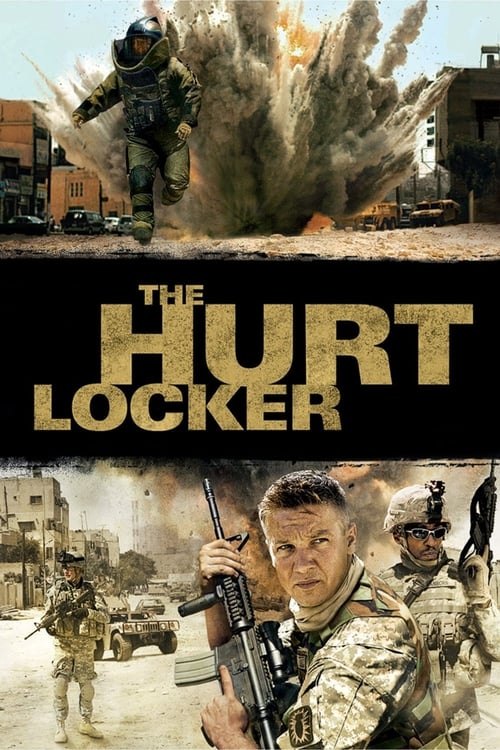
The Hurt Locker
2008 · Kathryn Bigelow
For when you want a white-knuckle thriller that's also about something — pure adrenaline with a moral hangover. This is a challenge watch, not a comfort watch; save it for a night you want to be pinned to the couch.
What it's about
A bomb-disposal team works the streets of Baghdad in the last weeks of its tour, defusing IEDs and car bombs while crowds watch from windows and rooftops. When a reckless new team leader arrives to replace a man killed on the job, his appetite for risk puts him at war with his own squad as much as with the insurgency. It follows the daily grind of men whose office is a blast radius — and one soldier who may need the danger more than he needs to go home.
The experience
Almost unbearably tense — each defusal plays out in real time, sweat and static and silence, and the film barely lets you exhale between them. It's less about plot than about pressure: you come out wrung dry, with a queasy understanding of why someone might miss this.
Performances
Jeremy Renner is the whole engine — swaggering, unreadable, and quietly hollowed out, a career-making turn. Anthony Mackie grounds the film as the by-the-book sergeant watching his team leader gamble with all their lives.
The craft
Kathryn Bigelow shoots the defusals with jittery handheld cameras and long-lens paranoia, so every bystander looks like a triggerman and every pile of trash could be wired. The sound design does half the work — dust, breath, the crunch of boots — and it rewards good speakers and a dark room. It won six Oscars, including Best Picture.
Why it matters
It made Kathryn Bigelow the first woman to win the Best Director Oscar and reset the template for the modern war film: intimate, procedural, and about the psychology of combat rather than its politics.
Snapshot
A twelve-man Explosive Ordnance Disposal unit rotates through Baghdad in the final days of its tour. When reckless Staff Sergeant William James replaces a team leader killed on duty, his addiction to the work — the wire, the sweat, the proximity to obliteration — fractures his squad and becomes the film's real subject. Not a film about the Iraq War as political event but about war as biochemical condition, The Hurt Locker strips combat cinema down to nerve-endings: an episodic, almost plotless sequence of set-pieces held together by character tension and an atmosphere of uncontrolled risk. It won six Academy Awards including Best Picture and Best Director, making Kathryn Bigelow the first woman to receive the latter prize.
Industry & production
Mark Boal, then a print journalist, embedded with a US Army EOD unit in Baghdad in 2004 and subsequently wrote a magazine article about the experience. The article became the basis for his original screenplay, bringing a reportorial specificity — unit nomenclature, procedural rhythms, the particular boredom-punctuated-by-terror texture of EOD work — that most Hollywood war scripts lack. Bigelow and Boal formed a production partnership that would define both careers for the following decade.
The film was produced on a budget reported at approximately eleven million dollars, remarkably modest for a war film requiring practical locations, multiple camera units, and significant stunt coordination. Financing was assembled through Voltage Pictures and Nicolas Chartier's production company, with Summit Entertainment acquiring US distribution rights ahead of the film's festival premiere. Summit, then best known for genre acquisitions, took an unusual swing; the film's eventual performance would confirm the studio's judgment, though the path was slow — The Hurt Locker expanded gradually from limited art-house release before awards momentum accelerated its theatrical footprint.
Principal photography took place in Jordan, primarily in and around Amman, with locations doubling for Baghdad neighborhoods, markets, and the desert periphery of the city. The production's decision to shoot on location rather than on stages or in a country with more permissive logistics significantly shaped the film's texture, though the choice also reflected the modest budget — Jordan offered relative affordability along with visual authenticity.
Technology
Barry Ackroyd shot the film using a multi-camera approach with as many as four cameras operating simultaneously, a methodology he had refined on Paul Greengrass's United 93 (2006). The cameras were loaded with a mixture of Super 16mm and 35mm film stocks, deliberately chosen rather than digital, in order to exploit the grain, slight instability, and tonal range of photochemical capture. Long telephoto and super-telephoto lenses were used extensively, flattening perspective in ways that compress the space between the camera and subjects and create an uneasy sense of surveillance — as if the film were being recorded rather than composed.
The production did not rely on motion-control systems or extensive CGI enhancement. Explosions and their practical aftereffects were executed as in-camera events. The choice to shoot photochemically rather than digitally was in some sense a period holdover — The Hurt Locker arrived just before the wholesale shift to digital acquisition in prestige filmmaking — but Ackroyd and Bigelow used it deliberately to maintain a material roughness that digital capture of the era could not replicate.
Technique
Cinematography
Ackroyd's work is the film's primary sensory argument. Long lenses produce heat shimmer and spatial ambiguity: figures in the middle distance become unstable, the relationship between foreground and background is compressed until it is impossible to gauge depth or threat from position alone. The camera rarely settles; even in stationary moments it registers the operator's breath, the slight drift of handheld work. This is not the kinetic shaking of action-cinema formula but something more physiological — the camera as nervous system rather than spectacle machine.
Crucially, Ackroyd and Bigelow often place the camera in positions a conventional film crew would not occupy: behind a pile of rubble, at the level of the road, inside a building across a market square. This positional strangeness creates a pseudo-documentary grammar without the self-conscious frame-breaking of mockumentary. The Iraqi urban environment — dust, crowds, heat, rubble — is captured as a genuinely foreign space rather than a backdrop.
Editing
Chris Innis and Bob Murawski won the Academy Award for Film Editing for work that is defined by its understanding of when not to cut. The film's bomb-disposal set-pieces accumulate duration rather than rhythm. Suspense accrues not through intercutting acceleration — the standard Hollywood grammar — but through sustained shots of hands, wires, faces beading with sweat, the slow passage of real time. When violence finally arrives, it is often sudden and non-spectacular: the edit does not linger for catharsis. Murawski had previously edited Sam Raimi's Spider-Man films, giving him genre credentials that suggest the deliberateness of The Hurt Locker's formal restraint.
The film is also organized by an unusual structural device: a countdown of days remaining in the rotation. This punctuates the episodic structure, imposing arithmetic time on what is otherwise a film resistant to conventional narrative progress.
Mise-en-scène / staging
Bigelow's staging of the EOD sequences is tactically specific in ways that reward close attention. She blocks James's body consistently at a slight remove from his team — not dramatically framed, but positioned to convey the separation his temperament creates. The recurring image of James walking alone in the bomb suit down an empty road — a kind of modern knight in industrial armor — is achieved through staging rather than symbolic imposition; it grows from the actual physical logic of EOD procedure.
The film's non-combat scenes — a base barracks, a supermarket cereal aisle back in the United States — are staged in deliberate contrast to the kinetic location work: flatter light, steadier framing, a dullness that the film treats as its own kind of horror.
Sound
Paul N.J. Ottosson won Academy Awards for both Best Sound Editing and Best Sound Mixing, and the film's sonic architecture deserves close attention. Explosions are not glamorized: detonations arrive with a physical concussiveness followed by an eerie vacuum of near-silence, a ringing that is almost tactile. Radio communication — its compressed, crackled clarity — becomes a formal device marking the boundary between controlled and uncontrolled space. The score by Marco Beltrami and Buck Sanders works subliminally, avoiding conventional orchestral swelling in favor of textures and tones that function more as environmental sound design than traditional underscore.
Performance
Jeremy Renner's performance as Sergeant First Class William James was widely recognized as a career-defining turn. Renner conveys James's addiction to risk not through actorly affect but through physical ease: he moves through active bomb sites with a calm that reads as pathological only in relation to the behavioral norm established by Anthony Mackie and Brian Geraghty around him. The three form a precise ensemble, with Mackie's Sanborn — disciplined, safety-minded, professionally reasonable — serving as the audience's proxy and James's foil. The film largely avoids the expository dialogue through which characters explain themselves; performance does the interpretive work. Guy Pearce, Ralph Fiennes, and David Morse appear in minor roles, their star presence contributing to an unusual effect — any character might be about to die, including the one the poster seems to promise will survive.
Narrative & dramatic mode
The Hurt Locker is structurally episodic rather than plot-driven. There is no antagonist in any conventional sense, no mission arc, no conventional dramatic question whose resolution the film builds toward. The countdown clock provides the only forward motion: the unit must survive its remaining days. Within that framework, each sequence is essentially self-contained — a bomb call that leads somewhere unexpected, an encounter outside the wire that goes wrong in an unpredictable direction. The film borrows from procedural drama and from literary war fiction (the episodic structure of The Things They Carried is a plausible literary analog) without committing fully to either.
The dramatic mode is behavioral rather than psychological: we understand James not through flashback, inner monologue, or explanatory dialogue but through the choices he makes under pressure. The film famously opens with a Chris Hedges epigraph — "The rush of battle is often a potent and lethal addiction, for war is a drug" — and then proceeds to dramatize that claim through observable behavior rather than argument.
Genre & cycle
The Hurt Locker arrived in the middle of a cycle of post-9/11 American war and political films — including Lions for Lambs, Rendition, In the Valley of Elah, Stop-Loss, Redacted, and Green Zone — most of which were received poorly at the box office and critically dismissed as preachy or aesthetically unresolved. The Hurt Locker distinguished itself within this cycle by largely evacuating explicit political argument. It takes no position on the legality or wisdom of the Iraq War; it is not interested in chain-of-command critique or in the suffering of Iraqi civilians as its primary subject. This formal neutrality was itself critically contested, with some arguing that the political evasion was itself a political stance. Nevertheless, it is formally coherent with the film's focus on addiction and sensation: it is a film about what war does to a body and a nervous system, not what it does to a geopolitical situation.
Within genre history, it belongs to a tradition of small-unit war films — the claustrophobic focus on a fireteam or squad rather than on strategy or campaign — that includes Das Boot, Platoon, and Full Metal Jacket. The EOD specificity, however, gives it something closer to procedural thriller than combat film, and in this respect it anticipates later entries in what might loosely be called the specialized-technical-operator film cycle.
Authorship & method
Kathryn Bigelow's filmography before The Hurt Locker — Near Dark (1987), Blue Steel (1990), Point Break (1991), Strange Days (1995), K-19: The Widowmaker (2002) — reveals consistent preoccupations: masculinity and its rituals, genre cinema inflected with formal self-awareness, the erotics of danger and risk. The Hurt Locker is in some respects the culmination of these concerns: a film that subjects masculine risk-addiction to sustained, clinical observation without sentimentalizing or condemning it. Bigelow had a background in painting and art theory before moving to film, and something of that formation — an interest in the politics of the gaze, in how images make arguments about power — remains legible in her work, even when (perhaps especially when) it is nominally genre filmmaking.
Mark Boal's contribution as screenwriter and journalist-researcher grounds the film in reportorial specificity that a purely cinematic imagination might not have achieved. His subsequent work with Bigelow on Zero Dark Thirty (2012) would repeat and extend this model of embedded journalism transformed into dramatic screenplay.
Barry Ackroyd brings a cinematographic tradition rooted in European social realism — he had worked with Ken Loach — and in the Greengrass docudrama aesthetic of Bloody Sunday and United 93. His collaboration with Bigelow is one of the film's defining relationships: his observational grammar suits her interest in behavior over statement.
Movement / national cinema
The Hurt Locker is American cinema operating in the tradition of realist war drama, but it is meaningfully inflected by European practices. Ackroyd's handheld multi-camera approach and the film's observational restraint connect it to the British docudrama tradition and to the broader influence of cinema vérité and Italian neorealism on English-language filmmaking. Pontecorvo's The Battle of Algiers (1966) — which also dramatizes urban asymmetric warfare with a faux-documentary aesthetic — is a credible antecedent, and one noted in critical reception.
Era / period
The film is a product of the mid-2000s environment in which American cultural production was attempting to metabolize the Iraq and Afghanistan conflicts, generally unsuccessfully in commercial terms. It was shot and released at a moment when the Iraq War remained politically active as a domestic issue, but it arrived in wide release as the political temperature around that conflict was beginning to shift. Its awards triumph at the 2010 ceremony (for a 2008-release film) coincided with a period of significant change in the industry's approach to war representation.
Themes
The film's central proposition — war as addiction — is stated in the epigraph and then dramatized without resolution or moral. James is not cured; the film's final sequence returns him to deployment, cycling back into the only environment in which he feels calibrated. This is not presented as tragedy (there is no conventional tragic arc) nor as critique (the film does not moralize), but as description: a behavioral fact about certain people and what certain environments do to them.
Secondary thematic concerns include: the incompatibility of combat competence with civilian existence; the ethics of risk-sharing within a unit (James's bravado endangers men who did not choose his methods); the way masculine identity organizes itself around proximity to death; and the failure of ordinary domestic life — cereal aisles, children, a modest suburban home — to provide the neurological intensity that combat has trained the body to require.
Reception, canon & influence
Critical reception: The Hurt Locker premiered at the Venice Film Festival and Toronto International Film Festival in September 2008, generating strong critical attention. Its limited US release in the summer of 2009 was accompanied by sustained critical advocacy. Roger Ebert gave it four stars. It appeared on numerous year-end and decade-end best-of lists. The film was widely praised for its procedural authenticity, its formal restraint, and Renner's performance, while a minority critical tradition — notably among veterans and military analysts — disputed the accuracy of its EOD depictions and questioned what some saw as an implicit glorification of recklessness.
Influences on the film (backward): The most direct formal ancestor is Greengrass's United 93 (2006), from which The Hurt Locker inherits both its cinematographer and its docudrama grammar. Pontecorvo's The Battle of Algiers — urban warfare, handheld authenticity, asymmetric conflict — is a longer-range precursor. The small-unit war film tradition runs from Das Boot and Platoon through Black Hawk Down, with the latter's Ridley Scott/Bruckheimer approach representing the commercially dominant mode that Bigelow's film consciously refuses. Chris Hedges's nonfiction writing, particularly War Is a Force That Gives Us Meaning (2002), provides the thematic armature.
Legacy and forward influence: The film's most direct forward consequence was Bigelow's own Zero Dark Thirty (2012), which extended the Boal-Bigelow collaboration into the Bin Laden raid narrative and proved that their model of journalist-inflected political drama could operate at larger scales and with more explicit political controversy. Jeremy Renner's career changed substantially: he moved to the Marvel Cinematic Universe and into a tier of leading-man projects that The Hurt Locker enabled. The film's aesthetic — handheld, multi-camera, telephoto, procedurally specific — became increasingly visible in prestige television and in action cinema during the following decade, though tracing direct influence is difficult given how much that grammar was already in circulation from Greengrass and others. Its status as the first Best Picture winner directed by a woman remains its most-cited cultural fact, and it is regularly invoked in discussions of gender and authorship in Hollywood.
A Deleuzian reading
A man stands in a supermarket aisle, back home, in front of a wall of breakfast cereal.
The full Deleuzian reading of The Hurt Locker →
Reception
Premiered quietly at Venice in 2008 and barely made a dent at the box office, then swept the 2010 Oscars — it's since become famous as the Best Picture winner almost nobody had actually seen, and its reputation as a lean, nerve-shredding classic has only firmed up.
How The Hurt Locker was received, from release to now →
Influences: the films it descends from and the films it influenced
- The Battle of Algiers (1966) — Marcello Gatti's staged 16mm pseudo-newsreel photography — grainy, telephoto, deliberately archival — established the grammar of fictional combat filmed as documentary observation that Barry Ackroyd's handheld-telephoto work directly inherits, particularly the asymmetric urban-warfare sequences shot as if by an embedded camera that never directed the action.
- The Wages of Fear (1953) — Clouzot's structuring of the entire film around the procedural management of an explosion hazard — every sequence organized by the spatial and temporal logic of preventing detonation — is the template for Bigelow's EOD episode format, where countdown to the charge and proximity to the device replace conventional dramatic conflict as the organizing principle.
- Das Boot (1981) — Petersen's staging of repeated technical procedural sequences — pressure readings, valve operations, instrument checks — as the primary carrier of suspense rather than dramatic confrontation directly prefigures Bigelow's EOD disarmament blocking, where the mechanics of the task are the drama.
- Come and See (1985) — Aleksei Rodionov's handheld immersion in a soldier's physiological experience of shellfire, and the sound design's use of post-explosion tinnitus and muffled hearing as sustained subjective point-of-view, is the direct template for The Hurt Locker's post-detonation silence sequences — treating the blast's auditory aftermath as drama rather than cutting away from it.
- Platoon (1986) — Robert Richardson's ground-level handheld patrol photography and Stone's casting of military veterans as atmosphere to ensure authentic small-unit behavioral patterns — soldiers who move, hold weapons, and respond to terrain the way soldiers do — established the experiential ground-truth aesthetic that Bigelow applies to EOD procedure and behavioral-physicality performance.
- Saving Private Ryan (1998) — Janusz Kaminski's use of modified shutter angles (45-degree for staccato movement) and multiple synchronized cameras for practical explosion photography established the in-camera destruction grammar that The Hurt Locker's effects sequences deliberately follow — no CGI substitution for IED detonations, detonations built practically and shot with actual film stock.
- Black Hawk Down (2001) — Pietro Scalia's rapid-fire intercutting across simultaneous small-unit actions in Mogadishu serves as Bigelow's negative formal template: she replaces Scott's orchestrated cross-cutting chaos with duration-based behavioral observation, explicitly rejecting the commercially dominant prestige-war-film editing model the dossier identifies as the mode she consciously refuses.
- The Wind That Shakes the Barley (2006) — Barry Ackroyd's handheld, available-light 16mm cinematography for Loach's IRA drama is the direct stylistic antecedent: the same operator's de-aestheticized observational grammar — reacting to performance rather than composing for visual beauty, keeping the camera in a position of witness rather than director — migrated intact into Bigelow's Iraq sequences.
- United 93 (2006) — Ackroyd shot both films using the same multi-camera, handheld, telephoto setup developed for Greengrass's docudrama; the procedural real-time structure — crisis as administrative procedure, no musical underlining, characters identified by function rather than backstory — transfers almost intact from the cockpit to the EOD suit.
- Full Metal Jacket (1987) — Barry Ackroyd's handheld combat cinematography — frenetic but formally controlled, using long focal lengths to compress the Baghdad streetscape into sightlines and threat geometry — extends FMJ's Hue grammar while the duality-of-man thesis (James psychologically unmade and remade by the institution until civilian life becomes uninhabitable) inherits FMJ's theme through formal rather than thematic means.
- Munich (2005) — Barry Ackroyd's multi-rig handheld approach — several cameras filming simultaneously at different focal lengths without pre-choreographed coverage — extends Munich's assassination-sequence grammar into the Iraq War, and Bigelow's sound mixing strategy (ambient explosive pressure over score, diegetic radio chatter as the primary emotional channel) is a direct application of Munich's diegetic-violence-realism sound design.
- Jarhead (2005) — Extends the post-9/11 skeptical war cycle Jarhead opened, built on episodic tension-without-payoff and a refusal of heroic catharsis around men addicted to a war that gives no resolution.
- Zero Dark Thirty (2012) — Bigelow and Boal repeat the embedded-journalism-to-screenplay pipeline with Ackroyd again providing the telephoto observational grammar; the Abbottabad raid's tactical blocking — SEAL teams moving through compound rooms in thermal-scope darkness — directly extends The Hurt Locker's EOD choreography, now applied to a raid sequence that required the same practical-darkness cinematographic discipline.
- Lone Survivor (2013) — Berg and cinematographer Tobias Schliessler adopted the multi-camera, telephoto, handheld grammar for Navy SEAL small-unit combat with explicit acknowledgment of The Hurt Locker as the new benchmark for American combat realism, extending the behavioral-physicality performance mode — actors trained by actual special-operations personnel — to a firefight structure organized around survival procedure rather than heroic narrative.
- American Sniper (2014) — Tom Stern's long telephoto work compressing Fallujah rooftop sightlines — near and far targets occupying the same shallow focal plane — directly inherits The Hurt Locker's long-lens compression technique for rendering tactical space, now repurposed for sniper POV rather than EOD spatial surveillance, creating the same flattened, watching distance from danger.
- Sicario (2015) — Roger Deakins adopted telephoto compression specifically for the Juárez bridge convoy and tunnel assault sequences, flattening tactical space into a single plane of long-lens anxiety — a formal inheritance of The Hurt Locker's EOD-surveillance visual logic applied to cartel interdiction, with duration-over-cutting structuring both films' set-pieces as procedural endurance rather than edited action.
- 13 Hours: The Secret Soldiers of Benghazi (2016) — Barry Ackroyd's direct involvement as cinematographer carries the telephoto-handheld observational grammar from The Hurt Locker into a Michael Bay production — a formal transplant that reveals how thoroughly Bigelow's visual approach had been institutionalized as the default grammar for American special-operations cinema, even when the directorial sensibility is otherwise antithetical to hers.
- The Town (2010) — Renner's physical performance grammar—contained explosive energy, the character fully present only under extreme pressure—carries directly from Sergeant James to Jem Coughlin; Bigelow's industrial-percussion sound architecture for improvised tension sequences is the formal model for The Town's action audio design.
- Anthropoid (2016) — Bigelow and Barry Ackroyd's handheld desaturated small-unit grammar — positioning the camera as near-peer observer within the operational unit rather than omniscient narrator — establishes the visual-stylistic template Ellis inherits for his two-register cinematography and situates Anthropoid within the 2010s desaturated-war-cinema movement.
- First Man (2018) — Handheld proximity to a suppressive male protagonist whose professional competence and emotional withholding are rendered inseparable, with industrial mechanical sound design — non-melodic, percussive — as the primary texture of occupational danger rather than scored accompaniment.
- Dunkirk (2017) — Barry Ackroyd's multi-camera proximity system — several handheld units simultaneously surrounding the actors — produced grain-texture rawness and unposed physical performance that van Hoytema adapts; the film also demonstrated commercial viability for austere dialogue-minimal war cinema before Dunkirk proved the same at blockbuster scale.
- Escape from Mogadishu (2021) — Bigelow's tension-release editing rhythm — the extended anticipatory build followed by sudden explosive release, with ambient sound deterioration marking the psychological state of the body under threat — is directly echoed in EfM's alternation between diplomatic deadlock and convoy combat.
- A House of Dynamite (2025) — Barry Ackroyd's ambient-practical handheld close-quarters cinematography and Mark Boal's research-intensive procedural texture establish the direct technical template: editing rhythm of sustained operational dread, performance calibrated to occupational function over psychological interiority, sparse score leaving institutional ambience to do the work.
- Warfare (2025) — Bigelow's EOD procedural staged the actual work rhythms of a military specialty — each step of a disarming procedure rendered in real operational sequence — without heroic amplification or score-driven emotional cuing, establishing that vocational specificity could sustain dramatic tension more effectively than conventional narrative stakes; the foundational model for Warfare's procedural-inhabitation performance approach.
- Redacted (2007) — De Palma's multi-format assemblage — soldier video diaries, surveillance footage, embedded journalism clips, insurgent videos — investigates the same question of how to represent Iraq War authenticity on film, choosing structural fragmentation and media archaeology where Bigelow chose observational immersion; both emerge from the same embedded-journalism-inflected moment in American war cinema.
- Restrepo (2010) — Hetherington's actual embedded telephoto-handheld documentary in the Korengal Valley uses the exact visual grammar The Hurt Locker simulates — long-lens compression, multi-camera behavioral observation, diegetic radio texture, no scored music — making it simultaneously a formal parallel and an implicit verification of Ackroyd's cinematographic decisions, confirming that the fiction film's visual approach was documentarily accurate.
- All Quiet on the Western Front (2022) — Barry Ackroyd's handheld proximity photography — alternating extreme close-ups of sweat-sheened faces and trembling hands with wide staging of the surrounding kill zone — shares the proximity-withdrawal alternation that defines Friend's approach to Paul in the trenches; both films refuse to stabilize the viewer in a master-shot geometry, keeping combat legible only through the body of the protagonist.
- Captain Phillips (2013) — Barry Ackroyd's documentary-trained handheld cinematography for contemporary conflict demonstrates that the observational visual grammar he and Greengrass developed is transferable across directors — the idiom belongs to Ackroyd's practice as much as to Greengrass's authorship.
- Fury (2014) — Barry Ackroyd's handheld cinematography embedded at operator-height rather than observational distance, and the episodic operational structure organized around discrete tactical tasks with no score anchoring emotional response, are formal siblings to Fury's approach to small-unit procedural drama.
- Green Zone (2010) — Direct aesthetic twin via cinematographer Barry Ackroyd: desaturated, dust-blasted available-light handheld coverage of Iraq shot multi-camera to harvest unrepeatable spontaneity.
- Jason Bourne (2016) — Shot by Barry Ackroyd using the same embedded multi-camera handheld coverage — capturing abundant live-environment footage to be rhythmically constructed at the bench — making it a DP-method twin of the Bourne films.
- The Outpost (2020) — Barry Ackroyd's multi-camera handheld coverage and tension built from spatial geography in an Iraq combat zone parallels The Outpost's procedural, terrain-driven suspense.
- Eye in the Sky (2015) — Builds unbearable suspense entirely from the procedural mechanics of a disarm/kill decision under a ticking clock and a restrained, near-absent score.
- Bloody Sunday (2002) — Adopts the multi-camera handheld, grainy, geography-eliding vérité immediacy to put the viewer inside combat tension, extending Greengrass's embedded-camera aesthetic into the Iraq War film.
- Elite Squad (2007) — Uses embedded, multi-camera handheld to render the adrenalized field POV of an armed unit at work, prioritizing tactile procedure over exposition.
- Land of Mine (2015) — Shares the bomb-disposal-as-ritual grammar — ground-level framing of hands working ordnance, tension built through duration and a score withheld until the moment before detonation.
Similar films
- Zero Dark Thirty (2012) — influence & lineage
- 13 Hours: The Secret Soldiers of Benghazi (2016) — influence & lineage
- Black Hawk Down (2001) — influence & lineage
- American Sniper (2014) — influence & lineage
- Platoon (1986) — influence & lineage
- Sicario (2015) — influence & lineage
- United 93 (2006) — influence & lineage
- Lone Survivor (2013) — influence & lineage
All the films related to The Hurt Locker →