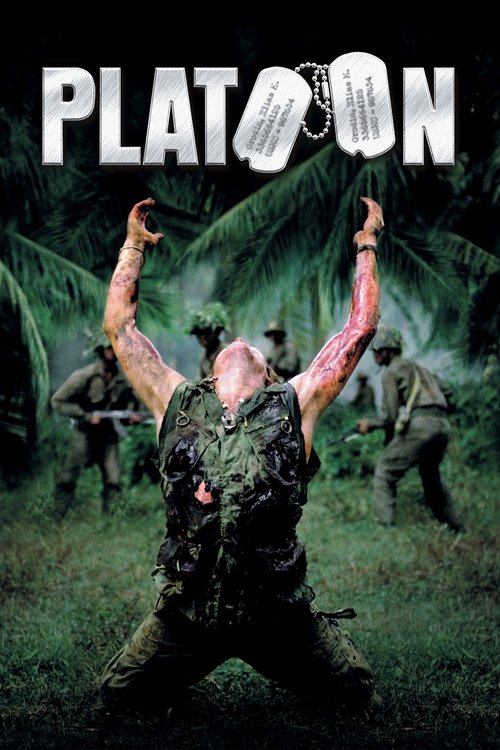
Platoon
1986 · Oliver Stone
For when you want a serious, gut-punch war film that tells you the truth instead of flattering you — a challenge, not a comfort watch, best when you have the emotional room for it.
What it's about
A privileged college dropout volunteers for infantry duty in Vietnam and lands in a rifle platoon that is at war with itself as much as with the enemy. Chris Taylor arrives naive and finds his loyalties split between two sergeants — one scarred but humane, the other brutally effective — as patrols, ambushes, and a raid on a village pull the unit toward moral collapse. It is drawn from Oliver Stone's own infantry tour, and it plays like testimony.
The experience
Grinding, frightening, and physically exhausting — the jungle heat, the fatigue, and the paranoia get under your skin long before the firefights do. It builds dread scene by scene and doesn't offer relief so much as reckoning; you come out shaken and quieter than you went in.
Performances
Willem Dafoe and Tom Berenger are unforgettable as the platoon's opposing sergeants — Dafoe radiating battered decency, Berenger all scar tissue and menace — with Charlie Sheen as the raw recruit caught between them.
The craft
Stone shoots the war at ground level: sweat, mud, night ambushes lit by flares, chaos that never feels choreographed. The sound design puts you inside the panic of a firefight, and the mournful string adagio that recurs through the film gives the violence a tragic weight. It rewards a big screen and good speakers — this is a film you should feel in your chest.
Why it matters
Arriving a decade after the war ended, it broke the era's rescue-fantasy treatment of Vietnam and reset the standard for combat realism; it won Best Picture and made Stone one of the defining American directors of his generation.
Snapshot
Platoon is the film through which Oliver Stone converted his own infantry tour in Vietnam into a national reckoning, and it remains the touchstone for the American combat picture's turn toward grunt-level realism. Released in December 1986 — more than a decade after the fall of Saigon, and at a moment when Reagan-era culture was busy re-mythologizing the war through Rambo and Missing in Action — it offered the opposite: no rescue fantasy, no redemption of American purpose, only the experience of an ordinary rifle company rotting from within. Narrated through the diary-letters of Chris Taylor (Charlie Sheen), a privileged college dropout who volunteers out of misplaced idealism, the film stages the war as a civil war inside a single platoon, personified by two sergeants — the scarred, merciful Elias (Willem Dafoe) and the brutal, charismatic Barnes (Tom Berenger). Stone's framing of these men as warring "fathers" and the soldier-narrator as their contested son gives the film its allegorical spine. Made cheaply and quickly under arduous conditions, it became one of the most decorated films of its era, winning the Academy Award for Best Picture and Best Director, and effectively defined how a generation pictured the war.
Industry & production
Platoon had one of the longest development gestations of any major American film of its period. Stone wrote the screenplay in the mid-1970s, drawing directly on his 1967–68 service with the 25th and 1st Infantry Divisions, but the script went unmade for roughly a decade; Hollywood considered a grim, unheroic Vietnam infantry story commercially toxic, and Stone's screenplay circulated for years without a green light. (One frequently repeated account holds that an early attempt to mount the film in the late 1970s collapsed; the specifics of that history are murkier than later retellings suggest, and should be treated with some caution.) Stone's emergence as a bankable screenwriter — an Oscar for Midnight Express (1978), then scripts including Scarface (1983) and Year of the Dragon (1985) — and his directorial breakthrough on the political thriller Salvador (1986) finally gave him the leverage to make it.
The film was ultimately financed not through a major studio but through Hemdale, the British company run by John Daly, with distribution in the United States by Orion Pictures. It was produced on a modest budget by the standards of a war film — the figure usually cited is around six million dollars — and shot in roughly two months in the Philippines, where military cooperation, jungle terrain, and low costs were available. Arnold Kopelson produced. The economy of the production is inseparable from its aesthetic: the cramped budget and tight schedule forced a stripped, in-the-mud immediacy rather than the logistical spectacle of a studio epic. Platoon opened in limited release in December 1986 to qualify for awards and expanded in early 1987, where it became a major commercial success — a genuine sleeper that vastly outperformed its cost.
Technology
Platoon is, technologically, a film of conventional mid-1980s 35mm production rather than of innovation; its force comes from method, not apparatus. It was shot on 35mm color negative with anamorphic or spherical lensing in widescreen, and its visual signature is the use of available and naturalistic light filtered through jungle canopy, dust, smoke, and the murk of night. The most consequential "technology" is arguably pyrotechnic and practical-effects work: the film's napalm strikes, the destruction of the village, and above all the climactic nighttime battle, in which an NVA assault overruns the American perimeter, depend on coordinated squibs, explosions, tracer fire, and smoke staged in real space rather than optical or composite trickery. Stone and cinematographer Robert Richardson committed to capturing chaos in-camera, with handheld coverage moving through live pyrotechnics, which lends the combat its disorienting credibility. The film predates digital intermediate grading and CGI augmentation entirely; what is on screen was largely built, lit, and detonated for the camera.
Technique
Cinematography
Platoon marks the beginning of one of American cinema's defining director–cinematographer partnerships: it was the first feature collaboration between Stone and Robert Richardson, who would go on to shoot most of Stone's major work. Richardson's photography here is more restrained than the stylized, overexposed-halo manner he later developed, but the seeds are visible. The camera is frequently handheld and embedded among the soldiers, privileging confusion, partial sightlines, and the soldier's-eye fragment over the commander's clarifying overview. Daytime patrol sequences exploit the oppressive density of the jungle — green walls that swallow figures, light coming in shafts — to communicate disorientation and ambush-dread, while the nighttime firefights dissolve geography into flares, muzzle flash, and silhouette. The film's single most reproduced image, Elias under fire in the clearing, arms flung upward as he is gunned down, is built on a slow, almost balletic visual treatment that lifts a death in the dirt into something explicitly Christlike. Richardson's work was recognized with an Academy Award nomination.
Editing
The film won the Academy Award for Best Film Editing for Claire Simpson. The cutting alternates between two registers: a patient, almost documentary observation of the dailiness of infantry life — digging, humping the bush, the boredom and exhaustion between contacts — and the compressed, percussive assembly of combat, where coverage is fragmented to deny the viewer a stable read on who is where. The structural achievement is the way the edit organizes the moral architecture: the village sequence builds escalating dread through accumulating small violences, and the climactic battle stages the convergence of the Barnes–Taylor and Barnes–Elias threads amid total chaos, then resolves them in the morning light. The voice-over diary entries provide connective tissue, and the editing paces them as punctuation rather than constant narration.
Mise-en-scène / staging
Stone's staging insists on authenticity of texture: filthy uniforms, sweat, the clutter of gear, the racial and class stratification of the platoon laid out in its very seating and bunking. The famous division of the unit into two cultures — the heads, who smoke marijuana and listen to Motown and rock in a candlelit bunker presided over by Elias, and the drinkers, who play cards and brood with Barnes — is conveyed almost entirely through staging and decor, a spatial map of the platoon's soul. The village massacre sequence, widely understood as Stone's reckoning with the kind of atrocity the war produced, is staged for maximum moral discomfort: it withholds easy villainy, showing decent men sliding into cruelty under fear and grief.
Sound
The film's sound design works to immerse and disorient: the layered ambience of the jungle at night, the sudden overwhelming concussion of incoming fire, the radio chatter and screamed commands of men who cannot see one another. Equally important is the diegetic and near-diegetic music — the soldiers' own soundtrack of period rock and soul — which Stone uses to locate the war in a specific generational moment. The non-diegetic score is dominated by Georges Delerue's adaptation of Samuel Barber's Adagio for Strings, whose elegiac swell underscores the film's set-piece deaths, most indelibly Elias's. The choice of Barber's Adagio, already culturally coded as music of mourning, is unsubtle but enormously effective, and it became so identified with the film that the association has shaped how the piece is heard ever since.
Performance
Platoon is an ensemble film, and its casting is part of its realism — a deep bench of then-young actors, several of whom became major figures, playing grunts without star insulation. Charlie Sheen's Taylor is deliberately a partly passive vessel, an everyman observer whose blankness lets the audience map itself onto him; the more combustible work belongs to the two sergeants. Tom Berenger, scarred and frighteningly persuasive as Barnes, and Willem Dafoe, whose Elias radiates a battered humane grace, both received Academy Award nominations for Best Supporting Actor. Stone famously subjected the cast to a punishing pre-production training regimen run by former Marine Dale Dye, who put the actors through field conditions — sleep deprivation, digging foxholes, patrols — to build genuine fatigue, cohesion, and military bearing into the performances. The result is an ensemble that reads as a unit rather than a collection of billed names.
Narrative & dramatic mode
The film operates as a coming-of-age tragedy structured around a moral inheritance. Its dramatic engine is the contest between Barnes and Elias for the soul of the platoon and, specifically, of Chris Taylor, who narrates the film as letters home to his grandmother — a confessional, retrospective voice that frames the events as a lesson already learned and grieved. Stone makes the allegory explicit in Taylor's closing narration, which names Barnes and Elias as the two fathers warring within him and declares the survivors obligated to teach what they learned. This bildungsroman-by-voice-over mode situates the war film inside the older tradition of the loss-of-innocence narrative, but strips it of consolation: Taylor's "graduation" is the discovery of his own capacity for murder. The structure is broadly chronological — arrival, acclimatization, the village, fracture, the final battle, departure — with the two great atrocities (the village, the killing of Elias) functioning as the hinges on which Taylor's moral fall turns.
Genre & cycle
Platoon belongs to the combat film, but it arrived as the spearhead of the second great wave of American Vietnam cinema and decisively reoriented it. The first wave — The Deer Hunter (1978), Apocalypse Now (1979), Coming Home (1978) — had treated Vietnam largely through allegory, mythic abstraction, or the home-front aftermath. Platoon instead planted the camera in the infantry experience itself, claiming the authority of the veteran-author. Its success triggered or accelerated a dense cycle of late-1980s Vietnam films, including Full Metal Jacket (1987), Hamburger Hill (1987), Gardens of Stone (1987), Casualties of War (1989), and Stone's own follow-ups Born on the Fourth of July (1989) and Heaven & Earth (1993), which together form his loosely conceived Vietnam trilogy. Within the broader war genre, Platoon is a foundational text of the "grunt's-eye," anti-heroic mode that would shape later combat realism.
Authorship & method
Platoon is the cornerstone of Stone's authorial identity as a confrontational, autobiographical political filmmaker. The film's authority rests on the fact that Stone had lived it: the screenplay draws on his own enlistment, his wounds (he was decorated for his service), and composites of men he served with, with Taylor functioning as a self-portrait. Stone's method here — visible across his subsequent career — combines aggressive editorial rhythm, a moralizing voice-over, and a willingness to render history as a clash of archetypes. The collaborators who defined this film also defined the work that followed: cinematographer Robert Richardson, beginning a partnership that ran through Wall Street, JFK, Natural Born Killers, and beyond; editor Claire Simpson, whose Oscar-winning cutting shaped the film's rhythm; and the use of Georges Delerue with the Barber Adagio as the emotional register. The military adviser Dale Dye became, in effect, an authorial collaborator on realism, a role he reprised across many subsequent war productions. Stone wrote and directed, and the film is unmistakably a writer-director's personal statement.
Movement / national cinema
Platoon is a thoroughly American film in subject and sensibility, but its production history complicates any simple national label: it was financed through a British company (Hemdale) and shot in the Philippines, a reminder that "American" Vietnam cinema of the era was frequently a transnational, runaway-production enterprise — much as Apocalypse Now had been shot in the Philippines a decade earlier. Aesthetically, the film belongs to the post-1970s American realist tradition that prized vérité texture and morally ambiguous protagonists, the inheritance of New Hollywood filtered into the 1980s. It is not part of any formal movement; rather, it is a key document of American cinema's decades-long effort to narrate the Vietnam War to itself.
Era / period
The film is doubly period-bound. It depicts 1967–68, the late-Johnson escalation around the time of Tet, when the war's futility was becoming undeniable to those fighting it. But it speaks as forcefully to its moment of release: the mid-1980s, when Reagan-era America was reprocessing Vietnam through revisionist action fantasies that recast defeat as betrayal and offered cathartic refighting. Platoon cut hard against that current, and part of its cultural impact lay in the contrast between its unsparing vision and the prevailing patriotic mythmaking. Its reception — embraced by critics, audiences, and many veterans as a corrective truth-telling — registers the period's hunger for a more honest accounting, even as the film's own allegorical structure remained a deliberate dramatization rather than documentary.
Themes
The film's governing theme is the war within, announced literally in its closing narration: the enemy is finally located not in the NVA but in the divided self and the fracturing of the American unit. Stone's title card — invoking the idea that the young die in war — and his framing of Barnes and Elias as good and evil fathers make the picture a study of moral inheritance and the corruption of innocence. Surrounding this are interlocking concerns: the class and racial stratification of who actually fought, with the platoon drawn disproportionately from the poor, rural, and nonwhite, and Taylor's privilege marking him as an anomaly; the moral collapse of men under fear, fatigue, and grief, dramatized in the village atrocity; the failure of institutions and command; and the survivor's burden of witness. The recurring "duality of man" motif, voiced explicitly by Taylor, is the film's thesis and, to some critics, its limitation — a schematic morality that risks tidiness even as the surrounding texture resists it.
Reception, canon & influence
Platoon was both a critical and commercial phenomenon. It was widely hailed as the most authentic combat film yet made about Vietnam, frequently praised precisely by veterans for capturing the texture of infantry experience, and it dominated the 1986 awards season, winning four Academy Awards including Best Picture and Best Director, with additional nominations for Berenger, Dafoe, Richardson, and Stone's screenplay. It has since been selected for preservation in the National Film Registry, confirming its canonical status.
Its influences run backward to the broader tradition of the anti-war combat film and, immediately, to the first wave of Vietnam cinema it sought to correct — The Deer Hunter and Apocalypse Now — as well as to the long lineage of war films built around a green recruit's initiation. Stone's deeper source, of course, was lived experience rather than other films.
Forward, its influence is vast. Platoon established the template of the veteran-authored, grunt's-eye war film and helped license the late-1980s Vietnam cycle. Its commitment to immersive, chaotic, in-the-mud combat realism — and to actor boot-camps as a path to authenticity — fed directly into later war filmmaking, most visibly the texture of pictures like Saving Private Ryan (1998) and television's Band of Brothers, both of which leaned on Dale Dye's military training methods. The pairing of slow-motion battlefield death with Barber's Adagio for Strings became one of the most imitated and parodied audiovisual gestures in American cinema, and the Elias image entered the broader visual culture as shorthand for the war itself. More than any single film, Platoon fixed the popular memory of Vietnam as the infantryman's nightmare — an achievement whose very dominance has prompted ongoing debate about how much its powerful, archetype-driven vision shaped, and narrowed, the way the war is remembered.
A Deleuzian reading
Arms flung up to a sky he can't reach, Elias runs across the clearing as the rounds find him, and the helicopter carrying Taylor lifts away above the canopy so that the whole death becomes something watched rather than stopped.
The full Deleuzian reading of Platoon →
Reception
A phenomenon on release — a $6M movie that became a blockbuster, won Best Picture, and was hailed as the first Vietnam film told from a grunt who'd actually been there. Today it's still canon, but cinephile rankings tend to slot it behind Apocalypse Now and Full Metal Jacket, with some finding its good-vs-evil framing more on-the-nose than it seemed in 1986.
How Platoon was received, from release to now →
Influences: the films it descends from and the films it influenced
- All Quiet on the Western Front (1930) — Establishes the green-recruit-to-disillusionment arc and the anti-war combat film's moral structure of innocence destroyed by the line that Platoon's coming-of-age tragedy directly inherits.
- A Walk in the Sun (1945) — Pioneers the squad-ensemble patrol film narrated by the foot soldier's literary interior voice, the voice-over-diary device Stone gives to Taylor.
- The Steel Helmet (1951) — Founds the grunt's-eye, morally-compromised patrol seen from the mud — combat as exhausted, cynical infantry experience rather than heroic maneuver.
- The Battle of Algiers (1966) — Models the handheld, documentary-grain immediacy that makes staged firefights read as captured reportage, the embedded-camera texture Richardson chases in the jungle.
- The Deer Hunter (1978) — The first-wave Vietnam film Platoon was built to correct — the working-class draftee remade by the war — supplying the cycle Stone deliberately answers.
- Apocalypse Now (1979) — Pairs diegetic period rock as combat soundtrack with a soldier's first-person voice-over descent into the war's moral dark, both adopted wholesale by Platoon.
- The Big Red One (1980) — The veteran-director's autobiographical, episodic squad-survival film drawn from his own service — the lived-experience authority Stone claims as Platoon's bedrock.
- The Elephant Man (1980) — Earlier cinematic deployment of Barber's Adagio for Strings as the score of doomed innocence, the audiovisual gesture Platoon canonized over Elias's death.
- Midnight Express (1978) — Stone matures the Midnight Express authorial signature — an individual raging against a dehumanizing system, real events heightened for ideological force — into his own direction.
- Cross of Iron (1977) — Pushes the grunt's-eye anti-heroic realism forward with desaturated jungle naturalism and no redemptive glory, the enlisted-man's-view combat cinema Cross of Iron helped license.
- Hamburger Hill (1987) — Rides the Platoon-licensed cycle with grunt's-eye attrition combat and an ensemble of anonymous infantry ground down on a meaningless objective.
- Casualties of War (1989) — Extends the squad's-war-within into atrocity drama, the platoon split by a moral fault line between predatory and conscience-bound soldiers.
- Born on the Fourth of July (1989) — Stone and Richardson reapply the same confrontational autobiographical method and Vietnam-as-counter-myth to the war's homecoming aftermath.
- JFK (1991) — Carries the Stone–Richardson partnership forward into an aggressive multi-format editorial assault wedded to a moralizing voice, the cutting rhythm born in Platoon.
- Natural Born Killers (1994) — Pushes Richardson's expressionistic format-mixing and Stone's fragmented combat cutting to a maximalist extreme.
- Saving Private Ryan (1998) — Inherits Dale Dye's actor boot-camp and the in-the-mud, chaotic immersive-combat realism Platoon established as the route to authenticity.
- Band of Brothers (2001) — Built explicitly on Dale Dye's military-training method for actors as the production's path to infantry authenticity, the collaborator-as-realism-author model Platoon created.
- Black Hawk Down (2001) — Stages Dale Dye-trained, sensory-overload chaos-of-combat realism with practical pyrotechnics, the embedded-grunt immersion descended from Platoon.
- Wall Street (1987) — Richardson and Simpson's collaboration with Stone immediately prior — Richardson's high-contrast kinetic photography and Simpson's percussive cutting — is the direct technical foundation for Wall Street; the moral triangle of a young soldier between two father figures (Barnes/Elias) is the structural template Stone transposes wholesale to Bud Fox between Gekko and Carl Fox.
- The Hurt Locker (2008) — Robert Richardson's ground-level handheld patrol photography and Stone's casting of military veterans as atmosphere to ensure authentic small-unit behavioral patterns — soldiers who move, hold weapons, and respond to terrain the way soldiers do — established the experiential ground-truth aesthetic that Bigelow applies to EOD procedure and behavioral-physicality performance.
- Fury (2014) — Stone's autobiographical method — drawing on personal combat experience to choreograph the specific behavioral rhythms of men under fire — and the moral initiation structure in which a green soldier is inducted by competing veteran figures representing irreconcilable ethical responses, are direct templates for Fury's Wardaddy dynamic.
- Hacksaw Ridge (2016) — Stone and Robert Richardson encoded moral testimony in the physical instability of grunt-level handheld cinematography, establishing the ethical stance of US prestige war cinema — camera as witness rather than orchestrator — that Simon Duggan's work at Hacksaw Ridge extends.
- Full Metal Jacket (1987) — Twin 1987 Vietnam film organized around a dehumanizing boot-camp-to-combat structure, paralleling Dale Dye's immersion-as-authenticity logic from the inside of the program.
- The Thin Red Line (1998) — Competing voice-over-diary war film that multiplies the interior monologue across soldiers, deepening Platoon's the-war-within into philosophical reverie.
- Aliens (1986) — Both films emerge simultaneously from the same post-Vietnam cultural formation — Stone's literal representation and Cameron's science-fiction displacement share the same institutional-betrayal structure (command sacrifices soldiers for concealed objectives) and both maintain ensemble spatial geography during combat through wide-lens blocking that keeps multiple bodies readable in frame.
Similar films
- The Thin Red Line (1998) — influence & lineage · same viewing thread
- Apocalypse Now (1979) — influence & lineage
- All Quiet on the Western Front (1930) — influence & lineage
- Full Metal Jacket (1987) — influence & lineage
- Black Hawk Down (2001) — influence & lineage
- Casualties of War (1989) — influence & lineage
- Saving Private Ryan (1998) — influence & lineage
- The Deer Hunter (1978) — influence & lineage
All the films related to Platoon →
Watch it with: curated runs of related films
- The Futility of War — A run of films about ordinary men fed into war's machinery — from the trenches to the Casbah to the Warsaw sewers — where the futility and human cost rhyme across a century and a dozen conflicts.