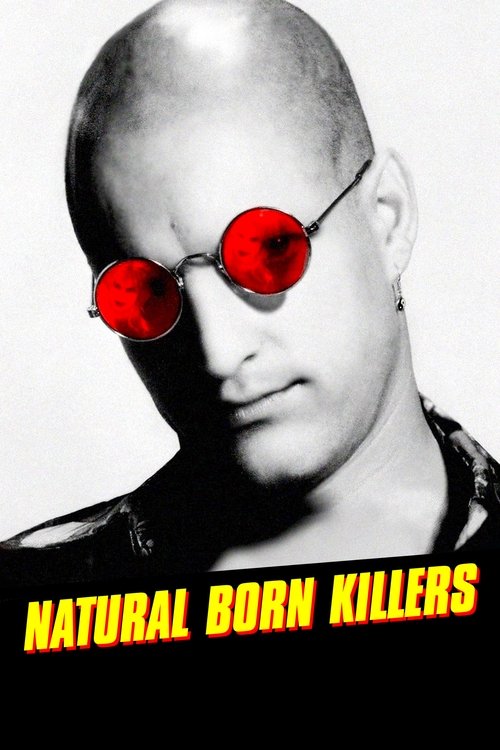
Natural Born Killers
1994 · Oliver Stone
For when you want to be provoked — a loud, confrontational ride that doubles as a shouting match about media and violence. Absolutely not comfort viewing; pick it when you have the stomach and the energy.
What it's about
Mickey and Mallory are two damaged kids who fall in love, hit the road across the American Southwest, and leave a trail of bodies — and the media can't get enough. A tabloid TV journalist builds them into outlaw folk heroes while ratings soar, and the film turns its fury less on the killers than on the culture cheering them on.
The experience
An all-out sensory assault: film stocks switch mid-scene, sitcom parody crashes into horror, and the editing never lets you settle for a second. It's funny, ugly, exhilarating, and deliberately too much — you come out rattled, half-complicit, and arguing with it.
Performances
Woody Harrelson and Juliette Lewis are feral and weirdly tender as the couple, Robert Downey Jr. is gleefully venal as the tabloid host, and Tommy Lee Jones goes gloriously over the top as a prison warden.
The craft
Oliver Stone throws the entire toolbox at the screen — 35mm, 8mm, video, animation, rear projection, black-and-white — stitched together with thousands of cuts and a wall-to-wall soundtrack assembled with Trent Reznor. It's filmmaking as deliberate overload, and it demands good speakers and your full attention.
Why it matters
One of the most controversial American films of the 1990s, it landed amid the O.J.-era tabloid frenzy it was diagnosing, sparked censorship battles and lawsuits, and remains the reference point for arguments about whether satirizing media violence feeds it.
Snapshot
Natural Born Killers is Oliver Stone's hallucinatory satire of an American media culture that manufactures celebrity out of slaughter. Mickey and Mallory Knox, two abused young people turned mass murderers, blaze a trail across the Southwest while a tabloid television journalist, Wayne Gale, turns them into folk heroes. What might have been a conventional lovers-on-the-run crime picture becomes, in Stone's hands, a formal assault: a barrage of film stocks, animation, rear projection, sitcom parody, and editorial collision designed to implicate the viewer in the very spectacle it depicts. Released in the late summer of 1994 — the same cultural moment that produced wall-to-wall coverage of the O.J. Simpson case — the film arrived as both diagnosis and symptom of a media ecology that could no longer distinguish news from entertainment. It remains one of the most aggressively stylized studio releases of its decade and one of the most contested.
Industry & production
The project's origin is inseparable from Quentin Tarantino, who wrote the original screenplay early in his career, before Reservoir Dogs established him. The script circulated and was eventually acquired with a path to production through producers including Jane Hamsher and Don Murphy. By the time Stone took the material, he and his collaborators substantially rewrote it; the final film credits the screenplay to David Veloz, Richard Rutowski, and Stone, with Tarantino credited for the story. Tarantino publicly distanced himself from the finished film, and the dispute over how much of his original conception survived is one of the better-documented authorship frictions of the period — a clash between Tarantino's pop-pulp sensibility and Stone's editorializing, didactic instincts.
The film was produced and released through Warner Bros., a major studio underwriting unusually transgressive content from a director then at the height of his commercial standing following Platoon, Born on the Fourth of July, and JFK. That standing bought Stone latitude. The most consequential production-adjacent story is censorship: the film's violence and tone forced repeated re-submissions to the MPAA to secure an R rating rather than the commercially fatal NC-17, and the theatrical cut is meaningfully tamer than the version Stone preferred, later circulated as a director's cut on home video. Beyond ratings, the film became a lightning rod for "copycat" litigation — most notably a long-running lawsuit, associated with the novelist John Grisham as a public advocate, alleging the film inspired real crimes. That suit was ultimately unsuccessful, but it shadowed the film's reputation for years and is part of why it functions as a touchstone in debates about media effects.
Technology
Natural Born Killers is, technologically, a film about format heterogeneity. Stone and cinematographer Robert Richardson shot on a deliberately incoherent mixture of formats: 35mm, 16mm, Super 8, Hi8 and other video, black-and-white, color, and color-reversal stocks. The point was not invisible polish but visible seams — each format carrying its own connotations (video for surveillance and tabloid TV, grainy stock for memory and degradation, slick 35mm for the "official" register). The film also leans on rear and front projection, animation, and back-projected imagery composited behind performers so that the world around the characters literally shifts register from shot to shot, sometimes within a single scene. This was a pre-digital, largely photochemical and optical approach to a layered audiovisual collage; the assembly burden therefore fell heavily on editorial and lab work rather than on the kind of digital compositing that would dominate a decade later. The result is a film whose technical means are foregrounded as part of its argument: the apparatus of image-making is never allowed to disappear.
Technique
Cinematography
Robert Richardson, Stone's regular collaborator, executed the film's defining look and it stands among the most distinctive work of his career. Richardson's signature top-light — a hot, often overexposed source pouring down on faces and backgrounds — recurs throughout, but here it is one tool among dozens. The camera is restless: canted angles, wide-angle distortion, sudden zooms, handheld lurches, and constant changes in stock that mean the image's very texture is unstable. Color is pushed to expressionist extremes, skies turned poisonous, interiors flooded with saturated or sickly light. The cinematography refuses naturalism as a matter of principle; the visual world is keyed to psychological and satirical states rather than to spatial coherence.
Editing
Editing is arguably the film's primary authorial instrument. Cut by Hank Corwin and Brian Berdan, the film is built on associative montage of extraordinary density — reportedly thousands of cuts, far above the norm for a feature of its length. Images are juxtaposed for ideological and emotional collision in a manner consciously descended from Soviet montage, but accelerated to the rhythm of channel-surfing and music video. Intercut stock footage, symbolic inserts (predators, fire, religious iconography), and abrupt shifts between media formats function as commentary, undercutting or amplifying the dramatic action. The "I Love Mallory" sequence — staging Mallory's incestuous family trauma as a laugh-tracked sitcom — is the most cited example of editorial and tonal collage doing the thematic work: domestic abuse rendered as broadcast entertainment.
Mise-en-scène / staging
Staging oscillates between heightened realism and overt theatricality. Diner, motel, desert, drugstore, and finally prison are rendered as charged, almost allegorical spaces. Rear projection and shifting backgrounds are used so that the environment behaves like projected thought rather than stable location — a demon may appear on a wall, a sky may turn apocalyptic behind a window. The prison-riot climax, in which Wayne Gale's live broadcast catalyzes mass violence, stages the film's thesis literally: the media presence becomes the accelerant of the carnage it claims merely to cover.
Sound
The soundtrack, supervised by Trent Reznor of Nine Inch Nails, is itself a collage — a dense weave of pop, rock, world music, dialogue samples, and score fragments mixed so that music, effect, and image bleed into one another. Reznor's compilation approach (rather than a single composed score) mirrors the visual strategy: sources are sampled, layered, and recontextualized. Sound design frequently violates realism, with audio cues bridging or contradicting cuts, reinforcing the sense of a mediated, manipulated reality.
Performance
Woody Harrelson and Juliette Lewis play Mickey and Mallory with a calibrated mixture of menace, wounded childishness, and rock-star charisma — performances pitched to make the audience's complicity uncomfortable. Robert Downey Jr. plays Wayne Gale with broad, satirical relish, his Australian-inflected tabloid showman embodying the film's contempt for sensational journalism. Tommy Lee Jones (as the unhinged warden) and Tom Sizemore (as the corrupt detective Jack Scagnetti) perform in a grotesque, caricatural register consonant with the film's satirical aims. The acting style is deliberately uneven across registers — naturalistic in the trauma flashbacks, cartoonish in the media-world scenes — by design rather than by accident.
Narrative & dramatic mode
The film's narrative spine is the familiar outlaw-couple romance, but Stone treats plot as a scaffold for essayistic and satirical digression. The dramatic mode is closer to Brechtian provocation than to identification: the film repeatedly breaks the realist contract through format shifts, direct address, ironic juxtaposition, and tonal whiplash, denying the viewer comfortable absorption. Causality is rendered through trauma — both protagonists are products of childhood abuse — but the film resists treating that backstory as exculpatory naturalism; it is presented as television, ironized even as it explains. The structure builds toward the prison interview and riot, where the diegetic act of broadcasting collapses the boundary between event and coverage, the film's formal method and its theme fusing in the climax.
Genre & cycle
Natural Born Killers sits at the intersection of the lovers-on-the-run crime film and the media-satire film. Its outlaw-couple lineage runs back through Bonnie and Clyde (1967), Badlands (1973), and Wild at Heart (1990); its satirical target — television's appetite for violence — links it to Network (1976) and the broader tradition of American media critique. It belongs, too, to a distinct early-1990s cycle of stylized, ironic American crime cinema energized by Tarantino, alongside films like True Romance (1993, also from a Tarantino script) and Pulp Fiction (1994). Where that cycle often aestheticized violence for cool, Stone turned the same materials toward moralizing critique — a tension that defines the film's reception.
Authorship & method
The film is unmistakably an Oliver Stone work: maximalist, polemical, formally aggressive, and morally insistent. Stone's method here extends the collage technique he had developed in JFK (1991), where mixed formats and rapid montage served argumentative ends; Natural Born Killers pushes that method to a near-experimental extreme. His key collaborators are central to the achievement: cinematographer Robert Richardson, whose multi-format imagery is the film's visual signature; editors Hank Corwin and Brian Berdan, whose montage carries much of the meaning; and music supervisor Trent Reznor, whose collage soundtrack defines its sonic identity. On the writing side, the film is a palimpsest — Quentin Tarantino's original story reworked by David Veloz, Richard Rutowski, and Stone — and the visible friction between Tarantino's pulp and Stone's didacticism is itself part of the film's character. The authorship question is genuinely unsettled, and any account should acknowledge that the finished film is a contested object rather than a clean expression of a single sensibility.
Movement / national cinema
The film is firmly a product of 1990s American studio cinema, but its formal vocabulary borrows from outside Hollywood realism: Soviet montage theory (collision editing as meaning), music-video and MTV aesthetics, and the self-reflexive, media-saturated sensibility sometimes labeled postmodern. It does not belong to a national or art-cinema movement so much as it imports avant-garde and televisual techniques into a mainstream commercial frame — a hybrid that was unusual for a wide studio release and that helps explain both its influence and its polarizing reception.
Era / period
Natural Born Killers is a quintessential mid-1990s artifact. It emerged amid anxieties about televised violence, the rise of tabloid news magazines and reality-television precursors, and a string of media-spectacle criminal cases that blurred journalism and entertainment. Released in 1994, it is in dialogue with the contemporaneous saturation coverage of high-profile crime, and its critique of the news-as-spectacle economy reads as both timely and prescient about the 24-hour, ratings-driven media culture that followed. It also belongs to the brief window when a major studio would finance a director's transgressive formal experiment on a substantial budget — a latitude tied to Stone's then-formidable commercial reputation.
Themes
The film's central theme is the symbiosis between violence and the media that monetizes it: the press does not merely report on Mickey and Mallory, it creates them, and the climactic riot literalizes media as accelerant rather than observer. Surrounding this are the cyclical transmission of trauma and abuse (the protagonists as products of domestic violence presented as broadcast), the manufacture of celebrity from atrocity, American culture's voyeuristic appetite, and the complicity of the spectator — the film's formal aggression is meant to refuse the viewer the comfort of detached consumption. The persistent religious and demonic imagery frames the violence in quasi-mythic terms, while the satirical caricature of authority (corrupt cop, deranged warden) extends the critique to institutions, not just individuals.
Reception, canon & influence
Critical reception was deeply divided and remains so. Admirers praised the film's audacity, its formal invention, and the prescience of its media critique; detractors found it hypocritical — indicting spectacle while reveling in it — and morally irresponsible. The controversy was not confined to reviews: the film drew sustained debate over censorship (the fight for an R rating, the suppressed director's cut) and over media-effects "copycat" claims, including litigation that publicly associated the film with real-world violence; that suit ultimately did not prevail, but it durably shaped the film's reputation. (Precise box-office and award details are not summarized here to avoid misstating figures.)
Looking backward, the film draws on the outlaw-couple tradition (Bonnie and Clyde, Badlands), the media satire of Network, Soviet montage, and the contemporaneous Tarantino-driven crime cycle, as well as Stone's own JFK. Looking forward, its influence is most visible in the aesthetics of late-1990s and 2000s music-video-inflected filmmaking and in the broader normalization of mixed-format, high-density montage in mainstream cinema and advertising. As a cultural text, it became a permanent reference point in arguments about media violence, copycat crime, and the ethics of stylizing atrocity — debates that have only intensified in the era of viral and algorithmically amplified spectacle. Its standing in the canon is unsettled by design: it is studied less as a consensus masterpiece than as a provocation whose questions about media complicity have proven durable.
A Deleuzian reading
A laugh track plays over a beating.
The full Deleuzian reading of Natural Born Killers →
Reception
In 1994 it was a genuine scandal — protested, blamed for copycat crimes, banned outright in Ireland for a time, and dismissed by many critics as the very media hysteria it claimed to satirize. Three decades on it's widely reappraised as queasily prescient about true-crime obsession, reality TV, and killers-as-celebrities.
How Natural Born Killers was received, from release to now →
Influences: the films it descends from and the films it influenced
- Gun Crazy (1950) — Founds the eroticized outlaw-couple genre with its single-take in-car robbery, the lovers-on-the-run grammar Mickey and Mallory inherit.
- Bonnie and Clyde (1967) — Pioneers tonal whiplash between slapstick and balletic slow-motion squib violence (Dede Allen's cutting), the model for NBK's comedy-to-atrocity editing swerves.
- Weekend (1967) — Supplies the Brechtian anti-illusionist toolkit — intertitles, direct address, collage and bourgeois-media critique — that NBK deploys to rupture identification.
- A Clockwork Orange (1971) — Models first-person stylized ultraviolence in expressionist color scored ironically against pop and classical music, NBK's strategy for aestheticizing killing.
- Badlands (1973) — Establishes the affectless young-spree-killer couple framed through ironic detachment and flat voiceover, the emotional register NBK adopts and amplifies.
- Network (1976) — Builds the media-satire thesis that television manufactures and feeds on spectacle, literalized in NBK's Wayne Gale and the prison-riot broadcast.
- Battleship Potemkin (1925) — Originates the associative collision montage — intercut symbolic images — that NBK's editors Corwin and Berdan repurpose as running moral commentary.
- JFK (1991) — The direct precursor: Stone/Richardson/Corwin multi-format montage (16mm, 8mm, video, B&W) used as argumentative collage, which NBK pushes to a near-experimental extreme.
- The Doors (1991) — Stone and Richardson extend The Doors' mixed-stock strategy to its formal extreme, layering 35mm, 16mm, Super-8, video, animation, and rear-projection within single sequences, inheriting and radicalizing the grammar The Doors established — the optical printing psychedelic insert becomes the entire film's default mode rather than a reserved device.
- Platoon (1986) — Pushes Richardson's expressionistic format-mixing and Stone's fragmented combat cutting to a maximalist extreme.
- Medium Cool (1969) — Pushes the associative, media-saturated montage and self-reflexive indictment of the news camera that Fields' essayistic cutting first modeled.
- Ace in the Hole (1951) — Pushes the crowd-paying-to-watch-a-curated-tragedy image to its endpoint — media that fabricates and celebrates the very event it covers as entertainment.
- Trainspotting (1996) — Carries NBK's MTV-aesthetic mixed-format cutting and aggressive needle-drop soundtrack collage into the subculture film.
- Run Lola Run (1998) — Extends NBK's multi-format strategy — intercutting 35mm, video and animation — with propulsive music-video editing as structural device.
- Fight Club (1999) — Inherits the Brechtian direct address plus media-saturated associative montage and consumer-spectacle satire NBK normalized for mainstream cinema.
- Requiem for a Dream (2000) — Develops NBK's rapid associative micro-cut montage into the 'hip-hop montage' for rendering altered and addicted states.
- Domino (2005) — Pushes NBK's oversaturated, multi-format, graphic-overlaid high-density montage to its saturation point, evidence of the technique's full mainstream absorption.
- Enemy of the State (1998) — Stone and Richardson's aggressive mixing of film stocks, video formats, and image textures—formats chosen specifically for their degradation properties—is the direct formal precedent for Enemy of the State's use of image quality as epistemological register, distinguishing institutional vantage from embodied civilian perspective.
- Confession of Murder (2012) — Pioneers the formal device of embedding diegetic media (news segments, talk-show footage) as satirical counterpoint to violence, making the celebrity-criminal apparatus itself a structural element of the film's grammar rather than a theme.
- Vice (2018) — Stone's radical mixed-media collage—Super-8, 16mm, 35mm, video, and animation cut together in rapid ironic juxtaposition—established the grammar of multi-stock satirical critique that McKay and Fraser absorb into Vice's visual language.
- Spy Game (2001) — Normalizes step-printing and saturated-then-degraded processed imagery as expressive register, the exact textural toolkit Scott would adopt and discipline by 2001.
- Three Kings (1999) — Mainstreamed cross-processing and mixed film-stock media collage with Brechtian rupture, the experimental image-degradation grammar Sigel adapts.
- The World of Kanako (2014) — The template for percussive multi-format cutting, ironic needle-drops over atrocity, and stock/film/video intercutting that implicates the viewer's appetite for violence — the assaultive editing grammar Kanako adopts wholesale.
- Kamikaze Girls (2004) — The kitchen-sink collage grammar — switching film stocks, cartoon interludes, and back-projection mid-scene — legitimizes Nakashima's maximalist mixing of live action with drawn animation and format shifts.
- Wild at Heart (1990) — Contemporaneous lovers-on-the-run rendered in lurid saturated color and overt artifice (rear projection, recurring fire motifs), a parallel Brechtian-pulp road movie.
- True Romance (1993) — Tarantino's other lovers-on-the-run script, sharing the pulp-romance DNA of NBK's original Tarantino story before Stone's rewrite.
- Pulp Fiction (1994) — The same 1994 Tarantino crime cycle: pop-cultural pulp dialogue and needle-drop musical juxtaposition NBK shares at its source even as Stone overwrites it.
- Kill Bill: Vol. 1 (2003) — Robert Richardson's hot top-light and genre-pastiche format-switching (color/B&W/anime) extend the cinematographer's NBK visual method into the next decade.
- Fear and Loathing in Las Vegas (1998) — Road movie structured as violent demolition of American mythology; Stone's cutting between 8mm, 16mm, 35mm, and video within a single sequence generates grain-instability as psychological fragmentation — a formal strategy for externalizing altered consciousness that runs parallel to Pecorini's lens-distortion approach rather than descending from it.
- Nixon (1995) — Hank Corwin and Brian Berdan's hyperkinetic multi-format editing — the same editors and cutting approach Stone uses in Nixon — reaches its most extreme formal pitch here, functioning as the technical laboratory whose lessons Stone then modulates into the more psychologically calibrated rhythm a three-hour political biography requires.
- Born on the Fourth of July (1989) — Pushes Richardson's halated overhead key light and the kinetic mixed-format montage to a hallucinatory extreme — the maximalist endpoint of the editing-Oscar style first perfected on this film.
- Man Bites Dog (1992) — Shares the mid-90s thesis that media frames and feeds the appetite for violence-as-spectacle, foregrounding the camera's role in manufacturing the celebrity-killer.
- Man on Fire (2004) — Pioneers the maximalist mixed-format assault — jump cuts, exposure shifts, intercut stocks and graphics rendering a deranged interior state — that Man on Fire transplants from satire into the revenge thriller.
- To Die For (1995) — Contemporary experiment in cutting a murder narrative out of mixed formats — video, film stock, tabloid TV inserts, a mock newsmagazine segment — though it pursues by assault what To Die For pursues by immaculate advertising gloss.
Similar films
- JFK (1991) — influence & lineage
- Pulp Fiction (1994) — influence & lineage
- Bonnie and Clyde (1967) — influence & lineage
- Requiem for a Dream (2000) — influence & lineage
- Raging Bull (1980) — often watched together
- Strange Darling (2024) — shared sensibility
- Bowling for Columbine (2002) — shared sensibility
- The Doors (1991) — shared sensibility