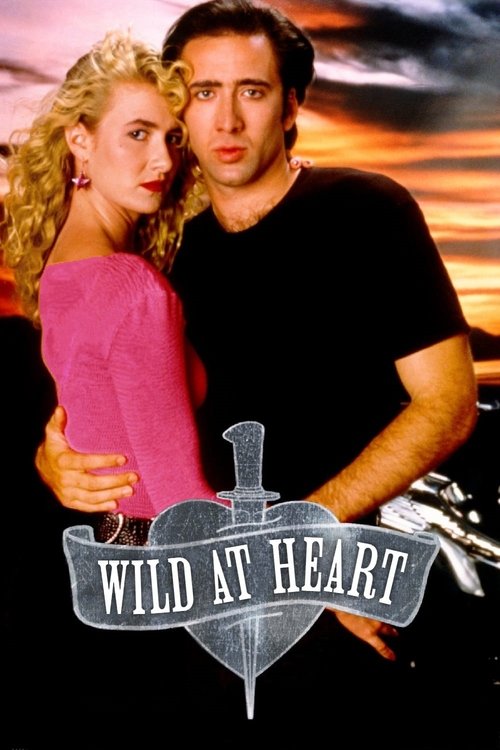
Wild at Heart
1990 · David Lynch
His January 2025 death was a global grief event that revealed how central he'd become to young cinephile identity; "Fix your hearts or die" and the daily weather reports became memorial memes. The reference point for everything called "Lynchian."
For when you want cinema unhinged — a wild, sexy, dangerous ride for a late night when normal movies feel too tame. Challenge over comfort, but with a big beating heart under the mayhem.
What it's about
Sailor, fresh out of prison, and Lula, madly in love with him, tear off across the American South in a convertible — pursued by Lula's unhinged mother, who has hired killers to end the romance for good. Their honeymoon-on-the-run detours through roadside bars, desert towns, and encounters with some of the strangest, most menacing people ever put on a highway.
The experience
A fever dream at 100 mph — swooningly romantic one minute, shockingly violent or laugh-out-loud bizarre the next. You don't so much follow it as ride it; the love story stays weirdly sincere no matter how deranged the world around it gets.
Performances
Nicolas Cage goes gloriously big as Sailor, channeling Elvis in a snakeskin jacket, and Laura Dern matches his heat with a Lula who's all appetite and vulnerability; Diane Ladd, Dern's real-life mother, is unforgettable as the film's lipstick-smeared fury.
The craft
Lynch floods the lovers-on-the-run formula with his signature textures — struck matches and roaring flames, pop songs turned ominous, sudden swerves from tenderness to nightmare — while winking constantly at The Wizard of Oz. The sound design and needle drops hit hard; it's a sensory assault worth good speakers.
Why it matters
It won the Palme d'Or at Cannes in 1990 — to audible boos — at the very peak of Lynch's cultural moment, and stands as one of the defining works of American surrealism crossing into the mainstream.
Snapshot
Wild at Heart is David Lynch's road movie as fever dream: a lovers-on-the-run picture that weds the iconography of Elvis Presley and The Wizard of Oz to extreme violence, screwball sexuality, and a recurring motif of fire. Sailor Ripley (Nicolas Cage), newly out of prison, and Lula Fortune (Laura Dern) flee across the American South pursued by Lula's mother Marietta (Diane Ladd), who has dispatched both a private detective and a contract killer to retrieve her daughter and destroy her lover. Adapted from Barry Gifford's 1990 novel, the film arrived at the precise crest of Lynch's cultural moment — produced in the gap between the two seasons of Twin Peaks and released the same year the series became a phenomenon — and won the Palme d'Or at the 1990 Cannes Film Festival amid audible booing in the hall. It is at once Lynch's most exuberant and most divisive feature: a film that some read as a sincere romance about love surviving a depraved world, and others as a knowing, almost camp exercise in genre overload. Both readings are sustained by the picture itself, which insists on its own emotional sincerity while continually flagging its artifice.
Industry & production
The project originated with producer Monty Montgomery, who held the rights to Gifford's novel and reportedly intended to direct it himself. He gave Lynch the galleys; Lynch responded to the material and asked to direct, with Montgomery staying on as a producer (and appearing onscreen as the Black Angel/Mr. Reindeer figure). The film was made through Propaganda Films, the prolific Los Angeles company co-founded by Steve Golin and Sigurjón "Joni" Sighvatsson, which was also the production base for Twin Peaks. This placed Wild at Heart inside a tight ecosystem of Lynch collaborators and a company adept at financing director-driven work.
Crucially, the film was shot quickly and during a window of intense activity for Lynch: he was simultaneously a television showrunner, and Wild at Heart functioned as a feature-scale release that capitalized on the Twin Peaks surge of 1990. The Samuel Goldwyn Company handled the U.S. release in August 1990. The Cannes triumph in May — the jury was presided over by Bernardo Bertolucci — gave the film a prestige imprimatur, though the divided reaction in the festival auditorium signaled the controversy that would follow it into wide release. The film's violence drew scrutiny from the MPAA; Lynch has spoken about trimming material (notably gore in the Bobby Peru shotgun sequence) to secure an R rating, though precise details of the cuts are not exhaustively documented and are best treated cautiously.
Technology
Wild at Heart is a conventionally photographed 35mm feature for its era, but its technological signature lies in Lynch's sound and image manipulation rather than in any novel apparatus. Lynch's long-standing fascination with texture — flame, smoke, the grain of a struck match in extreme close-up — depends on macro-photographic detail and meticulous in-camera and post-production sound design rather than optical or digital trickery. The film predates the digital-effects era; its fire imagery and its abrupt, near-subliminal cutaways are achieved photographically and through editing. The integration of pre-existing recordings (thrash metal, Chris Isaak, opera) alongside Angelo Badalamenti's original score reflects an increasingly sophisticated approach to the soundtrack as a layered construction, but the means remain those of standard early-'90s film production.
Technique
Cinematography
Frederick Elmes, Lynch's cinematographer on Eraserhead and Blue Velvet, shot the film, and his work here is markedly different from the controlled chiaroscuro of Blue Velvet. The palette runs hot — desaturated highway whites, blacks, and above all reds and oranges, with recurring inserts of flame that fill the frame. Elmes alternates between glossy, almost lurid daylight exteriors of the open road and claustrophobic interiors lit for menace. The film's most characteristic visual gesture is the extreme close-up of fire: a cigarette lit, a match struck, a house in flames, shot so tightly that the image abstracts into pure color and motion. These inserts punctuate the narrative as emotional and thematic rhymes rather than literal events. Elmes also stages several of the film's set-pieces — the desert night sequences, the neon-lit interiors — with a heightened theatricality that pushes the imagery toward the pop-iconographic register the film is reaching for.
Editing
Duwayne Dunham, who edited Blue Velvet and worked extensively on Twin Peaks, cut the film. The editing is one of its defining tools: Lynch and Dunham repeatedly break the forward motion of the road narrative with sudden associative cuts — to fire, to fragments of the past, to the Wizard of Oz. The rhythm lurches deliberately between languor and shock; long, dreamy passages of the lovers in motion give way to abrupt eruptions of violence rendered in jolting, percussive cutting (the opening murder, the late-film robbery and shootout). This montage logic, in which images recur as motifs and emotional states are conveyed through juxtaposition rather than continuity, is central to the film's hallucinatory texture.
Mise-en-scène / staging
Patricia Norris's production and costume design is indispensable. Sailor's snakeskin jacket — which he calls "a symbol of my individuality and my belief in personal freedom" — and Lula's wardrobe are pop-cultural signifiers worn as armor. The film is dense with Americana: motel rooms, diners, two-lane blacktop, the detritus of mid-century myth. Lynch stages performance and gesture in a heightened, presentational mode; characters address the camera's space directly, deliver monologues, dance, and pose. The Wizard of Oz motifs are built into the décor and staging — the Good Witch arriving in a bubble, ruby-slipper red, the Wicked Witch's cackle — so that the mise-en-scène itself becomes a running intertextual commentary.
Sound
Sound is arguably Lynch's primary expressive instrument. The film opens with the aggressive thrust of Powermad's thrash-metal track "Slaughterhouse," establishing a register of sensory assault, then pivots to the aching romanticism of Chris Isaak's "Wicked Game" and the operatic and orchestral textures of Badalamenti's score. Lynch layers room tone, amplified small sounds (matches, breath, flame), and music into a dense aural field. Sailor's recurrent invocation of Elvis is paid off when Cage sings — "Love Me" and "Love Me Tender" — folding the soundtrack into characterization. The contrast between brutal noise and tender melody enacts the film's central tension between violence and love.
Performance
The performances are pitched at the edge of stylization. Nicolas Cage plays Sailor as an explicit Elvis homage — the drawl, the cadence, the cool — while Laura Dern's Lula is volatile, sensual, and emotionally raw, given to sudden gestures (the radio-news breakdown, dancing in the desert). Diane Ladd, Dern's real-life mother, plays Marietta as a grotesque of maternal rage, in a performance that earned an Academy Award nomination for Best Supporting Actress; her image smearing red lipstick across her face is among the film's most indelible. Willem Dafoe's Bobby Peru, with rotted teeth and predatory menace, is a study in calculated repulsion. The ensemble — Harry Dean Stanton's mournful detective Johnnie Farragut, Isabella Rossellini's bleached Perdita Durango, Crispin Glover's cockroach-obsessed Cousin Dell, J.E. Freeman's gangster Santos — populates the film with vivid, often deliberately exaggerated grotesques.
Narrative & dramatic mode
The narrative is structured as a picaresque road movie, but its dramatic mode is closer to fairy tale and waking dream. The forward drive of flight-and-pursuit is repeatedly interrupted by digressions, monologues, and recovered memories — most darkly the revelation surrounding the death of Lula's father and Marietta's complicity. Lynch threads The Wizard of Oz through the story not as decoration but as structuring myth: the journey, the wicked mother-witch, the good witch who finally tells Sailor to stop running and not "turn away from love." The tone oscillates violently between sincerity and irony, horror and comedy, sometimes within a single scene. The effect is a melodrama whose extremity is both genuinely felt and self-aware — a romance that knows it is built from movie myths and chooses to believe in them anyway.
Genre & cycle
The film belongs to the lovers-on-the-run lineage that runs from They Live by Night and Gun Crazy through Bonnie and Clyde and Badlands, arriving in a late-'80s/early-'90s cycle of hyper-stylized, violent romances that would include True Romance (1993, also drawing on Elvis iconography) and Oliver Stone's Natural Born Killers (1994). It is simultaneously a road movie, a crime thriller, and a Gothic Southern grotesque. Where the classic outlaw-couple film tends toward social tragedy, Lynch refracts the form through surrealism and pop pastiche, foregrounding genre artifice rather than naturalism. It can be read as part of a broader postmodern moment in American cinema in which genre conventions were quoted, exaggerated, and recombined.
Authorship & method
Wild at Heart is unmistakably a Lynch film, and it reunites his core creative family. Cinematographer Frederick Elmes and composer Angelo Badalamenti — the latter Lynch's essential musical collaborator from Blue Velvet and Twin Peaks onward — supply the film's visual and sonic signatures. Editor Duwayne Dunham and designer Patricia Norris were likewise part of Lynch's recurring ensemble. The screenplay is Lynch's own adaptation of Barry Gifford's novel; Lynch reshaped the source materially, most famously importing the Wizard of Oz framework, which is largely his invention rather than Gifford's. (Gifford has spoken about the adaptation in interviews; the Oz overlay is generally credited to Lynch.) Lynch's method here is intuitive and associative — building from sound, texture, and image, trusting mood over explanation — and the film exemplifies his career-long practice of locating dread and beauty in the surfaces of American mid-century culture. The casting of Dern's actual mother as her tormentor, and the reuse of Blue Velvet alumni (Dern, Rossellini, Stanton), reflects Lynch's preference for a trusted repertory company.
Movement / national cinema
The film sits within American independent and auteur cinema of the late twentieth century, though Lynch's sensibility is steeped in European surrealism. Critics routinely connect his work to the Surrealist tradition of Buñuel and to a broader lineage of dream-logic filmmaking. Wild at Heart is also a profoundly American artifact — a meditation on the iconography of Elvis, Hollywood, the open road, and the Southern Gothic — refracted through that surrealist lens. Its Palme d'Or win marks it as a film embraced (and contested) by the European festival establishment even as its raw material is wholly American pop mythology.
Era / period
The film is a document of 1990, the apex of "Lynchian" as a cultural adjective. The simultaneity with Twin Peaks shaped both its reception and its meaning: audiences encountered Wild at Heart as the work of the man who had brought surrealism to network television. It belongs to a transitional moment in American filmmaking — after the New Hollywood auteurs, amid the rise of a stylized, media-saturated independent cinema that prized irony, pastiche, and extremity. Its violence and sexuality, and the debate over whether they were exploitative or expressive, situate it within early-'90s arguments about screen violence that would intensify with Tarantino and Stone a few years later.
Themes
Love against a violent and corrupt world is the film's overt subject — Sailor and Lula's devotion presented as a fragile refuge amid a landscape of predators, conspirators, and murderers. Fire recurs as the master motif: the burning of Lula's father, the matches, the literalization of passion and destruction as the same element. The Wizard of Oz supplies a counter-myth of home, journey, and the choice to embrace love rather than flee it. Other persistent Lynch concerns are present: the rot beneath American surfaces, the grotesquerie of family, sexuality as both ecstatic and menacing, and the thin membrane between dream and waking life. The film's controversial ending — in which Sailor, beaten and reformed, returns to Lula and sings — stages a deliberate, almost defiant choice of sincerity over nihilism, a fairy-tale resolution the film has spent two hours both undermining and earning.
Reception, canon & influence
Critical reception was sharply divided from the outset. The Cannes audience's mixed response to the Palme d'Or — applause and booing — set the template: admirers found it a delirious, emotionally committed masterwork; detractors found it gratuitous, smug, or hollow. Major American critics split along these lines, with some celebrating its energy and others recoiling from its violence and perceived self-indulgence. Diane Ladd's Oscar nomination provided a mark of mainstream recognition. Over time the film's standing has stabilized as a significant, if not universally beloved, entry in Lynch's filmography — less canonical than Blue Velvet or Mulholland Drive, but enduringly studied for its tone, its Oz intertextuality, and its place at the Twin Peaks-era peak of Lynch's influence.
Looking backward, the film draws on the outlaw-couple tradition (Gun Crazy, Bonnie and Clyde, and especially Malick's Badlands), on Elvis Presley as both musical and iconographic source, on The Wizard of Oz, on the Southern Gothic, and on Surrealist film practice. Looking forward, its fusion of pop pastiche, extreme violence, and romance prefigured and paralleled the hyper-stylized crime romances of the early-to-mid 1990s, and the collaboration extended into the Lynch–Gifford partnership and the wider Sailor-and-Lula universe (Gifford continued the characters in later fiction; the Perdita Durango figure spun into Gifford's own novel and a subsequent film adaptation). More broadly, Wild at Heart helped consolidate "Lynchian" as a recognizable aesthetic vocabulary — the marriage of Americana, dread, and dream — that would shape independent and arthouse cinema for decades. Its precise commercial performance is not something I will assert here without the figures to hand, but its cultural footprint, anchored by the Palme d'Or and the Twin Peaks moment, is secure.
A Deleuzian reading
A match flares.
The full Deleuzian reading of Wild at Heart →
Reception
It won the Palme d'Or at Cannes 1990 to a mix of cheers and audible boos, and plenty of critics wrote it off as Lynch self-parody at the peak of Twin Peaks mania. It's since settled into beloved cult status — the gonzo, sweaty middle child of the Lynch filmography that keeps climbing in reappraisals.
How Wild at Heart was received, from release to now →
Influences: the films it descends from and the films it influenced
- The Wizard of Oz (1939) — Lynch imports the film's iconography wholesale — the Good Witch's floating bubble, ruby-slipper reds, and 'don't turn away from love' — as an overlaid fairy-tale frame absent from Gifford's source novel.
- Badlands (1973) — The mythic lovers-on-the-run road structure built around a naive heroine whose fairy-tale narration romanticizes a charismatic, violent young man drifting across American emptiness.
- Gun Crazy (1950) — The eroticized outlaw couple in which sexual heat and gunplay are fused into a single charge, the gun as extension of desire.
- Bonnie and Clyde (1967) — The percussive, balletic cutting of sudden gun violence intercut with romance, and the deliberate tonal whiplash between tenderness and gore.
- Blue Velvet (1986) — Establishes Lynch's repertory company (Dern, Stanton, Rossellini) and the Elmes-photographed, Badalamenti-scored rendering of dread festering beneath mid-century Americana surfaces.
- Eraserhead (1977) — Layered industrial sound-design as primary dread-engine and grotesque extreme close-ups of texture and skin used as narrative rather than decoration.
- Un Chien Andalou (1929) — Surrealist associative montage and the assaultive close-up as pure shock device — image logic governed by dream-association, not causality.
- The Night of the Hunter (1955) — American Southern-Gothic fairy-tale mode rendering love-versus-evil as an expressionist storybook, the template for Lynch's innocence-menaced-by-monsters tonal register.
- King Creole (1958) — Supplies the Elvis Presley iconographic and performative source — the snakeskin-cool, diegetic-crooning masculinity Cage builds Sailor's whole persona around.
- Betty Blue (1986) — The American extension of the picaresque-to-doom couple film: episodic flight escalating into erotic-violent extremity, keyed throughout to a single recurring saturated color motif.
- Something Wild (1986) — Extends the romance-turned-atrocity road picture: curated needle-drops as authorial signature and violence that arrives inside a scene with no tonal preparation, the escalation structure Frye's script proved could hold.
- They Live by Night (1949) — Lynch keeps the fugitive lovers in motel-room enclosures scored by diegetic radio and record players, and preserves Ray's alternation: sustained tender two-shots between abrupt, unornamented eruptions of violence.
- Lost Highway (1997) — Extends the highway-as-dream road motif and the Lynch–Gifford collaboration into full noir, deepening the associative, non-causal editing pioneered here.
- Mulholland Drive (2001) — Matures the Lynchian fusion of Hollywood Americana, dream-logic narrative, and beauty-laced dread that Wild at Heart helped codify into a recognizable vocabulary.
- True Romance (1993) — Pop-pastiche lovers-on-the-run crime romance carrying the same Elvis-ghost iconography (Clarence's spectral Elvis mentor) and pulp-fairy-tale tone.
- Perdita Durango (1997) — Direct continuation of the Sailor-and-Lula universe, spinning Gifford's Perdita character into her own grotesque, hyper-stylized road-crime film.
- The Doom Generation (1995) — Neon-saturated, nihilist lovers-on-the-run pastiche built explicitly in the Wild at Heart mold — pop iconography, sudden violence, and ironic Americana.
- The Bride! (2026) — Lynch's hard music slams — Badalamenti's orchestral dread butted against speed metal and Elvis — and the compositing of undisguised fantasy inserts into a lovers-on-the-run road structure.
- Twin Peaks: Fire Walk with Me (1992) — Made at the same Twin Peaks-era peak with the identical Elmes/Badalamenti/Dunham toolkit — saturated reds, percussive violence, and dread-as-mood over explanation.
- Natural Born Killers (1994) — Pushes the associative-montage and percussive media-violence aesthetic to saturation over a lovers-on-the-run spine, extending the same stylized-crime-romance wave.
- Kalifornia (1993) — Pairs naive innocence with a charismatic killer on a cross-country road trip, riding the same early-90s stylized true-crime-romance current.
- Raising Arizona (1987) — Casts Nicolas Cage's sincere-absurd outlaw-lover persona — the unhinged tenderness Arizona launched — inside a Southern Gothic road fable steeped in mock-mythic, slightly demented Americana.
- Dinner in America (2020) — Fuses the lovers-on-the-run road picture with whiplash tonal violence and rock-idiom sincerity, licensing the pivot Rehmeier makes between abjection and swooning tenderness within a single scene.
- Knockin' on Heaven's Door (1997) — The crime road-couple picture that fuses the sublime and the profane through pop songs and highway iconography, the same tonal register of tenderness inside sleaze.
Similar films
- Lost Highway (1997) — influence & lineage
- Mulholland Drive (2001) — influence & lineage
- Twin Peaks: Fire Walk with Me (1992) — influence & lineage
- Eraserhead (1977) — influence & lineage
- Blue Velvet (1986) — influence & lineage
- El Topo (1970) — same viewing thread · often watched together
- Un Chien Andalou (1929) — influence & lineage · often watched together
- L'Âge d'or (1930) — often watched together
All the films related to Wild at Heart →
Watch it with: curated runs of related films
- Midnight Movie Provocations — Watch these when you want cinema at its most gorgeously deranged — cult objects that turn desire, violence, and pure anarchy into their own strange grace.