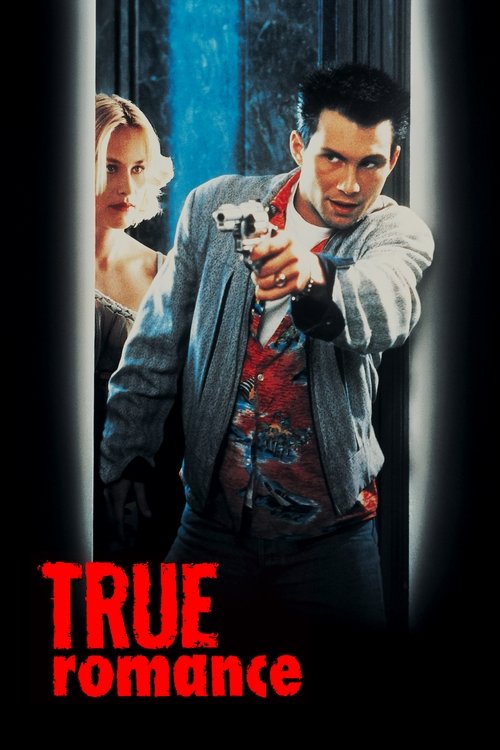
True Romance
1993 · Tony Scott
For when you want pure pulp adrenaline with a love story you can actually root for — a Friday-night ride, not homework. Fair warning: the violence is real, but the film's heart never stops being romantic.
What it's about
Clarence, a comic-store clerk raised on kung fu movies and Elvis, falls hard for Alabama on one wild night in Detroit — and marries her before the week is out. When he confronts her pimp, he walks away with a suitcase of mob cocaine, and the newlyweds bolt for Hollywood to sell it and start a life. Behind them, the men who own that coke start closing the distance.
The experience
It runs hot the whole way — motor-mouthed, funny, violent, and weirdly sweet at the center, so you're grinning through scenes that also make you flinch. A handful of two-person standoffs are so charged they've become the reason people rewatch it.
Performances
Christian Slater and Patricia Arquette give the runaway lovers a doomed-kids sincerity that keeps the mayhem grounded, and the film is stacked with unforgettable one-scene turns — Christopher Walken and Dennis Hopper's tense sit-down and Gary Oldman's dreadlocked pimp chief among them.
The craft
Quentin Tarantino's dialogue-drunk script meets Tony Scott's saturated, hyperkinetic style, and the collision produces real electricity: pop-culture riffs delivered at full velocity inside sun-blasted, neon-soaked images. The shootouts are staged with operatic excess that rewards a loud, big-screen viewing.
Why it matters
A modest theatrical run turned into one of the defining cult objects of '90s video culture, introducing Tarantino's voice to a mass audience before Pulp Fiction and giving Tony Scott his most beloved film among cinephiles.
Snapshot
True Romance is a hyperkinetic lovers-on-the-run crime film that sits at an unusual intersection of two very different directorial sensibilities: Quentin Tarantino's pop-mythological, dialogue-drunk screenwriting and Tony Scott's aggressively kinetic, image-saturated commercial style. The result is at once the most accessible Tarantino script and the most literary Tony Scott film — a contradiction that produces genuine electricity. A modest theatrical performer, the film found its real life on home video, where it became one of the defining cult texts of 1990s American cinema, establishing Tarantino's voice for mass audiences even before Pulp Fiction landed. It is simultaneously a B-movie tribute, a screwball romance, a gangster thriller, and a sustained meditation on how pop culture mythology shapes young men's understanding of themselves.
Industry & production
True Romance was produced by Morgan Creek Productions and distributed by Warner Bros. Tarantino wrote the script in the late 1980s, and it circulated among producers before he sold it — along with his Natural Born Killers script — in order to finance Reservoir Dogs (1992). This sequence of events matters: True Romance precedes Reservoir Dogs chronologically as a written work, which means the script represents Tarantino's earliest fully realized vision of the world he would spend the next decade exploring, unmediated by the practical constraints of a microbudget debut. The sale also meant that True Romance would be made without its author in the director's chair, creating the most notable case in the decade's cinema of a fully formed Tarantino script being interpreted by another filmmaker.
Tony Scott, whose commercial work for the Saatchi agency and whose studio films — Top Gun (1986), Beverly Hills Cop II (1987) — had made him one of Hollywood's most reliable high-concept directors, was attached to direct. Scott brought with him his cinematographer Jeffrey L. Kimball, editor Michael Tronick and Christian Wagner, and composer Hans Zimmer. The production assembled one of the more remarkable ensemble casts of the era: Christian Slater and Patricia Arquette in the leads, with Gary Oldman, Dennis Hopper, Christopher Walken, Brad Pitt, Val Kilmer, James Gandolfini, Bronson Pinchot, Chris Penn, Michael Rapaport, and Samuel L. Jackson in supporting and cameo roles. This casting density is itself a signature of a script that had passed through agents' hands as an object of desire and accumulated attachments accordingly.
The film was shot primarily in Los Angeles and Detroit. Its budget, while modest by studio action standards, afforded enough resources for the elaborate Chateau Marmont finale. The film's theatrical performance was disappointing relative to expectations — precise domestic figures are a matter of studio record, and this dossier refrains from speculating on numbers that the scholarly literature has not established with consistency — but home video revenues and cable exhibition transformed it into a profitable property and cultural touchstone.
Technology
True Romance was shot on 35mm film, consistent with industry-standard production of the period. Jeffrey L. Kimball, working in the mode that he and Scott had developed together, favored a multi-camera setup that allowed Scott to maintain coverage of scenes from multiple angles simultaneously, capturing spontaneous variations in performance. This practice, which Scott had refined across his commercial work, sacrifices the controlled lighting geometry of single-camera production in exchange for an improvisational energy that suits the film's emotional register.
The period's photochemical color timing permitted the heightened, almost hallucinatory palette that Scott sought — pushed contrasts, warm amber overexposure in daytime sequences, the bleached, overlit quality of Los Angeles exteriors. These effects were achieved through in-camera filtration and laboratory printing decisions rather than the digital color grading that would become standard practice in the following decade. The film pre-dates any significant digital intermediate workflow; what Kimball and Scott achieved was built into the negative.
Technique
Cinematography
Kimball's work for Scott throughout the 1980s and 1990s is characterized by a disregard for naturalism in favor of image as sensation. In True Romance this manifests in a palette of bruised blues and molten ambers, saturated to the edge of abstraction. The film owes something to the aesthetics of the music video — Scott had been deeply conversant with that form — and to advertising photography: images are composed to be instantly legible as beautiful before they are legible as realistic. Lenses favor longer focal lengths that compress space and isolate figures against bokeh backgrounds, giving performers a kind of poster-image clarity. The camera is rarely static; even in dialogue scenes it drifts and reframes, as though the world cannot quite hold still around these people.
The Chateau Marmont finale uses multiple cameras cutting among action in a manner that prioritizes energy over spatial coherence, a deliberate choice that privileges visceral impact over geometry.
Editing
The editing by Michael Tronick and Christian Wagner reflects a structural tension between Scott's instinct for propulsive cutting and the demands of scenes that Tarantino wrote to breathe. The Dennis Hopper–Christopher Walken confrontation — the film's most celebrated sequence — is cut with unusual restraint, allowing the performances to unfold in extended takes before the film intercedes. Elsewhere the cutting is rapid, particularly in the action sequences, and the film's rhythm accelerates as the narrative pressure builds toward the finale. The overall structure, like that of a pulp novel, moves in self-contained scenes that could, in a different director's hands, have been reordered — Tarantino's original script apparently employed a more fractured chronology that Scott elected to linearize, resulting in a more conventional narrative flow than would characterize Pulp Fiction.
Mise-en-scène / staging
Scott's staging reflects his background in image-making for consumer culture: every frame is saturated with objects that carry meaning. Clarence's bedroom is an autobiography of pop consumption — comic books, movie posters, neon signs, action figures — establishing the character's inner life through accumulation rather than exposition. The contrast between this cluttered American vernacular and the sleek threat of the Sicilian gangsters' spaces defines the film's moral geography.
The Val Kilmer Elvis apparition — Clarence sees his idol in bathroom mirrors, Elvis dispensing counsel like a tutelary deity — is staged with the matter-of-fact literalness of dream logic: there is no soft-focus treatment or dream-state signaling; Elvis simply appears, as he does in the mind of someone for whom a movie star has become a genuine locus of value. This refusal to psychologize the vision is a Scott directorial choice that honors the script's earnestness about pop mythology.
Sound
Hans Zimmer's score is one of the signal achievements of the film's production. The main romantic theme — a delicate, repetitive melodic figure built on a pentatonic structure, played with a lightness that contrasts sharply with the film's violence — creates the emotional frame within which everything else is perceived. By associating the theme with Clarence and Alabama's love, Zimmer (and by extension Scott) decisively argues for the relationship's authenticity, however fantastical its circumstances. The score's airiness functions as a kind of tonal counterweight to the pulp brutality of the action, enacting the film's central claim: that romantic love is real even when everything around it is absurd. The theme has become one of the more recognized musical signatures in 1990s American film and has been cited and sampled widely in subsequent decades.
Diegetic sound design follows Scott's commercial instincts: gunshots are loud and ugly, violence is tactile rather than stylized.
Performance
The casting decision to populate every supporting role with actors of unusual caliber produces a film in which even a scene lasting three minutes generates its own internal weight. Gary Oldman's Drexl Spivey — a white pimp who has adopted a Black vernacular identity — is a performance of committed extravagance that sits at the edge of discomfort and was not without controversy in its moment. Dennis Hopper's Clifford Worley and Christopher Walken's Vincenzo Coccotti share a scene that has entered the film canon as a masterclass: Hopper's monologue about the Moorish ancestry of Sicilians is a set piece of dialogue construction, performed by Hopper with the calm dignity of a man who has decided to accept death while giving his interlocutor the final insult. Walken meets it with a stillness that makes the scene's conclusion inevitable. Tarantino has identified this scene as the best writing he has done.
Christian Slater plays Clarence with a quality of earnest delusion that asks the audience to believe in a character whose worldview is entirely constructed from movies and music; the performance works because Slater never winks. Patricia Arquette plays Alabama with warmth and a survivalist resourcefulness that grounds the film's most difficult moment — her extended fight with James Gandolfini's Charlie Cali — in genuine stakes. Gandolfini's performance in that scene, years before The Sopranos, is a reminder of what the film gave early career definition to.
Narrative & dramatic mode
True Romance follows the classic lovers-on-the-run structure — a fugitive couple propelled by a single catastrophic event (Clarence's murder of Drexl and theft of the cocaine) into a flight that escalates through encounter with increasingly powerful antagonists. Tarantino's contribution to the form is to build the narrative from a series of largely self-contained confrontations, each with its own internal dramatic logic, so that the film has the texture of an anthology of scenes connected by plot rather than a conventionally continuous thriller. This structure — which owes something to the episodic architecture of pulp novels and to the chapter structure of crime fiction — would become a Tarantino signature, most fully realized in Pulp Fiction.
The film's most significant narrative deviation from its sources in the lovers-on-the-run tradition is Tony Scott's alteration of the ending: Tarantino's original script killed Clarence; Scott kept him alive, giving the film the happy ending that its romantic register arguably demands. This choice has been debated, with Tarantino on record as preferring his version. Both endings are defensible within the material.
Genre & cycle
True Romance participates in the early 1990s neo-noir and crime film renaissance that would produce, within eighteen months of its release, a cluster of films — Reservoir Dogs, Pulp Fiction, The Usual Suspects, Heat — that collectively redefined the American crime film. It is distinguished from most neo-noir by its romantic-comedy DNA: the film is genuinely funny in ways that depend on the audience's investment in Clarence and Alabama as a couple rather than as genre figures. The lovers-on-the-run tradition from which it descends — running through You Only Live Once (1937), Gun Crazy (1950), Bonnie and Clyde (1967), Badlands (1973) — typically treats the lovers' flight as elegiac; True Romance is almost giddy about it. This tonal divergence is one of the film's more original contributions to its genre.
Authorship & method
True Romance is the film in which the question of screenwriter-as-auteur is most productively complicated. The Tarantino dialogue, the Tarantino structural logic, the Tarantino pop-mythological framework are all unmistakably present; the visual register, the pacing of the action sequences, the overall sensory envelope of the film are unmistakably Scott. Neither author fully dominates. What results is a work that is in dialogue with two distinct artistic sensibilities and is richer for the friction.
Tony Scott's method on the film was consistent with his commercial practice: thorough pre-production, multi-camera shooting, heavy involvement in music and sound design, and a commitment to image saturation as a value in itself. Kimball's cinematography operationalizes Scott's aesthetic at a technical level. Hans Zimmer's compositional approach — romantic, melodic, built on repetitive figuration — collaborates with rather than comments on the material.
Movement / national cinema
True Romance belongs to the American independent sensibility that, in the early 1990s, was infiltrating studio production. The film is a studio picture — produced and distributed by major companies — but its script, its casting choices, and its willingness to sit with extreme violence and extreme tenderness in the same frame align it with the independent cinema that Sundance and the foreign-film-inspired American revival had made newly legitimate. It participates in a broader cultural moment in which a generation of filmmakers who had been educated by repertory cinema and VHS were finding their way into commercial production without surrendering their aesthetic education.
Era / period
The film is a product of the early Clinton years, a moment of cultural optimism and anxiety that produced, in popular culture, a fascination with the lives of people operating at the margins of the legal economy. The drug trade as background noise of American life, the aspirational fantasy of a score that would change everything, the sense that Los Angeles was simultaneously the promise and the rot of American life — these are period-specific preoccupations that True Romance shares with much of the crime culture of its moment.
Themes
The film's central argument is that romantic love — specifically, the love of two young people whose inner lives have been formed by pop culture — can be real and transformative even when the conditions that produce it are squalid and violent. Clarence's love for Alabama is inseparable from his identification with movie heroes; Alabama's love for Clarence is inseparable from her recognition that he is, by the standards of her experience, genuinely kind. The film treats this as sufficient.
The Elvis motif concentrates the film's deeper theme about pop mythology as a system of values. For Clarence, Elvis is not a celebrity but a figure of orientation — a way of understanding what a man should be. The film does not satirize this; it takes the mythology seriously enough to dramatize its consequences. Pop culture, in Tarantino's moral universe, is not escapism but reality: the movies people love form the moral imagination they actually have.
Reception, canon & influence
Critical reception on release was divided, with some reviewers responding to the film's energy and script quality and others finding Scott's visual approach incompatible with the material's subtleties. The film's theatrical performance was below expectations. Its subsequent trajectory on home video was significant: by the mid-1990s it had acquired the cult status that would prove durable, and its reputation has continued to appreciate as Tarantino's canonical standing has solidified.
The film's backward influences are legible throughout: Godard's À bout de souffle (the lovers-on-the-run structure, the cinephile protagonists), Bonnie and Clyde, Badlands (the fugitive couple's romantic isolation), Scarface (the cocaine economy, the aspiration toward a bigger life), Elmore Leonard's crime fiction (the escalating ensemble of criminals converging on a single prize), and the B-movies and exploitation films that Tarantino had absorbed exhaustively.
Its forward influence operates through two channels. As a Tarantino script, it established for a broad audience the dialogue style, pop-cultural vocabulary, and tonal mixture — comedy and violence, sentiment and brutality — that Pulp Fiction would render canonical. The Hopper/Walken scene in particular circulated widely as an example of what American screenwriting could do, and its pedagogical influence on a subsequent generation of writers is genuinely traceable. As a Tony Scott film, it represents a high point of the director's ability to find legitimate artistic ambition within a commercial frame, a tension he would pursue throughout the remainder of his career.
The film also functions as an early showcase for actors who would define 1990s and 2000s American cinema: Gandolfini, Oldman, Arquette, and others appear here in formative roles that the subsequent decades allow us to read retrospectively. True Romance is, in this sense, also a document of a particular moment of talent concentration that the American film industry rarely achieves.
A Deleuzian reading
Val Kilmer's Elvis is in the bathroom mirror, giving Clarence advice about whether to kill a man.
The full Deleuzian reading of True Romance →
Reception
A box-office flop in 1993 that barely made back its budget, it steadily climbed to stone-cold cult classic status through the '90s video-store era — now it's routinely called one of the best films of its decade and the coolest thing Tony Scott ever made.
How True Romance was received, from release to now →
Influences: the films it descends from and the films it influenced
- Gun Crazy (1950) — Lewis established the lovers-on-the-run B-noir grammar True Romance inherits: the female partner as the dominant criminal force who turns a romantic male toward violence, escalating episodic structure, and the confined-space staging of the climax that traps the couple against pursuing forces.
- À bout de souffle (1960) — Michel Poiccard's identity assembled from Bogart posters and American B-movie iconography is the direct model for Clarence's self-construction through comic books and kung-fu films — the premise of a young man who has built a self entirely from pop-culture objects rather than lived experience.
- Bonnie and Clyde (1967) — Penn established the American New Wave template for the lovers-on-the-run crime film that True Romance directly negotiates: sudden explosive violence rupturing romantic comedy, an ensemble of grotesquely comic secondary criminals, and the pop-mythological celebrity outlaw as aspirational figure.
- The Getaway (1972) — Peckinpah's staging of the heterosexual criminal couple as a structural unit — pursued simultaneously by law enforcement and a competing criminal, culminating in a hotel siege — provides the basic narrative geometry of True Romance's third act.
- Badlands (1973) — Alabama's detached lyrical voice-over mythologizing Clarence directly descends from Holly's narration in Badlands: a young woman's poetic account that transforms her outlaw lover into a figure of romantic mythology while staging violence with matter-of-fact emotional distance.
- Scarface (1983) — De Palma's maximalist staging of a man who builds his entire identity from B-movie archetypes — Tony Montana as self-assembled myth — shapes Tarantino's construction of Clarence, and the ensemble casting of recognizable actors in heightened genre roles establishes the density True Romance inherits.
- Something Wild (1986) — Demme's genre hybrid — romantic comedy that becomes crime thriller mid-film — is the immediate formal ancestor of True Romance's tonal register: pop-object accumulation as character identity (Lulu's wig, vintage records), episodic picaresque road structure, and sudden violent intrusion into comic romance.
- Wild at Heart (1990) — Direct predecessor: pop-mythological identity assembled from Elvis iconography as wearable self (Sailor's snakeskin jacket = Clarence's mythology), lovers-on-the-run against an ensemble of grotesque criminals, and matter-of-fact dream logic that presents surreal violence within a romantic comedy register.
- King of New York (1990) — Deploys Walken's quiet-menace register in its own key while extending the glossy, music-saturated 90s crime stylization, carrying forward the Walken-understatement performance idiom King of New York crystallized.
- Revenge (1990) — Kimball's cinematography carries the Revenge experiment forward successfully — smoke-and-raking-light interiors, dirty obstructed foregrounds, and violence held offscreen or cut away from until it detonates — proving the technique worked once attached to material that wanted velocity.
- Play It Again, Sam (1972) — Clarence's Elvis in the bathroom mirror reproduces Bogart's function and staging exactly — a hallucinated icon shot in shot/reverse as a physical scene partner, dispensing tactical advice the protagonist then acts on.
- Jackie Brown (1997) — The pop-object accumulation staging — soul records and Inglewood shopping mall consumer objects as character identity markers — and the elongated real-time scene sequences (the triple-perspective mall sequence) develop the True Romance approach to space and duration in Tarantino's most Scott-paced directorial work.
- Kill Bill: Volume 1 (2003) — The pop-mythology identity construction of True Romance — Clarence as a man assembled entirely from comic books and kung-fu films — becomes Kill Bill's structural premise: the Bride's identity is wholly built from genre film references, extending Clarence's self-construction from character quirk into formal system.
- Man on Fire (2004) — Scott's direct evolution of the True Romance amber-blue saturation and multi-camera approach using digital tools: the photochemical color palette pushed into bleach-bypass processing and the cutting rhythm extended by subtitle-text-as-edit devices unavailable in the earlier photochemical-only workflow.
- Domino (2005) — The furthest extension of the multi-camera handheld saturation style Scott developed in True Romance, taken to near-abstraction through digital manipulation — compressed telephoto lenses and amber-blue palette pushed until image content dissolves into pure chromatic sensation, the cinematographic program of 1993 reaching its terminal logic.
- Spy Game (2001) — Scott's first sustained break from Top Gun classicism into nonlinear sympathy and lyrical saturation — the early laboratory for the maximalist style Spy Game perfects.
- Knockin' on Heaven's Door (1997) — The Tarantino-scripted crime-lovers-on-the-run with a pop soundtrack and a bumbling-gangster underworld pursuit, modeling the pulp mechanics that keep Jahn's plot moving beneath the emotion.
- The Bride! (2026) — Scott's long-lens telephoto coverage isolating two faces in shallow, eavesdropped intimacy while violence plays out behind them, scored by Zimmer's lilting marimba as ironic counterweight — the exact pairing of observational long lens and wrong-mood music the seed runs.
- From Dusk Till Dawn (1996) — The nearest relative of Tarantino's first-half script: fugitive lovers-and-cash structure, motel rooms as pressure chambers, and long dialogue standoffs where the threat is in the courtesy — a Tarantino screenplay directed by someone else, exactly the arrangement here.
- Reservoir Dogs (1992) — Shares the confrontation-as-performance-set-piece architecture — the slow-burn standoff mirrors the Hopper/Walken scene's technique of sustained stillness before violence — and the ensemble casting approach where each recognizable actor receives one definitive moment rather than a full character arc.
- Natural Born Killers (1994) — Stone directed the other Tarantino lovers-on-the-run script sold in the same transaction; his MTV rapid-montage and media-saturation approach versus Scott's continuity-based cinematography reveals how profoundly directorial style determines the moral register of identical narrative DNA.
- Pulp Fiction (1994) — Deploys the same ensemble casting density, pop-mythology identity construction, and self-contained episodic scene structure, but restores the non-linear chronology that Scott's direction linearized — making the two films a paired experiment in how narrative order determines moral weight.
- Heat (1995) — Mann and Scott were parallel architects of the amber-toned photochemical neo-noir ensemble crime film; the Pacino/De Niro diner confrontation — two equally weighted performers held in sustained close-up with listening faces — deploys the same extended-take restraint Scott used for Hopper/Walken, confirming it as the decade's prestige set-piece form.
- Top Gun (1986) — Famously connected by Tarantino's Sleep With Me riff on Top Gun's homoerotic subtext, Scott here directs Tarantino's script with the same saturated, romantic-glow visual signature, showing the Top Gun style applied outside the blockbuster mode.
- Crimson Tide (1995) — First grafts Tarantino's pop-culture digression dialogue onto Scott's propulsive style, the same uncredited-Tarantino voice that produces Crimson Tide's Silver Surfer / Kirby-vs-Lee wardroom riff.
- Thelma & Louise (1991) — Outlaw-couple-on-the-run road romance from Ridley's brother carrying the same anamorphic gloss, extending the doomed-lovers-fleeing-a-corrupt-system structure into the '90s.
- Dinner in America (2020) — Model for the outsider couple whose cartoonish, escalating violence coexists with an utterly earnest romance — the film asks you to take the love seriously precisely because everything around it is lurid.
Similar films
- Scarface (1983) — influence & lineage · often watched together
- Heat (1995) — influence & lineage · often watched together
- Pulp Fiction (1994) — influence & lineage
- Jackie Brown (1997) — influence & lineage
- Reservoir Dogs (1992) — influence & lineage
- Bonnie and Clyde (1967) — influence & lineage
- Top Gun (1986) — often watched together
- GoodFellas (1990) — often watched together