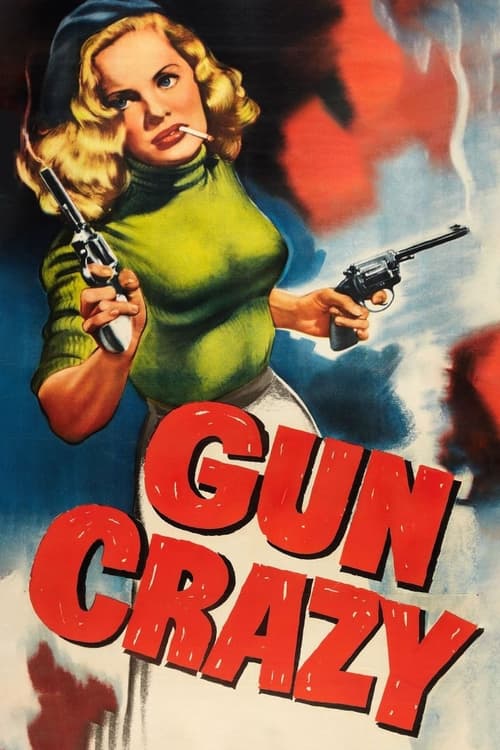
Gun Crazy
1950 · Joseph H. Lewis
For when you're craving something pulpy, sexy, and dangerous that doesn't waste a minute — an 87-minute shot of pure noir for a late night.
What it's about
A gentle ex-Army man who loves guns but can't stand killing meets his match at a carnival: a beautiful trick-shot artist with an appetite for danger. They fall hard and fast, and when the money runs out, she pulls him into a spiraling run of armed robberies across the country — two people who shoot straight at everything except each other.
The experience
Lean, fast, and feverish — a B-movie that plays like a fuse burning down. The attraction between the two leads is so charged it feels dangerous, and the film barrels forward with a desperate, doomed momentum that never lets you relax.
Performances
Peggy Cummins is unforgettable as the sharpshooter — hungry, glittering, genuinely frightening — and John Dall's soft, anxious decency makes their pairing feel like watching someone step willingly off a cliff.
The craft
Joseph H. Lewis wrings astonishing style from a tiny budget, most famously a real bank robbery shot in one unbroken take from the back seat of the getaway car — improvised street, real passersby and all. The script, secretly written by the blacklisted Dalton Trumbo, gives the pulp a startling psychological frankness.
Why it matters
A throwaway B-picture reappraised as one of the cornerstones of film noir, its lovers-on-the-run template and stripped-down daring echoing through decades of outlaw-couple movies.
Snapshot
Gun Crazy is a low-budget independent crime picture that has, over seven decades, been promoted from disposable B-feature to one of the foundational texts of American film noir and the lovers-on-the-run genre. Made by the King Brothers and released through United Artists, it follows Bart Tare (John Dall), a gentle marksman with a compulsive love of firearms and a horror of killing, who is drawn into a folie à deux with Annie Laurie Starr (Peggy Cummins), a carnival sharpshooter whose appetite for danger pulls them onto a spiraling crime spree. Directed by the studio-system craftsman Joseph H. Lewis from a script fronted by Millard Kaufman but substantially written by the blacklisted Dalton Trumbo, the film fuses pulp sensationalism with a startlingly frank treatment of sexual obsession and a handful of formally audacious sequences—above all a single-take bank robbery filmed from the back seat of a getaway car. Its reputation rests on the tension between its poverty-row means and the expressive intelligence with which those means are deployed. The film is also cataloged under its initial release title, Deadly Is the Female.
Industry & production
Gun Crazy belongs to the postwar ecosystem of independent B-production that flourished at the margins of the studio system. It was produced by Frank and Maurice King (the King Brothers), independent producers known for working cheaply and shrewdly, and distributed by United Artists, the company built precisely to release independently produced features. The source was a 1940 Saturday Evening Post short story by MacKinlay Kantor; Kantor is credited on the screenplay alongside Millard Kaufman. It is well established that Kaufman served as a front for Dalton Trumbo, one of the Hollywood Ten, who was blacklisted and could not work under his own name; Trumbo did much of the substantive screenwriting, and his credit has since been widely restored in scholarship and on reissues. This places the film squarely inside the political trauma of the era: it is a product of the blacklist's machinery of concealment.
The production was fast and economical, the typical condition of King Brothers pictures, and Lewis was the kind of efficient, resourceful director such productions prized. Precise budget and box-office figures for the film are not reliably documented in the popular record, and I will not invent them; what is clear is that it was made cheaply and did not register as a major commercial event on release. Distribution history is itself slightly tangled: the picture was first released in January 1950 as Deadly Is the Female and subsequently reissued under the title Gun Crazy, the name by which it is now universally known. The film's later canonization owes far more to revival screenings, cinephile championing, and home-video circulation than to its original theatrical performance.
Technology
The film was shot on 35mm black-and-white stock with the standard Academy ratio of the period, using the conventional optical and sound technology of late-1940s Hollywood. Its technical interest lies not in novel hardware but in the ingenuity with which ordinary equipment was pushed. The celebrated single-take robbery sequence depended on mounting the camera inside a real automobile, allowing the actors and the operator to occupy the car together while it moved through actual streets. Accounts of the production describe a specially rigged camera setup that permitted continuous handheld-style coverage from the back seat without the apparatus being visible to bystanders. The effect anticipates, by available means, the kind of mobile, in-the-moment shooting that lighter equipment would later make routine; here it was achieved through carpentry, planning, and nerve rather than miniaturized cameras.
Technique
Cinematography
The cinematography is by Russell Harlan, a gifted craftsman whose later career included Rio Bravo, Riot in Cell Block 11, and To Kill a Mockingbird. Harlan's work here is the film's most consistently praised technical element. He shoots in a deep, contrasty noir register—pools of shadow, hard key light, night exteriors—but the photography is most distinctive when it abandons studio control for documentary roughness. The robbery sequence, photographed largely in a single continuous take from inside the getaway car, captures real streets, real passersby, and natural light, producing a texture of lived immediacy rare in studio crime films of the period. Elsewhere Harlan favors fluid camera movement and unusually long takes, and he and Lewis stage action in depth so that the frame carries dramatic information without recourse to cutting. The visual style oscillates between expressionist stylization in the interior scenes and a near-newsreel naturalism on location.
Editing
The editing, credited to Harry Gerstad, is notable in large part for its restraint. The film's signature sequences withhold the cut: the bank robbery unfolds in real time within a single mobile shot, generating suspense through duration and continuity rather than fragmentation. This is the inverse of the conventional crime-film montage of the era, and it lends the sequence a documentary tension—the audience waits inside the car with the characters. Against these sustained passages, the film uses sharper, more conventional cutting in its set-piece confrontations, so that the long takes register all the more strongly by contrast. The editing logic is thus expressive and selective rather than uniform.
Mise-en-scène / staging
Lewis stages Gun Crazy around a small number of charged spaces—the carnival, cheap hotel rooms, the interiors of cars, the foggy marsh of the finale—and uses staging in depth to keep performance and environment in continuous relation. The carnival sequence in which Bart and Annie first compete in a shooting contest is a model of erotically charged blocking: the two are positioned as mirror images, their marksmanship a sublimated courtship, with guns standing in for desire. Throughout, Lewis composes for the long take, choreographing actors and camera so that emotional shifts play out within the shot. The recurring motif of the automobile as a mobile interior—an intimate, enclosing space that is also the instrument of flight—organizes much of the staging.
Sound
The sound design is conventional for its budget and period, but the use of natural sound in the location sequences contributes materially to their realism, and the improvisational, overlapping quality of the dialogue in the car heightens the sense of unrehearsed tension. The score by Victor Young, a prolific and respected Hollywood composer, supplies romantic and suspense cues in the idiom of the time; it underscores the doomed-romance dimension of the story without overwhelming the film's grittier passages. Detailed technical documentation of the sound recording is thin, and I will not overstate it.
Performance
The film lives on the chemistry and asymmetry of its two leads. Peggy Cummins, a British actress cast against her ingénue image, gives Annie Laurie Starr a predatory, restless energy that has become the performance's enduring legacy; she is the engine of the couple's destruction, and Cummins plays her without sentimental softening. John Dall, as Bart, offers the necessary counterweight: weak, adoring, morally squeamish, a man undone by his inability to refuse her. The two performances generate an erotic charge that the period's censorship could only render obliquely, and much of the film's frankness about sex is carried in performance and staging rather than dialogue. The supporting playing is functional in the B-picture manner; the film's intensity is concentrated in its central pair.
Narrative & dramatic mode
Gun Crazy is a compressed tragedy of compulsion. Its narrative mode is the criminal-couple romance: two people whose attraction is inseparable from their shared transgression, whose love can only express itself through escalating crime, and whose trajectory is fatally downward from the outset. The film frames Bart's gun obsession with a quasi-clinical backstory—childhood scenes establishing his fixation and his aversion to killing—giving the spree a psychological etiology rather than mere sensational motive. The dramatic engine is the imbalance between the partners: Bart wants the thrill without the violence; Annie wants both. Their relationship is a study in moral asymmetry, and the plot's forward motion is essentially the working-out of that imbalance toward catastrophe. The mode is fatalistic in the classic noir sense: the ending is legible from the beginning, and the pleasure and dread of the film lie in watching the inevitable arrive.
Genre & cycle
The film sits at the intersection of two formations. It is a film noir, sharing the cycle's fatalism, its sexual danger, its doomed protagonists, and its expressionist-cum-documentary visual texture. It is also a key early example of the "lovers on the run" or criminal-couple subgenre whose mythic ancestor is the real Bonnie and Clyde and whose later landmarks include They Live by Night, Bonnie and Clyde, Badlands, and Natural Born Killers. Within the noir cycle, Gun Crazy belongs to the B-picture stream—films made cheaply and quickly that could, precisely because of their marginal status and freedom from prestige expectations, take formal and thematic risks that A-productions avoided. Its frank linkage of sex, guns, and death pushes the noir cycle's latent content closer to the surface than most contemporaneous studio films dared.
Authorship & method
Gun Crazy is the central exhibit in the case for Joseph H. Lewis as a genuine auteur working within poverty-row constraints. Lewis (sometimes nicknamed "Wagon Wheel Joe" for his compositional flourishes) was a journeyman who specialized in elevating thin material through visual intelligence, and Gun Crazy is his most fully realized film. His method is identifiable: the long take, the staging in depth, the eroticized blocking, the readiness to shoot on real locations for documentary force. His reported direction of the leads before the robbery sequence—to play it for raw, edgy realism—is part of the film's lore and consistent with its achieved texture.
He worked with strong collaborators. Cinematographer Russell Harlan supplied the film's visual range, from noir stylization to location naturalism. Composer Victor Young provided a professional, romantic score. Editor Harry Gerstad shaped the film's distinctive rhythm of withheld and released cutting. And the screenplay's deepest authorial layer belongs to Dalton Trumbo, writing behind Millard Kaufman's name; the script's psychological framing of obsession and its sympathy for its doomed criminals are consonant with Trumbo's gifts, even as the precise division of labor between Kantor, Kaufman, and Trumbo remains partly obscured by the conditions of the blacklist. The film is thus a collaboration in which an underrated director and a concealed major screenwriter together exceeded the limits of their budget.
Movement / national cinema
The film is a product of classical Hollywood, specifically its independent-B and noir margins, rather than of any organized movement. Yet its retrospective importance is inseparable from a transnational current of reception: the postwar French critics and filmmakers who looked to American genre cinema, and to film noir in particular, found in pictures like Gun Crazy an art of expressive economy. Its mobile camera, its embrace of real locations, and its compression of melodrama into kinetic action anticipate concerns that the French New Wave would later make programmatic. The film belongs to American national cinema by production but to an international cinephile genealogy by influence.
Era / period
Gun Crazy is a deeply postwar film, marked by the anxieties of 1949–1950 America: the return of servicemen (Bart is an ex-Army man whose military marksmanship has no peacetime outlet), a culture of consumer desire pursued through cash and cars, and the gathering chill of the early Cold War. Its very making is stamped by the period's politics through the blacklist and Trumbo's concealment. The film's treatment of guns, violence, and sexual restlessness can be read as an oblique register of postwar dislocation, the energies of wartime turned destructively inward. It precedes the major loosening of the Production Code and works within its constraints, encoding its frankness in image and performance rather than statement.
Themes
The film's governing theme is the fusion of sex, guns, and death—the way desire, in Bart and Annie, can find expression only through transgression and violence. The gun is the film's central symbol, simultaneously phallic, vocational, and lethal, and the famous courtship-by-marksmanship makes the equation of shooting and sexuality explicit. A second major theme is compulsion and the limits of free will: Bart is presented as constitutionally unable to resist either guns or Annie, and the film's fatalism turns on this lack of agency. Related is the theme of folie à deux, the way two people can form a closed system that drives each toward ruin neither would reach alone. The film also touches the postwar problem of the veteran's reabsorption, the corrosiveness of money-hunger, and the impossibility of escape—the recurring motif of flight that only ever circles back toward death.
Reception, canon & influence
On first release Gun Crazy attracted little prestige attention; it was a B-picture, and its critical canonization came later. Its reputation was built through revival culture, auteurist criticism, and the advocacy of cinephile writers—Lewis's directorial achievement and the film's formal daring were increasingly recognized from the 1960s and 1970s onward—and it has since been admitted to the canon of essential American film noir, including selection for preservation in the National Film Registry by the Library of Congress. I will not attribute specific contemporaneous reviews I cannot verify; the broad shape of its reception—neglect followed by rediscovery—is, however, well documented.
Looking backward, the film draws on the mythology of the real Bonnie and Clyde, on the Saturday Evening Post pulp tradition of Kantor's source, on the conventions of film noir then crystallizing, and on the social-problem framing of criminal psychology common to the period. Looking forward, its influence is large out of all proportion to its original profile. It is widely cited as a key forerunner of Bonnie and Clyde (1967) and of the entire subsequent lovers-on-the-run lineage running through Badlands, Thieves Like Us, and Natural Born Killers. Its single-take, in-the-car robbery sequence is a touchstone for filmmakers interested in long-take realism and has been admired and emulated across decades. The film's championing by figures associated with the French New Wave sensibility helped secure its status as a model of how genre constraint and low budget could yield genuine art. Gun Crazy endures, finally, as the definitive demonstration that the American B-film could be a vehicle for serious formal ambition and for a frankness about sex and violence that its more respectable contemporaries could not match.
A Deleuzian reading
Two marksmen stand at opposite ends of a carnival shooting tent, and what passes between them is not competition but courtship.
The full Deleuzian reading of Gun Crazy →
Reception
Released as a cheap King Brothers B-picture (first under the title 'Deadly Is the Female') and barely noticed, it was rescued by French critics and later American reappraisal into the top tier of film noir — capped by a National Film Registry induction in 1998.
How Gun Crazy was received, from release to now →
Influences: the films it descends from and the films it influenced
- You Only Live Once (1937) — Established the sympathetic-fugitive-couple template — innocents hardened into doomed outlaws — with expressionist lighting that brands the lovers as fated, the narrative armature Lewis inherits wholesale.
- They Live by Night (1948) — The immediate lovers-on-the-run precursor, pioneering the tender naturalistic intimacy and location-inflected texture between a doomed young couple that Lewis sexualizes and accelerates two years later.
- High Sierra (1941) — Modeled the sympathetic doomed gangster shot against real exterior locations, fusing fatalist arc with documentary geography that Lewis adopts for his on-the-road realism.
- Double Indemnity (1944) — Codified the femme fatale whose sexual magnetism is the literal engine of a man's criminal ruin, plus the retrospective doom-narration grammar that underwrites Gun Crazy's fatalism.
- La Bete Humaine (1938) — Welded sexual compulsion, machinery, and killing into a single deterministic mechanism shot with location naturalism — the sex-guns-death circuitry Lewis transposes onto firearms and cars.
- My Name Is Julia Ross (1945) — Lewis's own earlier poverty-row proof that visual intelligence — staging in depth, expressive camera — could elevate thin B-material, the working method he perfects here.
- Detour (1945) — The parallel poverty-row noir demonstrating that a near-zero budget and a fatal femme could yield genuine formal art, the same B-picture-as-serious-cinema wager Lewis makes.
- The Postman Always Rings Twice (1946) — Pushes the conspiring-lovers crime-of-passion formula to its sexual-violent extreme, the femme fatale's physical magnetism explicitly motivating the male partner's escalating crimes.
- Breathless (1960) — Channels Lewis's admired American B-noir directly: a gun-toting couple, real Paris streets, and a loose handheld naturalism the New Wave canonized as the model of art-from-genre-constraint.
- Pierrot le Fou (1965) — Extends the folie-a-deux lovers-on-the-run into color and improvisation, keeping the sex-guns-death triad and the fatal female partner who pulls the man toward annihilation.
- Bonnie and Clyde (1967) — The direct heir — it openly cites Gun Crazy in treating the gun as eroticized sexual object, the doomed-couple frankness about sex and violence, and the sympathy-for-criminals framing.
- Badlands (1973) — Reworks the fugitive couple with affectless naturalism and vast real landscapes, retaining the folie-a-deux drift toward killing while cooling the eroticism into detachment.
- Thieves Like Us (1974) — Pushes the lovers-on-the-run toward total location naturalism and layered diegetic period sound, extending Lewis's documentary-force impulse to its overlapping-realism extreme.
- The Sugarland Express (1974) — Builds its fugitive-couple drama around the car interior, deploying car-mounted camera rigs to keep the action unbroken inside the moving vehicle as Lewis did in the robbery.
- Touch of Evil (1958) — Carries forward the unbroken-take-as-realism ambition, its celebrated opening tracking shot extending the principle of Gun Crazy's single-take in-the-car robbery sequence.
- Goodfellas (1990) — The Copacabana steadicam shot is the modern descendant of Lewis's withheld-cut bravura — a long unbroken take that immerses the viewer inside the criminal's gliding point of view.
- Children of Men (2006) — Its car-bound single-take ambush is the most literal heir to Gun Crazy's back-seat unbroken robbery shot, mounting the camera inside the vehicle to sustain real-time continuity.
- Natural Born Killers (1994) — Takes the folie-a-deux killer couple and the sex-guns-death triad to a media-saturated extreme, the lovers-on-the-run lineage Gun Crazy launched pushed to maximalist excess.
- Nouvelle Vague (2025) — Its single-take handheld robbery shot from the back seat of a moving car, plus its disreputable B-picture energy, is the concrete American-genre debt behind Godard's run-and-gun street method.
- True Romance (1993) — Lewis established the lovers-on-the-run B-noir grammar True Romance inherits: the female partner as the dominant criminal force who turns a romantic male toward violence, escalating episodic structure, and the confined-space staging of the climax that traps the couple against pursuing forces.
- Dark Passage (1947) — The famous unbroken back-seat bank robbery sequence — camera mounted inside the car, capturing the heist in a single continuous take — extends the documentary-subjective grammar of motivated location shooting into its most kinetic expression, developing the formal logic Daves applies to Parry's street-level fugitive itinerary.
- White Heat (1949) — Pairs psychosexually compulsive criminality with mobile-camera kinetics (the in-car robbery long take), the same marriage of pathology and propulsive staging White Heat practices.
- Bound (1996) — Prototype of the lovers-on-the-run couple who fuse desire and crime, treating the romantic bond itself as the getaway plan.
Similar films
- Bonnie and Clyde (1967) — influence & lineage
- Detour (1945) — influence & lineage
- Breathless (1960) — influence & lineage
- Double Indemnity (1944) — influence & lineage
- The Big Combo (1955) — shared sensibility
- Out of the Past (1947) — shared sensibility
- Criss Cross (1949) — shared sensibility
- The Asphalt Jungle (1950) — shared sensibility
All the films related to Gun Crazy →