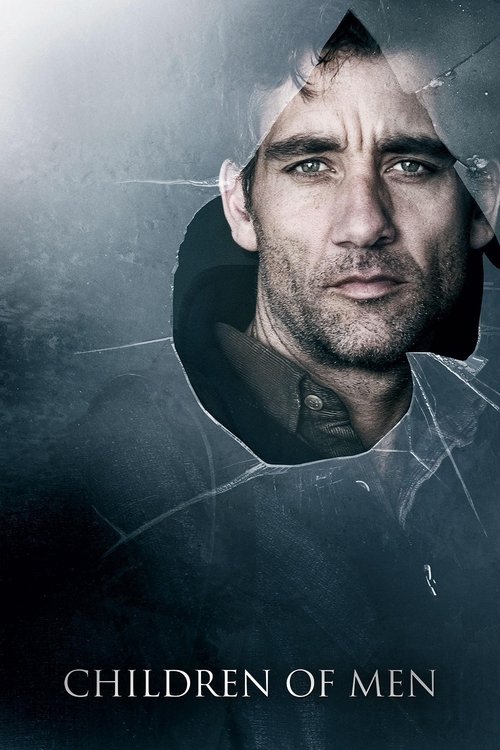
Children of Men
2006 · Alfonso Cuarón
For when you want to be gripped by the throat and left thinking about the news for days — a challenge, not a comfort, but one that pays you back.
What it's about
Nearly two decades after the last human birth, Britain has hardened into a fortress state — refugees in cages, bombs in cafés, a population quietly waiting to die out. Theo, a burned-out former activist, is pulled back into the fight when he's asked to escort a young refugee woman across the country, and discovers she's carrying the first pregnancy the world has seen in eighteen years. What follows is a desperate journey through checkpoints, safe houses, and open warfare toward a rumored sanctuary at sea.
The experience
Relentless and immersive — the camera stays at your shoulder through ambushes and firefights that seem to unfold in real time, so the dread never gets a cut to hide behind. It's grim, but it keeps finding flickers of grace and even dry humor, and it ends up strangely hopeful.
Performances
Clive Owen is perfect as a man whose cynicism keeps cracking to show the believer underneath; Michael Caine steals scenes as an aging hippie whose warmth is the film's one safe place; Clare-Hope Ashitey grounds the miracle in stubborn, funny, human terms.
The craft
Emmanuel Lubezki's handheld, documentary-style photography produces several astonishing extended takes — a car ambush and a running urban battle among them — that rank with the most technically audacious shots ever staged. Every frame of the ruined Britain is packed with background detail worth pausing over. See it big and loud: the sound design of gunfire, crowds, and sudden silence does half the work.
Why it matters
Initially under-seen, it has grown into one of the most acclaimed films of its century — the modern benchmark for grounded, politically charged science fiction, and the film that announced Cuarón as a major world director.
Snapshot
A speculative-thriller set in a near-future Britain where global human infertility has condemned the species to extinction, Children of Men follows Theo Faron (Clive Owen), a disillusioned former activist pressed into service escorting Kee (Clare-Hope Ashitey), a young African refugee who is, impossibly, pregnant, to a clandestine scientific collective called the Human Project. Shot in a rigorously documentary aesthetic by cinematographer Emmanuel Lubezki, the film is most immediately known for a series of extended, apparently unbroken long takes — particularly a car-ambush sequence and a sprawling urban battle — that rank among the most technically complex shots in contemporary cinema. Beyond technique, Children of Men operates as a sustained political allegory: its vision of Britain as a xenophobic fortress state surrounded by the burning ruins of the world arrived, in 2006, with uncomfortable prescience about surveillance, immigration detention, and the logic of permanent emergency.
Industry & production
The project originated with P.D. James's 1992 novel The Children of Men, a work of British speculative fiction more explicitly theological in emphasis than Cuarón's adaptation. Universal Pictures developed the property through Strike Entertainment and Hit & Run Productions, with Cuarón assuming the director's chair after an extensive development process during which the screenplay passed through multiple writers — including Timothy J. Sexton, David Arata, Mark Fergus, and Hawk Ostby — before Cuarón substantially rewrote the material himself. The production was headquartered in the United Kingdom, drawing extensively on actual locations in London and its environs: the Tate Modern's Turbine Hall served as the Ark of the Arts sequence (dressed with Michelangelo's David, a floating Pink Floyd pig, and Picasso's Guernica), Brentford Gas Works stood in for the immigrant detention camp Bexhill, and Thetford Forest in Norfolk provided the film's pastoral passages. This ground-level, location-authentic approach was a deliberate counter to the studio tendency toward controlled set construction for dystopian futures. Cuarón and Lubezki committed early to a visual strategy that would make the world look lived-in, decayed, and continuous with recognizable British infrastructure rather than stylized into abstraction. The production was by most accounts a demanding and physically grueling shoot, with the elaborate practical engineering required for the long takes adding complexity and risk to an already ambitious location-based project.
Technology
Children of Men represents a pivotal moment in the deployment of digital intermediate color grading alongside high-end film acquisition. Lubezki shot on 35mm with a distinctive desaturation strategy in the DI suite — bleach-bypass-adjacent processing that leeched warmth from the frame and gave the image a gritty, slightly clinical texture without abandoning the organic latitude of film grain. This look had precedents in the late-1990s bleach-bypass revival (notably the work of Darius Khondji on Seven), but Lubezki and Cuarón pushed further toward a newsreel drabness that avoided both the cool-blue sci-fi palette dominant in Hollywood at the time and any residual genre stylization.
For the film's celebrated extended long takes, the production engineered custom rigs. The car-ambush sequence — in which a vehicle carrying Theo and his companions is attacked on a forest road and the camera rotates 360 degrees within the interior while action erupts outside — required a specially built car chassis with removable panels and an internal gyroscopic camera mount. The rigging allowed Lubezki's camera to spin freely in the confined space, dipping in and out of the window lines, without interruption. This was not a single optical long take in the strict Hitchcock-Rope sense — it involved digital stitching and compositing at several seams — but the physical engineering, performance continuity, and choreographic precision required to achieve the illusion remain extraordinary. The Bexhill battle sequence near the film's climax, in which Theo walks through an active urban war zone while combatants on both sides temporarily cease fire at the sound of an infant's cry, was similarly assembled from multiple setups shot over several days, with compositing seamlessly stitching the joins. At one moment in this sequence, blood spatters across the lens; Lubezki and Cuarón kept the contaminated image rather than cutting around it, a decision that epitomizes the film's commitment to a documented-reality aesthetic over visual hygiene.
Technique
Cinematography
Lubezki's work on Children of Men is the defining technical signature of the film and one of the most discussed bodies of shot design in early twenty-first-century cinematography. Operating frequently handheld or on lightweight tracking rigs, he maintained proximity to the actors that collapsed the conventional distance between camera and subject, making Theo's experience feel witnessed rather than composed. The film largely eschews establishing shots: Lubezki enters scenes at body level, mid-action, and refuses spatial clarification as a rule rather than an exception. Wide lenses held close to actors produce a mild barrel-distortion quality associated with photojournalism; available and enhanced natural light, particularly in interior spaces, preserves a roughness that stylized lighting would eliminate. The approach did not emerge from improvisation alone — it was carefully choreographed precisely so that the extreme demands of the long takes could be met — but it is photographed in a manner that mimics contingency. Lubezki received an Academy Award nomination for Cinematography, though he did not win that year.
Editing
The film's editing, credited to Alex Rodríguez (with additional work during production), operates in deliberate tension with the long-take virtuosity. The film is not uniformly uncut; the sequences between the set-piece extended takes employ conventional continuity editing, and the contrast between those measured cuts and the unbroken duration of the ambush and battle sections is itself a dramatic instrument. The editing creates a rhythm that makes the loss of cutting feel visceral — the viewer becomes suddenly aware of having relied on the editor as a safety net. Received an Academy Award nomination.
Mise-en-scène / staging
Cuarón's staging philosophy on Children of Men is depth-of-field and duration: actors and blocking are organized so that background action carries as much meaning as foreground performance, and scenes are played out in real time rather than compressed. The world is consistently populated — crowds of refugees, soldiers, protesters, scavengers — and this density is never merely set dressing but a political statement about the film's subject. The Ark of the Arts sequence stages a grotesque collision between cultural wealth (masterworks preserved as the world collapses) and human erasure with the economy of pure composition. Production designer Jim Clay created environments that extrapolated from existing British institutional architecture — brutalist housing, converted warehouses, immigration processing facilities — to achieve a future that is continuous with the present rather than discontinuous from it.
Sound
The sound design uses silence as an active element. In the Bexhill battle, the momentary cessation of gunfire when the soldiers hear the baby's cry is rendered with a suspension of all non-diegetic sound — there is no score marking the significance of the moment. This restraint is among the film's most powerful decisions. The film's soundtrack draws on an eclectic compilation of pre-existing music rather than a conventional underscore: King Crimson's "The Court of the Crimson King," Jarvis Cocker's "Running the World" (deployed satirically over end credits), and other period selections ground the film in cultural memory even as the setting gestures forward. The film's original score elements remained relatively subordinate to this found-music approach, which gives the film an aural texture closer to a documentary or a road-trip chronicle than to genre science fiction.
Performance
Clive Owen's performance as Theo is built on exhaustion and residual conscience: the character has long since stopped believing in anything, and Owen communicates this through a kind of physical deflation punctuated by moments of improvised determination. The role required sustained physical ordeal — the film was shot largely in sequence of increasing difficulty — and Owen's deteriorating appearance over the course of the narrative is genuine rather than costumed. Michael Caine's Jasper, a reclusive former cartoonist and counterculture survivor, provides the film's warmest and most elegiac register; Caine brings a quality of rueful affection entirely unlike his earlier star persona. Clare-Hope Ashitey, then a relatively unknown young actor, carries Kee with a combination of wariness and irreducible vitality. Julianne Moore appears briefly as Julian, a former activist and Theo's estranged partner; her abbreviated presence casts a long narrative shadow.
Narrative & dramatic mode
Children of Men employs a classical protection-quest structure — a beleaguered escort narrative with distant sanctuary as its telos — but inflects it through persistent uncertainty about whether sanctuary actually exists. The Human Project may be a myth. The film refuses to confirm its reality even at the close, leaving the resolution ambiguous and the restoration of hope tentative rather than triumphant. This is generically unusual: the film withholds the genre payoff it appears to promise while providing, in the baby's cries halting a battle, a moment of mythic potency that exceeds what any conventional resolution could deliver. The narrative's dramatic mode is essentially tragic-lyric: Theo achieves his goal and does not survive it. His death happens offscreen, in a small boat, quietly, as the genre machinery of rescue begins to operate around him.
Genre & cycle
The film occupies the post-millennial resurgence of literary dystopia on screen, a cycle that includes 28 Days Later (2002), V for Vendetta (2006), The Road (2009), and eventually the YA adaptations of the following decade. Within this cycle, Children of Men stands apart for its formal severity and its refusal of genre consolation. It is a science-fiction film that performs the visual grammar of war reporting; it is a thriller that keeps its most tense sequence (the Bexhill battle) free of conventional suspense editing. The film's political allegory — xenophobic authoritarianism, the criminalization of migrants, perpetual war as state condition — aligns it with a broader post-9/11 Hollywood questioning of Western institutional violence, a tendency that also produced the Bourne franchise and numerous Iraq War dramas, but Cuarón's version is more aesthetically radical than almost any comparable studio production.
Authorship & method
Alfonso Cuarón is a Mexican filmmaker who trained in Mexico City at the Centro de Capacitación Cinematográfica and rose to international attention with Y Tu Mamá También (2001), a road film of tonal and formal sophistication that established his signature interest in the unbroken tracking shot and in the political embedded within the personal. His collaboration with Lubezki, who had been his cinematographer since the mid-1990s, is one of the most fruitful director-cinematographer partnerships of their generation, extending through Gravity (2013) and defining a visual language of embodied duration. On Children of Men, Cuarón's method involved extensive rehearsal with choreographic precision — the long takes could not be achieved without near-theatrical blocking discipline — while simultaneously committing to a location-based, physically exposed aesthetic that appears to reject that very precision.
Movement / national cinema
Children of Men inhabits an interesting national-cinema ambiguity. Cuarón and Lubezki are both Mexican; the film is a Universal Pictures release shot entirely in Britain with a predominantly British cast and a deeply British social substrate. The film's vision of England — post-imperial, surveillance-saturated, xenophobic, aesthetically in love with its own cultural legacy even as it destroys its future — is filtered through the perspective of outsiders to that culture. This produces a quality of both intimacy and estrangement: the dystopia is recognizably British in its texture (the NHS uniforms, the tabloid newspapers, the resigned bureaucratic tone), but seen from a position that has no investment in British self-flattery. Cuarón, Lubezki, and fellow Mexican directors Guillermo del Toro and Alejandro González Iñárritu had by the mid-2000s established a diasporic Mexican presence at the center of English-language prestige filmmaking that was unprecedented in Hollywood history.
Era / period
The film arrived in December 2006, deep into the Iraq War, amidst intensifying debates across Europe about immigration, border control, and the securitization of civilian life. The London bombings of July 2005 were recent; the debate over indefinite detention and extraordinary rendition was ongoing; the European far right was beginning an electoral recovery that would accelerate over the following decade. The film's vision of immigrant detention camps, of "Fugees" corralled in cages under a collapsed welfare state, read as extrapolation rather than invention. In retrospect, Children of Men has aged into its moment better than most of its contemporaries: its political architecture has become more rather than less legible as a diagnosis of emergent conditions.
Themes
Human extinction as a premise concentrates the film's thematic inquiry on the question of what remains worth protecting when the future is foreclosed. Cuarón and his collaborators answer: the impulse toward care itself. Kee's pregnancy is not presented as a genetic miracle to be scientifically harvested but as an occasion for responsibility — the film is about whether enough human beings retain the capacity to act for a future they will not live to inhabit. Religious allegory saturates the imagery (Kee's first revelation of her pregnancy, lit in a barn, is a deliberate Nativity staging) without committing to theological resolution. The film is also a film about witnessing: Theo survives Bexhill in part because Miriam (Pam Ferris), a midwife who has delivered the child, understands that a witness to birth must be preserved. Against themes of mass extinction and fascist order, the individual acts of midwifery and escort are what the film argues for.
Reception, canon & influence
Critical reception. Children of Men received strong critical notices on release, with particular emphasis on its technical ambition and political urgency. Roger Ebert awarded it four stars. It earned Academy Award nominations for Adapted Screenplay, Film Editing, and Cinematography. Despite this, the film performed modestly at the box office relative to its budget and did not achieve wide commercial traction during its theatrical run. Its reputation subsequently grew substantially; by the end of the decade, numerous critics' polls placed it among the most important English-language films of the 2000s, and by the 2010s it was routinely cited as the defining dystopian film of its era.
Influences on the film. Cuarón has acknowledged a range of precursors. The Italian neorealist tradition — particularly De Sica and Rossellini — informs the location-based, non-sanitized visual philosophy. Gillo Pontecorvo's The Battle of Algiers (1966), with its deployment of documentary grammar for staged political violence, is a direct ancestor of the Bexhill sequence. The Eastern European tradition of political allegory under censorship, particularly the films of Andrei Tarkovsky (whose Stalker shares the film's post-industrial landscape aesthetic and its provisional hope), exerts a tonal influence. Cuarón has also cited the influence of Ingmar Bergman on questions of performance and duration.
Legacy and forward influence. Children of Men reshaped the visual grammar of action filmmaking more than almost any single film of its decade. Sam Mendes and Roger Deakins's 1917 (2019), constructed entirely as an apparent single take, is the most direct formal descendant. The long-take battle sequence influenced television productions including segments of Dunkirk and numerous subsequent war sequences across the medium. The protection-quest narrative with a vulnerable charge — which the film did not invent but executed at a level of intensity that became the reference point — runs through The Road, A Quiet Place, Logan, and much of the post-apocalyptic prestige cycle of the 2010s. The film's desaturated, handheld-inflected visual grammar for near-future dystopia became so ubiquitous in subsequent years as to constitute a genre default, a development that can be attributed partly to the film's influence and partly to the wider availability of the digital tools that enabled Lubezki's approach. Lubezki himself went on to win three consecutive Academy Awards for Cinematography (Gravity, Birdman, The Revenant), a run that demonstrates the extent to which the working philosophy first fully articulated on Children of Men came to define a cinematographic standard.
A Deleuzian reading
The blood hits the lens and stays.
The full Deleuzian reading of Children of Men →
Reception
Dumped into US theaters on Christmas Day 2006 with barely any marketing, it underperformed at the box office despite rave reviews — then spent the next two decades climbing best-of-the-century lists, and is now routinely called the defining dystopia of modern cinema.
How Children of Men was received, from release to now →
Influences: the films it descends from and the films it influenced
- The Battle of Algiers (1966) — Marcello Gatti shoots with non-actors on real Algiers streets using handheld 16mm to produce a pseudodocumentary texture indistinguishable from news footage; Lubezki's approach to the Bexhill battle directly inherits this grammar of rendering political violence as witnessed reportage rather than staged spectacle.
- Come and See (1985) — Alexei Rodionov keeps the camera within arm's reach of the protagonist's face as he physically and psychologically deteriorates through wartime atrocity, establishing the ethical grammar of handheld-proximity-as-witness that Lubezki systematically applies to Theo's guided passage through Bexhill.
- Rope (1948) — Hitchcock engineers ten-minute apparent-continuous takes through furniture-obscured cuts and strategic performer blocking, establishing the long take as both theatrical engineering feat and sustained ethical presence — the formal template Children of Men inherits and scales with custom in-car rigs and digital compositing.
- Seven (1995) — Darius Khondji's silver-retention bleach-bypass processing — dense shadows, crushed blacks, warmth leeched from the frame — created the desaturated urban-dread palette that Lubezki and Cuarón transposed via digital intermediate into Children of Men's newsreel drabness, departing from the cool-blue sci-fi palette dominant in Hollywood at the time.
- Saving Private Ryan (1998) — Janusz Kaminski's handheld 45-degree-shutter combat photography — desaturated, motion-blurred, refusing conventional coverage angles — established Hollywood's template for rendering military violence in documentary register, a grammar Lubezki directly extends in the Bexhill battle sequence's choreographed chaos.
- Y Tu Mamá También (2001) — The first Cuarón–Lubezki collaboration develops their shared grammar of handheld scenes following characters through social space in sustained takes, with an omniscient narrating voice counter-running against the image — the prototype methodology that Children of Men then scales to war-zone engineering and political allegory.
- Russian Ark (2002) — Tilman Büttner's 96-minute unbroken Steadicam passage through the Hermitage — requiring exhaustive choreographic rehearsal of hundreds of performers across dozens of rooms — proved that the extended single take could sustain feature-length through precision staging, establishing the practical proof-of-concept that Cuarón's production team extended with custom-built rigs.
- Brazil (1985) — Jim Clay's production design extends Brazil's palette of bureaucratic decay into photorealist texture — surveillance architecture, detention infrastructure, the Ministry's administrative apparatus rendered as shabby institutional accumulation; Lubezki's cramped handheld-in-widescreen approach to occupied interior spaces echoes Pratt's grammar of ceilings and corridors as active threats.
- Twelve Monkeys (1995) — Cuarón achieves near-future dystopian texture without CGI world-building by shooting real contemporary locations with a cold desaturated palette and practical photography — the same strategy Gilliam and Pratt used in Philadelphia and Baltimore — confirming practical location work as the more cinematically persuasive alternative to digital environment construction.
- Medium Cool (1969) — Embeds long-take handheld camerawork inside unstaged-feeling combat so the lens becomes a participant dodging fire, descending from Wexler shooting drama within live riot.
- Minority Report (2002) — Inherits the desaturated, handheld, research-grounded near-future — credible extrapolated tech embedded in lived-in grime — pushing Minority Report's plausible-future design fiction toward documentary-realist immersion.
- Gun Crazy (1950) — Its car-bound single-take ambush is the most literal heir to Gun Crazy's back-seat unbroken robbery shot, mounting the camera inside the vehicle to sustain real-time continuity.
- Hunger (2008) — McQueen deploys extended single takes as ethical duration — including a 17-minute static two-shot dialogue with no coverage — and strips the soundtrack to near-silence and diegetic sound throughout, extending Children of Men's conviction that unbroken temporal duration is itself a political and moral stance in depicting state violence.
- The Road (2009) — Javier Aguirresarobe's ash-gray, bleach-bypass-adjacent cinematography and Hillcoat's insistence on diegetic-only sound design extend Children of Men's post-apocalyptic visual and sonic grammar directly onto a McCarthy adaptation structured as a father-figure escorting a vulnerable child through a landscape of atrocity.
- Gravity (2013) — Cuarón and Lubezki's follow-up pushes their long-take collaboration into digital space: the 17-minute opening shot engineers sustained unbroken camera movement through motion-capture and digital compositing with the same commitment to choreographic precision and production-engineered rigging that the Children of Men car-ambush sequence demanded in the physical world.
- Son of Saul (2015) — Mátyás Erdély locks the handheld camera to the protagonist's shoulder throughout Auschwitz at shallow focus, refusing establishing shots entirely and keeping peripheral atrocity deliberately blurred — a systematic radicalization of Lubezki's proximity-as-witness grammar, taken to its ethical extreme by reducing the frame to what a single body moving through chaos can hold.
- 1917 (2019) — Roger Deakins engineers an apparent single-take WWI film through precisely choreographed cuts hidden in darkness and motion blur, with a protection-escort narrative and refusal of conventional battle coverage — the project directly inherits Children of Men's fusion of custom-rig long-take engineering and the formal argument that war demands unbroken documentary witness.
- District 9 (2009) — Emmanuel Lubezki's vérité deep-focus handheld cinematography—which integrates VFX-heavy action sequences into documentary-grammar long takes without clean compositional framing—provides the direct cinematographic template for Blomkamp's approach to shooting township action sequences without a heroic clean frame.
- Dunkirk (2017) — Lubezki's long unbroken combat takes — Bexhill, the stairwell — kept the camera moving through action without editorial escape, making the threat omnipresent and invisible simultaneously; Nolan extracts this no-refuge cinematographic grammar and applies it as structural principle rather than isolated tour-de-force.
- Roma (2018) — Cuarón's development with Emmanuel Lubezki of extended autonomous long-take sequences — in which a single unbroken camera move carries the full burden of narrative event — is the direct formal precursor to Roma's autonomous camera method, here transferred from handheld crisis-mode to tripod-steady observational duration with the same principle of refusing the cut as an interpretive act.
- Harry Potter and the Deathly Hallows: Part 1 (2010) — Documentary-handheld, color-drained dystopian realism that stages a totalitarian state and a fugitive flight through gray landscape as if shot newsreel-style — the same anti-spectacle treatment of genre material.
- The Adventures of Tintin (2011) — Codified the choreographed composite long take as an action showpiece stitched from invisible cuts, the formal model for Tintin's unbroken Bagghar pursuit.
- The Avengers (2012) — Choreographed the sustained continuous-take action sequence as spatial storytelling, the precedent for Avengers' climactic circular oner that pivots through all six heroes to assert ensemble spatial coherence.
- Looper (2012) — Established the sun-bleached, handheld, documentary-grain near-future where dystopia is rendered through naturalistic texture and grime rather than glossy spectacle.
- 28 Days Later (2002) — Anthony Dod Mantle shoots on Sony DV with available light in emptied London locations, producing a brittle, pixelated urgency that runs parallel to Lubezki's documentary-realism strategy; both films construct British societal collapse through photographic texture rather than set construction, arriving at near-identical dystopian aesthetics through different capture formats.
- United 93 (2006) — Barry Ackroyd applies the same Dogme-adjacent handheld, available-light, no-conventional-coverage grammar to the September 11 hijacking, refusing the emotional distance that classical coverage would produce; both films deploy documentary immediacy as a political argument that the event depicted exceeds the conventions of genre fiction.
- Pan's Labyrinth (2006) — Del Toro's same-year production adapts a literary fantasy framework as vehicle for anti-fascist political allegory in a European landscape under duress — part of the same diasporic Mexican filmmaker cohort (Cuarón, del Toro, Iñárritu) deploying genre convention to address political trauma in settings distant from their national origin.
- I Am Legend (2007) — Emmanuel Lubezki's location-CG composite work — using natural light on practical locations then extending the frame with digitally degraded infrastructure — is the direct visual precedent for Andrew Lesnie's approach to I Am Legend's daylight sequences; both films treat the photographic specificity of real locations as the anchor that makes CG extension of civilizational collapse believable.
- A Quiet Place Part II (2021) — Cuarón and cinematographer Emmanuel Lubezki's warm-cool palette contrast — degraded amber for the collapsed world, cool blue-gray for moments of hope and open space — is the cinematographic grammar Polly Morgan works within for AQP II; both films use color temperature as an externalization of the emotional state of survival rather than as location-motivated naturalism.
- Three Kings (1999) — Pushed the immersive, embedded-handheld combat-realism — chaos staged in unbroken proximity to the protagonist — that Sigel and Russell prototyped.
- The Tree of Life (2011) — Develops, in parallel with Malick, Lubezki's handheld natural-light long-take method — the same collaborator's evolving grammar of immersive available-light camerawork.
- Green Zone (2010) — Contemporaneous benchmark for embedding the camera inside chaos — long handheld takes that put the viewer at the protagonist's shoulder amid combat — the immersive war-zone grammar Green Zone shares.
- Man of Steel (2013) — Pioneers the handheld, lens-spattered, you-are-there immersion in catastrophe that Mokri emulates — camera as panicked witness at ground level amid collapsing scale rather than clean god's-eye spectacle.
- Petrov's Flu (2021) — Lubezki's immersive bravura long takes plunge the camera through chaotic action, the contemporary touchstone for the choreographed unbroken shot Opelyants extends.
- Dune: Part Two (2024) — The long-lens, immersive, documentary-adjacent staging of crowds and political violence in a single grave register, a peer model for filming chaotic insurgency with sustained, unflinching tempo.
- Ambulance (2022) — Sibling in the single-take in-vehicle action set-piece — the rig-mounted camera roaming freely around a moving car's interior that legitimized the impossible-vantage shots Bay pushes via drone.
Similar films
- Gravity (2013) — influence & lineage · often watched together
- Pan's Labyrinth (2006) — influence & lineage
- Saving Private Ryan (1998) — influence & lineage · often watched together
- Come and See (1985) — influence & lineage · often watched together
- Sunshine (2007) — shared sensibility
- Threads (1985) — shared sensibility
- 28 Weeks Later (2007) — shared sensibility
- Dunkirk (2017) — shared sensibility
All the films related to Children of Men →
Watch it with: curated runs of related films
- Young Under a Darkening Sky — Watch these in a run as the frame darkens — the institutions built to shelter the young (a school, a walled glade, a nation, a highway) curdle into deadly contests and regimes they have to outlast.
Film essays and courses that include it
- One Continuous Breath: Masters of the Unbroken Shot
- The Art of the Assault: How Cinema Stages War
- Doing It for Real: A Century of Practical Spectacle
- After the Multiplex: Auteurs and the Streaming Disruption
- Pixels and Presence: How Digital Cameras Rewrote Cinema's Grammar
- After the Monolith: Science Fiction's Formal Inventions
- The Unbroken Take: From Camera Liberation to Single-Shot Cinema
- The Camera Gets Off the Tripod: Vérité from Flaherty to Bigelow
- Revolt in the Frame: Revolutionary Cinema 1925–2006
- This Sceptred Isle: British Cinema's Long Reckoning
- The Architecture of Ruin: Ninety Years of Dystopian Cinema
- Bodies at the Border: Cinema's Migrant Century
- The Three Who Left and Won
- The Ghost That Walks
- The Fear That Moved From the Machine to the Self
- The Shot That Won't Cut
- The Space That Forgot What It Was For
- The Light That Will Not Wait