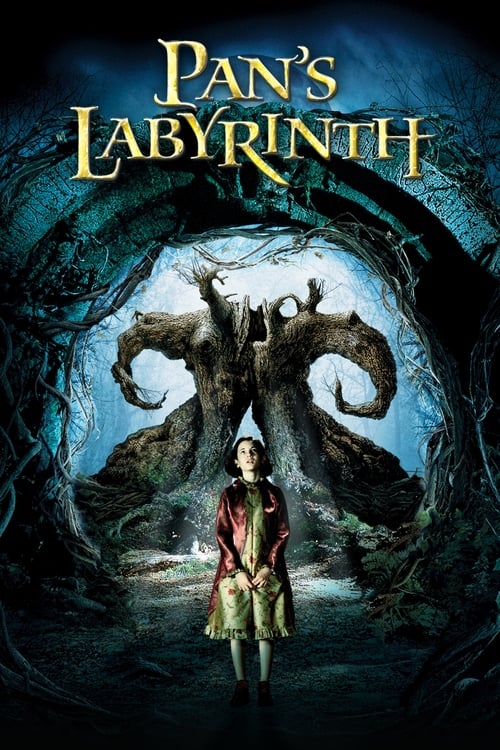
Pan's Labyrinth
2006 · Guillermo del Toro
Pinocchio's stop-motion Oscar and his Frankenstein made him the loudest voice for handmade craft against AI ("I'd rather die than use it") — his interviews are reliably viral anti-algorithm sermons. Cinephile Twitter's beloved uncle.
For when you want a film to chew on for days — a dark fairy tale for adults that earns both your awe and your tears. Not a kids' movie and not comfort viewing, but one of the most transporting things you can put on.
What it's about
Spain, 1944, five years after the Civil War: ten-year-old Ofelia arrives with her pregnant, ailing mother at a rural outpost commanded by her new stepfather, a fascist captain hunting the resistance fighters hiding in the hills. In an ancient labyrinth near the mill, a faun tells her she may be the lost princess of an underground kingdom — but to return, she must complete three dangerous tasks. The fairy tale and the war close in on each other, and both are deadly serious.
The experience
Enchanting and harrowing in the same breath — a film where wonder and dread share every frame, and the monsters in uniform are scarier than the ones with horns. It's intense, occasionally brutal, and it leaves you moved and haunted at once.
Performances
Young Ivana Baquero anchors the film with grave, unforced conviction, Sergi López makes the captain one of cinema's most frightening villains without a shred of caricature, and Doug Jones — under heavy prosthetics — gives both the faun and the nightmarish Pale Man uncanny, unforgettable life.
The craft
Guillermo del Toro's creature design and production design are peerless — handmade, tactile fantasy rather than weightless digital spectacle — and the amber-and-teal cinematography won an Oscar. Javier Navarrete's lullaby-based score threads the whole film together; it absolutely rewards a big screen, good speakers, and the lights off.
Why it matters
It became the defining dark fantasy of its era, won three Academy Awards, and elevated del Toro from cult genre director to major international auteur — proof that fantasy could carry the full weight of historical tragedy.
Snapshot
Pan's Labyrinth (El laberinto del fauno) is Guillermo del Toro's dark fairy tale set against the brutal consolidation of Francoist power in rural Spain, 1944, five years after the Civil War's end. A Spanish–Mexican co-production shot in Spanish, it interleaves two narrative registers: the historical horror of a Falangist captain hunting anti-Franco guerrillas (the maquis) in the northern hills, and the mythic ordeal of his stepdaughter Ofelia, a bookish girl who is told by a faun that she is the reincarnated princess of an underground kingdom and must complete three tasks to return. The film is del Toro's most fully achieved fusion of the two modes he had pursued separately — studio fantasy and personal art cinema — and it functions as the thematic companion to his earlier The Devil's Backbone (2001), another ghost story rooted in the war. Premiering at Cannes in 2006 to a sustained ovation, it won three Academy Awards (Cinematography, Art Direction, Makeup) and became, in the years following, a touchstone for the idea that fantasy can be a serious instrument for confronting history and fascism rather than an escape from them.
Industry & production
The film was produced as a cross-Atlantic collaboration between Mexican and Spanish companies — del Toro's Tequila Gang, Bertha Navarro and Frida Torresblanco among the producing team, with Spanish partners including Telecinco Cinema (Álvaro Augustín) and Estudios Picasso. Del Toro's friend and fellow member of the "Three Amigos," Alfonso Cuarón, is credited as a producer, part of the mutual-support network linking del Toro, Cuarón, and Alejandro González Iñárritu during the mid-2000s. The budget was modest by Hollywood standards — widely reported in the high teens of millions of dollars — which placed enormous pressure on the design and effects work to deliver a fully imagined secondary world without a blockbuster's resources.
Del Toro has spoken often about the personal financial stakes: he has described how production overruns led him to forgo his own salary to keep the film whole, and how Cuarón encouraged him during the shoot. Filming took place in and around the forests of the Guadarrama region near Madrid and on built sets, with a compressed schedule. The decision to make the film in Spanish, after del Toro had already directed English-language studio pictures (Mimic, Blade II, Hellboy), was a deliberate return to a more controlled, authored mode — a choice that paid off in the freedom it granted him over tone and content, including the film's unflinching violence.
Technology
Pan's Labyrinth sits at a transitional moment in effects practice, and del Toro's instincts were emphatically toward the physical. The faun and the Pale Man were realized chiefly through practical creature work — animatronics, prosthetics, and full-body suits performed by Doug Jones — with digital tools reserved for augmentation, cleanup, and impossible movements (the faun's aging and rejuvenation across the film, the giant toad, the mandrake root's writhing, set extensions of the labyrinth). The Spanish effects house DDT, led by makeup artists David Martí and Montse Ribé, built the prosthetic creatures; their work won the Academy Award for Makeup. CafeFX in the United States handled much of the digital compositing and CGI integration. The result is a hybrid aesthetic in which tactile, lit, in-camera creatures anchor the fantasy, lending it a weight and grain that pure CGI of the period rarely achieved — a methodology consistent with del Toro's lifelong allegiance to the handmade monster tradition of Ray Harryhausen and classic horror.
Technique
Cinematography
Guillermo Navarro, del Toro's longtime collaborator, shot the film and won the Academy Award for Cinematography. The visual scheme is built on a disciplined color logic: the world of the mill and the captain is rendered in cold steel blues and desaturated greens, while the fantasy spaces and Ofelia's threshold moments glow with warm ambers and golds. Crucially, del Toro and Navarro complicate any simple opposition — warmth seeps into the human world (Mercedes's kitchen, firelight) and coldness can shadow the fantasy — so that the two realms rhyme rather than divide cleanly. The camera is fluid and often subjective, moving with Ofelia's curiosity, descending into the fig tree or the Pale Man's chamber as an exploratory eye. Navarro favors painterly, low-key lighting with strong sourced motivation, and the framing repeatedly stages the vulnerable child small within oppressive architecture and vast natural spaces.
Editing
Bernat Vilaplana edited the film, and its central formal achievement is the rhythmic interleaving of the historical and fantastical strands so that they comment on each other through juxtaposition. Match-cuts and parallel actions bind the two worlds — most famously the structural rhyme between the Pale Man's banquet and Captain Vidal's dinner table, between forbidden grapes and the captain's tyranny, between the monster who eats children and the man who kills them. The cutting maintains suspense across the guerrilla subplot (Mercedes's double life, the doctor's quiet resistance) while preserving the dreamlike unhurriedness of Ofelia's tasks, an editorial balancing act that keeps the fairy-tale logic legible without draining the war story of tension.
Mise-en-scène / staging
Production designer Eugenio Caballero (Oscar winner for Art Direction) and the design team constructed a world saturated with motif. The labyrinth's spirals, the faun's bark-and-horn body, the uterine red of the underground stair, the mechanical iconography of clocks and keys surrounding Vidal — every element is deliberately patterned. Visual rhymes recur obsessively: circles and spirals, doorways and keyholes, the moon-shaped birthmark, the curling root. Caballero and del Toro modeled the Pale Man's lair on a Goyaesque dining hall, its walls hung with images evoking child-slaughter; the creature's displaced eyes — set into the palms of its hands — derive from a long folkloric and art-historical lineage of blindness and monstrous sight. Vidal's domain, by contrast, is all hard edges, machinery, mirrors, and his obsessively maintained pocket watch, the staging encoding his fascist fixation on order, lineage, and time.
Sound
Javier Navarrete's score is organized around a fragile lullaby — a wordless, hummed melody associated with Mercedes and with maternal protection — that recurs in varied orchestration and becomes the film's emotional spine, nominated for the Academy Award for Original Score. Sound design works in counterpoint to the music: the insectile clicking of the faun's joints, the wet movements of the toad and the mandrake, the Pale Man's awful stillness, and the mechanical sounds of Vidal's world all build a dense, tactile soundscape. The lullaby's simplicity against the violence of the human plot is one of the film's most affecting devices.
Performance
The film rests on Ivana Baquero, around eleven during filming, whose Ofelia is grave, watchful, and entirely unsentimental — a performance that refuses cuteness and grounds the fantasy in a child's real interiority. Sergi López plays Captain Vidal as one of cinema's most chillingly precise portraits of fascism: vain, sadistic, obsessed with his unborn son and his own father's legacy, terrifying precisely because he is so controlled. Maribel Verdú gives Mercedes, the housekeeper-spy, quiet courage and moral clarity, while Ariadna Gil plays Ofelia's ailing, compromised mother Carmen. Doug Jones, performing both the Faun and the Pale Man inside heavy prosthetics, delivers physically expressive creature work despite not speaking Spanish — he learned his lines phonetically, later dubbed, an example of the production's commitment to in-body performance.
Narrative & dramatic mode
The film's defining structural decision is the suturing of two genres that ordinarily exclude each other — the historical war drama and the quest fairy tale — into a single weave where neither is subordinate. The fantasy is given the classic three-task structure of folklore, complete with a faun-guide, magical objects (the chalk that opens doors, the mandrake, the book of crossroads), and prohibitions that Ofelia transgresses. The historical plot operates by the realist grammar of resistance thrillers: surveillance, betrayal, torture, a doctor's act of mercy, a guerrilla raid.
Central to the film is its calculated ambiguity about the fantasy's ontological status. Del Toro plants clues that could read the magical events as a traumatized child's coping mechanism — the chalk and book go unseen by adults, the labyrinth could be the projection of a girl fleeing horror — while also threading evidence (most pointedly the final escape route) that the kingdom is real. Del Toro himself has stated he believes Ofelia is a true princess and that the clues confirm it, but the film withholds final closure, allowing the magical and the psychological readings to coexist. This is not vagueness but design: the ambiguity is the meaning, insisting that imagination is a real and consequential form of resistance even when — especially when — it cannot save a body.
Genre & cycle
Pan's Labyrinth belongs to several overlapping traditions at once. It is part of a Spanish lineage of films using a child's perspective to refract the Civil War and its long shadow — The Spirit of the Beehive (Erice, 1973) is the essential ancestor, with its solitary girl, her monster-haunted imagination, and the war pressing at the edges; Cría Cuervos (Saura) and the broader genre of Spanish historical-memory cinema stand behind it as well. Within del Toro's own work it forms a Spanish Civil War diptych with The Devil's Backbone, the two films sharing the ghostly child, the cruel authority figure, and the conviction that the supernatural is the proper idiom for historical trauma. It also sits within the global art-horror and dark-fantasy revival of the 2000s, helping to legitimize "elevated" genre cinema. And it draws on the European fairy-tale tradition — illustrated children's books, the Brothers Grimm in their cruel pre-sanitized register, and the weird fiction of writers like Arthur Machen and Lord Dunsany whom del Toro reveres.
Authorship & method
The dossier here is on firm ground: Pan's Labyrinth is a deeply authored film, written and directed by del Toro, and it crystallizes his recurring obsessions — insects and clockwork, Catholic iconography turned ambivalent, the moral primacy of disobedience, monsters as figures of sympathy and authority figures as the true horrors, the wounded innocence of children. Del Toro is famous for his illustrated notebooks, and the film's creatures and motifs originate in his own drawings; the faun and Pale Man bear his signature blend of the grotesque and the beautiful.
His key collaborators are central to its identity. Cinematographer Guillermo Navarro had shot for del Toro since Cronos (1993) and gives the film its painterly chiaroscuro. Composer Javier Navarrete supplies the lullaby-centered score. Editor Bernat Vilaplana architects the dual-strand cross-cutting. Production designer Eugenio Caballero and makeup-effects artists David Martí and Montse Ribé build the physical fantasy. The collective achievement — three of the four below-the-line Oscars went to this team's work — reflects del Toro's method of assembling a trusted artisanal ensemble and directing in close detail across every craft, an approach he has carried through his subsequent career to The Shape of Water and beyond.
Movement / national cinema
The film is a product of the New Mexican Cinema's international ascendancy in the 2000s — the moment when del Toro, Cuarón, and Iñárritu became global auteurs — while being simultaneously and genuinely a Spanish film in language, setting, cast, and historical subject. This double belonging is part of its significance: it embodies a transnational Spanish-language art cinema funded across borders. Within Spain, it intervenes in the country's still-contested process of memoria histórica, the recovery of Civil War and Franco-era memory that intensified in the 2000s, taking an unambiguous stance with the defeated Republican resistance against the Francoist victors.
Era / period
Pan's Labyrinth is set in 1944, a deliberately precise choice. The open Civil War is over; Franco has won; the maquis fight on as a doomed guerrilla insurgency in the mountains, sustained by fading hopes that an Allied victory in the wider European war will turn against Spain's fascism — hopes the film and history alike show to be unfounded. This is the period of consolidation and reprisal, of a regime tightening control over a defeated population, and Vidal embodies its machinery. By choosing the aftermath rather than the battle, del Toro stages fascism not as combat but as domestic tyranny, bureaucracy, and the violent policing of bodies and stories.
Themes
The film's governing theme is disobedience as moral virtue. Ofelia is repeatedly tested less by danger than by prohibition, and her transgressions — eating the forbidden grapes, refusing the faun's final command to spill her brother's blood — are framed not as failures but as the assertion of conscience against authority. This rhymes directly with the political plot: Mercedes, the doctor, and the maquis all choose disobedience against fascist order, and the doctor's dying line about not blindly obeying is the film's thesis stated plainly within the realist strand. Against this stands fascism as the worship of obedience, purity, lineage, and time — Vidal's pocket watch, his fixation on a son to carry his name, his sadistic order. Further themes include the continuity of monstrosity and innocence (the child who must navigate a world where the real monster wears a uniform), storytelling and imagination as survival and resistance, the maternal and self-sacrifice, and a persistent Catholic-tinged iconography of blood, sacrifice, and rebirth turned toward secular, humanist ends. Underlying all of it is del Toro's insistence that fairy tales were never gentle — that their cruelty is precisely what equips a child to understand a cruel world.
Reception, canon & influence
Critically, Pan's Labyrinth was received as a major work almost immediately on its Cannes premiere and its international rollout, widely praised as del Toro's masterpiece and one of the finest films of its decade. It earned six Academy Award nominations, winning three (Cinematography, Art Direction, Makeup); it was nominated for Best Original Screenplay and Best Original Score, and famously lost the Foreign Language Film award — for which it was Mexico's submission — to The Lives of Others, an outcome often cited as a notable Oscar upset. It also won multiple BAFTAs and Goyas and performed strongly for a subtitled film in the English-language market, becoming one of the more commercially successful Spanish-language films of its era (precise figures vary by source and are not cited here).
The influences on the film are richly documented by del Toro himself: The Spirit of the Beehive as structural and tonal model; Francisco Goya — both his "Black Paintings" and Saturn Devouring His Son — for the Pale Man; the illustrated fairy-tale tradition of Arthur Rackham and the cruel Grimm; weird-fiction writers Arthur Machen and Lord Dunsany; Lewis Carroll's threshold-crossing logic; Catholic ritual imagery; and the iconography of classic horror. Its legacy, forward, has been substantial. It became a central exhibit in the critical case for genre cinema as serious art, anticipating the "elevated horror" discourse of the 2010s. It consolidated del Toro's authority and helped pave the way to his Oscar-winning The Shape of Water (2017), which extends the same monster-as-sympathetic-other vision into a Best Picture winner. More broadly it stands as a model — frequently invoked by later filmmakers — for fusing political history with myth, and for the principle that imagination is not a retreat from atrocity but a way of looking at it directly. It remains a fixture on canon lists of the 21st century's best films and a staple of teaching on adaptation, the fantastic, and the cinema of historical memory.
A Deleuzian reading
Ofelia kneels in front of a blank wall and draws a door on it with a piece of chalk.
The full Deleuzian reading of Pan's Labyrinth →
Reception
It arrived already anointed — a rapturous Cannes 2006 premiere with a marathon standing ovation, then three Oscars — but its stature has only grown since, hardening from 'great foreign film' into consensus best-of-the-century territory.
How Pan's Labyrinth was received, from release to now →
Influences: the films it descends from and the films it influenced
- The Spirit of the Beehive (1973) — Del Toro's explicit structural and tonal model — a solitary child in post-Civil-War Spain who answers fascist reality by communing with a movie-born monster; Ofelia's drift between worlds directly transposes Ana's wandering, spellbound gaze.
- Cronos (1993) — Founding entry of del Toro's artisanal ensemble (DP Guillermo Navarro) and the template for his insect-and-clockwork iconography and mechanically-rigged practical creatures favored over CGI.
- The Devil's Backbone (2001) — Direct companion piece: a child inside a Spanish-war institution where the supernatural indicts adult cruelty, establishing the amber/teal historical palette and the ghost-as-buried-history method Pan's politicizes further.
- La Belle et la Bête (1946) — Model for the Faun — a horned, hand-built practical creature shot in painterly chiaroscuro, with corridors and doorways staged as literal thresholds between the mundane and the enchanted.
- The Night of the Hunter (1955) — Child's-eye expressionist fairy tale that stages an adult predator in storybook high-contrast shadow, ancestor to Ofelia's low-key, fable-framed terror under Captain Vidal.
- Forbidden Games (1952) — A child constructs a private ritual/symbolic world as refuge from wartime death — the disobedience-and-secret-world structure del Toro inherits and recasts as moral resistance.
- Black Sunday (1960) — Baroque gothic chiaroscuro and macabre practical makeup (the masked, mutilated face) that feed directly into the Pale Man's tactile, lit-from-within horror grotesque.
- The Company of Wolves (1984) — Angela Carter's cruel-Grimm dark fairy tale realized through practical lycanthrope transformations and a coming-of-age threshold logic, the literalized-folklore-as-allegory approach Pan's extends.
- Fanny and Alexander (1982) — Del Toro inherits Bergman's structural principle that a child's subjective supernatural world—architecturally specific, spatially continuous with the real—coexists within a domain of adult cruelty without the film arbitrating which realm is authoritative; the punitive military stepfather replicates the bishop's domestic terror almost beat for beat.
- The Tin Drum (1979) — The definitive heir to magic-realist fascism-through-a-child's-eyes, building low-angle fairy-tale grotesquerie around a small protagonist who refuses the adult order.
- The Wizard of Oz (1939) — Inherits Oz's dream-frame ambiguity — a child's fantasy world left deliberately undecidable as real or imagined — and its quest-of-tasks structure within that frame.
- Orpheus (1950) — Practical-effects passage into an underworld governed by ritual prohibitions, extending Cocteau's principle of magic transformed in-camera rather than concealed.
- The Orphanage (2007) — Produced and shaped by del Toro, transplanting the Spanish-gothic child/ghost grief structure and slow-build chiaroscuro into his protégé's debut.
- The Shape of Water (2017) — Extends the monster-as-sympathetic-other vision into a color-coded (teal/amber) painterly romance using the same animatronic creature-suit craft and trusted below-the-line ensemble.
- Crimson Peak (2015) — Pushes Pan's color-coding (crimson/cobalt) and motif-saturated, practically-built gothic set design to a baroque extreme, ghosts rendered as physical artisanal effects.
- A Monster Calls (2016) — A child confronts atrocity and grief through a fairy-tale creature, continuing the Faun's lineage of myth as a way of looking directly at pain rather than escaping it.
- The Babadook (2014) — Central 'elevated horror' descendant in which the monster literalizes a psychological/emotional reality — the genre-as-serious-art discourse Pan's anticipated.
- Tale of Tales (2015) — Adult cruel-Grimm anthology realized with practical creature effects and painterly tableaux, extending del Toro's illustrated-fairy-tale-made-flesh aesthetic.
- The Witch (2015) — Folkloric elevated horror that, like Pan's, treats the fantastic as literally real inside a meticulously period-accurate, historically grounded world.
- Harry Potter and the Deathly Hallows: Part 1 (2010) — Establishes the template of fantasy as political allegory under a fascist regime, with magic shadowed by mortality and the threat of the authoritarian state rather than used for wonder.
- The Teacher Who Promised the Sea (2023) — Refracts Francoist brutality through a child's world in a remote rural setting, calibrating the collision of innocence and repression that Font's classroom idyll depends on.
- The Lovely Bones (2009) — A child braids an escapist, effects-realized fantasy world against unbearable real-world violence, with the two registers cross-cut so the fantasy carries the trauma — the braided-registers structure Jackson attempts with heaven.
- Guillermo del Toro's Pinocchio (2022) — del Toro's own blueprint of a child's dark fairy tale braided with fascist historical violence, including the disobedience-as-virtue moral structure Pinocchio reprises.
- Kung Fu Panda 2 (2011) — Del Toro, KFP2's creative consultant, brought his method of mythic, unsettling fairy-tale design and a child's trauma treated with genuine dread, pushing the villain Shen and the darker register past family-film convention.
- Y Tu Mamá También (2001) — New Mexican Cinema sibling from the same del Toro/Cuarón/Iñárritu artisanal cohort, fusing intimate character drama with an undercurrent of national-political reality.
- The Mysterious Gaze of the Flamingo (2025) — Shares the method of letting a child's fantastical vision carry the historical grief of a fascist regime, fusing allegory and the fantastic to political testimony exactly as Céspedes does.
- Children of Men (2006) — Del Toro's same-year production adapts a literary fantasy framework as vehicle for anti-fascist political allegory in a European landscape under duress — part of the same diasporic Mexican filmmaker cohort (Cuarón, del Toro, Iñárritu) deploying genre convention to address political trauma in settings distant from their national origin.
- Hannibal (2001) — Fuses erudition (folklore) with grotesque beauty through painterly golden-amber compositions and violence framed as composed, fairy-tale-baroque spectacle.
- Frankenstein (2025) — Cements the practical creature-design pipeline (sculpted prosthetics, performer-driven monsters via the Mike Hill / DDT atelier) that animates Elordi's Creature.
- Spirited Away (2001) — Shares the rule-bound-tasks-in-a-spirit-underworld structure and the motif of a child forbidden to eat the fairy realm's food on pain of transformation — del Toro openly credits Miyazaki's threshold logic.
- Harry Potter and the Prisoner of Azkaban (2004) — A New Mexican Cinema companion piece where a child's inner fantasy life is filmed against a genuinely threatening world, sharing Azkaban's insistence that fairy-tale imagery carry real menace and grief.
- The Fall (2006) — Released the same year, it cuts a child's self-authored fantasy against a brutal real world, using imagination as refuge from suffering — the identical dual-register structure and imagination-as-survival theme, told through a young naturalistic lead.
- Coraline (2009) — A dark fairy tale whose lonely child crosses into a beguiling-then-predatory other world governed by a binding bargain — the Faustian parallel-world grammar Coraline deploys.
- The Boy in the Striped Pyjamas (2008) — Runs a child's fable structure in parallel with fascist violence and climaxes on crosscutting between innocent ritual and lethal reality, using barrier compositions (thresholds, walls, gates) the same way to divide the child's world from the adult horror.
- Miss Peregrine's Home for Peculiar Children (2016) — Sets a child's dark fairy tale against a literal fascist-war backdrop and renders its horrors through practical creature design (Pale Man ↔ the Hollows' faceless bodies).
- The Boy and the Heron (2023) — A wartime child descends into a dark fairy-tale underworld whose cruelty and bargains mirror unbearable real loss — the same portal-fantasy-as-grief structure with a coded adult reading.
Similar films
- The Devil's Backbone (2001) — influence & lineage · same viewing thread
- The Shape of Water (2017) — influence & lineage
- The Spirit of the Beehive (1973) — influence & lineage
- Cronos (1993) — influence & lineage
- The Wolf House (2018) — same viewing thread · often watched together
- Guillermo del Toro's Pinocchio (2022) — same viewing thread
- La Chimera (2023) — same viewing thread
- Volver (2006) — same viewing thread
All the films related to Pan's Labyrinth →
Watch it with: curated runs of related films
- Where Children Meet the Dead — Watch these together and Coco's candlelit sweetness darkens by degrees into a run of folk fables where the dead won't stay buried and children bargain with mortality under the shadow of war and fascism.