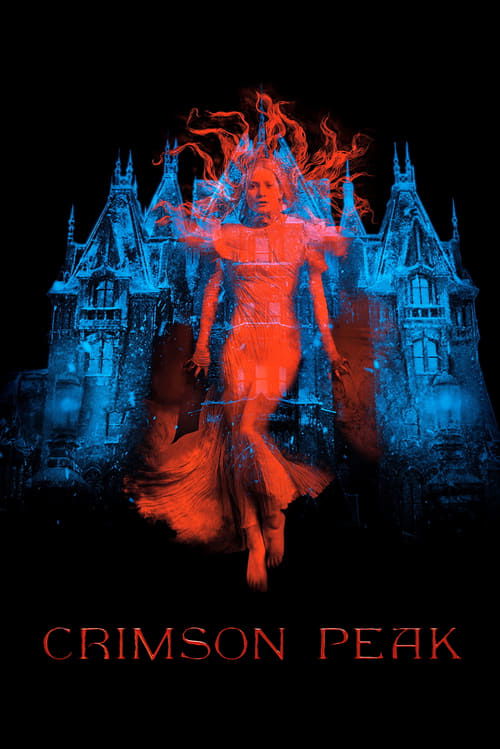
Crimson Peak
2015 · Guillermo del Toro
Pinocchio's stop-motion Oscar and his Frankenstein made him the loudest voice for handmade craft against AI ("I'd rather die than use it") — his interviews are reliably viral anti-algorithm sermons. Cinephile Twitter's beloved uncle.
For a stormy night when you want to be seduced and unsettled in equal measure — candlelit, romantic, macabre. Reach for it when you're craving atmosphere over gore and don't mind your love story laced with menace.
What it's about
An American heiress and aspiring novelist is swept off her feet by a charming but penniless English baronet and carried home to his ancestral mansion — a rotting pile sinking into blood-red clay, where he lives with his icy, forbidding sister. Snow falls through the broken roof, the walls seem to breathe, and the ghosts of the house keep trying to tell the new bride something she doesn't yet want to hear.
The experience
Sumptuous and swooning first, then increasingly suffocating — less a jump-scare machine than a slow-building fever of dread, desire, and secrets. The ghosts are frightening, but the mounting sense of what the living are hiding is worse.
Performances
Jessica Chastain is the standout, playing Lucille with a coiled, glittering menace that tips gloriously operatic; Tom Hiddleston makes the baronet's charm genuinely hard to read, and Mia Wasikowska grounds it all with intelligence and nerve.
The craft
Guillermo del Toro built Allerdale Hall as a colossal practical set, and it shows: every corridor drips with detail, crimson clay bleeds up through the floorboards, and the costumes and production design tell the story as much as the script does. It's one of the most ravishing-looking horror films of its decade — absolutely a big-screen, lights-off experience.
Why it matters
A cult favorite that has grown in stature as viewers caught up with what it actually is — not a haunted-house shocker but a full-blooded Gothic romance — and a key statement of del Toro's belief that monsters and beauty belong in the same frame.
Horror · Gothic · Haunted house & ghost story. A swooning Gothic romance in a rotting, blood-red mansion: lush practical sets, crimson ghosts, and dread over what the living hide.
Snapshot
Crimson Peak is Guillermo del Toro's most deliberate exercise in the Gothic mode: a lavish, self-conscious homage to nineteenth-century Gothic romance dressed as a studio horror release. An American heiress and aspiring novelist, Edith Cushing (Mia Wasikowska), is courted by an impoverished English baronet, Thomas Sharpe (Tom Hiddleston), and carried off to his decaying ancestral pile, Allerdale Hall, where he lives with his forbidding sister Lucille (Jessica Chastain). The house — sinking into blood-red clay, its rooms open to snowfall through a broken roof — becomes the film's true protagonist, and the ghosts that stalk it are, in del Toro's own repeated framing, less the point than the warning. The film's guiding paradox, spoken by Edith herself, is that this is "not a ghost story" but "a story with ghosts in it": the supernatural is metaphor, the real horror is human. Made with unusually deep art-department investment and released by Universal in October 2015, it was received as visually ravishing and narratively familiar, and it underperformed commercially against a marketing campaign that promised conventional scares. In del Toro's career it sits as a passion project realized at scale — the bridge between the intimate ghost story of The Devil's Backbone (2001) and the awards-winning fable The Shape of Water (2017).
Industry & production
Crimson Peak was produced by Legendary Pictures and distributed by Universal Pictures, part of the period when Legendary was aligned with Universal after leaving Warner Bros. Del Toro co-wrote the screenplay with Matthew Robbins, a longtime collaborator (they had previously worked together on Mimic and Don't Be Afraid of the Dark), from a script del Toro had nurtured for years before the project reached production. Del Toro produced alongside Legendary principals; the film was greenlit as a mid-budget, R-rated original — a comparatively risky proposition for a studio genre release built on no pre-existing IP.
Principal photography took place at Pinewood Toronto Studios, where the production built Allerdale Hall as a largely practical, multi-storey set rather than relying on digital environments — a decision central to both the film's aesthetic and its cost. The reported production budget placed it in the range of a substantial studio genre picture rather than a tentpole; I would rather flag than fabricate the exact figure, but the consistent public account is that it was expensive for its category and that its theatrical returns, especially domestically, disappointed. A significant factor cited across the film's reception is a mismatch between product and marketing: Universal's campaign leaned on jump-scare horror imagery, while the film itself is a slow, ornate Gothic melodrama, and the gap is widely credited with dampening its box office and word of mouth. Casting evolved during development — the ensemble ultimately settled on Wasikowska, Hiddleston, Chastain, and Charlie Hunnam as Edith's American suitor, Dr. Alan McMichael — but I would treat any specific account of earlier attached actors as uncertain unless verified.
Technology
The film's technological signature is its commitment to practical construction fused with restrained digital enhancement. Allerdale Hall was built physically, including a working, oozing floor and walls that "bled" red clay, so that actors performed inside the environment and light behaved naturally within it. The ghosts were achieved through a hybrid method: performer Doug Jones (a frequent del Toro collaborator) and others wore prosthetic and practical makeup, with computer-generated elements layered on to give the specters their distinctive attenuated, smoke-and-tendril anatomy and their translucent, clay-stained or skeletal forms. This approach — a real body as armature for digital augmentation — is characteristic of del Toro, who prefers the weight and on-set presence of a physical creature to a wholly synthetic one.
The film was shot digitally by cinematographer Dan Laustsen, and its imaging strategy exploited digital capture's latitude for saturated, high-contrast color and controlled darkness. The production's most conspicuous "technology," however, is old-fashioned craft at scale: full-size sets, elaborate costumes, insect and mechanical motifs, and in-camera atmosphere (falling snow, candlight, practical fog) that anchor the digital ghosts in a tangible world.
Technique
Cinematography
Dan Laustsen's photography is the film's most celebrated technical achievement and the clearest statement of its Gothic program. Laustsen, who had shot Mimic for del Toro nearly two decades earlier and would go on to The Shape of Water and Nightmare Alley, builds the film on a deliberate color architecture. Edith's American world — Buffalo, her father's home, daylight — is rendered in warm golds and amber; the Sharpe world of Allerdale Hall is drenched in cold blues, sickly greens, and the recurring bruise of blood-red. The palette is not naturalistic but symbolic, coding safety against menace and marking Edith's passage from one moral climate to another. The camera favors sweeping, fluid movement — craning through the house's vertical spaces, gliding along its galleries — that treats the set as a body to be traversed. Chiaroscuro lighting, pools of candlelight against engulfing shadow, and saturated color contrasts give the image the quality of a Pre-Raphaelite painting or a hand-tinted illustration.
Editing
Bernat Vilaplana, a recurring del Toro editor (a credited editor on Pan's Labyrinth among others), cuts the film at a patient, melodramatic tempo that prioritizes dread and dramatic revelation over shock. The pacing is front-loaded with romance and courtship and accelerates as the Sharpe secret unravels, building toward a violent, snow-bound climax. The editing lets the production design breathe — holding on the house, on ritual gestures, on the accumulation of clues — which aligns with del Toro's stated intent to make a "slow burn" in the tradition of literary Gothic rather than a modern fright machine.
Mise-en-scène / staging
Mise-en-scène is where Crimson Peak is most fully itself. Production designer Thomas E. Sanders and the art department conceived Allerdale Hall as a diseased organism: a house that sinks into red clay, whose walls seep, whose roof is torn open so that leaves and snow fall through the great hall, and whose decay is legible in every surface. The house is repeatedly figured as a living, remembering thing — "a house that breathes, bleeds, and remembers," in the film's own idiom. Kate Hawley's costumes extend the symbolic scheme: Edith's dress evolves in color and silhouette as her situation darkens, and the film threads an insect symbolism throughout — butterflies devoured by moths, Lucille associated with moths and predatory nature — that literalizes the fable of innocence and consumption. Staging within the vast set uses verticality and thresholds (staircases, elevators, locked rooms) to map power and entrapment.
Sound
Sound design foregrounds the house as an acoustic presence — creaks, the settling of timber, wind through the broken roof, the wet movement of clay — so that Allerdale Hall is heard as much as seen. The ghosts arrive with distinct sonic textures. Fernando Velázquez's score (see Authorship) is romantic and thematic, built on a memorable waltz motif that ties the film's love plot to its dread; the music leans toward lush late-Romantic orchestration rather than horror stingers, reinforcing the "Gothic romance" framing over the "horror movie" one.
Performance
The performances are keyed to melodrama, not realism, in keeping with the Gothic register. Mia Wasikowska plays Edith as intelligent, watchful, and increasingly resolute — a heroine who is also an author, and whose survival depends on reading her situation correctly. Tom Hiddleston gives Thomas the divided, seductive-yet-guilty charge the role requires, a decaying-aristocrat figure trapped by his sister and his past. Jessica Chastain, cast against her more sympathetic norm, delivers the film's most extravagant turn as Lucille — controlled, glacial, and finally volcanic — and is frequently singled out as its performative highlight. Charlie Hunnam's Dr. McMichael functions as the steadfast outsider-rescuer of Gothic convention. Doug Jones's physical performance under the ghost makeup supplies the specters' uncanny movement.
Narrative & dramatic mode
The film operates in the Gothic-romance mode, with its recognizable machinery: an orphaned or bereaved young woman, a brooding aristocrat with a secret, a sinister female rival or gatekeeper, a crumbling ancestral house, buried crimes, and a heroine who must uncover the truth to survive. Narration is anchored to Edith's subjectivity and, self-reflexively, to her identity as a writer — the film opens and closes on her authorial voice, insisting that ghosts are metaphor. The dramatic engine is revelation rather than surprise: the audience senses the Sharpes' menace early, and tension derives from watching Edith move toward knowledge. The mode deliberately privileges emotional and moral horror — betrayal, entrapment, familial corruption — over supernatural threat; the ghosts largely function as messengers and moral witnesses rather than antagonists.
Genre & cycle
Crimson Peak is best understood as a Gothic romance that studio economics and marketing tried to sell as horror. It belongs to a long screen lineage: the classical Hollywood Gothic melodrama (Rebecca, the "paranoid woman's film" cycle of the 1940s), the elegant ghost films The Innocents and The Haunting, the Roger Corman–Vincent Price Poe adaptations, Hammer's period horror, and the baroque Italian Gothic of Mario Bava. Within del Toro's own filmography it forms a ghost-story strand with The Devil's Backbone, where the supernatural similarly serves as the residue of human violence. The film arrived amid a broader 2010s revival of prestige and art-house horror and period Gothic, and its self-conscious literariness marks it as a curatorial, backward-looking entry in that cycle rather than a trend-setter.
Authorship & method
The film is unmistakably del Toro's: the ornate creature design, the insistence on practical sets and physical monsters, the ghosts-as-metaphor thesis, the fascination with childhood, buried history, and the beauty of decay, and the sympathetic reading of the monstrous. His method here is that of a scholar-craftsman staging a curated tribute to the Gothic canon while advancing his own preoccupations. Key collaborators shape the result. Cinematographer Dan Laustsen supplies the saturated, painterly image and the symbolic color scheme that would deepen further in their subsequent The Shape of Water and Nightmare Alley. Composer Fernando Velázquez — associated with Spanish-language genre cinema such as The Orphanage and with del Toro–produced work — provides a Romantic, waltz-driven score that tilts the film toward tragic romance. Editor Bernat Vilaplana sustains the slow-burn melodramatic rhythm. Co-writer Matthew Robbins shares screenplay credit, continuing a long working relationship with the director. Production designer Thomas E. Sanders and costume designer Kate Hawley are, in a film this design-driven, effectively co-authors of its meaning: the house and the wardrobe carry the theme.
Movement / national cinema
Del Toro is a Mexican filmmaker whose career straddles Mexican, Spanish, and Hollywood production, and he is often grouped with his compatriots Alfonso Cuarón and Alejandro González Iñárritu (the so-called "Three Amigos") as part of a generation of Mexican directors who achieved major international standing in the 2000s–2010s. Crimson Peak is, however, an English-language Hollywood studio production shot in Canada, not a Mexican national-cinema work; its "movement" affiliations are aesthetic and authorial rather than geographic. It draws on Anglo-American and European Gothic traditions filtered through del Toro's Latin American sensibility for the baroque and the fantastic — a sensibility more overtly rooted in Mexican and Spanish contexts in his Cronos, The Devil's Backbone, and Pan's Labyrinth.
Era / period
The film is set in the early twentieth century — around the turn of the century, spanning industrializing America (Buffalo, New York) and a moribund aristocratic England. That period frame is thematically load-bearing: it opposes Edith's modern, mechanized, self-made American world (her father is a self-made industrialist; Thomas seeks investment for a clay-mining machine) against the Sharpes' exhausted Old World lineage, sustained only by predation. The setting lets del Toro stage a confrontation between American modernity and European decadence that is itself a classic Gothic and Jamesian subject.
Themes
The governing themes are the persistence of the past and the impossibility of escaping inherited guilt — ghosts as the literal return of what was buried. The house-as-body conceit runs throughout: Allerdale Hall breathes, bleeds red, and remembers, collapsing the boundary between architecture and corrupted flesh. Female authorship and agency are foregrounded through Edith, a writer who resists being reduced to a Gothic victim and who reframes the very genre she inhabits. The Sharpe siblings' relationship introduces incest and familial corruption as the rot beneath aristocratic beauty, and the recurring butterfly/moth imagery encodes a fable of innocence consumed by predatory experience. Beauty and decay are held in constant tension — the film insists that horror can be exquisite, and that love and menace are entangled rather than opposed.
Reception, canon & influence
Critical reception was substantial but divided along a consistent line: near-unanimous praise for the film's production design, costumes, cinematography, and Chastain's performance, set against complaints that the story was predictable and that the film's emotional engagement lagged behind its visual splendor. Many critics also noted the marketing mismatch, arguing the film had been mis-sold as horror to its own detriment. Commercially it is generally regarded as a disappointment relative to its cost, particularly in the domestic market — I flag that I am not citing exact grosses to avoid inventing figures, but the qualitative record is consistent on the underperformance.
The influences ON the film are explicit and cited by del Toro himself: the Gothic literary tradition of the Brontës, Mary Shelley, Ann Radcliffe, Edgar Allan Poe, and Henry James's The Turn of the Screw; and the screen Gothic of Rebecca, The Innocents, The Haunting, the Corman–Poe cycle, Hammer horror, and Mario Bava's Italian Gothic. Its forward legacy is more diffuse. Crimson Peak did not launch a commercial cycle, but it stands as a touchstone in the 2010s revival of prestige Gothic and elevated period horror, admired as a design object and increasingly reassessed as a coherent, deliberate work once freed from the horror-marketing expectation. Within del Toro's own career its importance is clearer: the practical-set craft, the Laustsen color palette, and the romance-of-the-monstrous ethos feed directly into The Shape of Water, his subsequent Academy Award–winning film. As with several visually maximalist films that disappoint at release, its critical standing has tended to appreciate over time among genre scholars and Gothic enthusiasts, who read it as one of the most fully realized screen translations of the literary Gothic.
A Deleuzian reading
Snow comes down through the hole in the roof of Allerdale Hall and settles on the floor of the great hall.
The full Deleuzian reading of Crimson Peak →
Reception
Sold as a haunted-house horror in 2015, it underwhelmed at the box office and left gore-hounds shrugging — but a decade of October rewatches has recast it as del Toro's misunderstood gothic jewel, now routinely called his most beautiful film.
How Crimson Peak was received, from release to now →
How to watch Crimson Peak: what to notice on a first viewing
- Watch the color change when Edith arrives at the house. Dan Laustsen shoots Buffalo in warm gold and amber. Allerdale Hall comes in cold blue, sick green, and a recurring bruise of red. Candlelight sits in small pools against shadow that swallows the rest. The palette is not reporting on the weather. It tells you which world Edith is standing in before anyone speaks.
- Look at the red clay seeping up through the floorboards. Del Toro had the hall built at full scale with a floor engineered to ooze. Red comes up from below, snow falls in through the torn roof, and the walls seep. The actors stand inside the thing. The Sharpes are broke and living on top of the substance that is eating their house. That is the situation, stated in material.
- Notice the camera craning up through the great hall. Laustsen keeps moving: craning through the vertical space, gliding along galleries, traveling the staircases. The house gets covered the way a body gets examined, top to bottom, rather than shown room by room. The movement is what makes you feel the building as a single organism instead of a set of rooms.
- Listen to the house creak and settle in the wind. Timber groans, wind comes through the roof, clay moves wetly under the boards. Velazquez's score runs to a waltz rather than horror stingers, so the loudest thing in most scenes is the building itself. You hear Allerdale as much as you see it, and the waltz keeps tying the romance to the dread.
- Watch Chastain keep her face and voice under tight control. Everyone plays melodrama here rather than naturalism. Chastain holds Lucille glacial and exact for most of the picture. Hiddleston plays Thomas seductive and guilty at the same moment, never resolving into one or the other. These people are not deciding things. They are being driven, and the acting shows you the pressure they are holding down.
The whole guide to watching Crimson Peak, with the keys for a rewatch →
Influences: the films it descends from and the films it influenced
- Rebecca (1940) — Establishes the mansion-as-antagonist template — Manderley dominates and menaces the young second wife while the unseen dead first wife structures every frame — the direct precedent for staging/house-as-body and the intruding-bride plot.
- The Innocents (1961) — Freddie Francis's candle-lit CinemaScope deep-focus chiaroscuro and its insistence on keeping the ghosts psychologically ambiguous furnish del Toro's chiaroscuro grammar and the ghosts-as-metaphor thesis.
- The Haunting (1963) — Renders Hill House as a living organism through wide-angle architectural distortion and amplified diegetic groans, breathing walls and cold-spot acoustics — the model for Allerdale Hall's sound/diegetic-house-acoustics.
- Black Sunday (1960) — Del Toro's cited touchstone: the craning, gliding camera prowling cobwebbed Gothic interiors in high-contrast monochrome that Crimson Peak restages in color.
- Kill, Baby... Kill! (1966) — Bava's saturated gel lighting — crimson and emerald coding the supernatural as pure chromatic emotion — is the origin of the symbolic-color-palette Laustsen inherits.
- House of Usher (1960) — The Corman–Poe cycle's decaying aristocratic mansion whose literal structural rot externalizes the doomed bloodline is the blueprint for Allerdale Hall sinking into its blood-red clay.
- Horror of Dracula (1958) — Cited Hammer influence: lush Eastmancolor Gothic that weaponizes a single saturated red as the film's organizing chromatic shock, prefiguring Crimson Peak's bleeding house.
- Jane Eyre (1943) — Brontë screen Gothic staged in Wellesian expressionist shadow — the naive woman drawn to a brooding manor concealing a monstrous secret, the melodramatic register and revelation-not-surprise structure del Toro adopts.
- Beauty and the Beast (1946) — Cocteau's practical in-camera enchantment (living candelabra, breathing statuary) and its romance-of-the-monstrous ethos underwrite del Toro's practical-set craft and sympathy for the monster.
- The Red Shoes (1948) — Painterly three-strip Technicolor melodrama in which color and production design carry the emotional argument rather than illustrate it — the maximalist design-as-meaning principle Crimson Peak inherits.
- The Devil's Backbone (2001) — Del Toro's own formulation — 'a ghost is a tragedy condemned to repeat' — establishes his ghosts-as-metaphor and persistence-of-the-past method that Crimson Peak's revenants literalize.
- Pan's Labyrinth (2006) — Perfects the practical-creature/set craft seamlessly married to digital augmentation and the fairy-tale-inside-history structure that Crimson Peak's ghost design continues.
- The Shape of Water (2017) — Direct descendant: deepens Laustsen's saturated teal-and-red symbolic palette and carries the romance-of-the-monstrous ethos to an Oscar, with color again coding desire and threat.
- Nightmare Alley (2021) — Extends the del Toro–Laustsen practical-set/digital-hybrid method and painterly chiaroscuro into period noir, the mature refinement of Crimson Peak's craftsmanship.
- Suspiria (1977) — Extends Bava's symbolic gel color into hyper-saturated primary lighting as emotional architecture, the parallel branch of the same Italian-Gothic color lineage Laustsen draws on.
- The Orphanage (2007) — Del Toro–produced Spanish Gothic scored by Fernando Velázquez, whose Romantic, grief-swollen orchestral idiom becomes the waltz-driven tragic-romance tone Velázquez brings to Crimson Peak.
- The Others (2001) — Period Gothic built on revelation-not-surprise — its reveal reframes rather than shocks — the same structural wager Crimson Peak makes by telegraphing its horror as inevitability.
- Nosferatu (2024) — Contemporary female-centered Gothic built on saturated, hand-crafted period production design and the return-of-the-repressed plot — the prestige-horror revival of the Radcliffe/Brontë gothic Eggers shares.
- Frankenstein (2025) — Costume designer Kate Hawley and a controlled blood-red gothic palette establish the same authored color logic — black, white, and crimson for the maker's corrupted world — reused here.
- Dracula (2025) — Shares the gothic-operatic staging that privileges spectacle production design and romantic tragedy over jump-scare horror, treating the haunted-romance as costume melodrama.
- Stoker (2013) — Parallel revival of the du Maurier house-as-diagram — a breathing manor filmed in vertical strata with the horror sealed in basement and attic — and of color-coded costume in which the newcomer's wardrobe is gradually overwritten by the family's, the same succession-by-clothing Stoker runs on India.
- Marrowbone (2017) — Velázquez scoring a house that bleeds and breathes; del Toro's literalized house-as-body and the sibling secret sealed on an upper floor is Marrowbone's exact design vocabulary at scale.
- Mārama (2026) — Del Toro built a decaying English gothic manor on Canadian soundstages to stand in for northern England. Mārama uses the same production approach, with New Zealand doubling for Yorkshire, and both treat the house as a predatory collection of the family's sins.
Similar films
- The Devil's Backbone (2001) — influence & lineage · same viewing thread
- The Orphanage (2007) — influence & lineage · same viewing thread
- Suspiria (1977) — influence & lineage · often watched together
- Black Sunday (1960) — influence & lineage · same viewing thread · often watched together
- The Haunting (1963) — influence & lineage
- Nightmare Alley (2021) — influence & lineage
- The Innocents (1961) — influence & lineage
- Frankenstein (2025) — same viewing thread
All the films related to Crimson Peak →
Watch it with: curated runs of related films
- Haunted Castles and Restless Ghosts — A run of enchanted ruins, restless dead, and grief that won't stay buried — watch these when you want dread and reverie sharing the same frame.
- The New Gothic — Watch these together as a run of family secrets and haunted houses on fog-bound islands and in rotting mansions, where the ghost or monster usually turns out to be a story about guilt that someone has buried.