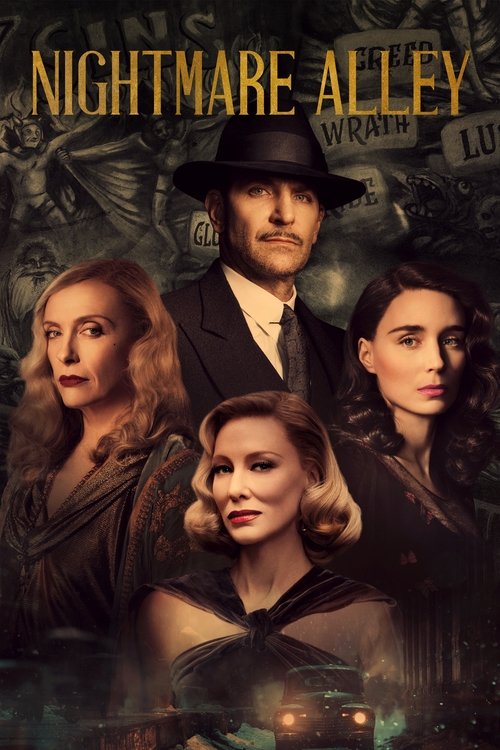
Nightmare Alley
2021 · Guillermo del Toro
Pinocchio's stop-motion Oscar and his Frankenstein made him the loudest voice for handmade craft against AI ("I'd rather die than use it") — his interviews are reliably viral anti-algorithm sermons. Cinephile Twitter's beloved uncle.
When you want a long, rich, grown-up thriller to sink into on a winter night — something wicked and fatalistic rather than fun. Best when you're in the mood to watch a man talk himself into his own doom.
What it's about
Stanton Carlisle, a drifter with a talent for reading people, washes up at a traveling carnival in the late 1930s and learns the tricks of a mentalist act — the codes, the cold reads, the well-chosen words that make strangers believe you can see into their souls. He takes the act to high society, where the marks are richer, the lies are bigger, and a coolly brilliant psychologist proves to be the one person he can't read. It's a con-artist story that keeps raising the stakes until the con becomes a trap.
The experience
A slow-burn noir that tightens like a fist — sumptuous and unhurried in its carnival first half, then colder and crueler as the grift escalates. It's less about jump scares than a creeping moral dread you can feel coming from miles away.
Performances
Bradley Cooper gives Stanton a hungry, wounded charm that curdles beautifully, and Cate Blanchett is pure venomous poise as the psychologist — their scenes together play like duels. Toni Collette and David Strathairn give the carnival half its bruised heart.
The craft
Del Toro builds two complete worlds — a mud-and-lightning carnival and an art-deco city of gleaming interiors — with astonishing production design and shadow-drenched cinematography. Every frame is composed like a period photograph, and it rewards the biggest screen you can find.
Why it matters
A rare major-studio return to full-blooded film noir, it earned a Best Picture nomination and proved del Toro could conjure horror with no supernatural creatures at all — only human ones.
Snapshot
Guillermo del Toro's Nightmare Alley is a meticulously mounted period noir following Stanton Carlisle, a drifter who absorbs the mind-reading techniques of a traveling carnival mentalist, reinvents himself as a high-society "spook show" act, and is ultimately destroyed by the very machinery of manipulation he spent years perfecting. Adapted from William Lindsay Gresham's 1946 novel — itself drawing on genuine carnival subculture and its lexicon of the "geek," the lowest rung of sideshow performance — the film is del Toro's most nakedly literary work: a structured moral fable about hubris, self-deception, and the impossibility of escaping one's origins. Where most of del Toro's output reaches toward the fantastical, Nightmare Alley is a film without monsters except the human kind, and that choice concentrates its darkness.
Industry & production
The film was produced by Searchlight Pictures, with del Toro himself among the producers, and principal photography took place in and around Toronto and Hamilton, Ontario. Del Toro had been attracted to Gresham's novel for years, and the project entered active development after the commercial and awards success of The Shape of Water (2017) gave him leverage to pursue a comparably ambitious, adult-oriented genre film that would not require the safety net of a franchise property.
Production was interrupted and reshaped by the COVID-19 pandemic, pushing the original schedule by several months and adding logistical pressure to what was already a demanding physical shoot that required the construction of a large, fully practical carnival midway — tents, sideshow banners, machinery, and all — on a Toronto soundstage. The decision to build the carnival as a practical environment rather than rely on digital augmentation was integral to the film's tactile aesthetic strategy and aligned with del Toro's longstanding commitment to handcrafted production design.
The film opened in wide release in the United States in December 2021 and underperformed commercially relative to its reported production budget of approximately sixty million dollars, a result attributed in part to pandemic-era theatrical conditions and in part to the film's uncompromising darkness and absence of genre comfort. Notably, del Toro subsequently released a black-and-white cut, Nightmare Alley: Vision in Darkness and Light, on a streaming platform, and publicly indicated this version was in some respects closer to his initial conception — an acknowledgment that the visual language of classic noir, built on high-contrast monochrome, remained the film's deepest aesthetic inheritance.
Technology
Dan Laustsen shot the film on large-format digital sensors in a 2.39:1 anamorphic widescreen ratio, choosing glass and focal lengths that produced a gently soft, slightly romantic quality in the carnival sequences before hardening into colder, more clinical precision in the city interiors. The wide anamorphic frame was used not for spectacle but for enclosure: characters are frequently positioned at the margins of wide compositions, isolated within sumptuous but oppressive environments.
The existence of a formally conceived black-and-white cut is unusual in contemporary studio filmmaking and reflects a deliberate technological double-consciousness during production: Laustsen and del Toro lit and exposed the film knowing both versions would exist, a decision that required the monochrome conversion to be achieved not as a simple desaturation but through a carefully graded translation that preserved tonal separation across the different color temperatures of the carnival and city palettes. The practical carnival construction paid dividends in this regard — physical light sources, lanterns, torchlight, and neon generated luminance relationships that hold in black and white in ways that digitally simulated lighting frequently does not.
Technique
Cinematography
Laustsen organized the film's visual world around a strict, purposeful chromatic binary. The carnival sequences are bathed in ambers, umbers, and deep ochres — the hues of sawdust, firelight, and tobacco — that render the sideshow a place of warmth, however corrupt. When Stanton moves into the city and begins working the elite hotel circuit, the palette shifts decisively into aqueous blues and cool silver-greys, the colors of wealth, glass, and emotional refrigeration. This is not merely decorative: the color temperature tracks Stanton's moral temperature, the warmth of genuine human contact giving way to the sterility of pure instrumentalization.
Laustsen frequently placed his camera at low and oblique angles in the city sequences, compressing space and creating a ceiling that presses down on characters — a classical noir compositional strategy invoking the sense of a world without exit. Against this, the carnival sets permitted a greater vertical freedom, the big tops and tent poles allowing the frame to breathe in a way it later refuses to.
Editing
Cam McLauchlin's editing is unhurried by contemporary standards, respecting the deliberate rhythms del Toro built into his staging. The film runs approximately one hundred and fifty minutes and resists compression: the extended carnival prologue, which a more conventionally paced film would abbreviate, is given room to establish not just plot mechanics but the sociology and moral atmosphere of the midway world. McLauchlin's cuts tend to be motivated by performance — the edit follows Cooper's eyes, his hesitations, the microgestures through which Stanton reads a mark — rather than action, which reinforces the film's interest in consciousness over event.
Mise-en-scène / staging
Del Toro's blocking consistently places Stanton in geometrically organized spaces that he either controls or fails to control, the staging externalizing the power dynamics of each scene. His staging of the mentalist performances — where Stanton reads audience members with practiced cold-reading technique — are choreographed with the precision of stage magic: movement, sight lines, timing, and misdirection operate as formal elements of the scene composition.
Production designer Tamara Deverell, a del Toro collaborator across multiple projects, constructed the carnival and the film's city interiors as distinct but related worlds. The carnival is organized around surfaces that reveal — sideshow banners, jars of foetal specimens, exposed machinery — while the wealthy interiors Stanton penetrates are organized around surfaces that conceal: mirrors, glass, lacquered wood, the studied blankness of money. Del Toro has spoken of Edward Hopper's paintings as a touchstone for the film's American spatial vocabulary, particularly for the isolation of figures within architectural environments, and the influence is legible in the staging of scenes in hotel lobbies and offices where characters occupy vast, empty-feeling rooms.
Sound
The sound design reinforces the film's emphasis on performance and the gap between appearance and reality. Carnival machinery — the ambient creaking of rides, the distant calliope, the barker's patter — establishes a sonic fabric that is at once nostalgic and unsettling, the fairground as a space of simulated wonder with a mechanical underside. In the city sequences, the soundscape becomes more interior: carpeted rooms, the hush of wealth, the muffled traffic of a city kept at arm's length. The transition marks a movement from public performance to private manipulation.
The score, composed by Nathan Johnson, draws on the conventions of mid-century noir underscore without pastiche, using strings and brass in modal configurations that evoke period atmosphere while maintaining an ironic distance from it. The music is most effective in its restraint: several of the film's most important scenes play largely without score, trusting the performances and the accumulated visual weight to carry the dramatic freight.
Performance
Bradley Cooper's casting was both commercial logic and conceptual precision: he brings to Stanton Carlisle a movie-star magnetism that is available to the performance as a resource, the charm that makes Stanton effective as a con man also being the charm that makes Cooper effective as a leading man. The performance traces Stanton's arc from impressionable apprentice to confident operator to hubris-driven overreacher with discipline and internal logic, resisting the temptation to telegraph the character's eventual dissolution in the early scenes. Cooper plays the cold-reading sequences with particular conviction, treating each as an athletic problem in attention and reaction.
Cate Blanchett as the psychiatrist Lilith Ritter operates in a register of absolute, almost parodic self-containment, a choice that makes her genuinely strange — she is legible as a noir femme fatale in outline but opaque in interior, which is precisely the film's point about her. The deliberate restraint creates an unease more effective than any conventionally telegraphed threat. Willem Dafoe's carny impresario Clem, who opens and closes the film with key information about the geek, is characteristically precise in the economy of his sinister authority. Toni Collette and David Strathairn bring weight to the carnival world that prevents it from serving merely as backstory.
Narrative & dramatic mode
The film is structured as a classical noir descent narrative whose trajectory is announced in its first minutes and whose end is visible from early in the second act to any viewer with knowledge of genre conventions or the source text. Del Toro makes no effort to disguise this; the film's pleasure is not in surprise but in the quality of the inevitability — watching a man walk consciously into every trap, his intelligence and his blindness operating simultaneously.
The "geek" is the film's central organizing symbol: a carnival worker, typically addicted and desperate, who performs an act of degradation (biting the heads off live animals) for a paying audience that regards him as subhuman. The film opens with Stanton asking Clem, with contemptuous disbelief, how a man becomes a geek. The answer — "we make him think it's the only way out" — establishes both the film's moral logic and its final, devastating image. The narrative is a demonstration of that answer applied to its protagonist.
The film divides structurally into two distinct halves: the carnival world (origin, apprenticeship, departure) and the city world (ascent, operation, collapse), with a brief coda that returns to the carnival as destination. This bifurcation is not merely spatial but moral: the carnival is a world of visible fraud, where marks know they are being entertained and consent to the illusion, while the city is a world of invisible fraud, where the wealthy marks Stanton targets believe they are purchasing genuine occult insight. The film implies that the city is the more corrupt environment.
Genre & cycle
Nightmare Alley belongs to the tradition of prestige literary noir adaptation — alongside such works as Chinatown (1974), L.A. Confidential (1997), and The Black Dahlia (2006) — in which studio resources and serious casting are applied to noir source material whose pessimism and moral complexity would typically prevent mainstream production. Within this tradition, del Toro's film is notable for its fidelity to the source's refusal of any redemptive arc, a fidelity that distinguishes it from many prestige adaptations that soften their originals.
It participates in a broader neo-noir revival that ran through the 2010s and into the 2020s, characterized by self-conscious formal sophistication and a tendency to foreground the generic machinery of noir rather than deploying it transparently. The relationship to the 1947 Edmund Goulding adaptation — itself a notable film, starring Tyrone Power in a career-disrupting role — is acknowledgedly dialogic: del Toro returns to the novel rather than the prior film, and the two adaptations illuminate different aspects of the source.
The film also belongs to what might be called the "carnival horror" cycle, a loosely defined grouping that includes Tod Browning's Freaks (1932) and various exploitation pictures that use the sideshow as a space of otherness, transgression, and the boundary between entertainment and atrocity.
Authorship & method
Del Toro co-wrote the screenplay with Kim Morgan, a film critic and author who brought both scholarly knowledge of noir tradition and a sensibility attuned to the film's literary dimensions. The collaboration represents an unusual screenwriting partnership in terms of the second writer's profile; the resulting script is notably more dialogue-driven and less reliant on del Toro's characteristic creature-and-monster iconography than most of his previous work, suggesting Morgan's influence in the direction of language and character over spectacle.
Dan Laustsen has served as del Toro's cinematographer on Mimic (1997), Crimson Peak (2015), and The Shape of Water (2017), among others, and their collaboration has developed a shared visual syntax centered on warm light against dark space, tactile surface detail, and a Romantic chiaroscuro that draws on Northern European painting traditions. On Nightmare Alley, the challenge was to transpose this syntax into a resolutely American visual idiom, and the solution — anchoring it in the amber-and-shadow world of the carnival — represents one of the partnership's most distinctive achievements.
Tamara Deverell's production design is an essential authorial contribution: her construction of the carnival as a complete, navigable practical environment gives the film its physical conviction and allows del Toro to move his camera through a world rather than in front of a set. Costume designer Luis Sequeira worked in close coordination with Deverell to ensure that character costumes functioned as part of the production design's environmental logic, particularly in the contrast between the worn, pragmatic fabrics of the carnival and the sleek, weaponized elegance of the city.
Movement / national cinema
Del Toro is Mexican by birth and formation, schooled in the traditions of Mexican fantastic cinema and in the shadow of genre filmmakers including the Spanish-language horror and adventure cinema of the mid-twentieth century. His career has been conducted primarily within Hollywood since Mimic, but his sensibility has remained shaped by his formation, which includes a deep literacy in European Gothic and an outsider's analytical relationship to American genre conventions.
Nightmare Alley is, however, his most determinedly American film — not in the sense of belonging to a national artistic tradition but in the sense of engaging with specifically American mythologies: the carnival as democratic spectacle, the self-made man as confidence artist, the Midwest and its buried violence. Del Toro approaches these materials with the combination of fascination and critical distance that characterizes the work of European and Latin American directors who have taken Hollywood genre as their subject matter, including Fritz Lang and Billy Wilder, both of whom made noirs that function as examinations of the American condition from positions of productive estrangement.
Era / period
The film is set in the late 1930s and early 1940s, a choice that situates it at the historical moment when the sensibility now called film noir was being formed: the Depression had created the conditions for a popular art defined by anxiety, fatalism, and the exposure of institutional corruption. The period is rendered with precise material attention — automobiles, typography, silhouette fashions, radio — but is not nostalgic; del Toro uses the period as a controlled environment for examining forces (manipulation, class violence, the abuse of psychological expertise) that are not historical.
The film's relationship to its production moment — the early 2020s, a period of widespread institutional distrust, the visibility of manipulation and disinformation as social mechanisms — is implicit rather than underlined. Del Toro has declined, in interviews, to make explicit allegorical claims, but the film's central subject (a gifted manipulator whose tools include the performance of sincerity) carries contemporary valence that reviewers noted.
Themes
The film's deepest concern is the structure of self-deception — specifically, the mechanism by which a person can simultaneously know and not know what they are doing. Stanton is never entirely a cynical operator; his ambition contains genuine longing, and the film traces the tragedy of that longing being entirely in the service of his hunger for power over others. The carnival's "cold reading" technique, in which a performer extracts and reflects back information to create the illusion of supernatural knowledge, serves as the film's master metaphor for a kind of intelligence that substitutes accurate perception for genuine connection.
Class and mobility are central: Stanton is a man without origins (the film opens with him burning a body in mysterious circumstances, erasing whatever past he has) who inserts himself into a social hierarchy at its weakest joints, exploiting the need of the wealthy to believe in forces beyond rationality. The film is astute about how spiritual credulity functions as class privilege — the very rich can afford irrationality in ways the poor cannot — and about how the figure of the psychic or medium has historically offered people a counterfeit version of the intimacy and understanding they cannot find elsewhere.
The "geek" as fallen state recurs as both literal plot element and moral category: what, the film asks, is the difference between the geek who performs degradation for carnival audiences and the businessman who performs sincerity for wealthy clients? The film's answer is one of degree rather than kind.
Reception, canon & influence
Nightmare Alley received generally strong critical notices, with particular praise directed at its visual ambition, the quality of its ensemble, and del Toro's evident commitment to the material. Some critics, working in comparison with both the 1947 Goulding film and del Toro's own The Shape of Water, felt the film was more accomplished as craft than as emotion — that its formal perfection held audiences at a distance its predecessor's rawer texture did not. The black-and-white cut attracted considerable attention on re-release and several critics who had been lukewarm on the theatrical version found it a more fully realized object.
The film received four Academy Award nominations: Best Picture, Best Cinematography (Laustsen), Best Costume Design (Sequeira), and Best Production Design (Deverell and Shane Vieau). Bradley Cooper, somewhat surprisingly given the critical attention to his performance, was not nominated for Best Actor. The film did not win in any category.
Its influences are explicit and acknowledged. The 1947 Goulding film is the most immediate antecedent; del Toro has spoken extensively about his admiration for it and for Tyrone Power's willingness to sacrifice his matinee-idol image for the role, a sacrifice Cooper to some extent mirrors. Beyond the prior adaptation, the film draws on the full body of American noir: the femme fatale architecture of Double Indemnity (1944) and The Lady from Shanghai (1947), the carnival Gothic of Browning's Freaks, the expressionist shadow-work of German-American noir directors including Lang and Edgar G. Ulmer. The influence of Edward Hopper's spatial melancholy, as noted, is a more unusual source for film noir — Hopper rendered American loneliness in color and light rather than shadow — and its incorporation gives the film a particular quality of daylit desolation in some of its city sequences.
Its forward legacy is more difficult to assess at this writing, given the film's comparatively recent release and modest commercial footprint. It has joined a small category of serious literary noir adaptations that demonstrate the continuing vitality of the form when handled with scholarly commitment and genuine formal ambition. As a document of del Toro's authorship, it stands as evidence that his concerns — monstrosity, the outsider, the cost of longing — can be pursued through entirely human means.
A Deleuzian reading
Start with a jar.
The full Deleuzian reading of Nightmare Alley →
Reception
It landed with a thud in December 2021 — buried at the box office by Spider-Man: No Way Home the same weekend — then rebounded with four Oscar nominations including Best Picture, and has been steadily climbing in estimation as one of del Toro's most rewatchable films.
How Nightmare Alley was received, from release to now →
Influences: the films it descends from and the films it influenced
- Nightmare Alley (1947) — Del Toro replicates Goulding's star-persona-as-resource strategy precisely: as Goulding weaponized Power's matinee-idol magnetism to make Stan's con work on the audience as well as his marks, del Toro uses Cooper's charismatic warmth so that the viewer's susceptibility to the star becomes the film's moral trap.
- Double Indemnity (1944) — The announced-descent narrative architecture — protagonist narrating his own doom before the flashback mechanism begins — is inherited directly; both films construct the protagonist's intelligence and self-belief as the precise instrument of his destruction, implicating the audience's admiration in the fall.
- Freaks (1932) — Browning established the geek as genre convention and moral terminus — the sideshow performer who was once human and is now consumed as entertainment — and del Toro's opening and closing images are a direct formal citation, inheriting the convention that the carnival's geek pit is both the genre's judgment and its origin.
- The Lady from Shanghai (1947) — Welles's spider-woman — whose sexual power is inseparable from professional manipulation, encoded in a silver-white chromatic palette against which the male protagonist's warm darkness reads as susceptibility — is the direct template for del Toro's Blanchett/Lilith and the film's chromatic moral coding of femme fatale danger.
- Detour (1945) — Ulmer's German-expressionist American noir demonstrates that chiaroscuro can achieve expressionist monumentality through framing and light placement alone, without production resources; the doom-as-given-condition structure — fate decided before the film begins, the narrative tracing only its mechanics — is the narrative model del Toro applies at prestige scale.
- Scarlet Street (1945) — Lang maps power geometry onto studio interiors — bodies positioned as a diagram of dominance, the manipulator always spatially elevated above the deceived — and builds a manipulation-and-hubris narrative in which the man's arrogant self-belief makes him the precise instrument of the femme fatale's destruction, the architecture del Toro inherits wholesale.
- Sunset Boulevard (1950) — Wilder combines announced-descent (protagonist already destroyed at the opening) with star-persona-as-resource (Swanson's faded stardom is the film's subject, not its background) to create the narrative and performance model that del Toro transposes to Cooper: the star's image is the character's currency and the currency's devaluation is the film's tragedy.
- The Cabinet of Dr. Caligari (1920) — Wiene's film originates the carnival showman who wields occult psychological control over a performing body — the Caligari/Cesare dyad — establishing the genre convention of the fairground as a site of power, exploitation, and mind-domination that del Toro inherits for the Zeena/Pete dynamic and Molina's mentorship of Stan.
- Chinatown (1974) — Polanski established the prestige neo-noir template: anamorphic widescreen encoding moral corruption in period composition (Alonzo), power geometry in sequences between Gittes and Cross where spatial elevation and eyeline encode knowledge as domination, and an announced-descent structure in which the protagonist's investigative intelligence accelerates rather than prevents catastrophe.
- The Shape of Water (2017) — The identical Laustsen/del Toro visual syntax — warm chromatic moral coding differentiating narrative worlds, practical environments built as complete navigable spaces allowing camera movement through rather than in front of sets — runs across both films; Nightmare Alley is the American-noir transposition of the authorial method worked out across four Laustsen collaborations.
- Crimson Peak (2015) — The same Laustsen/Deverell practical-production-design collaboration deploys Gothic-horror spatial grammar here — the house as a complete navigable environment, the amber-against-dark spatial syntax encoding warmth-as-danger — that Nightmare Alley then transposes into carnival and neo-noir registers.
- L.A. Confidential (1997) — Hanson's film is the genre template for prestige literary-noir: Dante Spinotti's anamorphic widescreen period compositions, ensemble casting as genre-seriousness credential, and the adaptation of an intractable literary source (Ellroy) with scholarly fidelity to period production design — the model del Toro follows when treating Gresham with comparable seriousness.
- Road to Perdition (2002) — Conrad Hall's cinematography deploys American Depression-era chiaroscuro with Hopper-influenced spatial desolation in exterior sequences — rain-slicked Midwestern streets, figures dwarfed by flat empty space rendered in backlit shadow — anticipating Laustsen's strategy for del Toro's daylit-despair passages, where the period American landscape is Hopper made cinematographic.
- The Talented Mr. Ripley (1999) — John Seale's anamorphic widescreen cinematography encodes moral corruption through color temperature shifts — the warm golden privilege of Italy vs. the shadow-blue of transgression's interior — while Minghella's prestige literary adaptation of a manipulation-and-hubris narrative shares both the chromatic moral coding logic and the performance-motivated editing that follows psychological micro-states over action beats.
- Blood Simple (1984) — Barry Sonnenfeld's off-axis, low-angle compositions establish the American indie neo-noir visual grammar — framing that encodes paranoia through geometric distortion — while the Coens' manipulation narrative, in which each character's deception becomes the precise instrument of their own destruction, is the structural model that del Toro applies to Nightmare Alley at studio scale.
- Frankenstein (2025) — Tamara Deverell's production design and Laustsen's large-format photography prototype the world-building craft and oversized period sets carried directly into Frankenstein.
Similar films
- Nightmare Alley (1947) — influence & lineage
- Crimson Peak (2015) — influence & lineage
- The Shape of Water (2017) — influence & lineage
- Double Indemnity (1944) — influence & lineage
- Carol (2015) — shared sensibility
- The Shining (1980) — shared sensibility
- Murder, My Sweet (1944) — shared sensibility
- The Maltese Falcon (1941) — shared sensibility
All the films related to Nightmare Alley →
Watch it with: curated runs of related films
- The Long Shadow of M — A run from Lang's Weimar crime films through their noir and neo-noir children — killers, con men, masterminds, and manhunts — where you can watch expressionist menace mutate step by step into the modern thriller.