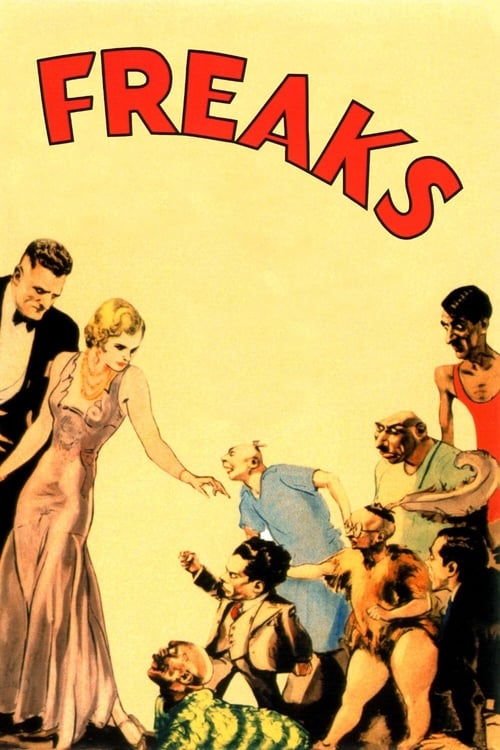
Freaks
1932 · Tod Browning
For when you want a horror film with a conscience — something old, transgressive, and unlike anything made since. It's a challenge, not comfort viewing, but a short and unforgettable one.
What it's about
Inside a traveling circus, a beautiful trapeze artist agrees to marry Hans, a sideshow performer with a sizable inheritance — but her affections are a con, cooked up with the strongman she's really involved with. The sideshow troupe, played by real carnival performers, closes ranks around Hans as suspicions grow. It's a backstage melodrama of love, greed, and loyalty among people the outside world treats as spectacle.
The experience
Tender and strange in equal measure — long stretches feel like a warm, gossipy hangout among carnival family, which makes the cruelty at its center land harder. By the end it curdles into something genuinely unnerving, with images that stay with you for days.
Performances
The cast of real sideshow performers — including Harry Earles as Hans — give the film its unrepeatable authenticity; their unguarded, dignified presence is the whole point, and no studio casting could fake it.
The craft
Tod Browning, who spent years working in carnivals himself, shoots the sideshow community with matter-of-fact intimacy rather than gawking, then unleashes a rain-soaked climax of pure nightmare staging. The pre-Code frankness and stark black-and-white photography give it a documentary rawness that modern horror rarely touches.
Why it matters
So scandalous on release that it was banned in places and nearly ended Browning's career, it was rediscovered decades later as a cult landmark and a founding text for horror that sides with the outsiders. Its wedding-feast chant has echoed through pop culture ever since.
Snapshot
Freaks is one of the most genuinely transgressive films ever released by a major Hollywood studio, and it nearly ended Tod Browning's career. Produced by Metro-Goldwyn-Mayer at the height of its prestige—the studio of Garbo, of glittering production values, of Irving Thalberg's taste—the film cast actual sideshow performers with physical anomalies as its protagonists and asked audiences to extend to them the moral sympathy normally reserved for conventional leads. Its plot is a melodrama of betrayal: Cleopatra, a beautiful trapeze artist, marries the dwarf Hans for his inheritance, conspiring with the strongman Hercules to poison him, and is ultimately hunted down and mutilated by the "freaks" she has scorned, transformed in the film's notorious climax into a feathered "human duck." Released into an unprepared public, it was savaged, censored, cut, and effectively buried for decades before its rediscovery on the European art-house and American counterculture circuit transformed it into a cult landmark and, eventually, a canonized object of serious study. It remains a film whose central provocation—who is the monster?—has lost none of its force.
Industry & production
Freaks was made at MGM, the most polished and conservative of the major studios, which makes its existence faintly miraculous. The driving force was Tod Browning, fresh from the enormous success of Dracula (1931) at Universal, who returned to MGM—where he had worked extensively in the silent era with Lon Chaney—with substantial creative capital. Irving Thalberg, MGM's production chief, reportedly backed the project despite knowing its commercial peril; the often-repeated anecdote that he said "I asked for something horrifying and I got it" is part of the film's lore and should be treated as such rather than as documented fact.
The source material was Tod Robbins's short story "Spurs" (1923), though the film departs sharply from it, retaining mainly the central conceit of a sideshow dwarf and a treacherous full-statured woman. Multiple writers worked on the screenplay, credited variously to Willis Goldbeck and Leon Gordon, with additional contributions; the precise division of labor is not cleanly documented.
The production's defining decision was casting. Browning, who had run away with a circus as a youth and worked as a carnival barker and sideshow talker, populated the film with real performers drawn from the carnival and vaudeville circuits: the conjoined Hilton sisters (Daisy and Violet), the limbless Prince Randian ("the Living Torso"), the "half-boy" Johnny Eck, the microcephalic performers billed as "pinheads" (including Schlitzie), the bearded lady, the bird-girl, the human skeleton, and the dwarf siblings Harry and Daisy Earles, who play Hans and Frieda. Harry Earles had worked with Browning before, and the project may have originated partly through that connection.
MGM previewed the film to disastrous results—accounts describe walkouts and at least one viewer reportedly threatening legal action over distress, though such anecdotes are hard to verify. The studio cut the film substantially from its original length (commonly cited as roughly 90 minutes) down to around 64 minutes. Roughly a half-hour of footage was removed and is now considered lost. To soften the ending, MGM appended a conciliatory epilogue reuniting Hans and Frieda, and some prints carried a moralizing prologue scroll added to frame the spectacle. The film performed poorly, was banned outright in the United Kingdom for some thirty years, and effectively damaged Browning's standing; he directed only a handful of films afterward and retired by the end of the decade.
Technology
Freaks was made in the early sound era using standard MGM equipment of 1931–32. It is a fully synchronized sound picture, shot on orthochromatic-to-panchromatic black-and-white stock with the relatively immobile, blimped cameras typical of the period's transition out of silent technique. There are no special-effects innovations in the conventional sense; the film's most startling "effects" are not effects at all but the unaltered bodies of its performers, photographed plainly. The climactic transformation of Cleopatra into the "human duck" is achieved through makeup and prosthetics rather than optical trickery, and is shown only briefly. The technological story of Freaks is therefore less about apparatus than about the studio's full command of classical resources turned toward unclassical ends.
Technique
Cinematography
The cinematography is credited to Merritt B. Gerstad, an experienced MGM cameraman. The visual approach is notably restrained and, for the most part, classically composed—a deliberate strategy. Browning largely refuses the expressionist shadow-play that defined Universal horror of the same moment; the sideshow performers are shot in clear, even light, frequently in medium and full shots that present their bodies matter-of-factly rather than as lurid revelations. This plainness is the film's ethical engine: by photographing the performers as people going about ordinary business—eating, sewing, flirting, gossiping—the camera normalizes them and reserves its menace for the "beautiful" antagonists. The exception is the climax, a rain-soaked nocturnal hunt in which the performers crawl through mud beneath the carnival wagons, knives in hand or teeth, lit in low-key fragments. Here the film finally deploys horror's visual grammar, and the effect is overwhelming precisely because it has been withheld.
Editing
The editing, credited to Basil Wrangell, must be discussed with the caveat that the film we have is a mutilated text—roughly a third shorter than Browning's version, with footage permanently lost. The surviving cut has a somewhat episodic, loosely strung rhythm in its first two acts, accumulating vignettes of sideshow life rather than driving hard on plot. Some of this looseness likely reflects the excisions: connective tissue and subplots (including, by various accounts, material involving Hercules and the bearded lady, and a more explicit fate for Hercules) were removed. The climactic pursuit, by contrast, is cut with mounting urgency, intercutting the crawling performers, the fleeing villains, and the storm into the film's one passage of sustained montage-driven suspense.
Mise-en-scène / staging
The film's world is the backstage of a traveling French circus, and its staging emphasizes communal space: caravans, mess tables, the open ground between wagons. The famous "wedding feast" sequence is the film's centerpiece of mise-en-scène, gathering the performers around a long table as they initiate Cleopatra into their fellowship with the chant "We accept her, one of us! Gooble gobble!"—passing a loving cup as a ritual of belonging. Cleopatra's revulsion ("Freaks! Freaks!") and her cruel rejection of the cup is staged as a violation of sacred hospitality, the moral hinge of the entire film. Throughout, Browning composes to insist on the performers' competence and autonomy: Prince Randian lighting a cigarette with his mouth, Johnny Eck moving with athletic ease, the armless woman dining with her feet. These are presented as demonstrations of dignity, not freaks-show "gags," even as the film cannot fully escape its own exhibitionary impulse.
Sound
As an early talkie, Freaks uses sound functionally rather than expressively for much of its length; dialogue is recorded in the somewhat boxy manner of 1932. The film has little non-diegetic scoring through long stretches, which lends the sideshow scenes a documentary plainness. Sound becomes a true instrument of horror only in the climax, where the rain, thunder, and the inarticulate sounds of the pursuing performers replace dialogue, generating dread through aural texture. The chant of the wedding feast is the film's most memorable use of the voice—rhythmic, ritualistic, and unsettling in its collective unity.
Performance
Performance in Freaks is radically uneven by conventional measure, and this is inseparable from its method. The professional actors—Olga Baclanova as Cleopatra, Henry Victor as Hercules—deliver broad, theatrical, almost operatic villainy; Baclanova in particular gives a performance of glittering, predatory contempt that reads as silent-era melodrama carried into sound. The sideshow performers, by contrast, are largely non-actors, and their line readings range from stiff to halting (Harry Earles's accented, sometimes difficult-to-parse delivery as Hans among them). The contrast is itself meaningful: the "beautiful" people perform monstrousness with practiced artifice, while the "freaks" are simply, unactorly present. Daisy and Violet Hilton bring a real poignancy to their scenes, and the children-like microcephalic performers radiate an unguarded warmth that the film clearly cherishes.
Narrative & dramatic mode
The dramatic mode is melodrama—specifically a morality tale of greed, betrayal, and communal retribution—grafted onto the structure of a circus-life ensemble piece. The first two acts are loose and observational, building an entire society with its codes of loyalty, courtship, and mutual care; the romance subplots (Phroso the clown and Venus the seal-trainer; the Hilton sisters' suitors) establish a world worth protecting. The villainy of Cleopatra and Hercules is the intrusion, and the narrative's engine is the slow discovery by the community that one of their own is being poisoned for money. The mode then pivots, in the final reel, into something close to gothic horror and revenge tragedy. Crucially, the film's moral architecture inverts the genre's usual sympathies: the conventionally "normal" are the grotesques, and the physically anomalous are the moral center—a community whose code ("offend one and you offend them all," as the prologue glosses it) is presented as just, even as its enactment is terrifying.
Genre & cycle
Freaks sits inside the early-1930s American horror cycle ignited by Universal's Dracula and Frankenstein (both 1931), and Browning's own Dracula was a foundational entry in that wave. But Freaks is an outlier within it. Where Universal horror traded in supernatural monsters, gothic castles, and expressionist atmosphere, Freaks is resolutely earthbound, its "monsters" human and real, its setting a working circus. It belongs equally to the carnival/sideshow melodrama lineage that runs through Browning's silent collaborations with Lon Chaney (The Unholy Three, 1925; The Unknown, 1927), films of disguise, mutilation, and erotic obsession set among performers. In that sense Freaks is the culmination of a personal cycle as much as a participant in a studio one. Its commercial failure also marked it as a cautionary limit-case: it demonstrated how far the pre-Code horror film could go, and helped define, by negative example, the boundary the genre would not cross again.
Authorship & method
Freaks is among the most personal films in the studio system, inseparable from Tod Browning's biography. His youthful flight to the circus, his work as a sideshow talker, and his long fascination with disguise, deformity, and the underside of spectacle saturate the film. The decade-long partnership with Lon Chaney—the "man of a thousand faces," who contorted and tortured his body for roles—had already made bodily difference Browning's great subject; Freaks takes the radical further step of casting performers whose difference was not makeup but life. Chaney had died in 1930, and one can read Freaks as Browning pursuing his obsessions past the point where a star's prosthetic suffering could mediate them for an audience.
Among collaborators, cinematographer Merritt B. Gerstad executed the film's deliberately plain, humane visual style; editor Basil Wrangell shaped (and was then forced to re-shape under studio pressure) its rhythm. The screenplay passed through several hands—Willis Goldbeck and Leon Gordon are the principal credited writers, adapting Tod Robbins's "Spurs"—and the precise authorship of individual scenes is not reliably documented. There is no significant original musical score in the auteurist sense; the film's "voice" is overwhelmingly Browning's, backed by Thalberg's willingness, however briefly, to let it exist. After the film's failure, Browning's directorial career effectively contracted to a close within a few years, making Freaks both his most personal statement and, in career terms, his undoing.
Movement / national cinema
Freaks is a product of the Hollywood studio system, not of any organized aesthetic movement, and it would be inaccurate to file it under expressionism or any European school despite horror's debts to those traditions. If anything, its plain photographic realism runs counter to the expressionist current then shaping American horror. Its eventual cultural meaning, however, was substantially shaped abroad and outside the mainstream: long suppressed in the U.S. and banned in Britain, it found its second life in European cinephile and festival contexts in the postwar decades and within the American underground and exploitation circuits, where it was reframed as a work of accidental surrealism and outsider art. Its rehabilitation owes much to a sensibility—part Surrealist, part countercultural—that recognized in it a radical assault on bourgeois notions of normalcy.
Era / period
The film is a quintessential pre-Code production. Released in 1932, before the Production Code's rigorous enforcement began in mid-1934, it exploited a window in which Hollywood could court sensation, sexual frankness, and grotesquerie with comparative freedom. Cleopatra's open adultery with Hercules, the frank treatment of sexuality among the performers (the Hilton sisters' romantic entanglements; the implied physical reality of conjoined life), and above all the spectacle of real anomalous bodies would have been unthinkable under the enforced Code. Freaks thus stands as a marker of pre-Code Hollywood's outer limit—and its commercial catastrophe, arriving as moral-reform pressure on the industry intensified, is part of the larger story of why that window closed.
Themes
The film's governing theme is the inversion of monstrosity: the question of who truly deserves the name "freak." Physical difference, the film insists, is not moral difference; the deformity that matters is Cleopatra's and Hercules's—greed, vanity, cruelty—housed in beautiful bodies. Bound up with this is the theme of community and its codes: the performers form a society with fierce internal loyalty, mutual aid, and a covenant of belonging, and the film treats their solidarity ("one of us") as both touching and, when violated, awful in its retributive power. There is a theme of love and bodily intimacy across difference, pursued without the era's usual euphemism. And there is the persistent, uncomfortable theme of spectatorship itself—the film implicates its own audience, who have, after all, bought a ticket to look at the very people the narrative asks them to stop gawking at. That tension between humanist sympathy and exhibitionary display is never fully resolved, and is central to the film's enduring critical interest.
Reception, canon & influence
On release, Freaks was a critical and commercial disaster. Contemporary reviewers were largely repulsed; the film was cut, banned in Britain for roughly three decades, withdrawn, and circulated for years on the exploitation circuit under lurid alternative titles. It damaged Browning's career and was, for a generation, an object of embarrassment for MGM.
Its influences run backward into Browning's own body of work—the Chaney collaborations The Unholy Three and The Unknown, with their carnival settings and themes of bodily mutilation and disguise—and into the broader 1920s vogue for circus and sideshow melodrama, as well as Tod Robbins's source fiction. The Universal horror successes of 1931 created the commercial opening MGM exploited.
The forward influence is far larger than the film's reception would have predicted. Rediscovered and championed from the 1960s—its screening at the 1962 Venice Film Festival is frequently cited as a turning point in its rehabilitation—Freaks became a touchstone of cult cinema, embraced by the counterculture, by underground filmmakers, and by critics who read it as a humanist masterpiece and a proto-Surrealist provocation. Its "one of us" chant entered the broader culture (echoed, for instance, in later music and television), and its central ethical reversal—the monstrousness of the beautiful, the humanity of the marginalized—reverberates through subsequent films and television concerned with outsider communities and bodily difference. It has been recognized in institutional canons (including selection to the U.S. National Film Registry) and is now routinely taught as a key text in disability studies, in the history of horror, and in debates about the ethics of representation and the gaze. Few films have traveled so completely from suppressed scandal to canonized landmark, and fewer still continue to unsettle the viewer as directly as Freaks does the moment its performers raise the loving cup.
A Deleuzian reading
A man with no arms and no legs lies on a mat, takes a cigarette paper between his lips, rolls it, strikes a match, and smokes.
The full Deleuzian reading of Freaks →
Reception
A career-ending catastrophe in 1932 — MGM hacked out a third of it after horrified test screenings, and it was banned in the UK for three decades — before a 1962 Cannes revival kicked off its rebirth as a countercultural cult classic, later enshrined in the National Film Registry.
How Freaks was received, from release to now →
Influences: the films it descends from and the films it influenced
- The Unknown (1927) — Browning's own template for Freaks: an armless carnival performer whose bodily difference drives a melodrama of betrayal and mutilation, staged within the troupe's backstage intimacy.
- The Unholy Three (1925) — Established Browning's method of building plot from a closed sideshow ensemble of performers (strongman, midget, ventriloquist) who police their own loyalties against outsiders.
- He Who Gets Slapped (1924) — The circus-humiliation melodrama with Chaney as the abused clown — the troupe-as-family avenging one of its own that Freaks literalizes in its banquet revenge.
- Variety (1925) — The trapeze love-triangle of betrayal inside a performing troupe, with subjective camera placing the viewer among the performers rather than in the paying audience.
- The Cabinet of Dr. Caligari (1920) — The fairground frame in which a showman exhibits a human curiosity, inverting who the true monster is — the 'who is the monster?' reversal Freaks builds its ethics on.
- The Man Who Laughs (1928) — Permanent facial deformity exhibited as carnival attraction yet framed for pathos, modeling the sympathetic-grotesque gaze Freaks extends to non-actors.
- The Penalty (1920) — Chaney's legless gangster — the man-of-a-thousand-faces lineage of physically transformed performance whose prosthetic suffering Freaks replaces with actual difference.
- Greed (1924) — Naturalist insistence on real, un-beautiful bodies and locations — and the studio-mutilated text — that prefigures both Freaks' casting ethic and its butchered release print.
- Dracula (1931) — Browning's static, dialogue-bound early-talkie horror grammar and its box-office success created the exact commercial opening MGM exploited for Freaks.
- Nightmare Alley (1947) — Carries forward the carnival geek and sideshow as a moral underworld where the 'normal' grifter is the real degenerate — the inverted-sympathies structure applied to noir.
- Spider Baby (1967) — A household of 'freaks' whose loyalty to one another indicts the predatory normates who intrude — the besieged-outsider-family plot and its banquet menace.
- Even Dwarfs Started Small (1970) — Builds an entire film around performers with dwarfism as actors rather than spectacle, extending Freaks' radical casting of real difference into anti-spectacle provocation.
- Pink Flamingos (1972) — Transgressive non-actor casting and an underground 'one of us' ethos that turns the marginalized troupe against bourgeois respectability.
- The Elephant Man (1980) — Stages Victorian sideshow exhibition to flip monstrousness onto the cruel beholders, the direct heir to Freaks' who-is-the-monster reversal and humanist gaze on deformity.
- Basket Case (1982) — Sideshow body-horror of a deformed sibling exacting revenge on those who reject him — the mutilation-melodrama and outsider-vengeance engine in exploitation register.
- Santa Sangre (1989) — Circus-troupe melodrama with an armless mother and surrealist bodily spectacle, fusing Browning's carnival milieu with the proto-Surrealist reading Freaks later attracted.
- Eraserhead (1977) — Browning used the spectacle of genuinely deformed human bodies as the primary generator of cinematic dread, establishing body horror as a mode grounded in biological rather than supernatural difference; Lynch's monstrous infant directly extends this strategy of making the exposed, uncontrollable biological body itself the irreducible source of horror.
- Nightmare Alley (2021) — Browning established the geek as genre convention and moral terminus — the sideshow performer who was once human and is now consumed as entertainment — and del Toro's opening and closing images are a direct formal citation, inheriting the convention that the carnival's geek pit is both the genre's judgment and its origin.
- Sweetie (1989) — The empathetic-grotesque gaze on marginalized bodies that Diane Arbus revered and reframed; Sweetie channels that Arbus-mediated attention to the strange and the off-kilter in its portraiture of family oddity.
- House of 1000 Corpses (2003) — Establishes the sideshow-performer tableau and 'one of us' carnival grotesquerie that Zombie recycles in Spaulding's museum-of-monsters and the film's freakshow staging.
- Big Fish (2003) — Establishes the sideshow/carnival iconography of the marvelous outsider — the giant, conjoined performers, the traveling circus — staged with real bodies, the visual grammar Burton's Calloway circus inherits.
- Mask (1985) — Centers a facially different protagonist within a carnival-adjacent outsider community, deploying plain, even-lit framing to humanize rather than exhibit the body.
Similar films
- Pink Flamingos (1972) — influence & lineage · often watched together
- Nightmare Alley (1947) — influence & lineage
- Santa Sangre (1989) — influence & lineage · same viewing thread
- Häxan (1922) — same viewing thread · often watched together
- The Cremator (1969) — same viewing thread
- Suspiria (2018) — same viewing thread
- The Cabinet of Dr. Caligari (1920) — influence & lineage · often watched together
- Greed (1924) — influence & lineage · often watched together
All the films related to Freaks →
Watch it with: curated runs of related films
- Fever-Dream Horror — Watch these when you want horror that runs on dream logic — witches, circuses, crematoria and occult dread rendered as hand-crafted, hallucinatory nightmare rather than jump-scare.