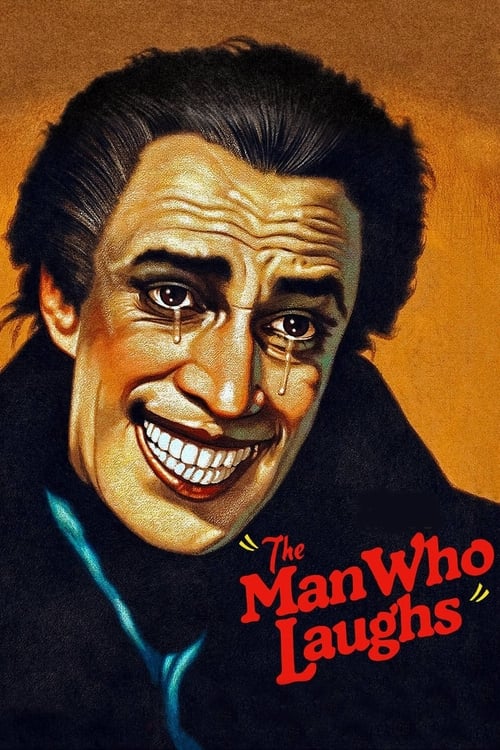
The Man Who Laughs
1928 · Paul Leni
For when you want to feel something big — a candlelit, curl-up-and-be-swept-away melodrama, and a perfect first silent film for the curious. Expect a lump in your throat, not a fright.
What it's about
England, 1690. When a proud noble defies the despotic King James, he is executed and his young son is surgically disfigured — his face carved into a permanent grin. Raised as a sideshow attraction, Gwynplaine grows up as the laughing man crowds pay to gawk at, and falls in love with a blind girl who cannot see the face the world mocks. From Victor Hugo's novel: a grand melodrama of cruelty, spectacle, and a love that looks past the surface.
The experience
Astonishingly expressive for a silent film — swirling, shadow-drenched, and genuinely moving, with an image at its center you will never forget. It plays like horror and lands like heartbreak.
Performances
Conrad Veidt, the somnambulist of Caligari, gives one of the silent era's most astonishing performances — acting entirely with his eyes above a rictus held in place by prosthetic dental hooks. The anguish he wrings from a frozen smile remains uncanny nearly a century on.
The craft
Paul Leni, a veteran of Germany's great Ufa studio, brought Expressionism to Hollywood and built a swirling Jacobean England of gibbets, palaces, and fairgrounds, all carved from shadow. The makeup design is one of the most influential faces ever put on screen, and the imagery rewards the biggest screen you can find.
Why it matters
Gwynplaine's frozen grin famously inspired the look of the Joker, and the film stands as the high-water mark of German Expressionism transplanted to Hollywood — a bridge between European art cinema and the Universal horror tradition.
The high-water mark of German Expressionism transplanted to Hollywood. Paul Leni, the Ufa veteran who made Waxworks, was imported by Universal and here adapted Victor Hugo's novel about Gwynplaine, a nobleman's son mutilated in childhood so that his face wears a permanent carnival grin — then raised as a sideshow attraction who falls in love with a blind girl who cannot see what audiences pay to laugh at. Conrad Veidt, the somnambulist of Caligari, gives one of the silent era's most astonishing performances, acting entirely with his eyes above a rictus held in place by prosthetic dental hooks; the anguish he wrings from a frozen smile remains uncanny. Around him Leni builds a swirling, shadow-drenched Jacobean England of gibbets, palaces and fairgrounds. Marketed as horror, it is really a grand romantic melodrama about cruelty and spectacle. Veidt's grin was the acknowledged visual source for the Joker in 1940. Leni died of sepsis the following year, at forty-four, one of cinema's great truncated careers.
Reception
Released in 1928 just as talkies were steamrolling silent cinema, it did respectable business but got lost in the transition; today it's routinely ranked among the great late silents and the crown jewel of Paul Leni's short Hollywood career.
How The Man Who Laughs was received, from release to now →
Influences: the films it descends from and the films it influenced
- The Cabinet of Dr. Caligari (1920) — Established Conrad Veidt's somnambulist Cesare as a body-and-eyes performance under painted expressionist shadow — the exact vocabulary of masklike face plus expressive gaze that Veidt reuses as Gwynplaine.
- Waxworks (Das Wachsfigurenkabinett) (1924) — Leni's own portmanteau rehearses the fairground/sideshow framing device and warped, hand-built expressionist sets he brings intact to the carnival milieu of The Man Who Laughs.
- The Hunchback of Notre Dame (1923) — Lon Chaney's sympathetic grotesque adapted from Victor Hugo — the template of prosthetically deformed outcast as tragic romantic lead that Gwynplaine directly extends.
- The Phantom of the Opera (1925) — Universal's Chaney disfigurement showpiece set the studio playbook of hidden-then-revealed prosthetic horror sold via ballyhoo marketing, the commercial mold Leni's film was cut to fit.
- Nosferatu (1922) — Murnau's low-key chiaroscuro and looming cast shadows codified the German lighting grammar Leni imports to Hollywood interiors and dungeon staircases.
- Warning Shadows (Schatten) (1923) — A near-titleless drama driven by silhouette and shadow-play, the expressionist chiaroscuro-as-narrative technique Leni matches in his silent storytelling.
- The Golem: How He Came into the World (1920) — Architectural expressionist sets and the misunderstood-monster pathos that make deformity legible as innocence rather than menace.
- Faust (1926) — UFA's peak expressionist light-and-fog craftsmanship and grand allegorical staging, the studio-trained visual command Leni exported to Universal's back lot.
- Dracula (1931) — Inaugurated Universal's sound-era horror cycle on the émigré chiaroscuro and monster-marketing foundation Leni had laid three years earlier.
- Frankenstein (1931) — Jack Pierce's sculpted-prosthetic monster and the creature's mute, eyes-first pathos continue the sympathetic-grotesque makeup lineage from Gwynplaine's fixed rictus.
- Freaks (1932) — Pushes the carnival-sideshow spectacle and 'cruelty toward the malformed' theme to its extreme, extending Leni's fairground staging of bodies on display.
- Eyes Without a Face (1960) — Builds an entire film around a mask-like disfigured face whose horror and tenderness live in the eyes, the direct art-film heir to Gwynplaine's expressive-mask problem.
- Joker (2019) — Realizes on film the character Gwynplaine's carved grin inspired — a rictus-faced outcast whose fixed smile masks anguish — closing the influence/joker loop back to Veidt's makeup.
- Bride of Frankenstein (1935) — Leni's Universal import taught the studio the expressionist grotesque; Conrad Veidt's frozen carved face is the direct antecedent of makeup-bound pathos in the Monster.
- Terrifier 2 (2022) — Conrad Veidt's surgically fixed rictus — a horror face that cannot stop grinning, forcing the performance into eyes, hands and spine — is the direct design and pantomime template for Thornton's mute, greasepainted Art.
- The Hands of Orlac (1924) — Contemporary Veidt vehicle built around anguished hands and haunted eyes, the same restraint-under-torment acting method he deploys behind the frozen grin.
- The Cat and the Canary (1927) — Leni's immediately prior Universal film, where he tunes the gliding subjective camera and old-dark-house lighting he carries straight into The Man Who Laughs.
- The Last Warning (1928) — Leni's final Universal picture, extending the same mobile expressionist camera and theatrical spectacle-space (a haunted playhouse) as this film's fairground stage.
Similar films
- The Cabinet of Dr. Caligari (1920) — influence & lineage
- Faust (1926) — influence & lineage
- Joker (2019) — influence & lineage
- Eyes Without a Face (1960) — influence & lineage
- Frankenstein (1931) — influence & lineage
- Nosferatu (1922) — influence & lineage
- The Phantom Carriage (1921) — often watched together
- The Last Laugh (1924) — shared sensibility