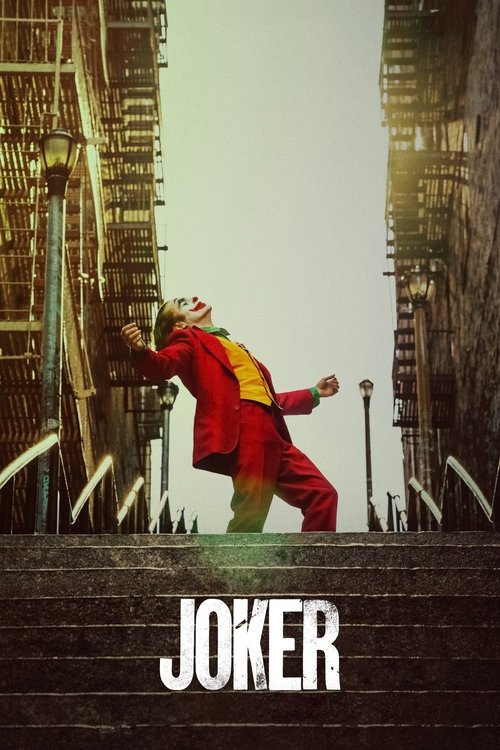
Joker
2019 · Todd Phillips
The $200M sequel that seemingly despised its own fanbase — a musical that tanked with the incel-adjacent audience the first film courted — spawning endless "intentional act of sabotage or catastrophic misread" debate.
When you want to be disturbed and have something to argue about afterward — this is a challenge, not a comfort. Absolutely not for a light night; reach for it when you're up for a grim, divisive character study.
What it's about
In a grimy, garbage-strike Gotham of the early 1980s, Arthur Fleck scrapes by as a party clown, cares for his ailing mother, and nurses a doomed dream of stand-up comedy while the city's social services collapse around him. Ignored, medicated, and repeatedly humiliated, he begins a slow slide from invisible victim toward something far darker — the origin story of a famous villain told as a raw character study, with the comic-book trappings almost entirely stripped away.
The experience
Oppressive, slow-burning, and genuinely uncomfortable — it sits you inside a deteriorating mind and refuses to let you look away. There's no relief valve of action or humor; the tension builds like a headache until it breaks.
Performances
Joaquin Phoenix won the Oscar for a physically extreme, fully committed performance — gaunt, contorted, with a pained involuntary laugh that becomes the film's most unnerving sound.
The craft
The film painstakingly recreates a rotting late-70s/early-80s New York in Gotham's clothes, all sickly fluorescents and graffiti, and Hildur Guðnadóttir's groaning cello score (also Oscar-winning) does as much psychological work as the script. It rewards a dark room and good speakers — the sound design gets under your skin.
Why it matters
The first comic-book adaptation to win Venice's Golden Lion and a billion-dollar hit from an R-rated character drama, it became a genuine cultural flashpoint — fiercely debated as either bold filmmaking or irresponsible provocation — and proved studios could sell superhero IP as art-house misery.
Snapshot
Todd Phillips's Joker is a villain-origin psychological drama set in a fictionalized early-1980s Gotham City, following Arthur Fleck — a mentally ill, socially invisible party clown — as he spirals from passive suffering toward charismatic nihilism. Produced outside the main DC Extended Universe continuity, the film dispensed with superhero genre conventions entirely, presenting itself as a character study in the tradition of 1970s American art cinema. It became a cultural flashpoint on release in October 2019: celebrated at Venice (where it won the Golden Lion, the first comic-book adaptation to claim the festival's top prize), it was simultaneously praised as a bold formal exercise and condemned as a politically irresponsible fantasy of male grievance. Commercially, it crossed one billion dollars worldwide on a reported production budget of approximately fifty-five to sixty-five million dollars, establishing that a hard-R, largely actionless genre film could command mainstream audiences at scale. Joaquin Phoenix's performance won the Academy Award for Best Actor; Hildur Guðnadóttir's score won Best Original Score, making her the first woman to win that category as a solo composer.
Industry & production
Joker emerged from an unusual industrial moment at Warner Bros., a period in which the studio, stung by the critical and commercial instability of its DC Extended Universe slate, began authorizing standalone "Elseworlds" or label-adjacent productions not bound to franchise continuity. Phillips — whose prior Warner Bros. work was entirely in broad studio comedy (The Hangover trilogy, Old School, Due Date) — pitched the film as a character drama that happened to use DC iconography; the Joker would function less as a supervillain than as a Dostoevsky-style antihero. Scott Silver, whose credits include 8 Mile (2002) and The Fighter (2010), co-wrote the screenplay, bringing experience with working-class masculine psychologies and environments of failure.
Martin Scorsese was attached as a producer at various stages of development, a fact that was widely reported and that shaped both the film's marketing and critical framing. He ultimately did not serve as a hands-on producer, though his aesthetic shadow is everywhere apparent. Warner Bros. greenlit a budget modest by franchise standards — well below a typical superhero tentpole — accepting that Phillips's approach precluded spectacle-driven box-office insurance. Principal photography ran from October through December 2018, shot almost entirely on location in New York City. Gotham was rendered not as a designed fantasy city but as a lightly re-dressed version of the early-1980s Bronx and downtown Manhattan, their decay, poverty, and ambient menace doing the world-building work that would ordinarily fall to production design.
Technology
Lawrence Sher shot Joker on 35mm Kodak film stock — a deliberate choice to invoke the grain, contrast, and tonal warmth of the 1970s and early-1980s New York pictures the film consciously emulates. The use of photochemical film rather than digital capture was not merely aesthetic nostalgia: it imposed a discipline on coverage and contributed to the tactile, slightly worn quality of the image. Sher shot anamorphic, widening the frame in a manner that gave even claustrophobic interiors a certain horizontal loneliness and kept Phoenix's body language — his gait, his contortions — legible within shallow, painterly depths of field. The combination of grain and anamorphic optics gave Joker an image texture that felt categorically distinct from the crisp, digitally composited look of the broader DC and Marvel universe.
Production design (Mark Friedberg) and costume design (Mark Bridges) worked in careful period register, reconstructing an early-1980s urban landscape of peeling walls, broken neon, uncollected garbage, and downward-class dress — a Gotham continuous with the city that had appeared in Scorsese's New York films and in Sidney Lumet's work of the same era.
Technique
Cinematography
Sher organized the film's visual arc around the idea of progressive spatial liberation: Arthur begins the film in compressed, low-ceilinged, institutional spaces — the social-services office, the refrigerator he climbs into, the tight apartments — and as he transforms into Joker, the frame gradually opens. The staircase ascent in the Bronx, shot in full anamorphic width with Arthur moving upward against a backdrop of gray daylight, is the film's single most composed image, and it became one of the more discussed shots of the year — not least because the actual location (the Anderson Avenue steps in the Mott Haven–Highbridge neighborhood) became a tourist destination immediately after release. The color palette moved from desaturated institutional greens and browns toward more saturated reds and golds as Arthur's delusion solidified.
Sher's lighting drew explicitly on Gordon Willis's chiaroscuro work for Francis Ford Coppola and on the location-dependent, available-light school of 1970s New York cinematography. Faces are frequently lit from below or from harsh practical sources; there is very little of the soft, even illumination characteristic of contemporary blockbusters.
Editing
Jeff Groth's editing is notably patient by franchise standards. The film's rhythm is governed by Phoenix's physical performance rather than by action imperatives, and the cut regularly holds well beyond the point at which a genre film would move on. The fantasy sequences — Arthur's television date with Murray Franklin, the imagined romantic attachment to Sophie Dumond — are integrated without explicit flagging, held at the same narrative level as "real" events until Phillips reveals their status retroactively. This unreliable-narrator construction, managed at the editorial level, demands a second viewing to fully trace which scenes are fantasized; it is the film's central structural gambit.
Mise-en-scène / staging
Phillips's staging foregrounds the body. Arthur's pseudobulbar affect — the pathological laughter he cannot control — required that Phoenix's physical performance generate a physiological response in the audience, and the mise-en-scène consistently clears space to let that performance breathe. The film is unusually sparse in cutting-away from discomfort; long single-shot passages place the viewer alongside Arthur as social interactions collapse around him. The apartment interiors are staged with a documentary closeness that borders on surveillance footage, an effect reinforced by Sher's tendency to shoot through doorways and across pieces of furniture rather than from idealized vantage points.
Sound
Guðnadóttir's score represents one of the more formally unusual composer-director collaborations in recent American film. Phillips provided her with the screenplay early and she composed substantial cues before filming began; those recordings were then given to Phoenix, who used them during preparation and, in some cases, during performance. The score is built largely around solo cello — raw, searching, with extended technique passages that blur the line between melody and anguish — and it informed Phoenix's physicality at a stage when the image did not yet exist. The sound design in the riot sequences and the Murray Franklin studio scene amplifies crowd noise to an almost sensory-overload level, positioning the viewer inside Arthur's subjective overwhelm.
Performance
Phoenix's preparation was extensive and well-documented in the press: he lost a reported fifty-two pounds for the role, developed Arthur's distinctive contorted dance movements collaboratively with a choreographer, and studied the psychophysiology of pathological laughter at length. The performance is built around fragility made suddenly, shockingly powerful — the transition from hunched, averted passivity to the spread-armed, self-possessed Joker persona is managed not through a single epiphanic cut but through accumulated micro-adjustments across the film's running time. Robert De Niro's casting as Murray Franklin, the talk show host Arthur fixates on and eventually murders on live television, is a sustained intertextual reference: in Scorsese's The King of Comedy (1982), De Niro had played Rupert Pupkin, an aspiring stand-up comedian who kidnaps a talk show host played by Jerry Lewis. In Joker, the cast positions are inverted — De Niro is now the host, Phoenix the humiliated supplicant — a transposition that functions as a kind of homage-by-reversal and that anchors the film's lineage visibly to its source material.
Narrative & dramatic mode
Joker operates as a first-person subjective portrait pushed to the point where the narrator's reliability dissolves entirely. The film's formal mode — interior monologue as diary (Arthur's notebook), fantasy sequences presented as reality, a final framing scene in Arkham that suggests the entire narrative may be a retrospective confabulation — belongs to a literary-cinematic tradition of pathological unreliable narrators: Dostoevsky's underground man, the murderers of Camus, Poe's confession-mode first persons, the cinema of Cassavetes and the early Scorsese. The dramatic mode is tragic irony: the audience accumulates contextual knowledge (of Arthur's actual parentage, of the reality or unreality of his relationship with Sophie) that Arthur himself either cannot access or refuses, and the film uses that gap to generate something between pity and dread rather than the identification a more conventional genre treatment would produce.
The narrative is also a class-allegory machine: Gotham's garbage crisis, its shuttered city services, its gated Wayne manor set against the crumbling Bronx apartment, function as a map of structural abandonment whose product — eventually — is Arthur Fleck and the clown riots. Whether this allegory is legible as critique or as rationalization of mass violence was the central axis of the film's critical controversy.
Genre & cycle
Joker belongs to at least three overlapping generic traditions. It is, at its surface, a comic-book villain origin story, a cycle with precedents in Batman Begins (2005) and the wider trend of psychological backstory in genre cinema. More substantively, it belongs to the American urban paranoia film of the 1970s — a genre defined by lone male protagonists failing to fit a decaying social order, by real-location New York City imagery, and by tonal ambivalence toward its antiheroes. Within that cycle, Joker positions itself explicitly beside Taxi Driver (1976, Scorsese) and The King of Comedy (1982, Scorsese) and more distantly beside Network (1976, Lumet) and Dog Day Afternoon (1975, Lumet). It also participates in the late-2010s prestige superhero sub-cycle — alongside Logan (2017) and, in a different register, The Dark Knight (2008) — in which studios authorized more formally and tonally ambitious work within IP frameworks, often accompanied by R-ratings and art-house rhetoric.
Authorship & method
Todd Phillips had not previously worked in dramatic register, and Joker involved a deliberate and self-conscious reinvention of his authorial persona, one he described in press extensively as a reaction to the difficulty of making mid-range adult comedies in the contemporary studio landscape. His co-writer Scott Silver brought structural familiarity with the working-class male melodrama. Lawrence Sher had shot all three Hangover films for Phillips — an unusual fidelity given how different the work is — and their collaboration here reflects a shared trust in location-based authenticity over constructed glamour. Hildur Guðnadóttir had scored Chernobyl (2019, Craig Mazin) immediately before Joker; her cello-led approach to catastrophe and psychic damage carried directly from one production to the other. Mark Bridges (costume design) had worked repeatedly with Paul Thomas Anderson — Phantom Thread (2017), The Master (2012), Inherent Vice (2014) — and his period instincts contributed to the film's sense of historical specificity.
Movement / national cinema
Joker is formally and industrially American — a Warner Bros. studio film made almost entirely in New York City — but it self-consciously situates itself within a tradition of American independent and art cinema that had been largely displaced from studio production by the mid-2000s. The film's rhetoric of reclamation — the attempt to restore the adult dramatic film to the mainstream studio system using genre IP as the delivery mechanism — became part of its cultural meaning. Internationally, it was received as an American pathology film: its Gotham-as-New York setting, its iconography of urban abandonment and racial and class stratification, and its anxious relationship to populist violence all registered as specifically American diagnoses in European critical discourse.
Era / period
Joker arrived in autumn 2019 into a political and cultural environment primed to receive it with exceptional friction. Its themes — inequality, the failure of public mental health infrastructure, the media's manufacture of celebrity out of chaos, the susceptibility of the dispossessed to demagogic self-narratives — mapped with uncomfortable directness onto the American political atmosphere of the late 2010s. The US military reportedly issued internal warnings to service members about potential copycat incidents at screenings, reflecting a level of official anxiety unusual for any film. This context shaped critical reception to an unusual degree: assessments of the film's formal quality and assessments of its political responsibility were frequently and sometimes indistinguishably entangled in reviews.
The film was simultaneously a product of 1970s nostalgia — Phillips, Sher, and the score all operate within a visual and sonic memory of that decade — and a symptom of the 2010s; it used the aesthetic vocabulary of one era's alienation to process another's.
Themes
The film's primary thematic territory is the production of the monstrous by neglect. Arthur Fleck is denied medication by the city's budget cuts, failed by every institutional support structure he encounters, and subjected to casual cruelty by nearly all social classes above the absolute bottom. The film is interested in this not as exculpation but as structural analysis: it traces the precise mechanisms by which abandonment produces the kind of selfhood that becomes dangerous. Mental illness is rendered not as spectacular Gothic madness but as chronic, grinding, institutional invisibility — a choice that attracted both praise (for destigmatising mundane suffering) and criticism (for conflating mental illness with violence).
The second major thematic axis is celebrity and media spectacle as engines of social meaning. Murray Franklin's television show functions as a society that only notates outsiders to mock them; Arthur's eventual appearance on it — as a deliberate suicide broadcast — recapitulates Network's thesis about the media's appetite for spectacle at the cost of life. The film is also consistently engaged with class: the Wayne family's wealth and its casual contempt, the Gotham garbage crisis as municipal abandonment, the rioters' clown masks as appropriated iconography — all position the film as a study in what happens at the bottom of a society that has stopped pretending to care about the bottom.
Masking, performance, and identity are present throughout: Arthur's clown makeup is both his cage and his liberation, a motif the film handles with more complexity than its reputation sometimes suggests.
Reception, canon & influence
Critical reception was sharply divided. The festival premiere at Venice — and its Golden Lion win — generated enthusiastic notices that emphasized the formal ambition and Phoenix's performance. Anglophone critical reception on general release was more contested: the New York Times, The Guardian, and others published influential negative reviews arguing that the film aestheticized and rationalized male grievance without sufficient critical distance, while advocates (including many major critics at Time, Rolling Stone, and elsewhere) argued that the film's moral ambiguity was its point. It finished at the high end of awards consideration: eleven Academy Award nominations, two wins.
Influences on the film (backward): Taxi Driver (Scorsese, 1976) is the most widely acknowledged source — the lone urban male protagonist, the grimy New York setting, the question of whether the narrator's violence is heroic or deranged, even the score's saxophone motif in Bernard Herrmann's original versus Guðnadóttir's cello. The King of Comedy (Scorsese, 1982) provides the failed comedian / talk show obsessive narrative and the De Niro casting explicitly activates the intertextual echo. Alan Moore and Brian Bolland's graphic novel Batman: The Killing Joke (1988) contributed the "one bad day" origin concept, though Joker departs from it substantially. Network (Lumet, 1976) underlies the media-spectacle sequences. The physical performance tradition — Cassavetes, early Brando, early De Niro himself — informs Phoenix's approach.
Legacy and forward influence: Joker immediately reshaped conversations about the commercial and critical viability of adult-oriented, R-rated genre films. Its billion-dollar gross on a mid-range budget demonstrated a model that studios had largely abandoned, and it contributed to subsequent studios' willingness to authorize similar tonal departures within IP frameworks. Phoenix won the BAFTA, SAG, Golden Globe, and Academy Award, and the performance became a reference point for physical and psychological commitment in franchise acting discussions. The film produced a sequel, Joker: Folie à Deux (Phillips, 2024), which departed radically in form (incorporating musical sequences) and was both a critical and commercial failure — its reception demonstrating the degree to which the original's power was inseparable from its unexpectedness. The "Joker Stairs" in the Bronx became a recurring site of street photography and informal pilgrimage, an unusual form of location tourism that reflects the image's penetration into popular visual culture.
A Deleuzian reading
Watch Arthur Fleck right after the subway.
The full Deleuzian reading of Joker →
Reception
It arrived in 2019 trailing genuine moral panic — op-eds fretting about copycat violence, theaters adding security — then won the Golden Lion at Venice, made a billion dollars, and got Joaquin Phoenix an Oscar. Today the panic looks overblown and the debate has settled into a quieter question of whether the film itself was ever as dangerous, or as deep, as everyone claimed.
How Joker was received, from release to now →
Influences: the films it descends from and the films it influenced
- Taxi Driver (1976) — Sher's chiaroscuro 35mm location work directly cites Chapman's methodology; Guðnadóttir's solo cello score is a structural rhyme with Herrmann's solo saxophone; and the subjective voiceover framing an alienated urban male whose violence the film refuses to adjudicate is the template Phillips lifts verbatim.
- The King of Comedy (1982) — De Niro's casting as Murray Franklin is an explicit intertextual device — audiences are required to read Phoenix's Arthur Fleck against De Niro's Rupert Pupkin — and the failed comedian obsessing over a talk-show host as vehicle for class grievance provides the direct narrative architecture Phillips and Silver transplant.
- Network (1976) — The television-studio climax and its framing of mental breakdown as entertainment spectacle borrow Lumet's structural move of using broadcast aesthetics — the camera as complicit audience — to indict mass media's appetite for spectacle, which Phillips reprises in Arthur's Murray Franklin appearance.
- Raging Bull (1980) — De Niro's sixty-pound physical transformation established the performance-as-bodily-sacrifice template Phoenix deployed; Chapman's high-contrast anamorphic photography also provides the visual grammar — deep blacks, blown highlights, faces carved by single-source light — that Sher's chiaroscuro 35mm work explicitly extends.
- Dog Day Afternoon (1975) — The working-class New York male protagonist whose crime becomes a media spectacle, and whose violence the film refuses to simply condemn, provides the class-allegory grammar Phillips updates; Lumet's location-shoot documentary authenticity — non-studio, non-glamourised New York — is the direct precursor to Sher's approach to Gotham.
- Chinatown (1974) — Alonzo's 35mm anamorphic photography established the period American-city noir grammar — anamorphic bokeh, warm desaturated palette implying historical distance — that Sher borrows wholesale for his 1981 Gotham, and Polanski's use of a first-person protagonist whose subjective account of events is systematically unreliable prefigures Phillips's narrative method.
- The Conversation (1974) — Coppola's staging of the camera as institutional watcher — extreme close-ups that frame the protagonist as both observer and observed, creating surveillance-proximity aesthetics — provides the visual grammar Phillips uses to literalise Arthur's sense of being perpetually surveilled and judged by Gotham's social apparatus.
- Batman Begins (2005) — Pushes Gotham-as-real-1970s-crime-cinema to its limit, inheriting Begins' grounding of comic material in gritty urban character study.
- To Catch a Killer (2023) — Extends the alienated-loner-to-public-violence character study into the contemporary cycle of social-rage cinema, foregrounding the misanthrope's interiority as the film's primary subject.
- Logan (2017) — Extends Logan's proof that an R-rated, character-driven comic-book film could earn prestige recognition, abandoning spectacle for somber, performance-led character study.
- Star Wars: Episode III - Revenge of the Sith (2005) — A 'villain-origin predetermined tragedy' built on the same dramatic engine as Anakin's fall — a sympathetic figure marched, step by inevitable step, toward the monster the audience already knows he becomes.
- The Man Who Laughs (1928) — Realizes on film the character Gwynplaine's carved grin inspired — a rictus-faced outcast whose fixed smile masks anguish — closing the influence/joker loop back to Veidt's makeup.
- The Batman (2022) — Fraser's 35mm anamorphic cinematography and chiaroscuro lighting grammar — nearly lightless interiors, rain-soaked expressionist exteriors — directly cites Sher's Joker as the proof-of-concept that this register was commercially and critically viable within DC franchise filmmaking, and Reeves explicitly adopted Joker's tonal severity as the permission structure for his own project.
- Beau Is Afraid (2023) — Aster's unreliable narrator integration — the camera fully inhabiting a paranoid male protagonist's deteriorating grasp on reality, with urban space rendered as hostile surveillance apparatus — extends the formal license Joker opened; Pogorzelski's surveillance-proximity staging for Beau's street-level horror borrows the same logic of camera-as-social-pressure that Sher developed.
- Cruella (2021) — The prestige-adjacent adult villain-origin model, staging a sympathetic descent-into-the-persona arc with a bravura lead performance in a theatrical register.
- The Bride! (2026) — The seed's crew rehearsal: Sher's long-lens framing that watches a performer from across a room without ever cutting in, and Guðnadóttir's score written from the script and played back on set so performance and music were cut against each other rather than laid on after.
- There Will Be Blood (2007) — Greenwood composed and recorded the score before principal photography and played it on set — the direct methodological precedent for Guðnadóttir's approach on Joker — and the solo string instrument (violin, cello) as index of psychological deterioration is a shared formal strategy; Day-Lewis's physical transformation and the editing governed by bodily performance rather than conventional coverage are parallel methods.
- Phantom Thread (2017) — Mark Bridges, who designed costumes for Phantom Thread, did the same for Joker; his period-specific class-marking through clothing (the precision of Reynolds Woodcock's suits rhymes with Arthur's clown costume as class armor) operates identically in both films, and Greenwood's pre-production compositional method is the direct precedent Guðnadóttir cites.
- Black Swan (2010) — Aronofsky's unreliable narrator integration — the camera inhabiting the protagonist's subjective reality so fully that hallucination and fact are visually indistinguishable until the final act — is the closest structural parallel to Phillips's technique; the physical transformation performance (Portman's weight loss, Phoenix's emaciation) and the performance-governed editing rhythm tracking the body as primary temporal organizer are shared formal methods.
- Nightcrawler (2014) — Gilroy's staging of an amoral male protagonist whose pathology the film frames with visual glamour and withholds moral judgment on — the night-camera surveillance aesthetics rhyming with Arthur's experience of being watched — and the urban paranoia genre's structural refusal to assign the protagonist a stable moral position are the direct formal parallels.
- Whiplash (2014) — Chazelle and editor Tom Cross built the cutting rhythm entirely around bodily event — the drum stroke, the blood — rather than narrative beat; Phillips and editor Jeff Groth use the identical performance-governed rhythm, tracking Phoenix's involuntary laugh and physical eruptions as the primary temporal organizing principle rather than scene logic.
- Uncut Gems (2019) — The Safdies' surveillance-proximity framing — handheld tight close-ups that deny the protagonist any spatial escape, using the camera's physical closeness as a correlative for social and financial pressure — and the urban paranoia grammar (class-marked NYC spaces, a protagonist whose self-destructive trajectory reads as both symptom and choice) are shared formal registers operating in the same release year.
- Spider-Man: Brand New Day (2026) — Grafts a 1970s New Hollywood character-study grammar onto a comic property — the same 'indie sensibility over spectacle' gambit applied to a marquee IP.
- Citizen Vigilante (2026) — Elevates the disaffected urban loner into a media event and mob figurehead via a desaturated, grimy palette, the recent template for violence-as-virality the film updates.
- Wicked (2024) — Extends the same sympathetic villain-origin cycle, dramatizing a scapegoating allegory in which the audience is aligned with the figure a society casts as monstrous.
- The Hunger Games: The Ballad of Songbirds & Snakes (2023) — Provided the sympathetic-descent template — a slow character study that walks a pitiable figure into the monster we already know — that the film's villain-origin architecture directly borrows.
- Wicked: For Good (2025) — Extends the villain-origin reframing as prestige tragedy, rebuilding a familiar antagonist's mythology around social scapegoating and audience sympathy.
- Thunderbolts* (2025) — Extends the same craft of treating clinical mental illness as a comic-book film's central text, with an auteur importing grimy, grain-forward naturalism into IP filmmaking.
Similar films
- Beau Is Afraid (2023) — influence & lineage
- The Batman (2022) — influence & lineage
- Taxi Driver (1976) — influence & lineage
- The Dark Knight (2008) — shared sensibility
- Jojo Rabbit (2019) — shared sensibility
- Batman: Mask of the Phantasm (1993) — shared sensibility
- Terrifier 3 (2024) — shared sensibility
- Barton Fink (1991) — shared sensibility
All the films related to Joker →
Watch it with: curated runs of related films
- Rise, Reign, and Ruin — Watch these together for the full arc of the self-made man — the hunger, the empire built on violence, and the rot that comes for whoever built it.