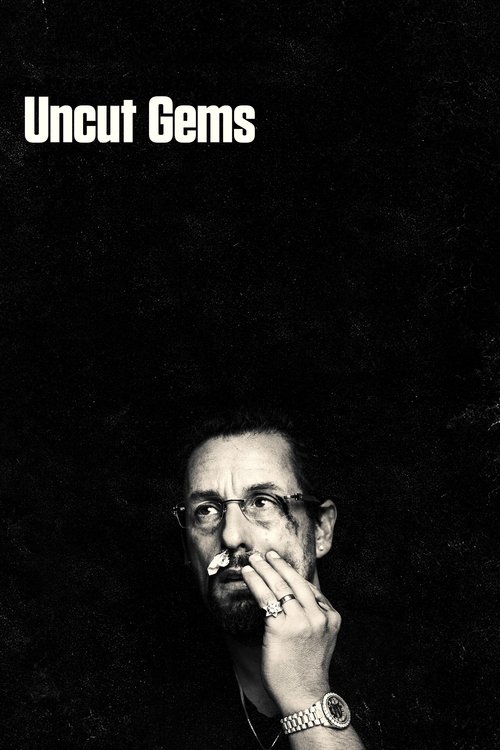
Uncut Gems
2019 · Josh Safdie
For when you want your pulse up — a stress-watch, not a comfort-watch. Reach for it when you're in the mood to white-knuckle something brilliant, not when you need to unwind.
What it's about
Howard Ratner runs a jewelry shop in Manhattan's Diamond District and cannot stop gambling — on basketball, on a smuggled Ethiopian opal he's convinced is his fortune, on his own ability to talk his way out of anything. Over one frantic week he juggles furious creditors, a crumbling marriage, a mistress, and an NBA star obsessed with his stone, always doubling down when any sane person would fold.
The experience
Two hours of sustained, almost physical anxiety — overlapping shouting, constant motion, stakes compounding by the scene. It's also bleakly funny, and weirdly exhilarating; you come out wrung out and buzzing.
Performances
Adam Sandler gives the performance of his career as Howard — all charm, hustle, and self-destruction at once — and NBA star Kevin Garnett is startlingly good playing himself.
The craft
The Safdie brothers engineer tension like a machine: dense overlapping dialogue, a jittery camera that shoves you into every room, and a pulsing electronic score that never lets the pressure drop. The sound mix is half the experience — good speakers turn the chaos into something you feel in your chest.
Why it matters
It redefined what an Adam Sandler performance could be, cemented the Safdies as the leading voices of a new high-anxiety American cinema, and became one of A24's defining releases.
Snapshot
Uncut Gems is the fourth feature directed by Josh and Benny Safdie and the most fully realized expression of the "anxiety cinema" the brothers had been refining since Heaven Knows What (2014) and Good Time (2017). It follows Howard Ratner, a Diamond District jeweler and compulsive gambler played by Adam Sandler, across roughly a week of escalating debt, deception, and self-sabotage organized around a smuggled Ethiopian opal and a series of parlayed bets on NBA playoff games. The film is at once a thriller, a character study, and a tragicomedy of addiction, built as a relentless forward-pressure machine that withholds release almost to its final minutes. It was the Safdies' first film with a major star and a substantial budget, and it arrived under the A24 banner with a profile far above their prior work. Critically it was received as a breakthrough — a vindication of Sandler as a dramatic actor and a confirmation of the Safdies as among the more distinctive American directors of their generation. Its reputation as a sustained exercise in controlled chaos has only grown, and "Uncut Gems energy" entered the culture as shorthand for sustained, structured dread.
Industry & production
The film had an unusually long gestation. The Safdies have said in interviews that they conceived the project around 2009–2010, before they had directed a narrative feature of any scale, drawing on their father's milieu in New York's Diamond District. The script, written with Ronald Bronstein — their longtime collaborator and co-editor — went through many years and many drafts while the brothers made other films, and the casting of the lead role proved decisive to getting it financed. They pursued Adam Sandler for years; the part had earlier been associated with other names in the trade press, but the Safdies have consistently described Sandler as their long-held ideal. The success of Good Time with Robert Pattinson gave them the leverage and credibility to mount a larger production.
The film was produced by Scott Rudin, Eli Bush, and the Safdies' Elara Pictures partner Sebastian Bear-McClard, with executive-producer credit for Martin Scorsese, whose attachment lent the project gravity during development. It was distributed by A24, which by 2019 had established itself as the defining American independent studio of the decade. The budget was modest by studio standards but large relative to the Safdies' earlier no-budget work, and the production made extensive use of real Diamond District locations and non-professional or first-time performers cast for authenticity — most notably Kevin Garnett, the retired Boston Celtics star, playing a fictionalized version of himself during his real 2012 playoff run, and the singer-songwriter The Weeknd appearing as himself. Idina Menzel, Lakeith Stanfield, Eric Bogosian, and newcomer Julia Fox (in her screen debut) filled out the principal cast. The film premiered at the Telluride and Toronto festivals in the autumn of 2019 and opened theatrically in the United States in December.
Technology
Uncut Gems was shot on film rather than digitally, continuing the Safdies' and cinematographer Darius Khondji's commitment to celluloid grain and texture; the production used 35mm photography, with the documented use of longer lenses to compress the cramped Manhattan spaces and to surveil the protagonist from a slight remove. The choice of film stock is integral to the picture's sensory register: the images carry a warm, slightly grimy density that digital capture of the period tended to smooth away. Beyond capture format, the most consequential "technology" of the film is arguably its sound design and score — Daniel Lopatin's electronic compositions, made under his Oneohtrix Point Never alias, deploy synthesizers and processed textures that function less as accompaniment than as an additional pressure system layered over the drama. The opening and closing sequences notably use macro and medical-imaging-style photography — a colonoscopy passage that dissolves into the crystalline interior of the opal — bridging the body and the gem through optical means. Specific lens and camera-package details beyond the 35mm format are not exhaustively documented in the public record, and I won't manufacture them.
Technique
Cinematography
Darius Khondji — the French-Iranian cinematographer of Se7en, Delicatessen, and films for Haneke, Fincher, and Allen — shot Uncut Gems, and his presence marks a step up in resource and refinement from the Safdies' guerrilla roots while preserving their aesthetic of immersion. The camera favors long lenses and tight framing that crowd Howard within his own spaces — the jewelry store's buzzer-locked vestibule, the cluttered back office, the apartment, the casino corridors. This compression produces a constant low-grade claustrophobia; figures pile into the frame, backgrounds press forward, and the depth of field isolates faces against soft chaos. The film also uses the long lens for a quasi-documentary, observed quality, watching Howard as if from across a crowded room. Where Good Time was all neon and sodium-vapor night, Uncut Gems is warmer and more interior, gold-toned to match the gem trade, with the recurring motif of light caught and refracted through stones.
Editing
The editing, by Ronald Bronstein and Benny Safdie, is the film's structural engine and perhaps its defining technical achievement. The cut sustains an almost unbroken forward momentum across more than two hours, layering overlapping dialogue and interrupting scenes before they resolve so that the viewer is never granted a breath. Conversations collide; multiple characters talk over one another in a continuous wall of sound that the edit refuses to clarify. The pacing is deliberately exhausting, mimicking the cognitive state of a gambler who cannot stop moving. Crucially, the film's tension is constructed in the cutting room as much as on set — the parlay sequence near the climax, intercutting Howard's locked-room standoff with the live basketball game, is a masterclass in cross-cut suspense that ties the protagonist's fate to events he cannot control.
Mise-en-scène / staging
The staging is dense and centripetal. The Diamond District store is rendered as a pressurized container — the double-buzzer security doors become a recurring spatial motif and a literal mechanism of entrapment and release. Crowd scenes are choreographed for overlap and friction; Howard is forever pushing through bodies, working multiple conversations at once. The production design and set dressing emphasize accumulation — display cases, paperwork, screens, merchandise — a visual correlative for a man buried under obligations. The casting of real-world figures and non-actors into these spaces heightens the documentary texture, blurring the line between staged drama and observed reality.
Sound
Sound is foundational rather than supportive. The film's dialogue mix is famously maximalist, with overlapping speech engineered to create a sense of perpetual overwhelm. Against this, Daniel Lopatin's synthesizer score introduces an almost cosmic register — shimmering, arpeggiated, sometimes serene — that sits in ironic counterpoint to the on-screen panic, and at moments seems to view Howard's frenzy from a vast, indifferent distance. The interplay of naturalistic chaos and electronic transcendence is one of the film's signature effects; the score won notable critical praise and several critics' prizes that year.
Performance
Adam Sandler's performance as Howard Ratner is the film's center of gravity and was widely regarded as the finest of his career. Drawing on the manic, motor-mouthed energy of his comic persona but stripping out the sentiment and goodwill, Sandler builds a character who is exhausting, charismatic, self-deluding, and genuinely tragic. The performance is physical and verbal at once — a body in perpetual motion, a voice always selling. Around him the ensemble works in the Safdies' preferred register of overlapping naturalism: Julia Fox, in her debut, holds the screen as Howard's mistress and employee Julia; Lakeith Stanfield plays the fixer Demany; Eric Bogosian is the menacing creditor and brother-in-law Arno; Idina Menzel is the estranged wife. Kevin Garnett, playing himself, delivers a performance of startling conviction, his real athletic intensity channeled into the film's mysticism around the opal.
Narrative & dramatic mode
The film operates in a tragic-ironic mode disguised as a thriller. Its dramatic engine is compulsion: Howard does not want money so much as he wants the feeling of the win, and the narrative is structured as a series of bets, debts, and reckless doublings-down that any rational actor would refuse. The screenplay denies the audience the relief of a wise protagonist; we are locked into Howard's perspective and his self-justifying logic. Tension is generated less by external plot machinery than by the certainty that the character will sabotage every safe outcome. The film's structure resembles a tightening spiral rather than a conventional three-act build, and its ending — which I will not spoil in detail — delivers a shock that recasts the entire enterprise as a meditation on the gambler's fatal relationship to chance and consequence. The "score" of the title is double-edged: the gem, the bet, and the existential reckoning.
Genre & cycle
Uncut Gems belongs to a lineage of American urban thrillers and crime-adjacent character studies, but it resists clean genre placement. It is a thriller without a conventional antagonist-protagonist structure, a crime film whose crimes are largely financial and self-inflicted, and a tragicomedy whose comedy is woven into its dread. It sits within a cycle of late-2010s A24 auteur films that prized formal intensity and ambiguous protagonists, and within the Safdies' own developing cycle of New York street films about marginal, desperate men. It also participates in a tradition of Jewish-American character portraiture set in the specific economic ecology of the Diamond District, a milieu rarely given this kind of cinematic attention.
Authorship & method
The Safdie brothers' method is collaborative and research-driven. Josh and Benny direct together, with Benny also acting (here in a small role) and co-editing; Ronald Bronstein is the essential third author, co-writing and co-editing. Their working method, well documented across interviews about Heaven Knows What and Good Time, emphasizes long immersion in real milieus, casting from within those worlds, and building fiction atop documentary observation — for Uncut Gems this meant years of contact with the Diamond District drawn from their father's experience there. Darius Khondji brought world-class craft to the brothers' immersive instincts; Daniel Lopatin, who had also scored Good Time, provided the synthetic-transcendent sonic identity; Bronstein and Benny Safdie shaped the relentless edit. Martin Scorsese's executive-producer role is partly emblematic — the Safdies are frequently and fairly read as heirs to the abrasive, sympathetic-to-the-doomed New York cinema of Mean Streets and After Hours — but the Uncut Gems style is genuinely their own: more claustrophobic, more sonically aggressive, and more committed to perpetual motion than its forebears. Uncut Gems would prove to be the last feature the brothers directed jointly before they announced a creative separation, lending it retrospective weight as a culmination.
Movement / national cinema
The film is a product of American independent cinema, specifically the New York–centered, festival-and-A24 ecosystem of the 2010s. It draws on the city-symphony and street-realist traditions — from the New York films of Scorsese, Lumet, and Cassavetes to the immersive vérité of more recent independent work — while updating them with contemporary sound design and a heightened, almost expressionist intensity. It is not a movement film in the sense of belonging to a coherent school with a manifesto, but it is a defining text of a particular moment in American indie auteurism, when boutique distribution allowed formally aggressive director-driven work to reach a wide audience and awards-season attention.
Era / period
Uncut Gems is set in 2012, anchored precisely to the Boston Celtics' 2012 playoff run and Kevin Garnett's presence on that team — a period detail essential to the plot's basketball wagers and to the casting. The film's texture is contemporary-recent rather than historical: the world of smartphones, sports betting, livestreamed games, and a globalized gem trade with origins in Ethiopian mines. Made and released in 2019, it captures a pre-pandemic New York at a particular pitch of economic precarity and hustle. Its evocation of period is not nostalgic but immediate, using the recency of 2012 to ground a story that feels timeless in its portrait of compulsion.
Themes
The governing theme is addiction — to risk, to the dopamine of the near-win, to the perpetual deferral of satisfaction. Howard is less a man who gambles than a man who is constituted by gambling; the film studies the gambler's relationship to luck as a kind of faith, even a religion, with the opal serving as a sacred object promising transcendence. Adjacent themes include the corrosion of family and trust under the pressure of debt; the performance of masculinity and salesmanship as perpetual hustle; assimilation, Jewish-American identity, and the specific economy of the Diamond District; the commodification of beauty and the global supply chains beneath a luxury object; and the thin membrane between aspiration and self-destruction. The recurring image of the gem — beauty extracted from the earth at human cost, refracting light into chaos — operates as the film's central metaphor for value, desire, and the cosmic indifference within which human striving plays out.
Reception, canon & influence
Critical reception was strongly positive, with particular and widespread acclaim for Sandler's performance, the Safdies' direction, the editing, and Lopatin's score; the film became one of the most discussed releases of its season. It featured prominently in critics' year-end lists and won a number of critics'-group awards, including recognition for Sandler and for the score. The most-noted awards-season story was a negative one: Sandler's exclusion from the Academy Award nominations was widely treated by critics and audiences as a significant snub, an omission that paradoxically cemented the performance's reputation. The film performed well for an independent release and became, by A24 standards, a sizable commercial success, though I won't cite specific figures I can't verify here.
Looking backward, the film's lines of influence run through the abrasive New York cinema of Martin Scorsese (Mean Streets, After Hours, The King of Comedy) and Sidney Lumet (Dog Day Afternoon), the gambling-as-pathology tradition, and the immersive street realism the Safdies had themselves been developing. Looking forward, its impact has been felt in the broader normalization of relentless, anxiety-driven pacing and maximalist overlapping sound in American genre and independent film, in the critical re-evaluation of comedic stars as dramatic actors, and in the elevation of the Safdie brothers (and their separate subsequent careers, including Benny Safdie's acting and directing) to major-figure status. "Uncut Gems energy" became cultural shorthand for sustained, structured dread, a sign that the film's formal signature had penetrated the popular vocabulary. As the final jointly directed Safdie feature, it stands as both a peak and a hinge in one of the more singular American directorial projects of its era.
A Deleuzian reading
The film opens inside a rock.
The full Deleuzian reading of Uncut Gems →
Reception
Critics adored it on release, but Oscar voters snubbed it completely — zero nominations, and the outrage over Adam Sandler's shutout arguably did more for the film's legend than a statue would have. Since then it's only climbed, now firmly canon as the definitive anxiety-cinema movie.
How Uncut Gems was received, from release to now →
Influences: the films it descends from and the films it influenced
- Mean Streets (1973) — Establishes the doomed-hustler-in-a-claustrophobic-ethnic-enclave protagonist driven by debt and bravado, the template the Safdies inherit for Howard's compulsive small-time scheming inside a tight social container.
- After Hours (1985) — Pioneers the escalating one-bad-night spiral where each attempted exit deepens the trap, the tightening-noose structure the Safdies extend into a feature-length anxiety mechanism.
- The King of Comedy (1982) — Casts a beloved comic (De Niro/Lewis) against type into excruciating dramatic discomfort, the precedent for weaponizing Adam Sandler's manic comedic persona as a dramatic engine.
- Dog Day Afternoon (1975) — Confines a botched scheme to a single sweat-soaked container with overlapping shouted dialogue and real-time pressure, the urban-pressure-cooker realism the diamond store inherits.
- The Friends of Eddie Coyle (1973) — Embeds crime fiction in granular procedural realism of low-level operators and their transactions, the documentary-grain underworld texture the Safdies build their fiction atop.
- Good Time (2017) — The Safdies' own immediate prototype: long-lens compression, neon-grime cinematography, non-professional casting, and Daniel Lopatin's synth score driving a single-night propulsive panic.
- Heaven Knows What (2014) — Develops the brothers' method of years-long immersion in a real milieu and casting from within it, the documentary-rooted fiction-building reapplied to the Diamond District.
- Se7en (1995) — Darius Khondji's bleached, oppressive, detail-saturated photography here is the craft DNA he carries into Uncut Gems' clammy, crowded close interiors.
- Funny Games (1997) — Khondji's collaboration on sustained on-screen dread and the refusal of relief informs the long-lens entrapment and denial of catharsis in the Safdie edit.
- The Gambler (1974) — Codifies gambling-as-self-destructive-pathology where the protagonist courts ruin for the high of risk itself, the addiction-to-risk tragic logic Howard embodies.
- California Split (1974) — Altman's dense, overlapping, layered-microphone dialogue inside the gambling demimonde is the direct ancestor of the film's maximalist competing-voices sound design.
- Punch-Drunk Love (2002) — First major reframing of Adam Sandler's rage and neediness as art-cinema material, the dramatic-recasting move Uncut Gems completes.
- Hustle (2022) — Directly extends the post-Uncut-Gems dramatic-Sandler template, with Sandler as a frayed striver shot in handheld immersion within a closed professional subculture.
- Are You There God? It's Me, Margaret / Safdie-adjacent — Marriage to anxiety pacing: Challengers (2024) — Imports Uncut Gems' relentless propulsive scoring and structured-dread momentum, applying maximalist electronic sound to sustain unbearable competitive tension.
- Iceman / The Curse (2023) — Benny Safdie carries the brothers' cringe-dread and overlapping-discomfort sound design forward into long-form, the post-separation continuation of the signature.
- The Smashing Machine (2025) — The immediate method precedent: high-anxiety vérité texture, casting real-world figures, and recasting a comic-coded star (Sandler) in a dramatic register — recalibrated from frenzy to melancholy.
- Marty Supreme (2025) — The direct progenitor, reassembling the same engine room — Khondji's lenses, Lopatin's synths, Bronstein's pen and razor — to drive a protagonist through escalating compulsion on a wall of overlapping, abrasive dialogue and sound.
- The Drama (2026) — Sustained anxiety-comedy pressure — overlapping dialogue and mounting social dread as the film's propulsive motor rather than plot mechanics.
- Gary (2026) — The immediate Sandler precedent and the model for overlapping-dialogue cutting — voices layered so speakers step on each other and the mix decides what is audible, dramatizing divided attention instead of delivering information.
- Pi (1998) — Shares the obsessive-protagonist-cornered-by-his-own-compulsion structure with relentless subjective sound and escalating dread, an adjacent New York anxiety-cinema strain.
- Krisha (2015) — Builds suffocating familial dread from overlapping dialogue, encroaching score, and a single domestic container, a parallel American anxiety-cinema experiment.
- Diamond District street-cast realism — Bringing Out the Dead (1999) — Khondji and Scorsese's nocturnal, hallucinatory propulsion through a single overworked New York vocation prefigures the sensory-overload immersion of Howard's day.
- Joker (2019) — The Safdies' surveillance-proximity framing — handheld tight close-ups that deny the protagonist any spatial escape, using the camera's physical closeness as a correlative for social and financial pressure — and the urban paranoia grammar (class-marked NYC spaces, a protagonist whose self-destructive trajectory reads as both symptom and choice) are shared formal registers operating in the same release year.
- Boiling Point (2021) — Real-time escalation toward a no-catharsis conclusion with ambient sound design derived entirely from the diegetic environment (the gem district's overlapping noise) and ensemble sustained performance under constant professional-economic pressure; the formal commitment to unrelenting duration without release and the pressure-chamber workspace directly parallel Boiling Point's kitchen structure.
- Emily the Criminal (2022) — The Safdies' sound-design methodology — overlapping dialogue, street noise, and electronic score fragments used as sustained psychological pressure rather than emotional signposting — mirrors Ford's deployment of Los Angeles urban ambience as the film's primary tension mechanism.
- Anora (2024) — Extended-duration sequences of sustained social discomfort with diegetic sound architecturally layered — overlapping calls, crowd noise, ambient television — preventing viewer detachment; the formal model for Anora's second-act farce, in which discomfort is extended past the conventional point of comedic or dramatic relief.
- Whiplash (2014) — Escalating cut-to-anxiety editing and oppressive sound repurpose music-synced assault as pure ambient dread, making ambition feel like a sustained panic attack.
- Eddington (2025) — Khondji's restless anxiety-camera applied to an escalating-pressure structure that tightens toward catastrophe — the same DP translating mounting dread into image.
- Hard Eight (1997) — Generates dread from sustained gambling tension and an immersive ambient-drone soundscape, the maximalist heir to Hard Eight's casino-floor sound design and debt-and-repayment structure.
- If I Had Legs I'd Kick You (2025) — The accumulating-crisis structure — overlapping dialogue, layered off-screen pressure, no relief — turned by Bronstein from gambling onto caregiving.
- On the Count of Three (2022) — The anxiety-attack performance style and ticking-clock escalation of a man cornering himself over a single stretch of time, sustaining dread and comic desperation simultaneously.
Similar films
- Marty Supreme (2025) — influence & lineage
- Good Time (2017) — influence & lineage
- The Smashing Machine (2025) — influence & lineage
- Pi (1998) — influence & lineage
- After Hours (1985) — influence & lineage
- Greed (1924) — shared sensibility
- Casino (1995) — shared sensibility
- Synecdoche, New York (2008) — shared sensibility
All the films related to Uncut Gems →