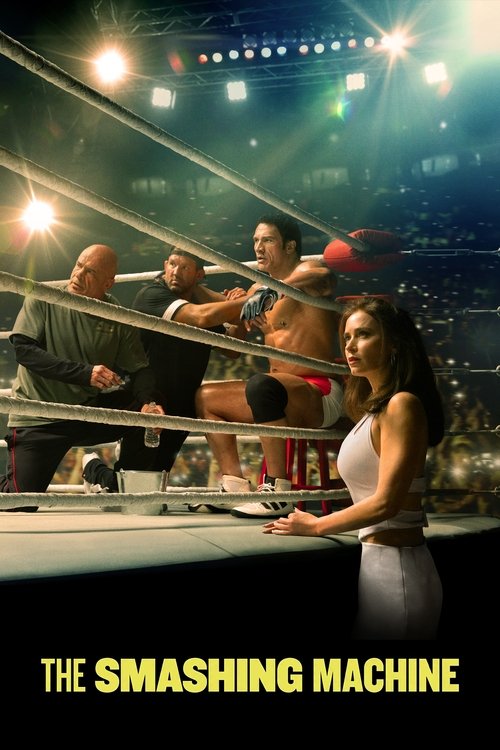
The Smashing Machine
2025 · Benny Safdie
For when you want a serious, human sports story rather than a triumphant one — a film about the cost of greatness to sit with, not cheer at. More challenge than comfort, but deeply rewarding if you're in the mood to feel for someone.
What it's about
In the late 1990s, heavyweight fighter Mark Kerr is one of the most feared men in the young sport of no-holds-barred fighting, dominating opponents in American rings and on Japan's Pride circuit. Away from the mat, his life is coming apart in slow motion: an opioid dependence that grows with every injury, and a passionate, volatile relationship with his girlfriend Dawn that keeps threatening to blow up his career. It follows a man built to absorb punishment as he learns the real damage is happening off-camera.
The experience
Quiet where you expect noise — the fights are brutal but the film's real tension lives in hotel rooms and kitchens, in the dread of watching someone hold it together in public. It's intimate, melancholy, and hard to look away from, closer to a slow ache than an adrenaline rush.
Performances
Dwayne Johnson, playing completely against type under prosthetics, gives the most vulnerable work of his career — gentle, wounded, almost childlike between bouts. Emily Blunt matches him as Dawn, making a combustible relationship feel painfully real rather than melodramatic.
The craft
Benny Safdie's first film directed without his brother trades the Safdies' trademark frenzy for patient, deglamorized observation, drawing texture from documentary footage of the era. The fight scenes are staged with bruising physical credibility, and the period recreation of late-'90s MMA — the arenas, the locker rooms, the Japanese circuit — is immersive on a big screen.
Why it matters
It announced Safdie as a distinctive solo director and reframed Dwayne Johnson as a dramatic actor, landing as one of the most talked-about transformations of its year.
Snapshot
The Smashing Machine is Benny Safdie's first feature directed without his brother and longtime collaborator Josh, and it announces that solo voice through an unexpected vehicle: a sober, deglamorized biopic of the mixed-martial-arts pioneer Mark Kerr, played against type by Dwayne Johnson. Set largely in the late 1990s and the early 2000s, when no-holds-barred fighting was migrating from American spectacle toward the codified Japanese Pride Fighting Championships circuit, the film tracks Kerr's ascent as a dominant heavyweight while his body and relationships erode beneath him — opioid and painkiller dependence on one side, a combustible romance with his partner Dawn on the other. It is at once a sports picture and a study of decline, drawing its structure and even some of its texture from the 2002 HBO documentary of the same name. Distributed by A24 and premiered at the Venice Film Festival, where Safdie was recognized for his direction, the film reads as a deliberate inversion of both the inspirational fight-movie tradition and of Johnson's own star persona.
Industry & production
The project sits at the intersection of A24's prestige-auteur model and the star-driven production muscle of Dwayne Johnson's Seven Bucks Productions, with Johnson serving as both lead and a producing force. That pairing is itself the story: one of the most bankable mainstream action stars of the century deliberately subordinating his persona to an art-house director known for abrasive, anxiety-soaked realism. Emily Blunt, a frequent Johnson collaborator, took the role of Dawn, the girlfriend whose relationship with Kerr supplies much of the film's domestic friction.
The source material is documentary. John Hyams's 2002 HBO film The Smashing Machine: The Life and Times of Mark Kerr established the factual spine — Kerr's wins, his dependency, the on-camera volatility of his home life — and Safdie's fiction feature openly descends from it rather than from a conventional "based on a true story" treatment built from scratch. The casting reached into the sport's real ranks, with veteran fighters appearing in and around the cast (the former Olympic wrestler and UFC champion Mark Coleman, Kerr's real-life friend and rival, is portrayed within this milieu of authentic combat-sports figures), reinforcing the film's claim to procedural credibility.
The film's festival route was its principal industrial event: it competed at Venice, where Safdie's work was singled out by the jury — a recognition that did significant work positioning the film as a serious auteur statement rather than a star vehicle. Beyond the festival framing and A24's specialty-release apparatus, the granular commercial record (budget, grosses) is not something I can responsibly quantify here; I will not invent figures.
Technology
The most conspicuous technological dimension of the film is corporeal rather than digital: the physical reconstruction of Dwayne Johnson into Mark Kerr. Johnson is a performer whose body is itself a kind of established special effect, and the production worked against that recognizability through prosthetic and makeup augmentation — a reshaped brow, altered nose and ears, the thickened, blunted look of a career heavyweight — so that the star's familiar silhouette dissolves into the character. This prosthetic strategy is continuous with a broader contemporary tendency in prestige biopics to use makeup design as a transformative technology equal in importance to performance.
On the capture side, the film pursues a grainy, period-true, near-documentary image consistent with the Safdie house style, which has historically favored celluloid and long-lens textures over clean digital polish. I want to be careful not to overstate the exact acquisition format as settled fact; what is clear from the film's look is an aesthetic of analog warmth and visible grain that evokes both the 1990s-2000s period and the televisual grammar of the HBO documentary it descends from.
Technique
Cinematography
The cinematography, by Maceo Bishop — a camera operator and image-maker who came up within the Safdie orbit — extends the brothers' established visual language while tempering its frenzy. Where Good Time and Uncut Gems pressed faces into the frame with telephoto compression and relentless handheld proximity, The Smashing Machine applies that intimacy to a slower, heavier subject. The camera stays close to Kerr's body, observing it as both weapon and liability; fight sequences are shot less as choreographed spectacle than as something witnessed, with the framing and shallow focus mimicking broadcast and documentary coverage of the era. The overall palette leans toward muted, naturalistic interiors and the harsh institutional light of gyms, hotel rooms, and arenas, an anti-glossy approach that refuses the heroic backlighting of the conventional boxing or MMA film.
Editing
The cutting favors observational duration over montage adrenaline. Rather than building bouts through the rapid, percussive assembly typical of the genre, the film tends to let scenes breathe — to hold on aftermath, on the deflation that follows violence, on the quiet of dependency. Domestic confrontations are allowed to run past the point of comfort, a rhythm that recalls the documentary's own willingness to keep the camera rolling through real arguments. The precise editing credits and division of labor on this solo Safdie production are not something I can attest to in detail without overstating the record, but the cut's logic is plainly the same one that governs the film's whole sensibility: deglamorization through patience.
Mise-en-scène / staging
Staging is built around authenticity of milieu — the unglamorous geography of professional fighting circa 2000. Locker rooms, training mats, weigh-ins, anonymous hotels, and the specific cultural texture of the Japanese Pride era are reconstructed as lived-in environments rather than backdrops. The presence of real fighters within the frame anchors the staging in physical credibility; bodies move and collide with the weight of people who actually do this. Domestically, the mise-en-scène contracts to cramped, charged interiors where Kerr and Dawn's relationship plays out, the spatial confinement mirroring the emotional one.
Sound
Sound design is integral to the film's realism, foregrounding the unlovely acoustics of combat — the dull impact of strikes, labored breathing, the ambient roar and hush of arenas. Against this, the score, which I understand to be the work of the ambient-jazz composer Nala Sinephro, supplies a contemplative, atmospheric counterweight rather than the brass-and-percussion triumphalism the genre usually demands. (I flag that composer attribution with appropriate caution.) The effect of pairing diegetic brutality with a restrained, almost meditative musical register is to keep the audience inside Kerr's interiority — the loneliness beneath the violence — rather than cueing them to cheer.
Performance
Performance is the film's center of gravity. Dwayne Johnson delivers a deliberately interiorized, soft-spoken Kerr, trading his customary charisma and command for vulnerability, halting gentleness, and the dissociated affect of a man medicating pain. The casting is itself an argument: the audience's foreknowledge of Johnson as an indestructible icon is mobilized against the spectacle of that icon's fragility. Emily Blunt's Dawn supplies the film's volatility, a performance pitched at the abrasive emotional realism the Safdie school prizes; the relationship scenes depend on the friction between Johnson's withdrawal and Blunt's confrontation. The supporting presence of genuine fighters lends the ensemble a documentary credibility that trained actors alone could not.
Narrative & dramatic mode
The film operates in an anti-triumphal register. It borrows the scaffolding of the sports biopic — the rise, the title bouts, the rivalry, the woman at home — but systematically declines the genre's redemptive payoffs. There is no clean arc toward a culminating victory that resolves the protagonist's flaws; instead the structure is one of accumulation and erosion, where each win is shadowed by deepening dependency and relational damage. Its dramatic mode is closer to the addiction drama and the character study than to the inspirational fight film, and its documentary lineage gives it an observational, fly-on-the-wall quality. The emotional climaxes are domestic and physiological — overdose, withdrawal, the collapse of a relationship — rather than athletic.
Genre & cycle
The Smashing Machine belongs to the lineage of the serious boxing-and-fighting picture — a tradition that runs through Raging Bull, The Wrestler, and The Fighter — but it specifically extends the post-Wrestler strand in which the sport is a site of bodily self-destruction rather than uplift. Darren Aronofsky's The Wrestler (2008) is the most direct generic antecedent: the aging combatant whose vocation is killing him, shot in grainy intimacy. It also participates in the contemporary cycle of transformation-biopics in which a recognizable star physically disappears into a real figure. And as an MMA film, it is comparatively rare prestige treatment of a sport more often handled in genre-action registers, giving it a near-historical documentary value as a portrait of the discipline's formative, pre-mainstream era.
Authorship & method
The defining authorial fact is that this is Benny Safdie's solo feature debut as writer-director, following a celebrated run of co-directed films with his brother Josh (Daddy Longlegs, Heaven Knows What, Good Time, Uncut Gems). The film both continues and recalibrates the Safdie method: the verité texture, the casting of non-actors and real-world figures, the unbearable-intimacy framing, and the refusal of glamour all carry over, but they are applied to a slower, more melancholy and elegiac subject than the brothers' signature high-anxiety crime cinema. Where the joint films sprinted, this one sits with its subject.
Among collaborators, cinematographer Maceo Bishop is the clearest continuity with Safdie's prior visual world. The screenplay is Safdie's own, adapting and extending the factual record established by John Hyams's documentary. The score appears to come from Nala Sinephro, whose ambient sensibility shapes the film's contemplative undertow (noted with caution as to attribution). On the editing and remaining technical credits for this specific production, I would rather acknowledge the limits of what I can verify than assign names speculatively. Crucially, the authorship is doubled: Dwayne Johnson, as star and producer, is a co-author of the film's central gambit — the dismantling of his own persona — and that collaboration between art-house director and global star is itself the work's signature.
Movement / national cinema
The film is a product of American independent-prestige cinema as channeled through A24, the distributor-producer that has become a de facto movement-brand for auteur-driven work in the 2010s and 2020s. More precisely it issues from the New York indie sensibility the Safdies helped define — a strain of grimy, propulsive realism descended from John Cassavetes and 1970s American cinema by way of contemporary verité technique. Its subject also opens a transnational dimension: the late-1990s/early-2000s migration of elite fighting to Japan's Pride circuit situates the story within a globalized sporting culture, even as the film's craft idiom remains rooted in American independent practice.
Era / period
As a 2025 release, the film arrives in an industrial moment defined by the prestige biopic's dominance at festivals and awards, the rise of physical-transformation performance as a marker of seriousness, and A24's consolidated role as an auteur platform. As a period piece, it reconstructs the turn-of-the-millennium world of no-holds-barred and early sanctioned MMA — a transitional era before the UFC's mainstream legitimization, when the sport was culturally marginal, regulatorily contested, and physically more lawless. The film thus carries an archival charge, preserving a vanished moment in the history of a sport that has since become a global industry, and implicitly contrasting that rawer past with the present.
Themes
The film's central theme is the cost of the body — the way a vocation built on physical dominance consumes the very instrument it depends on, and the way pain management slides into addiction. Opioid dependency is treated not as a villain's vice but as an occupational hazard and a quiet, ordinary tragedy, aligning the film with the broader cultural reckoning around the opioid epidemic. Adjacent themes include masculinity and its inarticulacy — Kerr's gentleness and emotional muteness set against his profession's brutality — and the corrosive entanglement of love and codependency dramatized through his relationship with Dawn. Underlying all of it is the theme of decline: the recognition that strength is finite, that winning is not the same as being well, and that the machine, however smashing, breaks.
Reception, canon & influence
Critically, the film's reception coalesced around two recognitions: the seriousness of Benny Safdie's solo directorial voice, affirmed by his jury recognition at the Venice premiere, and the revelation of Dwayne Johnson in a register entirely outside his established range. The dominant critical narrative framed the film as a deliberate dismantling of a star persona and a maturation of the Safdie method into something more sorrowful and restrained. I will avoid attributing specific reviews or quotations I cannot verify, but the broad shape of the response was that of a respected, divisive-toward-admired auteur work anchored by a transformative lead.
Looking backward, the influences ON the film are legible: the verité crime cinema of the Safdie brothers themselves; Aronofsky's The Wrestler as the proximate generic model; the long shadow of Raging Bull over all serious fight-cinema; and, most directly and unusually, John Hyams's 2002 documentary, which supplies not just facts but tonal and structural DNA. Looking forward, the film's likely legacy lies in two directions. First, as a proof-of-concept for the radical recasting of a blockbuster star in deglamorized auteur work, it strengthens a path between the multiplex and the festival that other action icons may follow. Second, as Safdie's solo debut, it functions as the founding text of a directorial career distinct from the brothers' joint filmography — the work against which his subsequent solo films will be read. Its longer influence on the still-thin canon of serious MMA cinema will depend on what that sport's storytelling becomes, but the film stands for now as the form's most ambitious dramatic treatment.
A Deleuzian reading
Start with the face.
The full Deleuzian reading of The Smashing Machine →
Reception
Premiered at Venice 2025 to a huge tearful ovation and instant Oscar-frontrunner buzz for Dwayne Johnson, then face-planted at the box office with one of the worst wide-release openings of his career — the awards narrative deflated almost as fast as it inflated.
How The Smashing Machine was received, from release to now →
How to watch The Smashing Machine: what to notice on a first viewing
- Watch how quietly Dwayne Johnson speaks in every scene. Johnson trades command and charisma for halting gentleness and the flat affect of a man managing pain. Prosthetics blunt his brow, nose and ears into the face of a career heavyweight. You keep looking for the star and keep finding a soft-spoken man instead. The casting is the argument.
- Notice how the fights are shot like television coverage. Maceo Bishop stays close on Kerr's body with long lenses and shallow focus, framing the bouts as something witnessed rather than choreographed. The look copies broadcast and documentary footage of the era. You are put in the position of a spectator at the time instead of a fan being handed a hero.
- Watch what the film holds on after the violence stops. Instead of assembling bouts from fast percussive cuts, Safdie stays with the aftermath and the deflation. Arguments at home run well past the point of comfort, the way the documentary kept its camera rolling. The picture spends its time on what follows an event. Duration is the thing it wants you to feel.
- Listen for the ambient score against the dull impacts. The design hands you labored breathing, the thud of strikes and the roar and hush of an arena. Nala Sinephro's music stays contemplative rather than supplying the genre's usual brass and drums. Nothing cues you to cheer. The mix keeps you inside the loneliness underneath the fighting.
- Look at the locker rooms, the mats and the weigh-ins. The late-1990s fight world, including the Japanese Pride circuit, is reconstructed as lived-in space rather than backdrop. Real fighters stand in frame and move like people who actually do this. The milieu carries the credibility. You learn what this life is from the rooms it happens in.
The whole guide to watching The Smashing Machine, with the keys for a rewatch →
Influences: the films it descends from and the films it influenced
- The Smashing Machine (2002) — The literal source text: its observational documentary fight-coverage and unguarded locker-room/relationship footage supply the drama's structural beats and elegiac tonal DNA, which Safdie restages nearly shot-for-feeling.
- The Wrestler (2008) — The proximate generic model: Maryse Alberti's follow-behind, over-the-shoulder telephoto vérité tracking a deglamorized fighter through physical decline is the exact handheld-intimacy grammar Safdie inherits.
- Raging Bull (1980) — Founding text of the serious fight film: subjective in-ring sound design (amplified blows, animal roars, sudden silence) and the athlete's bodily self-destruction as moral spectacle hang over all the film's combat staging.
- Fat City (1972) — Conrad Hall's low-light naturalism and the anti-triumphal portrait of journeyman fighters defines the decline-not-victory arc and authentic-milieu staging the film adopts over the Rocky template.
- A Woman Under the Influence (1974) — The American indie vérité root: observational long-take duration that sits inside raw, behaviorally interiorized performance — the durational patience Safdie applies to Johnson's vulnerability.
- Heaven Knows What (2014) — Establishes the Safdie practice of casting real non-actors inside their own deglamorized milieu, the authentic-environment realism carried into the MMA gyms and motels here.
- Good Time (2017) — Source of the unbearable-intimacy framing — long-lens handheld pressed flush against faces under available/neon light — that Safdie reuses but slows from sprint to dirge.
- Uncut Gems (2019) — The immediate method precedent: high-anxiety vérité texture, casting real-world figures, and recasting a comic-coded star (Sandler) in a dramatic register — recalibrated from frenzy to melancholy.
- Million Dollar Baby (2004) — Anti-triumphal fight drama that converts the sports-victory arc into bodily catastrophe and aftermath, modeling the refusal of redemptive climax central to the film's structure.
- Foxcatcher (2014) — The same star-against-type gambit (Carell deglamorized) inside a wrestling tragedy, plus ambient-dread sound and restrained, withheld performance over melodrama.
- The Fighter (2010) — HBO-documentary visual texture and addiction-within-the-family realism rendered in a working-class fight milieu — the doc-inflected register the dossier flags via Hyams's HBO lineage.
- Warrior (2011) — The direct MMA-cinema sibling: cage-fight coverage built for diegetic combat realism, sharing the still-thin canon of serious mixed-martial-arts drama the film aims to anchor.
- Sound of Metal (2019) — Body-cost realism delivered through immersive diegetic sound design — physical deterioration experienced sensorially rather than narrated, paralleling the film's diegetic-combat-realism approach.
- The Iron Claw (2023) — A24-era anti-triumphal study of the wrestling body as it breaks down; the cost-of-the-body decline narrative and deglamorized physical-transformation lead built on the same elegiac restraint.
- Punch-Drunk Love (2002) — Template for recasting a broad comic star (Sandler) into an interiorized, vulnerable dramatic key — the persona-dismantling craft that Johnson's against-type turn extends.
- Dallas Buyers Club (2013) — The physical-transformation biopic performance — a star reshaping his body and image into deglamorized fragility — the same transformation-as-authorship gambit Johnson and Safjson co-author.
- Marty Supreme (2025) — The parallel solo debut applying the shared immersive-athlete method to a real sportsman, the controlled experiment that lets critics isolate which brother carried which part of the craft.
Similar films
- Marty Supreme (2025) — influence & lineage
- Warrior (2011) — influence & lineage
- The Wrestler (2008) — influence & lineage
- Raging Bull (1980) — influence & lineage
- Million Dollar Baby (2004) — influence & lineage
- Uncut Gems (2019) — influence & lineage
- The Iron Claw (2023) — influence & lineage
- Better Man (2024) — same viewing thread
All the films related to The Smashing Machine →
Watch it with: curated runs of related films
- The Making of a Legend — A run of biopics that watch private people get forged into public icons — the ambition, the pressure, and the loneliness of becoming somebody the world can't stop looking at.