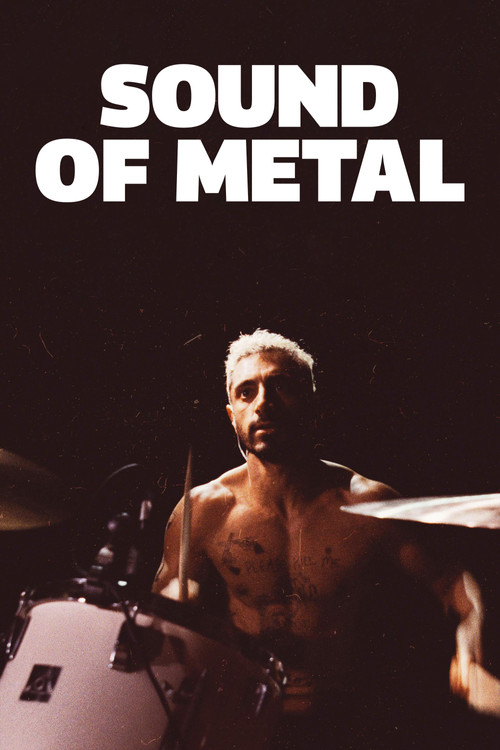
Sound of Metal
2020 · Darius Marder
For when you want a drama that actually puts you through something and leaves you changed — a film to sit with in silence after. Not comfort viewing, but deeply humane, and worth every hard minute.
What it's about
Ruben, a heavy-metal drummer and recovering addict, starts losing his hearing mid-tour — fast, and for good. His girlfriend checks him into a rural community for Deaf recovering addicts, where he has to face the question underneath the panic: is deafness a catastrophe to be fixed, or a life to be entered?
The experience
It starts loud and frightening, then grows quiet in ways that get under your skin — the film keeps dropping you inside Ruben's ears, so you feel the loss rather than watch it. Wrenching, tender, and finally something close to peaceful.
Performances
Riz Ahmed, who spent months learning drums and American Sign Language, plays coiled panic slowly unclenching. Paul Raci, a hearing child of Deaf parents who worked in near-anonymity for decades, is flinty and tender as the community's leader — one of the great late-arriving performances.
The craft
Nicolas Becker's sound design is the film's signature: roars, smothered voices, ghostly frequencies, and stretches of near-silence that put you inside Ruben's skull. Watch it with good headphones or proper speakers — the sound isn't decoration here, it's the story.
Why it matters
A breakthrough for Riz Ahmed and Paul Raci, a milestone for how movies represent deafness and Deaf culture, and an instant reference point for what sound design can do in drama.
Darius Marder's debut — developed from a project Derek Cianfrance abandoned — follows Ruben, a heavy-metal drummer and recovering addict whose hearing collapses mid-tour, forcing him into a rural community for Deaf recovering addicts and into the hardest question of his life: whether deafness is a catastrophe to be fixed or a culture to be entered. Riz Ahmed, who spent months learning drums and American Sign Language, gives a performance of coiled panic gradually unclenching; opposite him, Paul Raci — a hearing child of Deaf adults who had worked for decades in near-anonymity — delivers one of the era's great late-arriving performances as the community's flinty, tender leader. The film's signature is Nicolas Becker's sound design, which drops us inside Ruben's skull: roars, smothered voices, metallic ghosts of frequencies, and passages of profound silence, all presented with open captions as a gesture of access. It won Academy Awards for sound and editing, but its craft serves a spiritual idea, stated plainly by Raci's Joe: stillness, not restoration, as the kingdom of God.
A Deleuzian reading
The voices go wrong before they go away.
The full Deleuzian reading of Sound of Metal →
Reception
It premiered at TIFF in 2019 and slipped onto Amazon Prime in the pandemic winter of 2020, then snowballed from streaming sleeper into an awards juggernaut — six Oscar nominations including Best Picture, with wins for Sound and Editing. It's since settled in as one of the defining 'discovered at home' films of the COVID era.
How Sound of Metal was received, from release to now →
Influences: the films it descends from and the films it influenced
- Blue Valentine (2010) — Marder co-wrote it, and its Cianfrance house-method — actors living in-character before shooting so behavior emerges rather than being played — is the exact immersion pipeline Riz Ahmed underwent (months of drumming and ASL to be).
- The Place Beyond the Pines (2012) — Marder shares story credit; its handheld, consequence-driven naturalism and unshowy long takes trained the observational grammar Marder brings to the addiction-recovery beats.
- It's All Gone Pete Tong (2004) — The direct precursor to the film's central device: dropping the audio mix into a musician's failing ears, muffling and cutting frequencies so the audience loses hearing alongside the protagonist.
- The Conversation (1974) — Walter Murch's design makes the act of hearing the film's true subject — degraded, re-focused, subjectivized audio — the foundational grammar for treating a soundtrack as a character's interior auditory POV.
- Children of a Lesser God (1986) — Established the mainstream template of casting a Deaf actor and treating ASL as a full language on its own terms rather than a disability to be cured, the ethic Marder extends with Paul Raci and Deaf non-actors.
- The Diving Bell and the Butterfly (2007) — Builds an entire sensory POV of impairment from the inside — camera and sound locked to one damaged perception — the same first-person embodiment strategy Marder uses for deafness.
- Raging Bull (1980) — Frank Warner's abstracted, subjective fight-sound (silences, distortions, animal roars) is the model for expressive rather than literal audio; De Niro's total physical transformation prefigures Ahmed's method immersion.
- Into Great Silence (2005) — Turns monastic silence and stillness into a spiritual formal device — no score, ambient quiet as content — the exact register of the film's climactic retreat where stillness becomes the point, not restoration.
- Whiplash (2014) — Percussion rendered as visceral, body-punishing sound and image — a drummer pushed to physical injury — sharing the tactile drum-craft realism at the film's opening and its bond between playing and self-destruction.
- The Wrestler (2008) — Builds on total-embodiment performance and the body-in-extremis premise — a performer losing the very faculty his identity depends on — rendered through patient, self-effacing observation and an ambiguous, non-redemptive ending.
- Manchester by the Sea (2016) — Naturalistic ambient sound design paired with an anti-cathartic arc that denies the protagonist the recovery-and-redemption the story seems to promise.
- Babel (2006) — Renders deafness from inside via subjective sound design that drops the audience into silence — the direct heir to Babel's nightclub deaf-subjectivity sequence.
- CODA (2021) — Casts Deaf actors throughout and, at the recital, drops the mix to complete silence to seat hearing viewers inside the Deaf family's experience — directly inheriting the subjective-silence device a year later.
- Deaf (2025) — Uses subjective sound design that muffles and drops out the audio mix to seat the audience inside the character's hearing loss, the exact 'withdrawal into silence' device Deaf deploys for Ángela's POV.
- Tuner (2026) — Nicolas Becker's design shifts the mix between objective room and the character's own cochlea, teaching contemporary audiences to read a hard cut in perspective as a cut in hearing — the subjective-listening grammar Tuner assumes fluency in.
- The Tribe (2014) — An all-Deaf cast performing in unsubtitled, unscored sign language forces the hearing audience into sensory dislocation — the same refusal to translate or cushion that Marder pursues through open captions and dropped sound.
- A Quiet Place (2018) — Cuts hard to a Deaf character's total silence (played by Deaf actor Millicent Simmonds) as an immersive POV switch, deploying the same audience-inside-deafness sound edit as its central shock.
- Baby Driver (2017) — Renders a character's tinnitus as a persistent sound-design motif woven into the edit, tying subjective hearing damage directly to the film's rhythmic cutting.
- Notes on Blindness (2016) — Reconstructs the loss of a sense using subjective sound design as the primary storytelling engine, the documentary-side counterpart to Marder's constructed deaf soundscape.
- The Father (2020) — Uses editing and production-design manipulations to lock the viewer inside an unreliable, deteriorating perception — the same 'trap the audience in the protagonist's altered reality' construction, applied to dementia instead of deafness.
- Sound of Noise (2010) — Treats percussion and everyday noise as the film's expressive foreground, foregrounding the sonic-texture-as-drama sensibility that Sound of Metal channels through drumming and cochlear distortion.
- A Quiet Place Part II (2021) — Marder's film develops the deaf-POV sound design approach most rigorously in contemporary cinema: the audience's subjective audio experience shifts to match Ruben's progressive hearing loss, with silence rendered as a specific textured sound state distinct from mere quiet — the formal technique AQP uses for Regan's perspective sequences, here given full systematic treatment.
- The Smashing Machine (2025) — Body-cost realism delivered through immersive diegetic sound design — physical deterioration experienced sensorially rather than narrated, paralleling the film's diegetic-combat-realism approach.
- Marty Supreme (2025) — Builds drama out of an abrasive, subjective immersive sound mix as its primary engine — the same conviction that the mix, not the score alone, carries the protagonist's interior state (with Benny Safdie on story/cast).
- System Crasher (2019) — Uses point-of-audition sound design — distortion, muffling, overload — to trap the viewer inside a character's dysregulated sensorium, the audio counterpart to Benni's subjective immersion.
- The Broken Circle Breakdown (2012) — Centers a musician whose body becomes the site of loss and whose identity is inseparable from performance, extending the singing-body-as-archive concern into immersive sound design.
- Thunderbolts* (2025) — Parallel innovation in rendering a mental/perceptual condition through subjective sound design, the same depression-as-sonic-condition strategy of making an interior state audible rather than illustrated.
Similar films
- The Father (2020) — influence & lineage
- CODA (2021) — influence & lineage
- Whiplash (2014) — influence & lineage
- A Quiet Place (2018) — influence & lineage
- Deaf (2025) — shared sensibility
- Memoria (2021) — shared sensibility
- Sirāt (2025) — shared sensibility
- Tuner (2026) — shared sensibility