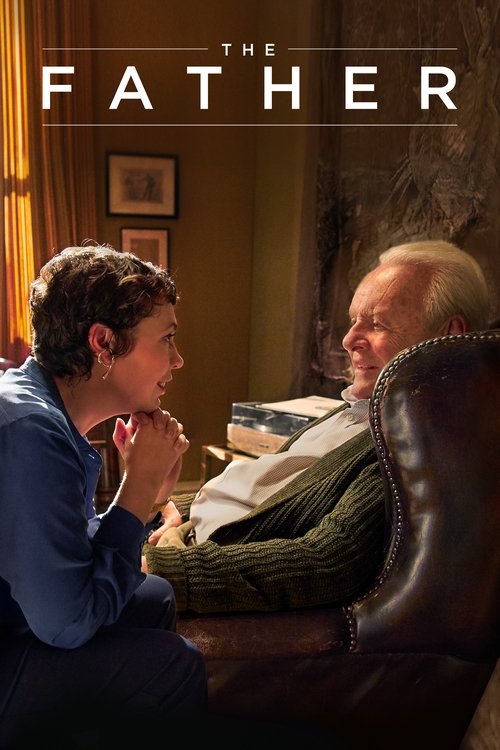
The Father
2020 · Florian Zeller
When you want a film that wrecks you and you're ready for it — a challenge, not a comfort, and one you'll be turning over for days. Save it for a night when you can sit with heavy feelings afterward.
What it's about
An elderly, fiercely proud Londoner refuses all help from his daughter as his memory begins to fail. Instead of watching his decline from outside, the film locks you inside his perception: his flat subtly rearranges itself, familiar faces answer to the wrong names, and he — and you — can no longer be sure what's real.
The experience
Plays like a chamber thriller more than a weepie: disorienting, quietly terrifying, and then devastating, because the puzzle you're solving is a mind coming apart. It earns its tears honestly, without a drop of sentimentality.
Performances
Anthony Hopkins gives one of the great late-career performances — charming, cruel, imperious, and suddenly childlike, sometimes within a single scene — work that won him the Oscar. Olivia Colman matches him as the daughter absorbing every blow with a fixed, breaking smile.
The craft
The design is the masterstroke: the flat itself is the unreliable narrator, its kitchen tiles, hallways, and furniture reconfiguring between scenes so subtly you feel wrong before you know why. Zeller adapts his own hit play with Christopher Hampton in a script that won the Oscar, turning stage material into something only cinema could do.
Why it matters
It redefined how movies portray dementia — from the inside, as experience rather than diagnosis — and delivered Hopkins his second Best Actor Oscar nearly thirty years after his first.
Florian Zeller's play Le Père had already conquered stages worldwide when the novelist-playwright, directing his first film, found the cinematic form his subject demanded: dementia rendered not from outside, with pity, but from inside, with terror. Anthony — Zeller renamed the role for Anthony Hopkins — is a proud Londoner who refuses his daughter's help, and the film locks us into his perception as it fails. The brilliance is architectural: the flat itself is the unreliable narrator, its kitchen tiles and hallways quietly reconfiguring between scenes, furniture migrating, familiar faces answering to the wrong names as actors swap roles mid-story. What could have been prestige-drama embalming becomes something closer to a chamber thriller, a puzzle whose solution is heartbreak. Christopher Hampton's co-adaptation won the Oscar, and Hopkins — at 83 the oldest Best Actor winner in history — gives a late-career summit performance, vain and charming and suddenly, unbearably small. Olivia Colman absorbs it all as the daughter, her face doing the grieving the film's structure won't pause for.
Reception
Acclaimed from its Sundance 2020 debut, but Hopkins's Oscar win was initially overshadowed by the ceremony chaos around it — five years on, the noise has faded and the film has settled in as the definitive dementia movie, with the win now widely seen as earned on pure merit.
How The Father was received, from release to now →
Influences: the films it descends from and the films it influenced
- Amour (2012) — Confines terminal cognitive decline to a single Paris apartment, making the flat a closing prison — the immediate chamber-drama-of-aging precedent for Zeller's set.
- Memoir of a Murderer (2017) — Translates Alzheimer's disease into cinematic formal structure through spatial disorientation — rooms, faces, and identities shift between cuts without narrative acknowledgment, making the viewer inhabit the protagonist's collapsing epistemology rather than observe it from outside; extends Memoir's Alzheimer's-as-form principle to full subjective immersion.
- 45 Years (2015) — Late-life cinema in which memory itself is the antagonist, the interior of an aging mind made the site of drama, extending the older-protagonist seriousness 45 Years helped legitimize.
- Shadowlands (1993) — Theatrical adaptation by its own originating dramatist — Nicholson's three-stage path replayed — with Hopkins anchoring a chamber drama of cognitive loss through pure withholding.
- Thanmathra (2005) — Formalizes the erosion-of-self subjectively — shifting rooms, faces, and chronology — turning the interior POV that Thanmathra implied into the film's explicit editing device.
- Kishkindha Kaandam (2024) — Renders dementia formally so shifting set details and continuity 'errors' become diegetic clues to a decaying mind, putting the viewer inside the same disoriented subjectivity Vijayaraghavan's character imposes.
- Last Year at Marienbad (1961) — Contradictory continuity and sets that silently rearrange between cuts — the deliberately unreliable editing of time and space that The Father borrows to externalize a mind that can no longer trust its own rooms.
- Repulsion (1965) — Renders a deteriorating mind from the inside by treating a single apartment as an unstable subjective space whose walls and dimensions morph as the protagonist decompensates.
- The Tenant (1976) — Single-flat paranoia in which neighbors and architecture are quietly recast and reconfigured while the occupant's sense of identity dissolves — the chamber-thriller template of an unreliable domestic narrator.
- Persona (1966) — Chamber two-hander that blurs and swaps faces/identities, prefiguring the film's recast-roles device where a stable person suddenly wears a different actor's face.
- That Obscure Object of Desire (1977) — The literal recast-role: one character played by two different actresses with no diegetic explanation, forcing the audience to hold an unstable identity — exactly Hopkins's daughter/wife slippage.
- Wild Strawberries (1957) — Ancestor of dementia-as-staging: an aging man's past physically intrudes into present rooms, memory dramatized as walk-in space rather than voiceover.
- Rope (1948) — Play-to-screen single-location chamber piece that sustains its whole running time inside one apartment, proving theatrical confinement can be pure cinema.
- Memento (2000) — Puzzle structure engineered so the fractured, out-of-order editing makes the viewer suffer the protagonist's memory disorder firsthand rather than merely observe it.
- Mulholland Drive (2001) — Dream-logic recasting of characters and reconfigured spaces the audience must reassemble, normalizing an unreliable narrator whose reality reshuffles mid-film.
- Synecdoche, New York (2008) — A theatrical set continually rebuilt and roles endlessly recast as the literal architecture of a disintegrating self — reconfiguring-set staging pushed to metaphysics.
- Anomalisa (2015) — Uses a single shared voice and face for every 'other' person (a Fregoli-delusion device) — a formal externalization of perceptual disorder cousin to The Father's recast faces.
- Still Alice (2014) — Dramatizes early-onset dementia subjectively through performance and rack-focus/aural drop-outs, the acting-led sibling to Hopkins's interior collapse.
Similar films
- Amour (2012) — influence & lineage · same viewing thread
- Vortex (2021) — influence & lineage
- Synecdoche, New York (2008) — influence & lineage
- Anatomy of a Fall (2023) — same viewing thread
- Beau Is Afraid (2023) — same viewing thread
- Hamnet (2025) — same viewing thread
- Sentimental Value (2025) — same viewing thread
- Persona (1966) — influence & lineage · often watched together
All the films related to The Father →
Watch it with: curated runs of related films
- When the Family Comes Undone — Watch these when you want intimate, one-household dramas where love and grief are the same thing — a parent fading, a marriage on trial, a child at the center of the wreckage.