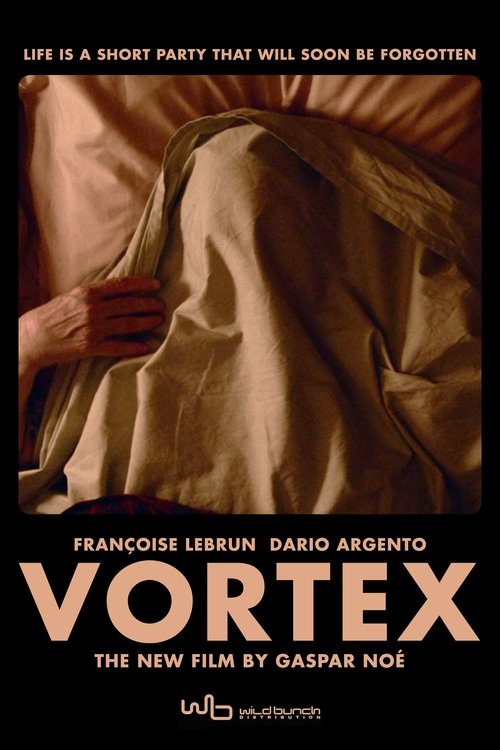
Vortex
2021 · Gaspar Noé
When you're ready to be wrecked — to sit with mortality, memory, and love at the end of the line. This is the opposite of comfort viewing; save it for a night when you can give it your full heart and maybe a phone call to your parents after.
What it's about
An elderly Parisian couple — he a film critic writing a book about cinema and dreams, she a retired psychiatrist — live out the final weeks of a decades-long marriage as her mind dissolves into dementia and his heart fails. Their grown son, wrestling with his own troubled past, hovers at the edges, unable to hold his parents' world together. The whole film unfolds in their cramped, book-crammed apartment.
The experience
Devastating in slow motion. The screen is split in two — one image for each spouse — so you watch two people who shared everything become unable to share a frame, and the effect is quietly crushing rather than sensational. It's long, intimate, and honest in a way that stays with you for days.
Performances
Horror director Dario Argento, cast against type in a rare acting role, and Françoise Lebrun are extraordinary — largely improvising, they make the couple's routines and confusions feel documentary-real rather than performed.
The craft
Gaspar Noé, known for sensory assault, pivots to restraint: the split screen runs nearly the whole film, turning a formal gimmick into the story's emotional engine as the two panels drift out of sync. The dense, lived-in apartment becomes a character itself — a life's accumulation of books and papers that no one will sort. Patient, precise filmmaking in service of feeling.
Why it matters
A startling late-career reinvention for Noé that won over critics who had dismissed him as a provocateur, and one of the most formally daring films ever made about dementia and dying.
Snapshot
Vortex is Gaspar Noé's late-career pivot from sensory assault to something quieter and more devastating: a two-and-a-half-hour observation of an elderly Parisian couple in the final weeks of a marriage undone by dementia and heart disease. An unnamed husband, credited as Lui ("Him"), is a film critic and writer at work on a book about cinema and dreams; his wife, Elle ("Her"), is a retired psychiatrist whose mind is dissolving. Noé stages nearly the entire film in split screen — two adjacent images, one following each spouse — so that a couple who have shared a life and a cramped, book-choked apartment for decades are rendered, formally, as two people who can no longer occupy the same frame. The film is dedicated "to all those whose brains will decompose before their hearts," a line that doubles as its thesis. Cast against type, the Italian horror auteur Dario Argento plays the husband and Françoise Lebrun — indelible from Jean Eustache's The Mother and the Whore (1973) — plays the wife. Premiering at Cannes in 2021, Vortex was widely received as Noé's most humane and least provocateur work, and as one of the most unsparing films ever made about aging and decline.
Industry & production
Vortex is a French production, financed and distributed through Noé's established European backers — Rectangle Productions and Wild Bunch among the principal companies — with the kind of modest budget that Noé's improvisational method requires and rewards. It was shot fast, reportedly over roughly a month, and largely in a purpose-dressed Paris apartment whose density of books, posters, records, and medical texts is itself a form of production design. The picture belongs to a distinct moment in Noé's biography: in 2020 he suffered a near-fatal brain hemorrhage, an experience he has repeatedly described as reorienting him toward mortality and directly informing the film. That the shoot happened during the broader disruptions of the COVID-19 period is consistent with its stripped-down scale — a two-hander in confined interiors, small crew, minimal locations.
Noé worked, as is his habit, without a conventional screenplay. Accounts of his process describe a short outline or "scriptment" rather than scripted dialogue, with the actors improvising within situations he set. This method places enormous weight on casting, and Noé's choices were pointedly cinephilic: Argento and Lebrun are not only performers but living emblems of film history, their presence lending the domestic drama a layer of movie memory. Alex Lutz plays the couple's son, Stéphane, a recovering addict with a young child of his own, the third point in the film's small triangle of dependency and helplessness.
Vortex premiered at the 2021 Cannes Film Festival in the Cannes Première sidebar — out of the main competition — before rolling out through arthouse channels internationally. Precise box-office figures are not something I can responsibly cite; as an austere, subtitled, split-screen film about dementia running well past two hours, it was self-evidently a specialized theatrical release rather than a commercial one, and should be understood in those terms.
Technology
Technologically, Vortex is defined by a single decision executed with rigor: the split screen. Rather than simulate the effect in post from a single capture, Noé built the film around two images running in parallel for almost its full length, each following one spouse with its own camera and operator, the two streams then synchronized in the edit. The result is not the flashy, multi-panel montage of the 1960s split-screen tradition but a sustained double portrait — two continuous documentary-like observations laid side by side. This required a shooting approach in which both cameras could work the tight apartment simultaneously, catching the husband in one room and the wife in another, or both in the same space from two vantages. The film uses a hard black divider between the frames; the seam is a formal presence, sometimes a wall, sometimes an abyss. The apparatus is otherwise unshowy — no elaborate rigs of the kind Noé used for the floating camera of Enter the Void or the crane-and-Steadicam choreography of Climax. Here the technological ambition is entirely conceptual, spent on the diptych structure rather than on movement or effect.
Technique
Cinematography
The images are by Benoît Debie, Noé's longtime director of photography (Irréversible, Enter the Void, Climax), with Noé himself closely involved in operating and framing, consistent with his hands-on practice. In sharp contrast to the saturated, strobing, weaponized color of their earlier collaborations, the cinematography here is naturalistic and restrained: available-feeling light, muted domestic tones, handheld framing that follows the actors with an observational patience closer to vérité than to spectacle. The camera stays inside the apartment's clutter, and the shallow, crowded compositions make the space feel both intimate and suffocating. The two frames often differ in light and rhythm — one calm, one agitated — so that the diptych becomes an emotional instrument, not just a spatial one.
Editing
The film's meaning is made in the cut, because the cut is doubled: every moment is a choice about what happens in the left frame and the right, and how the two relate — mirroring, ignoring, or missing each other. The editing logic is the film's dramaturgy. Early on the two frames are physically close, the couple sharing rooms; as the wife's condition worsens, the frames drift into separate errands, separate crises, characters passing through doorways from one image into the other. In the film's culminating passages the divided frame resolves — one image goes black at a death, collapsing the diptych — a formal event that lands harder than any line of dialogue. I won't attribute the edit to a specific named editor here, as I can't verify that credit with confidence; what is certain is that the assembly, overseen by Noé, is the film's central authorial act. Noé also punctuates the film with stark black title cards, a device recurring across his filmography, which segment the descent into discrete stages.
Mise-en-scène / staging
The single apartment is the film's whole world, and its overstuffed interiors do enormous work: the husband's cinema — books, film posters, DVDs, his manuscript on cinema and dreams — presses against the wife's psychiatric library and medical papers, two intellectual lives sedimented into one dwelling. The staging exploits the real geography of the flat — its corridors, its kitchen, its cluttered study — so that the split screen maps onto actual adjacent rooms. Objects carry the plot: pills, gas taps left running, a manuscript, keys, the front door. In the film's final movement the mise-en-scène itself is dismantled on camera — the apartment emptied, pictures taken down, furniture removed — a literalization of a life being cleared away that is among the most affecting sequences Noé has staged.
Sound
Vortex has essentially no original score, in keeping with Noé's habit of building soundtracks from pre-existing music. It opens with the couple toasting on their balcony to Françoise Hardy's "Mon amie la rose," a song whose imagery of a rose's brief bloom sets the film's terms. Thereafter the soundtrack is largely diegetic and domestic — the low ambient hum of the apartment, television, radio, the city outside — a restraint that makes the sensory experience the opposite of Noé's usual bombardment. The near-silence is itself expressive: the muffled, closed-in soundscape mirrors the wife's shrinking world and the general sense of a life contracting toward its end.
Performance
The performances are the film's core achievement. Françoise Lebrun renders dementia without a trace of the actorly — the vacancy, the loops, the moments of frightening lucidity, the wandering — in a portrait of great tenderness and precision. Dario Argento, in his first substantial screen-acting role, is remarkable precisely because he is not a trained actor: his weariness, irritation, and love read as unperformed, a real body under strain from a real weak heart in the fiction. Because the dialogue was largely improvised, the two carry long passages on presence and rhythm alone, and Alex Lutz's son adds a third register of exhausted, guilty devotion. The casting of two figures from film history deepens the effect — we are watching cinema's own memory grow old.
Narrative & dramatic mode
The dramatic mode is observational and terminal: there is no plot to speak of, only a decline charted to its end. Noé removes suspense in the conventional sense — we know from the dedication and the tone where this goes — and substitutes the dread of duration, the sense of watching an inevitability arrive in real, unhurried time. The narrative is episodic, structured by black cards and by the daily rounds of caretaking, medication, wandering, and small emergencies. Its central formal conceit converts a private story into a study of separateness: two consciousnesses, side by side, unable finally to reach each other. If Noé's earlier films are structured as descents — the reverse chronology of Irréversible, the drug spirals of Enter the Void and Climax — Vortex keeps the descent but strips it of transgressive charge, leaving only the fall.
Genre & cycle
Vortex sits within the small, serious genre of the aging-and-dementia film — most obviously alongside Michael Haneke's Amour (2012), the comparison nearly every critic reached for, and within a broader European art-cinema tradition of unflinching films about the end of life. It also belongs to a cycle of late-2010s/early-2020s dementia dramas that gave the subject formal experiment (the perceptual scrambling of Florian Zeller's The Father, released the same period, is a frequent point of contrast). Within Noé's own body of work it reads as a genre inversion: the extremity that once took the form of graphic violence and sensory overload is here relocated entirely into subject matter — old age as the horror.
Authorship & method
Vortex is unmistakably a Gaspar Noé film even as it renounces much of his signature: the black chapter cards, the reflexive love of cinema, the interest in altered and dissolving consciousness, the fascination with the body's vulnerability, and the willingness to make an audience sit inside discomfort all persist. What changes is the method's target. Noé has been candid that the film grew out of his own brush with death and out of watching relatives decline, and the improvisational, script-light approach — situations rather than lines, real spaces, actors chosen for what they are — is the same working method he has used throughout, now bent toward realism. His key collaborator remains cinematographer Benoît Debie, whose palette is deliberately drained of its former excess. The casting of Dario Argento and Françoise Lebrun functions as authorship too — a cinephile's gesture that folds film history into the drama. There is no composer of note, by design; the "score" is curated source music. The editing — the doubled cut that is the film's engine, overseen by Noé — is where his authorship is most concentrated.
Movement / national cinema
Noé is a French-Argentine director and a central figure in what critics dubbed the "New French Extremity" of the 2000s — the loose tendency (Bruno Dumont, Claire Denis, Catherine Breillat, Marina de Van, among others) toward confrontational depictions of sex, violence, and the body in French art cinema. Vortex is a French film squarely within this national art-cinema economy of festival premiere and specialized distribution, but it can be read as Noé stepping partly out of the "extremity" label he helped define — retaining its seriousness about the body while abandoning its shock tactics. Lebrun's presence explicitly links the film back to a foundational text of French auteur cinema, Eustache's The Mother and the Whore, situating Vortex within a longer lineage of the French film about intimate life.
Era / period
Made and set in the present of its production, Vortex is a film of the early 2020s and of Noé's own sixties — a late-style work in the most literal sense, preoccupied with endings. It is legible against its immediate moment: a period newly saturated with mortality, and a stage of Noé's career in which the enfant terrible turns to reckoning. It also participates in an early-2020s wave of prestige art films confronting dementia, giving the era one of its bleakest and most formally distinctive entries.
Themes
The governing theme is decline — of the mind, of the body, of a shared world — and the loneliness that persists even within a long marriage. The split screen is the film's thesis made visible: love does not close the gap between two separate consciousnesses, and that gap only widens as one mind fails. Memory is a second theme, and specifically cinematic memory: a critic writing about films and dreams as his own wife forgets, two icons of movie history aging before us, an art form's relationship to time and loss. The film meditates on caregiving and its exhaustion, on the indignities and small cruelties of dependence, on the way a life reduces at the end to objects and paperwork and an emptied room. And it insists on the body's frailty — the failing heart, the failing brain — the concern that runs through all of Noé's cinema, here stripped of provocation and left as plain fact.
Reception, canon & influence
Vortex was met with strong and, for Noé, unusually warm critical reception. Many longtime skeptics of his work regarded it as his most mature, compassionate, and formally disciplined film, praising the Lebrun and Argento performances and the emotional force of the split-screen conceit; the comparison to Haneke's Amour recurred so often as to become the film's default critical frame. Its influences on the film run backward to that Haneke lineage of unsparing end-of-life cinema, to the split-screen experiments of earlier film history repurposed for grief rather than spectacle, and — through Lebrun — to the intimate French realism of Eustache. Noé's own filmography is the other clear source: the black cards, the descent structure, and the fixation on dissolving consciousness carry over from Enter the Void and Climax, now turned inward.
Its forward legacy is still consolidating, as with any recent film, and it would be premature to claim a settled canonical status. What can be said is that Vortex has already reframed how Noé is discussed — evidence that his interests could be pursued without shock — and that it stands as a significant contemporary entry in the cinema of aging, a film likely to be cited whenever the possibilities of split screen or the depiction of dementia are debated. Its most durable influence may be demonstrative: proof that a director defined by extremity could make the ordinary fact of death the most extreme subject of all.
A Deleuzian reading
They are on the balcony with wine.
The full Deleuzian reading of Vortex →
Reception
Cannes 2021 gasped at the sight of cinema's great provocateur delivering something tender, and the 'Noé grows up' narrative stuck — it's now routinely called his best and most humane film, a reputation that has only solidified since.
How Vortex was received, from release to now →
Influences: the films it descends from and the films it influenced
- Amour (2012) — Haneke's fixed-camera, single-apartment durational observation of an elderly spouse's terminal decline is the exact restrained end-of-life template Vortex adopts, then literally divides in two.
- The Mother and the Whore (1973) — Eustache's lived-in French realism made Françoise Lebrun; casting her imports that unperformed, intimate naturalism straight into Noé's improvised, script-light scenes.
- Enter the Void (2009) — The black inter-title chapter cards and the structuring of the film as a descent through dissolving consciousness carry over wholesale, redirected from psychedelia to dementia.
- Climax (2018) — The method of building loose situations for actors to inhabit rather than scripted lines — casting people for what they are — is the working process Vortex reuses.
- Napoléon (1927) — Gance's Polyvision triptych pioneered the split/multi-frame image as expressive formal expansion rather than gimmick — the deep root of Vortex's permanently divided frame.
- The Boston Strangler (1968) — Fleischer's multi-panel split-screen for simultaneous, physically separated action is the grammar Vortex applies to a couple sharing one apartment yet siloed in adjacent frames.
- Chelsea Girls (1966) — The durational side-by-side dual projection turned split-screen into a tool for real-time observation instead of spectacle, prefiguring Vortex's contemplative rather than kinetic use.
- Timecode (2000) — Figgis's continuous, real-time multi-panel split-screen proved the format could carry a whole feature's drama, the modern precedent for Vortex's feature-length two-frame architecture.
- Umberto D. (1952) — Neorealist observation of an old man's ordinary daily routine and encroaching solitude models the unsentimental, terminal-observational gaze Vortex trains on its aging couple.
- Wild Strawberries (1957) — Bergman's late-life reckoning, intercutting present decline with intruding memory, is the art-cinema template for Vortex's meditation on a mind's cinematic memory dissolving.
- Deep Red (1975) — Casting Argento as the husband is a cinephile authorship gesture: his giallo career and the character's book on cinema-as-dream fold film history directly into the drama.
- Irréversible (2002) — Noé's rigorously structured descent toward death established his habit of building a film as an inexorable formal slide, here inverted from reverse-chronology into linear decline.
- Lux Æterna (2019) — Noé's immediately prior feature runs almost entirely in split-screen, making Vortex the refinement of that just-tested dual-frame device into sustained domestic drama.
- The Father (2020) — Zeller's contemporary dementia film uses a mutating single-apartment set as a formal device to render cognitive collapse from within — a parallel craft solution to Vortex's split frame.
Similar films
- Amour (2012) — influence & lineage
- Irreversible (2002) — influence & lineage
- Climax (2018) — influence & lineage
- The Father (2020) — influence & lineage
- Enter the Void (2010) — shared sensibility
- Possession (1981) — shared sensibility
- Close Your Eyes (2023) — shared sensibility
- Anatomy of a Fall (2023) — shared sensibility