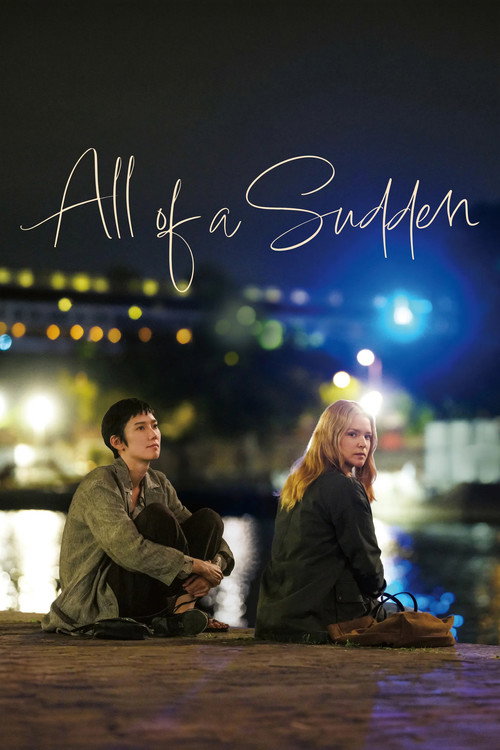
All of a Sudden
2026 · Ryusuke Hamaguchi
Drive My Car's surprise Best Picture nomination made three-hour Japanese Chekhov adaptations a mainstream conversation topic; "the Hamaguchi pace" is now cinephile shorthand for durational patience as pleasure.
For when you want to give a whole evening to one film and let it work on you slowly — a movie about friendship, care, and mortality to sit with, not escape into. This is a challenge-and-reward watch, not comfort food, though it's gentler than its subjects suggest.
What it's about
Marie-Lou runs a care home for the elderly in the Paris suburbs, where she's pushing to transform how her residents are treated — a philosophy of care built on really looking at people, speaking to them, touching them with respect — against pushback from her own staff. Then she meets Mari, a Japanese theater director living in France who is terminally ill with cancer. The two women form a deep friendship, and the film follows how that bond reshapes Marie-Lou's fight for dignity in the home and both of their lives.
The experience
Long, patient, and quietly absorbing — nearly three and a half hours that move at the rhythm of conversation rather than plot. It's tender without being soft: the film sits with illness, aging, and friendship honestly, and the accumulation of small exchanges builds real emotional weight by the end.
Performances
Virginie Efira anchors the film as Marie-Lou, carrying both institutional battles and private grief, with Tao Okamoto as Mari giving the friendship its still, dignified center.
The craft
Hamaguchi, working in French for the first time, builds the film the way he builds all his best work: out of long, carefully shaped conversations where listening matters as much as speaking. The script, co-written with Léa Le Dimna and loosely inspired by a real exchange of letters between a philosopher and a care practitioner, gives the dialogue an essayistic depth without losing warmth. It rewards an unhurried sitting more than a big screen — this is a film of faces and voices.
Why it matters
A major step in Hamaguchi's career — his first feature made largely outside Japan and in a language not his own, extending his international standing after his Oscar-winning breakthrough into European art cinema.
Snapshot
All of a Sudden is Ryusuke Hamaguchi's French-language debut, a long chamber drama running more than three hours — the longest film in the main competition at the 2026 Cannes Film Festival. Marie-Lou Fontaine (Virginie Efira), the newly appointed director of an elder-care home in the Paris suburbs, champions Humanitude, a care method that treats patients, especially those with dementia, as fully human. She meets Mari Morisaki (Tao Okamoto), a Kyoto theater director who once studied in Paris and is now terminally ill with cancer, and a close friendship forms between the two women. The screenplay, by Hamaguchi and Léa Le Dimna, is based on You and I – The Illness Suddenly Gets Worse, the published correspondence between the philosopher Makiko Miyano and the medical anthropologist Maho Isono; Miyano died fifteen days after writing the book's preface. The film premiered in competition at Cannes on May 15, 2026, where Efira and Okamoto shared the Best Actress prize, Okamoto becoming the first Japanese performer to win it. Japan selected the film as its submission for Best International Feature at the Academy Awards. Bitters End released it in Japan on June 19, 2026, Diaphana in France on August 12, and Neon brings it to North America on November 25.
Industry & production
The film is a co-production of France, Japan, Germany, and Belgium, with producers including Cinefrance Studios, Office Shirous, Bitters End, Heimatfilm, and Arte France Cinéma. Hamaguchi has said that Cinefrance approached him about shooting in France. The international structure follows the global profile he gained after Drive My Car (2021) won the Academy Award for Best International Feature and Evil Does Not Exist (2023) won the Grand Jury Prize at Venice: with that standing, a Japanese auteur could assemble European co-production money on a scale normally reserved for established European art-cinema names.
Principal photography took place in 2025, mainly in Paris and the surrounding region, with additional filming in Kyoto. The production shot in an actual elderly care facility in Paris, and its residents appear in the film as extras. Hamaguchi has said that when he began researching Humanitude he found it shared many issues with the film industry itself. Efira had two months to learn Japanese for the role, and the cast conducted repeated bilingual readings before shooting; the actors in the Humanitude scenes trained with the method's originators. The film moves throughout between French and Japanese.
Neon acquired North American rights at the Berlin market in February 2026. After its Cannes premiere, the film followed the standard art-house release calendar through Japan and France toward its late-November American opening.
Technology
The film was made in real, working locations rather than on studio sets, most consequentially the elder-care facility itself, whose residents and daily routines are woven into the fiction. The locations — the nursing home, a theater, Paris streets, a kitchen — do structural work, organizing the film's emotional beats, as Steve Pond observed in TheWrap. Beatrice Loayza in Film Comment noted how dynamically the film uses Paris: moving trams, walkways shifting elevation along the Seine, gardens whose greens and blues turn painterly by moonlight. Hamaguchi's earlier digital features were likewise shot in real places with modest equipment, and this production extends that practice to a French institutional setting.
Technique
Cinematography
Alan Guichaoua photographed the film, his first collaboration with Hamaguchi, who had previously worked with Japanese cinematographers such as Yoshio Kitagawa (Wheel of Fortune and Fantasy, Evil Does Not Exist) and Hidetoshi Shinomiya (Drive My Car). Critics described a camera under careful control: Sophia Ciminello at Awards Watch admired how precisely it attends to mundane daily moments at the care facility, while Pond noted that it backs away during the characters' most vulnerable moments and lingers on spaces after people have left them. Loayza found individual scenes consistently unrushed, with the city photographed in motion and the gardens given a near-painterly treatment. The discretion of the camera — withdrawing rather than pressing in at moments of exposure — fits Hamaguchi's long-standing view that the camera should record performance rather than build it.
Editing
The editor is Azusa Yamazaki, who also cut Drive My Car and Evil Does Not Exist; her continued role is one of the clearest links to Hamaguchi's Japanese films. Like Happy Hour (2015) and Drive My Car, the film runs past the three-hour mark, and its structure gives long, mostly uninterrupted blocks of time to conversation, institutional routine, and illness. Ciminello reports that roughly half the runtime is devoted to the two women's initial connection — duration itself doing the dramatic work of making a friendship credible. The pacing divided critics along predictable lines: RogerEbert.com's Cannes coverage argued the film justifies its length by being intrinsically about patience, while Anat Goldstein in the Harvard Crimson, in an otherwise admiring four-star review, judged the runtime unjustified and the one thing keeping the film from greatness. Pond found the last hour scattered, accumulating ending after ending, though rewarding; he also suggested the film's digressive shape mirrors the theater-making inside it.
Mise-en-scène / staging
The main staging choice is the location. A real care facility, populated in part by its actual residents, gives the film a near-documentary texture around its fictional core — a method connecting back to Hamaguchi's documentary work, including the Tōhoku trilogy made with Kō Sakai after the 2011 disaster, and to Happy Hour, which grew out of an improvisation workshop with non-professional performers in Kobe. Humanitude is itself a practice of bodily staging, built on eye contact, speech, and touch, and the film frames those acts of attention closely. Theater is nested inside the drama: several plays appear within the film, Q&A sessions produce unguarded moments, and one theatrical sequence plays out in what feels like real time — a passage Ciminello linked to Hamaguchi's earlier work and to Cassavetes. David Jenkins in Little White Lies singled out a scene in which a whiteboard is used to diagram ideas about capitalism as a genuine visual set piece; Goldstein, less charmed, found the same Marxist-lecture material heavy-handed. The protagonist's vocation continues the interest in theater-making that ran through Drive My Car's multilingual staging of Uncle Vanya.
Sound
The score is by Samuel Andreyev, a Canadian-born composer based in France known mainly for contemporary concert music, in his first collaboration with Hamaguchi. This marks a break from the director's recent partnership with Eiko Ishibashi, whose music for Drive My Car and Evil Does Not Exist was central to those films' identity. The soundtrack's dominant element is speech: long bilingual dialogue sequences in French and Japanese carry the film, and Jenkins heard in that bilingualism a suggestion of communion beyond ordinary communication.
Performance
Performance is the core of the film and the basis of its main prize. Efira became a leading French art-cinema actress in the 2010s and 2020s, with work in Justine Triet's Sibyl, Paul Verhoeven's Benedetta, Rebecca Zlotowski's Other People's Children, and Alice Winocour's Paris Memories. Okamoto began as a model and moved into acting through Hollywood and international productions. Both leads work across French and Japanese, and the shared Cannes award recognized the two-hander as a single joint achievement: Goldstein found their chemistry fully convincing, Nicholas Bell at ionCinema thought it as potent as any romantic entanglement onscreen, and Loayza noted that both characters at times verge on the angelic. The supporting cast — Kyōzō Nagatsuka as Gorô Kiyomiya, Kodai Kurosaki as Tomoki Kubodera, Jean-Charles Clichet as Olivier, Marie Bunel as Sophie, and Marie Denarnaud as Laurence, alongside the facility's real residents — gets genuine development of its own, as Jenkins observed. Hamaguchi's method shaped the work from casting on: he has said he does not ask people to act when casting but simply converses with them, and that extensive rehearsal let the multilingual cast soak in the situation. He has described wanting to record not prepared emotions but the emotions that arise as actors react to one another — which takes time — and he writes dialogue physically, noting that when actors cannot rely on language they attend to each other's bodies.
Narrative & dramatic mode
The film is a relational drama, a narrative of friendship under the shadow of death, running on two linked lines. One is institutional: Marie-Lou's effort to change how her facility treats its residents. The other is intimate: her growing bond with Mari as Mari's illness advances. The source book was a letter exchange between two women thinking about illness, care, and the unexpected; Hamaguchi turns that epistolary, reflective material into physical presence and dialogue — he has said he reread the letters until they became part of his body, and that he builds a script from overall structure down to scene and then dialogue, testing each line against whether the character would plausibly say it. The title takes up the source's interest in how illness breaks the expected course of a life. Dialogue is the dramatic action itself, to the point that Rotten Tomatoes' critical consensus characterized the film as much a Socratic dialogue as a movie, kept riveting by its two leads. Not everyone was persuaded by the mode: Bell found little conventional dramatic tension and thought the healthcare sequences played like French medical dramas, and Peter Bradshaw in The Guardian, in a three-star review, found the film tender and meditative but a little too precious for its own good.
Genre & cycle
The film belongs to the international art-cinema drama, and more specifically to a recent body of films about care, aging, dying, and the institutions that look after the old and sick. Relevant points of reference include Michael Haneke's Amour (2012), Chie Hayakawa's Plan 75 (2022), and French social-realist films about hospital and care work — a comparison critics themselves made, for better and worse. All of a Sudden differs from many of these by centering the care workers' philosophy, not only the patients' decline. It also belongs to the long, multi-act "event" art films of the 2020s (Drive My Car among them), whose length is part of the claim they make on the viewer.
Authorship & method
Hamaguchi studied at Tokyo University of the Arts under Kiyoshi Kurosawa. He built his reputation through very long, actor-centered works (Happy Hour), a festival breakthrough (Asako I & II, in competition at Cannes in 2018), and a remarkable 2021, in which Wheel of Fortune and Fantasy won the Berlinale Grand Jury Prize and Drive My Car won Best Screenplay at Cannes and later the Oscar. He co-wrote Wife of a Spy (2020), and with Evil Does Not Exist (2023) he moved into a more elliptical, landscape-led register.
This film keeps his core method — extended rehearsal, conversation-based casting, repeated readings, multilingual communication, immersion in a real place and community — and his stated distaste for plot-driven filmmaking: he has said he relies on his own discomfort with films that simply assert how things are and push forward. Key collaborators:
- Screenplay: Hamaguchi and Léa Le Dimna, who anchors the French dialogue and institutional detail.
- Cinematography: Alan Guichaoua (first collaboration).
- Editing: Azusa Yamazaki (continuing collaborator).
- Music: Samuel Andreyev (first collaboration).
- Production design: Mila Preli. Costume design: Caroline Spieth.
- Source: Makiko Miyano and Maho Isono's published correspondence, written during Miyano's illness.
- Stated influences: Rohmer's My Night at Maud's as a model for philosophical conversation as entertainment; Fritz Lang's You and Me (1938) for building clarity into difficult conversations; Chizuko Ueno's Patriarchy and Capitalism and Nancy Fraser's Cannibal Capitalism behind the film's discussion of capitalism.
Movement / national cinema
The film sits between national cinemas. It is a Japanese auteur's work, chosen as Japan's Oscar submission, with Bitters End, a long-standing Japanese art-house distributor and producer, among the partners. Yet it is set and largely shot in France, mostly in French, with a French lead and a mostly European financing structure. It continues a long tradition of Japanese directors working in France — Nagisa Ōshima's Max, mon amour (1986), Kiyoshi Kurosawa's Daguerrotype (2016), Hirokazu Kore-eda's The Truth (2019) — and goes further than most of those films in making the cultural crossing its subject: the meeting of a French care professional and a Japanese artist is both the story and the production's own situation. It also connects to a French tradition of attentive, institution-based social drama.
Era / period
The film is a product of the mid-2020s. Auteur films in Europe now regularly run past three hours, and Asian auteurs work through international co-production as a matter of course. Post-pandemic attention to care homes, aging populations, and the dignity of dependent people has given the subject public urgency in both France and Japan, two of the world's oldest societies. Humanitude was developed in France by Yves Gineste and Rosette Marescotti and has since spread widely in Japan — the originators themselves trained the film's actors — which gives the Franco-Japanese premise a documented real-world basis.
Themes
- Care as an ethics of attention. Humanitude's emphasis on looking at, speaking to, and touching people often treated as objects of management carries over into the film's own way of filming people.
- Mortality and the sudden. Illness breaks the expected shape of a life, as the title and the source book both stress.
- Friendship across language and culture. The bilingual bond between Marie-Lou and Mari sharpens Hamaguchi's long interest, central to Drive My Car, in how understanding happens through imperfect shared languages — and critics heard in the film's bilingualism something beyond ordinary communication.
- Capitalism and the body. The film argues openly, whiteboard included, about systemic inequality and what economic logic does to care.
- Theater and life. A dying theater director brings in questions of performance, presence, and reaching others across language; plays nested in the film mirror its form.
- Dignity of the old and the dying, set against bureaucratic or purely clinical models of care.
Reception, canon & influence
Critical reception. The film was received as one of the high points of the 2026 Cannes competition, with a standing ovation at the premiere reported at eleven minutes, and the jury gave Efira and Okamoto the shared Best Actress prize. It holds a 93% approval rating on Rotten Tomatoes and 87 on Metacritic — "universal acclaim," with fifteen positive reviews, one mixed, and none negative among the first sixteen counted. Jessica Kiang in Variety described a film achieving a kind of levitating grace, with a screenplay built on faith in the power of language to transform and console, and called it the rarest type of film: not merely good enough to remind you what cinema can be, but great enough to remind you what life can be. Nicolas Rapold in Sight and Sound found a radically tender questioning of philosophies of care, in which the women's friendship becomes a bulwark against helpless decline and the film builds slowly before crystallizing into something that can change one's sense of what is possible on screen and off. Luke Hicks in The A.V. Club called it sublime, a deep friendship overflowing with insight, likening the screenplay to the Tao Te Ching; Ty Burr wrote that the film's kindness and its understanding of human touch run through it like an underground river; Pond concluded that it gently insists no one is normal and helps the viewer find beauty in that. The reservations were mild: Bradshaw's three stars and charge of preciousness, Bell's sense of slack dramatic tension, Goldstein's complaint about the runtime, Pond's scattered final hour.
Influences on the film (backward). The direct source is the Miyano–Isono letters. Within Hamaguchi's own work it draws on Happy Hour (long duration, workshop-built performance, female friendship), Drive My Car (theater, multilingualism, grief), and his documentary practice (real communities on screen). The director's own citations for this film — Rohmer's My Night at Maud's, Lang's You and Me, Ueno and Fraser on capitalism — join the lineage of patient, dialogue-led humanist cinema critics have long traced through Rohmer, Cassavetes, and Renoir in discussing him; in interviews around the release he again praised Cassavetes, along with Nicholas Ray's Johnny Guitar.
Legacy (forward). The film is months old, and its longer-term place depends on an awards season still ahead, including the American release in late November and Japan's Oscar campaign. What can already be recorded: it confirmed Hamaguchi as a director who can work across national industries without losing his method; it produced a historic acting prize for a Japanese performer at Cannes; and it is positioned to become a reference point in the growing body of films about care work and aging.
Reception
It premiered at Cannes in May 2026 to a reported 11-minute standing ovation and a shared Best Actress prize for Virginie Efira and Tao Okamoto, then rolled out through Japan in June and France in August, with Neon releasing in the US on November 25. The notices have held steady at rave level: 93% on Rotten Tomatoes and an 87 on Metacritic, where it sits in the universal-acclaim band with just one mixed review against fifteen positive.
How All of a Sudden was received, from release to now →
How to watch All of a Sudden: what to notice on a first viewing
- Notice when the camera steps back from a face. Guichaoua's camera attends closely to the mundane routine of the care home, then backs away at the characters' most exposed moments and stays on a room after the people have left it. The film refuses to press in on pain; it gives you the room instead and lets you supply the feeling.
- Watch how the staff look at, speak to and touch residents. Humanitude, the method Marie-Lou brings in, is built on eye contact, speech and touch. Hamaguchi frames those acts closely, inside a real care facility whose actual residents appear, while part of her staff resists. The care philosophy and the film's way of filming people are one practice: attention held on a body.
- Listen for when the talk switches between French and Japanese. Speech carries the film. Marie-Lou and Mari talk in long bilingual stretches, and Efira and Okamoto work across both languages. Hamaguchi says actors who cannot rely on words attend to each other's bodies instead. Understanding is built through an imperfect shared language, and you can watch it happen sentence by sentence.
- Notice how long a conversation is allowed to run. Yamazaki, who cut Drive My Car, gives whole uninterrupted blocks of time to talk, institutional routine and illness. About half the runtime goes to the two women first getting to know each other. The length is the argument: the friendship becomes credible because you watched the hours it took.
- Watch for the plays staged inside the film. Mari is a theater director, and several plays appear within the drama. Q&A sessions produce unguarded moments, and one theatrical sequence plays out in what feels like real time, a passage Ciminello linked to Cassavetes. The stage scenes show the same thing the care home practices: reaching another person with your full attention.
The whole guide to watching All of a Sudden, with the keys for a rewatch →
Influences: the films it descends from and the films it influenced
- La direction d'acteur par Jean Renoir (1968) — Records Renoir's 'Italian reading' method, in which actors repeat the text flatly with no intonation until it settles into them, and Hamaguchi has named it the source of the table-read workshops behind the film's two performances.
- Husbands (1970) — Hamaguchi has cited it as the film that made him a filmmaker; its long, unbroken conversations run past the point where a scene would normally end, which is the root of his durational dialogue sequences.
- My Night at Maud's (1969) — Dramatizes philosophical argument as the main action, the template for turning Miyano's written reflections on care and contingency into spoken debate.
- Tokyo Story (1953) — Ozu's frontal, near-lens eyelines make the viewer the person being looked at, a device Hamaguchi adapts to film the Humanitude principle of sustained gaze at eye level.
- Jeanne Dielman, 23 quai du Commerce, 1080 Bruxelles (1975) — Lets domestic and bodily routines play out in near-real time without cutting, the model for staging washing, lifting and touching as complete gestures inside a three-hour form.
- News from Home (1976) — Builds a film around letters read aloud against observed places, a precedent for keeping a correspondence's voice audible while the images move to a physical setting.
- Near Death (1989) — A six-hour record of an intensive-care unit, where long conversations among clinicians, patients and families make institutional care decisions into the film's drama, the basis of the film's institutional storyline.
- La Moindre des choses (1996) — Shoots inside a working psychiatric clinic and has its patients and carers rehearse a play there, merging a real care facility with theatrical workshop, as Hamaguchi does with his care-home location.
- Amour (2012) — Its static long takes of a husband physically caring for his ailing wife in a French setting set the formal benchmark the film answers, by putting attention and touch where Haneke puts dread.
- Voices from the Waves (2013) — In the Tohoku trilogy, Hamaguchi and Sakai filmed survivors talking to each other with eyelines close to the lens, the documentary origin of his practice of putting real communities on screen and of his frontal, listening camera.
- Happy Hour (2015) — A 317-minute film built from an improvisation workshop with non-professionals; its long real-time workshop scene showing a 'centering' exercise in touch and listening anticipates the film's three-hour shape and its scenes of bodily contact.
- Drive My Car (2021) — Puts the Renoir-derived affectless table read on screen and stages a production in several languages, including Korean Sign Language, the direct model for the film's Japanese–French friendship across languages; it was edited by Azusa Yamazaki.
- Daguerrotype (2016) — Hamaguchi's teacher made a French-language film with a French crew and cast and directed through interpreters, the working model Hamaguchi follows in his own French co-production.
- The Truth (2019) — Kore-eda's first film outside Japan, directing French stars through a translator and reworking scenes daily from rehearsal, a parallel to Hamaguchi transplanting his workshop method to a French cast.
- All the Long Nights (2024) — A Japanese contemporary that films mutual care between two coworkers with chronic conditions through patient, observational two-shots of small attentive gestures, treating care as attention as Hamaguchi's film does.
Similar films
- Happy Hour (2015) — influence & lineage
- Amour (2012) — influence & lineage
- Drive My Car (2021) — influence & lineage
- Tokyo Story (1953) — influence & lineage
- Like Someone in Love (2012) — shared sensibility
- A Place for Her (2026) — shared sensibility
- Silent Friend (2026) — shared sensibility
- Perfect Days (2023) — shared sensibility