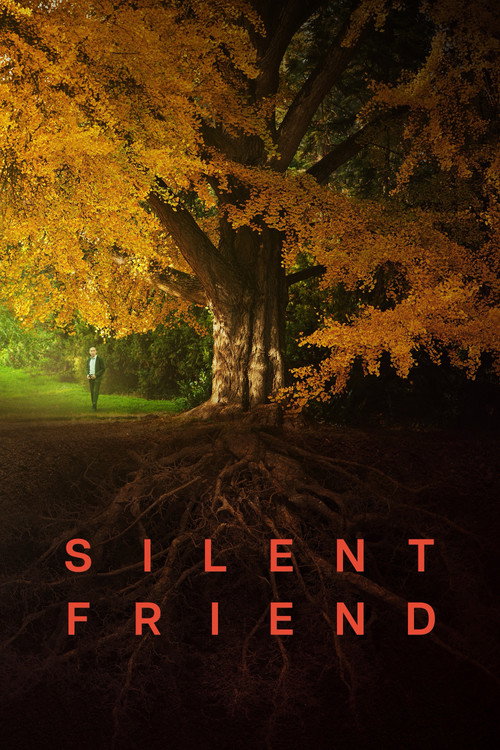
Silent Friend
2026 · Ildikó Enyedi
For when you want a film to chew on for days — something meditative and mind-opening rather than gripping, best met in a calm, curious frame of mind. Comfort viewing for people whose idea of comfort is a beautiful, unusual thought.
What it's about
A majestic ginkgo tree stands in the botanical garden of a medieval German university town, and across three eras — 1908, 1972, and 2020 — it becomes the still point in the lives of three searching people. Each chapter follows someone wrestling with their own questions about perception, connection, and what it might mean for a plant to notice us back. A century of human restlessness unfolds around one patient, silent witness.
The experience
Contemplative and quietly wondrous, with flashes of humor and romance threaded through its big ideas. It has the unhurried rhythm of a walk through a garden — you leave feeling like the world is stranger and more alive than you'd assumed.
Performances
Luna Wedler won the Marcello Mastroianni Award at Venice for her work here — a breakout turn that anchors one of the film's eras with real openness and feeling.
The craft
Ildikó Enyedi directs with the patience the subject demands, giving each period its own texture while letting the tree's stillness organize the whole film. The botanical-garden setting is a genuine sensory pleasure — light through leaves, the hush of greenhouses — and the triptych structure turns a century of history into something you feel rather than study.
Why it matters
It premiered in competition at Venice, winning the FIPRESCI critics' prize, and confirmed Enyedi — an Oscar nominee and Berlin Golden Bear winner — as one of Europe's most original filmmakers of consciousness and connection.
Snapshot
Silent Friend (German: Stiller Freund) is Ildikó Enyedi's first feature since The Story of My Wife (2021), a three-part drama organized around a single ginkgo tree standing in the botanical garden of Marburg, a medieval German university town. Across three loosely linked episodes — set in 1908, 1972, and 2020 — the tree presides over solitary people drawn into questions about perception, consciousness, and the porous boundary between human and vegetal life. The film premiered in competition at the 82nd Venice International Film Festival on 5 September 2025, where it received a sustained ovation and won the FIPRESCI Prize and the Marcello Mastroianni Award (for Luna Wedler); it opened theatrically in Germany via Pandora Film on 15 January 2026. Enyedi herself has described it, only half-jokingly, as "a sci-fi with a sense of humor." Running roughly 147 minutes, it is at once her most internationally scaled production — anchored by Tony Leung Chiu-wai in his first European role and a returning Léa Seydoux — and a direct continuation of the metaphysical, inter-species curiosity that has defined her authorship since the late 1980s.
Industry & production
Silent Friend is a four-country co-production, with German, French, Hungarian, and Chinese partners — an unusually broad financing base reflecting both Enyedi's art-house prestige and the casting of a major East Asian star. The lead producers are Pandora Film (Germany), Galatée Films (France), Inforg–M&M Film (Hungary), and Radiance Films (China), with co-production support from Arte France Cinéma and ZDF/Arte. The participation of Galatée Films is notable on its own terms: founded by the late Jacques Perrin, the company is synonymous with a tradition of immersive nature cinema (Microcosmos, Winged Migration, Oceans), and its involvement situates Silent Friend within a French lineage of films that take the non-human world as a serious subject rather than a backdrop. Production was centered in Marburg, whose genuine university and botanical-garden heritage supply the film's spine. Tony Leung was announced in August 2023; Enyedi has said she wrote his role specifically for him after watching his interviews. The film was the headline title of its Hungarian-led producing team and arrived on the festival circuit (Venice, then Toronto, New York, Chicago, Valladolid) as one of the most discussed European auteur works of the 2025–26 season. North American distribution was secured following Venice. Precise budget and box-office figures are not part of the reliable public record, and I won't speculate on them.
Technology
The film's defining technological gesture is its use of a different capture medium for each era — a structural rather than merely decorative choice. The 1908 segment was shot on black-and-white 35 mm; the 1972 segment on 16 mm; and the contemporary 2020 segment digitally. The escalation of format tracks the forward march of the century, so that the image stock itself becomes a kind of dendrochronology — each "ring" of the narrative legible in its grain, gauge, and tonality. Within the diegesis, technology of perception is also a theme: the 1972 strand turns on plant-attached sensors that register electrical responses, echoing the real 1970s vogue for plant-perception research (the Cleve Backster experiments and the 1973 bestseller The Secret Life of Plants), while the 2020 strand has its neurologist correlating neural-activity readings with the electrical signals of the ginkgo itself, a conceit grounded in the contemporary scientific discourse around plant signaling and "plant cognition." The film treats these instruments not as gadgetry but as attempts — always partial, often comic — to make the inaudible audible.
Technique
Cinematography
Hungarian cinematographer Gergely Pálos is the film's central craft collaborator, and his work won Best Cinematography at the Chicago International Film Festival. Rather than a unified house style, Pálos builds three distinct visual idioms keyed to the three formats: the silvered, pictorialist monochrome of the 1908 photographer's studio and lecture hall; the warmer, grainier, more handheld texture of 16 mm for the 1972 student-housing milieu; and a cooler, cleaner digital register for the pandemic-era present. The ginkgo is the connective visual motif across all three, repeatedly framed as a presiding consciousness — observed in changing light, seasons, and weather. Critics singled out the film's image-making as among its chief pleasures, an extension of Enyedi's long-standing attention to the sensuous surface of the world.
Editing
Edited by Károly Szalai, the film's principal formal challenge is the management of three timelines that touch only obliquely. Reports from the festival premiere emphasize a patient, contemplative rhythm across its 147 minutes, with the tree functioning as the cut-point that licenses passage between eras. The editing logic is associative and rhyming rather than plotted: gestures, glances, and natural phenomena recur across centuries so that the structure reads as a set of variations on a theme rather than a braided thriller.
Mise-en-scène / staging
The single location — Marburg and its botanical garden — gives the film an almost theatrical unity of place against its century-long sweep of time. Period reconstruction (the Wilhelmine examination board of 1908, the West German campus of 1972, the depopulated COVID-era present) is handled with specificity, but the staging consistently subordinates human incident to the standing presence of the tree. Enyedi's framing repeatedly decenters her characters, letting them be small figures within a larger, slower, vegetal order.
Sound
The score is credited to Gábor Keresztes and Kristóf Kelemen. Detailed published analysis of the music is still thin, so I'll avoid overstating its character; what is consistent in the reception is the film's broader sound-design ambition — to evoke a world of signals beneath the threshold of ordinary human attention, the "silent" communication implied by the title. Tony Leung's near-wordless performance places unusual weight on ambient and environmental sound in the 2020 strand.
Performance
Performance style is deliberately restrained. Enyedi reportedly directed Leung with the instruction "you just need to be there," and he plays the neurologist Dr. Wong as, in his own words, "a very lonely guy," with minimal dialogue he found more demanding than a talkative part. Léa Seydoux, reuniting with Enyedi after The Story of My Wife, plays the botanist Dr. Sauvage. Luna Wedler's 1908 student Grete — the role recognized with Venice's Mastroianni Award for an emerging performer — anchors the earliest and most socially pointed strand. The supporting ensemble (Martin Wuttke as the photographer Fuchs, Sylvester Groth as a janitor, Marlene Burow as a 1972 plant researcher, Enzo Brumm as the student Hannes, Rainer Bock) is drawn substantially from German theater and screen.
Narrative & dramatic mode
The film is a triptych or portmanteau, three self-contained stories unified by place and by the figure of the tree as silent witness. Its dramatic mode is contemplative and fabular rather than conventionally suspenseful: each strand follows a solitary person edging toward a relationship — with another person, and with the non-human world. In 1908, Grete fights to enter Marburg's botany program against a sexist examination board, is socially ostracized after her admission, takes refuge in a photographer's studio, and finally seeks a place on an expedition. In 1972, the initially plant-indifferent Hannes meets a researcher studying plant–human interaction and becomes fascinated by her sensor apparatus. In 2020, Dr. Wong, stranded by the pandemic from his intended study of newborn brain activity, pivots to charting the electrical life of the ginkgo with Dr. Sauvage. The connective tissue is thematic and tonal, not causal — the audience, like the tree, watches lives pass.
Genre & cycle
Nominally a historical drama, Silent Friend sits at the intersection of several cycles. It belongs to the multi-era, century-spanning anthology tradition (the lineage that includes works like Cloud Atlas and, more atmospherically, Terrence Malick's consciousness-and-nature cinema), and to a growing strand of art films engaged with "critical plant studies" and non-human perception. Enyedi's own framing as comic "sci-fi" signals her resistance to solemnity: the film flirts with speculative ideas (plants that perceive, trees that register human presence) while keeping a wry, humane register. It is best understood as an auteur's nature-philosophy film rather than a genre exercise.
Authorship & method
Enyedi both wrote and directed, and Silent Friend is unmistakably of a piece with her body of work. Her preoccupations — two solitary beings achieving an improbable communion, consciousness shared across the species line, the marvelous lodged inside the everyday — recur here transposed from animals (the shared deer-dreams of On Body and Soul) to plants. Her method is patient and observational, built on long looking and an instruction to her actors to simply be, which suits Leung's minimalist register and the film's vegetal tempo. Her key collaborators on this film mark a partial change of personnel from her recent work: cinematographer Gergely Pálos (rather than Máté Herbai, her shooter on On Body and Soul and The Story of My Wife), editor Károly Szalai, and composers Gábor Keresztes and Kristóf Kelemen. The casting of Léa Seydoux continues a relationship begun on The Story of My Wife, while Leung's recruitment reflects Enyedi's habit of building a film around a face and a presence she finds inwardly expressive.
Movement / national cinema
Enyedi is a central figure of contemporary Hungarian art cinema, with roots in the late-socialist avant-garde milieu of Budapest's Béla Balázs Studio, where she worked before her breakthrough feature My 20th Century (1989) won the Caméra d'Or at Cannes. Within Hungarian cinema she represents a distinct pole from the austere long-take tradition of Béla Tarr — more fabulist, sensual, and humane, attentive to wonder and to women's interiority. Silent Friend, though shot in Germany in German, English, and other languages with a pan-European and Asian cast, remains a Hungarian-authored work in its sensibility and is partly Hungarian-produced. It thus also exemplifies the present condition of Eastern European auteur cinema: nationally rooted but financed and realized as a transnational European co-production.
Era / period
The film is a product of the mid-2020s European festival ecosystem, made in the immediate aftermath of the COVID-19 pandemic — which it folds directly into its 2020 strand, using lockdown isolation as the condition that turns a neurologist toward a tree. Its tri-format structure also makes it, reflexively, a film about the history of the cinematic image across the very century it depicts: from the silver-nitrate era of 1908, through the 16 mm counterculture moment of 1972, to the digital present. It arrives at a cultural juncture of intensified interest in ecology, non-human agency, and the limits of anthropocentric science.
Themes
At its center is communication across thresholds usually thought impassable: between humans and plants, between eras, between people separated by language and solitude (Leung's near-silent neurologist is the figure for this). The ginkgo — a "living fossil," among the most ancient surviving tree lineages — embodies deep time and patient witness, set against the brevity and agitation of human lives. Recurring concerns include consciousness and perception beyond the human; the persistence of wonder within rationalist science; gender and exclusion (Grete's 1908 struggle against a sexist academy); and isolation transmuted into connection. The title's "silence" is double-edged: the muteness of the natural world, and the possibility that it is in fact speaking in a register we have only begun to instrument.
Reception, canon & influence
Silent Friend was among the most warmly received titles of Venice 2025, drawing a multi-minute standing ovation and the FIPRESCI critics' prize, with Luna Wedler taking the Mastroianni Award for an emerging performer; it added the Silver Spike at Valladolid, a Best Cinematography prize at Chicago for Pálos, and a cluster of ecologically themed festival awards (including the Green Drop Award). Critics across the trade and specialist press praised its beauty, ambition, and tonal generosity, with particular attention to Pálos's images and to Leung's restrained turn, the chief novelty being his first European leading role. As to influence: backward, the film draws on Enyedi's own On Body and Soul (the shared-consciousness conceit, the two solitary souls) and on a documentary and philosophical tradition of nature cinema, with the participation of Jacques Perrin's Galatée Films as a tangible link; the 1970s plant-perception culture supplies its middle panel's intellectual furniture. Forward, its legacy is still being written, but its release lands squarely within a widening cycle of films and criticism concerned with vegetal life, deep time, and post-anthropocentric perception, and it consolidates Enyedi's standing — already established by a Golden Bear and an Academy Award nomination for On Body and Soul — as one of European cinema's foremost poets of inter-species feeling. Claims beyond this would be premature for a film so recently in release.
A Deleuzian reading
Start with the tree.
The full Deleuzian reading of Silent Friend →
Reception
Left Venice 2025 as the competition's quiet over-achiever — no Golden Lion, but the FIPRESCI Prize plus a small armful of side awards (Interfilm, Green Drop) — and rolled into its 2026 arthouse release as one of the spring's most talked-about festival imports.
How Silent Friend was received, from release to now →
How to watch Silent Friend: what to notice on a first viewing
- Notice the same tree returning in every era. 1908, 1972, and 2020 all circle back to the same ginkgo in the same garden, so the three periods feel present at once instead of arranged in order. The eras sit side by side rather than one leading to the next.
- Notice how different each era's film grain looks. 1908 is silvery monochrome, 1972 is grainier handheld 16mm, and 2020 is clean digital, each texture distinct on the same tree. The film stock itself marks time, the way rings mark a trunk.
- Watch Dr. Wong mostly sit and watch the tree. Tony Leung plays the stranded neurologist with almost no dialogue, spending most of his screen time simply present and observing rather than pursuing a goal. Watching stands in for acting here, since there is nothing left for him to do.
- Notice how small the people look beside the tree. Enyedi's framing keeps placing her characters as small figures inside the garden, so the tree, not any person, feels like the steady center of the shot. The world seems arranged around the tree, not around whoever is nearby.
- Listen for sounds just at the edge of hearing. The sound design leans on faint ambient and environmental noise, as if straining to register a kind of communication most people would miss. You are asked to listen the way the film's scientists are trying to listen, past what's obvious.
The whole guide to watching Silent Friend, with the keys for a rewatch →
Influences: the films it descends from and the films it influenced
- On Body and Soul (2017) — The direct authorial parent: the shared-consciousness conceit (two solitary beings communing across the species/consciousness divide) transposed from dreamed deer to plant life, with the same 'instruct the actor to simply be' minimalist direction.
- My Twentieth Century (1989) — Enyedi's debut establishing her signature lodging of the marvelous inside the everyday and a cosmic, decentered framing of human action that the triptych's deep-time perspective extends.
- The Story of My Wife (2021) — Same authorial workshop and casting method — the Léa Seydoux relationship continues here, and the practice of building a film around an inwardly expressive face anticipates the Leung recruitment.
- Microcosmos (1996) — The Galatée Films house style of macro nature observation, treating non-human life as the protagonist of sustained, decentered close looking rather than as scenic backdrop.
- Winged Migration (2001) — Galatée Films' immersive nature-cinema method — patient, technically elaborate capture that grants the non-human its own sustained point of view — a tangible production-lineage link via Galatée's participation.
- The Secret Life of Plants (1979) — Supplies the intellectual furniture of the middle panel: the 1970s plant-perception culture of vegetal sentience and inter-species signaling that the film stages and historicizes.
- The Tree of Life (2011) — Deep-time montage that dwarfs the human figure within geological and cosmic scale, edited by associative rhyme rather than causal plot — the formal template for decentering the human.
- In the Mood for Love (2000) — Establishes Tony Leung's restrained, sub-expressive register; Enyedi builds around exactly the inwardly legible face Wong cultivated, here in his first European lead.
- The Grand Budapest Hotel (2014) — The device of assigning each historical era its own distinct film idiom (here aspect ratio / stock) — the closest precedent for the three-format-capture structuring the three time-panels.
- Intolerance (1916) — The originating multi-era anthology braided not by plot but by associative cross-cutting — montage of analogy across periods, the structural ancestor of the rhyming triptych.
- The Turin Horse (2011) — Hungarian art-cinema sibling: rigorous unity of place, durational long-looking, and a human figure decentered against elemental, indifferent nature.
- Uncle Boonmee Who Can Recall His Past Lives (2010) — Inter-species communion and animist deep time rendered through sub-threshold ambient sound, a sibling model for treating the more-than-human as a perceiving presence.
Similar films
- Memoria (2021) — influence & lineage
- EO (2022) — influence & lineage · same viewing thread
- Dry Leaf (2026) — same viewing thread
- Close Your Eyes (2023) — same viewing thread
- The Ice Tower (2025) — shared sensibility
- 20,000 Species of Bees (2023) — shared sensibility
- The Oldest Person in the World (2026) — shared sensibility
- Satantango (1994) — shared sensibility
All the films related to Silent Friend →
Watch it with: curated runs of related films
- The Land Holds Vigil — Watch these together for the way a thousand-year tree, a wandering donkey, a returned fishing boat, or an emptied countryside becomes the patient witness to human searching and loss.