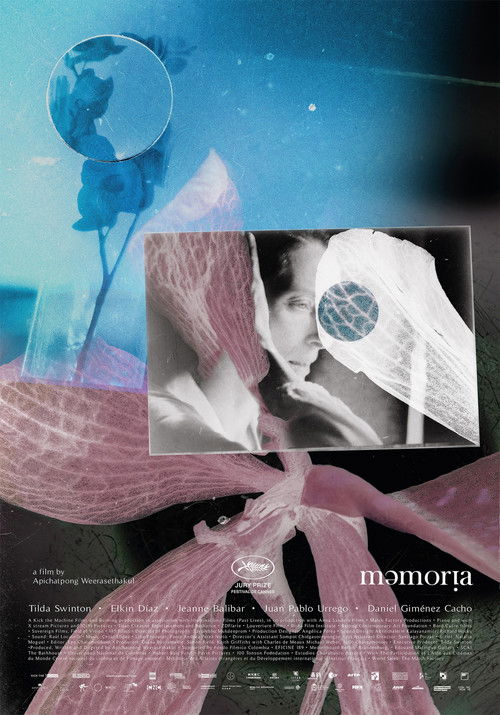
Memoria
2021 · Apichatpong Weerasethakul
Memoria's "one screen at a time, never streaming" release turned distribution itself into an artwork and a permanent debate about access versus aura. The name that signals deepest-end cinephilia.
For when you want to be genuinely altered by a movie — phone off, lights out, full surrender. This is deep-end challenge viewing, best when you're craving something meditative you'll be puzzling over for weeks.
What it's about
A Scottish woman living in Colombia wakes before dawn to a deep, concussive bang that only she can hear. While visiting her ill sister in Bogotá, she tries to track the sound down — working with a studio engineer to reconstruct it digitally, drifting through an archaeological lab, and eventually following the mystery into the jungle and mountains, where it opens onto something much stranger than she expected.
The experience
Hypnotic and hushed — very long takes, long silences, and then that sound, which jolts you every time. It works less like a mystery than a trance; some viewers find it transcendent, others fall asleep, and the film seems fine with both.
Performances
Tilda Swinton, in nearly every frame, gives a marvel of stillness and attention — she plays listening itself, and makes it riveting.
The craft
This is one of the great sound-design films: the mysterious bang, the hum of Bogotá, jungle rain, and the recording-studio scenes where sound is literally being sculpted make theater-grade speakers close to essential. Apichatpong Weerasethakul composes patient, painterly frames of Colombia, his first feature made outside Thailand.
Why it matters
A Cannes prize-winner famously released as a traveling one-screen-at-a-time theatrical event, it became a rallying point for cinema as a communal, sensory experience that can't be replicated at home.
Snapshot
A Scottish orchid grower living in Medellín wakes before dawn to a sound only she can hear: a low, concussive bang she later describes as a ball of concrete dropped into a metal well surrounded by seawater. From that single perceptual event, Memoria builds a two-hour investigation that behaves less like a mystery than like a geological survey. Jessica Holland (Tilda Swinton) drifts between a Bogotá hospital where her sister lies ill, a university sound studio where an engineer tries to reconstruct her noise from a digital library, an archaeological lab holding bones exhumed from a tunnel bored through the Andes, and finally a river valley in the coffee country where an old man claims to remember everything that has ever happened to him and never to have left.
It is Apichatpong Weerasethakul's first feature made entirely outside Thailand, his first with an international star, and his first in Spanish and English. It shared the Jury Prize at the 2021 Cannes Film Festival with Nadav Lapid's Ahed's Knee. In the United States it became notorious for its distribution as much as its content: NEON released it not into wide circulation but as a perpetual tour, one theater at a time, one week at a time, with no announced streaming or home-video window — a release strategy that turned the film into an argument about what a cinema is for.
Industry & production
Memoria is a paradigm case of the contemporary global art film: a director's vision financed by stacking a dozen small national and institutional sources across four continents. Apichatpong's own Bangkok company, Kick the Machine, remained the anchor, alongside his long-standing British producers at Illuminations Films (Keith Griffiths and Simon Field, who have shepherded his work since the early 2000s) and, crucially, the Colombian producer Diana Bustamante and her company Burning Blue. Further coproduction and fund support came from French, German, Mexican, Chinese and Qatari partners, with public broadcasters and festival funds filling out the budget. No single market could have paid for the film; the film exists because roughly a dozen partners each paid for a fraction of it.
The Colombian relocation was not a whim of exoticism. Apichatpong has been open about the political conditions that made working in Thailand untenable for him: after the 2014 coup, under a censorship regime that had already forced cuts to Syndromes and a Century (2006), he declared that Cemetery of Splendor (2015) would not be shown in Thai theaters and spoke of needing to work elsewhere. Colombia offered a landscape with its own dense sediment of violence and disappearance, an active state film-support apparatus, and in Bustamante a producer who had helped build the country's post-2003 art-cinema infrastructure. Principal photography took place in Colombia in 2019 — Bogotá, Medellín, the Andean tunnel works, and the Quindío countryside near Pijao — and the pandemic pushed the premiere from the canceled 2020 Cannes to the delayed July 2021 edition.
The release is the industrially significant chapter. NEON's "never-ending tour" — booking the film into a single venue at a time, indefinitely, refusing a home format — was defended by the distributor and the director as fidelity to a work whose sound design collapses outside a properly calibrated room, and attacked by others as a stunt that made a difficult film artificially scarce and inaccessible to disabled, rural, and non-metropolitan viewers. Both readings are defensible, and the debate itself did more to circulate the film's name than any conventional campaign would have. Outside the United States distribution followed more ordinary patterns, with standard theatrical and subsequent availability in several territories.
Technology
Memoria is, at the level of story, a film about recording technology: the sound studio with its DAW timeline and its shelves of sampled effects, the hard drive as a figure of speech, the archaeological lab where a 6,000-year-old skull with a drilled hole is read as a storage medium for a belief about spirits. The film's central scene — Jessica coaching the engineer Hernán through iterative revisions of her bang, "rounder," "more earthy," until the file matches the sound in her head — is a small essay on the gap between perception and its technical reproduction. The audience hears both the memory and the mockup, and the film quietly notes that we cannot tell which is which.
That reflexivity extends to the picture's own making: the sound the character reconstructs on screen is the sound the film's team had to construct in post. Its design, led by Apichatpong's long-time sound collaborator Akritchalerm Kalayanamitr with an international team, is the film's most demanding technical achievement — a broadband, low-frequency event that must land as physical impact without registering as an effect.
Published technical documentation of the shoot is thinner than for Apichatpong's Thai productions, and the honest position is that the equipment list is not something to assert. What can be described is the working discipline: available and practical light, long takes on a locked camera, minimal coverage, and an almost complete absence of digital manipulation until the final movement, where a single effects sequence arrives with the force of a rupture precisely because nothing before it has been enhanced. The film's true technological argument is exhibitionary rather than productive — it was made on the assumption of a dark room, a large screen, and a multichannel system, and its distribution was engineered to enforce that assumption.
Technique
Cinematography
Sayombhu Mukdeeprom, who has shot most of Apichatpong's features since Syndromes and a Century and who in the same period photographed Luca Guadagnino's Call Me by Your Name and Suspiria, works here in a register of extreme restraint. The camera is nearly always static and frequently placed at a polite middle distance; close-ups are rationed to the point that Swinton's face becomes an event when it finally fills the frame. Compositions favor deep, cluttered planes — hospital corridors, restaurant interiors, the mouth of a tunnel — through which characters enter and leave rather than being followed. Interiors are lit low and cool, with the Bogotá overcast doing much of the exterior work; the jungle and river sequences push toward the limits of low-light exposure, retaining shadow rather than lifting it.
The most-discussed shot is a night exterior in which a parked car's alarm triggers, then another, then another, cascading across a street while the frame holds and refuses to cut. It is a pure demonstration of the film's method: the image supplies a stable, unemphatic container, and sound supplies the drama.
Editing
Lee Chatametikool, Apichatpong's editor since Tropical Malady (2004) and a director in his own right, sustains shots well past the completion of their dramatic business. The grammar is one of duration and omission: scenes end without punctuation, transitions withhold establishing information, and a character can simply cease to exist between sequences — as the young Hernán does, when Jessica returns to the studio and is told no such person works there. The film's structure is a gentler variant of the bifurcation Apichatpong used in Tropical Malady and Syndromes and a Century: an urban, institutional first movement gives way to a rural, elemental second, joined by the doubled name Hernán across two bodies and two generations.
Mise-en-scène / staging
Staging is frontal, patient, and architecturally attentive. Apichatpong builds the film out of thresholds — hospital doorways, studio glass, the tunnel bore, the shallow river — and lets his actors occupy them for a long time. Bodies are often arranged in profile or turned partly away; conversation is staged in unbroken two-shots rather than shot-reverse-shot. The extended sequence in which the elder Hernán (Elkin Díaz) lies down beside the stream and becomes utterly inert while Jessica watches is the film's staging philosophy taken to its endpoint: an actor doing nothing, held long enough that stillness reads as death, sleep, and transmission at once.
Sound
Sound is not a department here but the film's subject, protagonist and organizing logic. The bang recurs unpredictably, unmoored from any visible cause, so that the audience is placed in Jessica's condition — startled by something the image cannot account for. Around it Apichatpong lays a dense, unsweetened field recording of the world: rain, generators, insects, traffic, footsteps on wet ground, the enormous ambient hum of a city at 4 a.m. There is no conventional score; the only substantial music is diegetic, a band rehearsing in the studio, which functions less as scoring than as another recorded artifact. In the final movement, sound becomes explicitly a medium of history, as what the old man "remembers" is delivered to Jessica — and to us — as an audio field of storm, machinery and distant violence.
Performance
Swinton gives one of the most self-effacing performances of her career, and one built almost entirely from listening. Jessica is a foreigner in Colombia, fluent enough in Spanish to function and never at home; Swinton plays her as attentive, courteous, slightly depleted, with her characteristic angularity dialed almost to zero. The performance's key gesture is reactive — the small startle, the head turned toward a sound off-frame — and its restraint is what allows the film's final passivity, Jessica sitting and receiving another person's memories, to read as an action rather than a collapse.
Around her, Apichatpong assembles a genuinely transnational ensemble in his usual mode of understated, non-declamatory playing: Elkin Díaz, cast in Colombia, whose weathered calm gives the film its second center; Juan Pablo Urrego as the vanishing young engineer; Jeanne Balibar, of Rivette's and Desplechin's cinema, as the archaeologist Agnes; the Mexican actor Daniel Giménez Cacho, of Zama, as Jessica's brother-in-law; and Agnes Brekke as the bedridden sister.
Narrative & dramatic mode
Memoria borrows the armature of detective fiction — an inexplicable event, an investigator, a series of expert consultations — and systematically declines to close it. Each expert offers a partial frame: the engineer offers acoustics, the doctor offers pathology and refuses her a sedative, the archaeologist offers deep time, the old man offers something that is not explanation at all but direct transfer. The mode is not mystery but attunement: the question shifts from "what is the sound?" to "what kind of receiver must Jessica become?"
Causality is deliberately porous. People disappear without narrative accounting; time is unmarked; the difference between waking, dreaming and remembering is never adjudicated. This is consistent with Apichatpong's long practice of treating the ghost story's logic — the coexistence of the living, the dead and the not-yet — as ordinary rather than supernatural. The film's closing turn, in which a craft rises from the hillside, is offered without emphasis or reaction shot, so that a science-fiction image arrives in the same flat register as a passing truck.
Genre & cycle
The film sits at the intersection of three cycles. It belongs to international slow cinema — long takes, ambient soundscapes, ellipsis, a festival-funded circuit — alongside Lisandro Alonso, Lav Diaz, Tsai Ming-liang and Carlos Reygadas. It belongs to the strand of art cinema that uses science fiction as metaphysics rather than spectacle, descending from Solaris and Stalker and running through Under the Skin and Arrival. And it belongs to a specifically Latin American cycle of films in which sound and the tropical landscape carry colonial memory — Lucrecia Martel's Zama and La Ciénaga are the most exact comparanda, with Alonso's Jauja and Ciro Guerra's Embrace of the Serpent nearby as accounts of Europeans undone by the continent's deep time.
The heroine's name is the loudest generic signal: Jessica Holland is also the somnambulant wife of Val Lewton and Jacques Tourneur's I Walked with a Zombie (1943), a correspondence widely noted by critics and consistent with Apichatpong's declared affection for mid-century genre cinema. The reference imports a whole lineage — the white woman adrift in a tropical landscape whose spiritual system she cannot read — and inverts its politics, since here the landscape's knowledge is not menacing but simply larger than she is.
Authorship & method
Apichatpong's authorship is unusually collaborative and unusually consistent. The core team is a decades-old unit: Mukdeeprom on camera, Chatametikool cutting, Kalayanamitr on sound, Griffiths and Field producing from London. He writes his own scripts, but writes them loosely, building around locations, real anecdotes gathered on site, and the temperaments of performers, many of whom in his Thai work were non-professionals playing versions of themselves. Colombia forced adaptations — a foreign language, a star, an unfamiliar crew culture, a national history he had to learn rather than inherit — and much of the film's strangeness comes from a method premised on intimacy being applied to a place the director was still meeting.
The film's origin is autobiographical and well documented: Apichatpong has described experiencing exploding head syndrome, a real parasomnia in which sufferers hear a loud crash at the edges of sleep. Memoria takes that private symptom and treats it as a research question, which is characteristic; his cinema regularly converts personal or medical material — his parents' hospital in Syndromes and a Century, a real village and a real folk narrative in Uncle Boonmee — into a formal system. Sleep, in his account, is not a lapse in consciousness but a site of it, and the cinema is its architectural equivalent: a dark room where people lie back and receive images.
Movement / national cinema
Memoria is doubly placed. Apichatpong is the central figure of the Thai independent cinema that emerged around 2000 — alongside Pen-ek Ratanaruang, Wisit Sasanatieng and, later, Anocha Suwichakornpong — a movement defined by its bypassing of the domestic commercial industry in favor of festival funding, and by its running collision with Thai censorship and lèse-majesté law. Blissfully Yours (2002), Tropical Malady (2004) and the Palme d'Or-winning Uncle Boonmee Who Can Recall His Past Lives (2010) made him the most internationally decorated Thai filmmaker in history and, simultaneously, one barely exhibited at home.
On the Colombian side, the film joins a national cinema rebuilt from near-nothing after the 2003 film law, which created the funding and tax structures that produced Los viajes del viento, El vuelco del cangrejo, La sirga, La tierra y la sombra and Embrace of the Serpent. Diana Bustamante was a producer at the center of that generation, and her involvement situates Memoria inside Colombia's own cinema of memory and territory rather than beside it as visiting-auteur tourism. Whether a Thai director's film about a Scottish woman counts as Colombian cinema is exactly the sort of question the coproduction era keeps posing.
Era / period
The film's moment is legible in three registers. Politically, it arrives in a Colombia processing the 2016 peace accord and the work of its Truth Commission — a country conducting literal and figurative exhumations, where bones found during infrastructure work are never only archaeological. Apichatpong's decision to build his film around a dig and a man who cannot forget lands in that context with a specificity he did not need to underline.
Industrially, it is a pandemic-era release: shot in 2019, held for a delayed Cannes, and delivered into a theatrical market that had spent two years being told it might be optional. NEON's tour was a polemic aimed precisely at that condition. And personally, it marks Apichatpong's exile period — a director who left a country where his films could not be shown, making his most portable and most placeless film about a woman who does not belong where she lives.
Themes
Memory in Memoria is not psychological but material: it is stored in stone, in bone, in soil, in bodies that function as recording surfaces. The old man's claim to remember everything, and his corollary refusal to travel or to dream — too much input already — literalizes the idea that a person can be a medium rather than a mind. Against this, Jessica's condition is reframed: her syndrome is not illness but reception, and her arc runs from seeking a cure to accepting a function.
Braided through this is a politics of violence and its residue. The exhumed skeleton with its trepanned skull, the tunnel bored through a mountain, the sounds of gunfire and machinery in the final transmission all propose that the land holds what the archive does not, and that history is not narrated but overheard. The film is also, quietly, about foreignness — about the ethics of listening in a place whose past is not yours — and about the non-human: rivers, insects, weather and rock treated as full participants rather than setting. Finally, it is about sleep and cinema, the two dark rooms of Apichatpong's work, and the possibility that attention is a form of surrender rather than mastery.
Reception, canon & influence
Critical reception was strong and, as expected, divided along tolerance lines. The Cannes Jury Prize confirmed institutional standing; year-end critics' polls, including Sight & Sound's, placed it near the top of 2021, and the film accumulated the kind of extended, essayistic critical writing usually reserved for major works — much of it on the sound design and on the ending, which some read as a genuine science-fiction revelation and others as a dream, a joke, or a figure for cinema itself. The dissenting position, fairly stated, held the film to be an exercise in supplied profundity, its slowness doing the work of meaning. The distribution strategy generated a second, parallel discourse about access and exclusivity that at times overshadowed the film.
Its backward influences are clear: Tarkovsky's use of duration and unexplained event; Antonioni's landscapes of dislocation, from Red Desert's sensory affliction to The Passenger's vanishing foreigner; the Lewton–Tourneur tropical gothic named in the protagonist; the Thai animist and Buddhist frameworks that structure all of Apichatpong's cinema; Martel's precedent for sound as the primary carrier of unease; and his own earlier films, of which Memoria is a portable, deracinated restatement.
Forward, its legacy is still forming and should be described cautiously. The most concrete effect has been on exhibition discourse — the NEON tour became a standing reference point in arguments about theatrical exclusivity, event releasing, and whether scarcity can be a form of curation. Aesthetically, it consolidated a mode of sound-first art cinema and strengthened a growing body of films made by directors working outside their national contexts through coproduction. And it has become a durable teaching text in sound design and film-sound courses, where the studio scene functions almost as a demonstration reel for the problem of describing what one hears. Whether it holds a place in the longer canon alongside Tropical Malady and Uncle Boonmee is a judgment the record is genuinely too young to make.
A Deleuzian reading
A car alarm goes off on a street in Bogotá at night.
The full Deleuzian reading of Memoria →
Reception
It premiered at Cannes 2021 to raves and a Jury Prize, then became less a movie than a pilgrimage: Neon's US release toured it one theater at a time with a pledge of no streaming or home video, so its reputation grew city by city, screening by screening.
How Memoria was received, from release to now →
How to watch Memoria: what to notice on a first viewing
- Listen for the bang and notice you can't place it. The sound recurs without warning and the image never shows a source for it, so you are stuck exactly where Jessica is, startled by something you cannot see. The mystery here was never a clue being withheld from you. It has nowhere to be located at all.
- Watch for the small startle when Jessica hears something off-frame. Swinton plays Jessica almost entirely through reaction, a head turning toward an off-screen sound, her whole performance built from listening rather than acting on what she hears. Her stillness is doing the work. This is a performance built to receive, not to decide anything.
- Notice how rarely the camera moves or cuts in close. Mukdeeprom holds the camera still at a polite middle distance for most of the film, so a close-up on Swinton's face becomes a rare, marked event. The picture stays calm and steady on purpose, so all the drama has to happen in what you hear.
- Listen for how much of the sound is just the world. There is no conventional score. Rain, generators, insects, traffic, and footsteps build a dense, unsweetened field recording that runs under nearly every scene. The absence of music means nothing is telling you how to feel about what you are hearing.
- Notice how long conversations stay in one unbroken shot. Apichatpong stages talk in doorways and glass thresholds without cutting to reverse angles, letting two people occupy the same frame for the whole exchange. Staying in one shot keeps you watching the whole relationship instead of cutting between two separate reactions.
The whole guide to watching Memoria, with the keys for a rewatch →
Influences: the films it descends from and the films it influenced
- I Walked with a Zombie (1943) — Memoria's protagonist takes her name from Tourneur's Jessica Holland, and the cane-field night walk is the operative template — a barely-lit frame in which the threat exists only as off-screen sound (wind in the cane, distant drums, unattributed weeping) whose cause the film never grants an image.
- Red Desert (1964) — Antonioni hands the score's job to processed industrial noise and Gelmetti's electronic tones so that environmental sound *is* the rendering of a woman's sensory illness — the exact equation Memoria makes between a diagnosable auditory symptom and the film's entire sound track.
- The Conversation (1974) — Murch builds the drama out of a man re-auditioning one recorded fragment through successive filters until its meaning inverts; Memoria's studio scenes lift that apparatus wholesale, with Jessica directing an engineer to reconstruct her bang from a sample library, playback by playback.
- India Song (1975) — Duras builds the sound track as a fully post-synced autonomous body, so voices and events are permanently severed from any visible source — the acousmatic principle (sound present, cause structurally absent) that Memoria applies to a single percussive event.
- Jeanne Dielman, 23 quai du Commerce, 1080 Bruxelles (1975) — Perpendicular, tripod-locked framing at doorways and thresholds, with the camera refusing to reframe or cut in while a task plays out in real time — the compositional grammar behind Memoria's frontal staging and its rationing of the close-up.
- The Passenger (1975) — The penultimate seven-minute take drifts away from the protagonist so the decisive event happens off-screen and reaches us only as sound through a window grille; it is also the source text for the foreigner who dissolves into a landscape whose language and history are not theirs.
- Stalker (1979) — Artemyev's design keeps the boundary between score and environment deliberately illegible — drips, wind, subsonic drone — inside takes long enough that ambience becomes the event, and the film flatly declines to explain the phenomenon it is built around.
- Blow Out (1981) — A sound recordist isolates, cleans and re-syncs a single recorded bang as forensic evidence, with the Foley-and-library rebuild staged as procedure; Memoria borrows the whole technical ritual — waveform, monitor, re-synthesis — while withholding any verdict.
- Tropical Malady (2004) — Apichatpong's own precedent for the mid-film rupture: a title card severing one picture into two incommensurate halves, which Memoria restates as the passage from Bogotá's institutional interiors to the riverside second film.
- Syndromes and a Century (2006) — His method of converting private medical material (his parents' hospital) into a doubled formal system, staged in frontal corridor and consulting-room compositions carried by air-handling hum — the working template for turning exploding head syndrome into structure rather than plot.
- The Headless Woman (2008) — Martel opens on an off-screen impact whose cause is never shown and organizes the entire film around that unverifiable sound, layering dense out-of-frame audio over shallow-focus fragments; Memoria's detective armature runs on the same device.
- Uncle Boonmee Who Can Recall His Past Lives (2010) — The locked tableau held under jungle field recordings mixed loud enough to function as the film's music, with non-professionals performing near-total stillness — the recording practice Memoria transplants from Isan to Colombian forest and city.
- Eureka (2023) — Post-Memoria continuation of the ruptured multi-part structure and ambient-only mix across a coproduced, cross-continental shoot in which a foreign star moves through communities the director had to research rather than inherit.
- Jauja (2014) — A foreign lead walks out of one film into an unmarked temporal rupture, shot in boxed, immobile Academy-ratio compositions with a diegetic-only wind track; the same solution to making a deracinated director's outsider status the film's formal subject.
- Zama (2017) — The mix is built as an invented acoustic ecology — insect drone, a rising Shepard-tone ripple — that carries the protagonist's dissolution while the image stays frontal and static, a parallel wager that a mind's affliction is best rendered in the sound department.
- Vitalina Varela (2019) — Available-light, near-black digital chiaroscuro with an immobile camera and non-professionals holding position for minutes at a time, betting exactly as Memoria does that an unmoving face in low light constitutes dramatic action.
- Sound of Metal (2019) — Becker's point-of-audition mixing makes a change in one person's hearing the film's actual dramatic content, engineered for multichannel theatrical playback — the same decision to locate meaning in the mix rather than in a score.
- Days (2020) — Scoreless, near-dialogue-free construction in static long takes where the performance consists of waiting and listening, extending the conviction that attention itself can be staged and held as the shot's content.
- The Secret Agent (2025) — Acoustic permeability as both formal device and epistemological question: the protagonist's sensitivity to an unexplained sonic event structures a meditation on how historical violence persists acoustically in the body, using the same durational patience and behavioral naturalism The Secret Agent employs.
- Silent Friend (2026) — Builds narrative around a sub-threshold sonic signal and a geological sense of deep time — the same use of barely-perceptible sound cues as a perceptual and dramatic engine.
- The Blue Trail (2025) — Sound-first construction in which a Latin American jungle's acoustic field becomes the primary narrative driver, kin to the film's integral Amazonian sound design.
- Trenque Lauquen (2023) — A woman methodically chasing an unknowable phenomenon across a landscape toward an unresolved, quasi-sci-fi revelation — the same 'female investigator of the unaccountable' mode Trenque Lauquen builds its back half around.
- All We Imagine as Light (2024) — As a transnational-coproduction art film built on ambient urban-and-rural soundscape and a woman moving through unexplained sensory events, it extends the same porous-realism, sound-forward mode into the mid-2020s festival cohort.
Similar films
- Uncle Boonmee Who Can Recall His Past Lives (2010) — influence & lineage
- Syndromes and a Century (2006) — influence & lineage
- India Song (1975) — influence & lineage
- Tropical Malady (2004) — influence & lineage
- Zama (2017) — influence & lineage
- Cemetery of Splendor (2015) — shared sensibility
- Close Your Eyes (2023) — shared sensibility
- Resurrection (2025) — shared sensibility