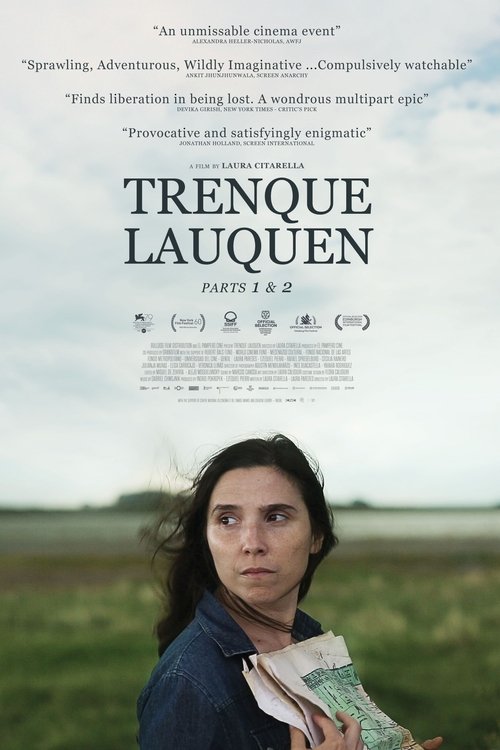
Trenque Lauquen
2023 · Laura Citarella
For a free weekend afternoon when you want to be completely swallowed by a story — something to get lost in and then chew on for days. A commitment, but a gentle and generous one, not a punishing one.
What it's about
A woman named Laura vanishes from a small town on the Argentine pampas, and the two men searching for her — her older boyfriend and a colleague — piece together her last months, only to discover they never really knew her. The trail runs through love letters hidden in library books, local rumors, and something stranger still, each story nesting inside the last.
The experience
Four hours that feel like sinking into a long novel — patient, quietly funny, hypnotic, and constantly rearranging itself just when you think you know what kind of mystery you're in. It rewards surrender rather than impatience.
Performances
Laura Paredes, who also co-wrote the film, is a marvel of withholding as the missing woman — present mostly in fragments and recollections, and all the more vivid for what she refuses to explain.
The craft
Made over six years by the Buenos Aires collective El Pampero Cine on its own stubborn schedule, and the structure is the craft: a two-part, digressive design where voiceover, letters, and radio broadcasts open one story inside another like Russian dolls. Unassuming to look at, intricate as a watch.
Why it matters
A landmark of contemporary Argentine independent filmmaking and proof that a collective working outside the industry, on almost no money, could produce one of the most acclaimed films of its year.
Out of El Pampero Cine — the Buenos Aires collective behind La Flor that makes sprawling, novelistic films on shoestring budgets and its own stubborn schedule — Laura Citarella spun this four-hour, two-part mystery about a woman who vanishes from a small pampas town and the two men who, searching for her, discover they never knew her at all. The film keeps molting: a missing-person procedural becomes an epistolary romance hidden in library books, then drifts toward something stranger still, each nested story opening onto another like a set of Russian dolls left deliberately unclosed. Laura Paredes, who co-wrote the screenplay, plays the absent center with wonderful opacity — a woman exercising the radical option of becoming unaccountable. Citarella's method is patience itself: shot over six years, the film treats digression as a form of respect for the world's strangeness. Cahiers du cinéma named it the best film of 2023, confirming Argentina's artisanal slow cinema as one of the most vital currents anywhere. Its abiding image may be simplest: a car radio, a long flat road, a story being told.
Reception
A four-hour Argentine mystery that premiered quietly in Venice's Orizzonti sidebar in 2022, then snowballed through pure cinephile word-of-mouth until Cahiers du Cinéma crowned it the best film of 2023 — from festival footnote to instant canon in about a year.
How Trenque Lauquen was received, from release to now →
Influences: the films it descends from and the films it influenced
- Historias extraordinarias (2008) — Established the El Pampero Cine template Citarella inherits — a voice-over-driven, multi-hour anthology in which found objects and documents each detonate a nested, digressive tale, the exact structural engine of Trenque Lauquen's chaptered embedded stories.
- La Flor (2018) — Citarella produced and worked on it; it modeled the method of building a film around a fixed troupe of actresses (Laura Paredes among the Piel de Lava quartet) across a multi-year shoot, letting the narrative molt from genre to genre episode by episode.
- Ostende (2011) — Citarella's own debut launched the same character Laura (Laura Paredes) as an amateur observer assembling a mystery purely from watching strangers at a resort — Trenque Lauquen extends that surveillance-into-fiction procedure into a full disappearance plot.
- L'Avventura (1960) — Invented the missing-person search that quietly abandons its own solution and dissolves into landscape and drift; Citarella borrows the procedural-that-refuses-to-resolve and the vanished woman who is never accounted for.
- Céline and Julie Go Boating (1974) — Rivette's method of two women reconstructing a haunted story by literally entering it treats investigation as collaborative, playful fiction-making — the female storytelling-as-detection mode Trenque Lauquen runs on.
- Out 1 (1971) — The durational conspiracy where a hidden network is glimpsed only through digression and the paranoid close-reading of texts prefigures Trenque Lauquen's secret-romance-in-the-library strand and its patience-testing runtime.
- Picnic at Hanging Rock (1975) — Weir's refusal to explain a disappearance swallowed by an overpowering landscape, paired with the motif of women who exceed all accounting, is the tonal grammar behind Trenque Lauquen's unresolved vanishing in the pampas.
- Vertigo (1958) — The man who reconstructs an absent woman from her traces is echoed directly in the film's second half, where two men trail Laura through annotations she hid inside library books and through her cassette recordings.
- Last Year at Marienbad (1961) — Codified narration that never stabilizes into fact — competing, embedded accounts held permanently unresolved — the ambiguity-as-structure principle Trenque Lauquen adopts for its layered, unverifiable romances.
- Mysteries of Lisbon (2010) — Ruiz's infinitely nesting tales, where each character's backstory blooms into a fresh embedded narrative, share Trenque Lauquen's matryoshka construction — the letters-in-books love affair opening onto yet another story.
- Certified Copy (2010) — Kiarostami's mid-film ontological switch, where the register silently reclassifies without warning, is the same genre-molting maneuver Trenque Lauquen performs sliding from procedural to romance to near-sci-fi.
- Uncle Boonmee Who Can Recall His Past Lives (2010) — Apichatpong's serene shift from naturalism into the frankly fantastical without explanation or tonal alarm parallels Trenque Lauquen's calm accommodation of a creature-in-the-water mystery.
- Memoria (2021) — A woman methodically chasing an unknowable phenomenon across a landscape toward an unresolved, quasi-sci-fi revelation — the same 'female investigator of the unaccountable' mode Trenque Lauquen builds its back half around.
- Zama (2017) — Contemporary Argentine sibling that runs on sustained performative opacity and off-screen sound as narrative engine within a landscape of waiting — the withholding acting register Paredes shares in Trenque Lauquen.
- The Human Surge (2016) — Williams's digressive drift, which abandons its protagonists to follow the environment wherever it wanders, is the post-narrative Argentine tendency Trenque Lauquen channels into its own principled digressions.
Similar films
- Extraordinary Stories (2008) — influence & lineage
- Zama (2017) — influence & lineage
- The Currents (2025) — shared sensibility
- La Flor (2019) — shared sensibility
- Close Your Eyes (2023) — shared sensibility
- The Mysterious Gaze of the Flamingo (2025) — shared sensibility
- La Ciénaga (2001) — shared sensibility
- Dry Leaf (2026) — shared sensibility