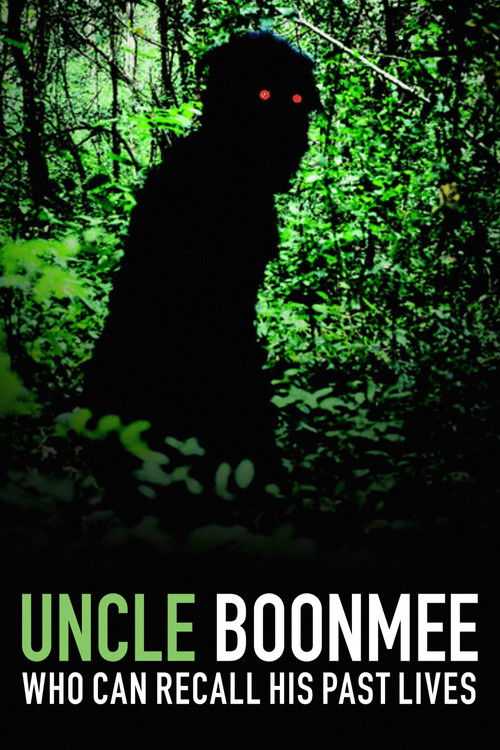
Uncle Boonmee Who Can Recall His Past Lives
2010 · Apichatpong Weerasethakul
Memoria's "one screen at a time, never streaming" release turned distribution itself into an artwork and a permanent debate about access versus aura. The name that signals deepest-end cinephilia.
For when you want to slow all the way down — a late, quiet night when you're open to something meditative and gently otherworldly rather than plot-driven. It asks patience and gives back a rare kind of peace; not a comfort watch in the usual sense, but genuinely soothing if you meet it on its terms.
What it's about
Boonmee, a farmer in Thailand's rural northeast, is dying of kidney failure and has come home to spend his last days among family. At dinner one evening the ghost of his late wife quietly joins the table, and his long-lost son returns in a strange non-human form — and nobody screams, because in this world the dead and the living simply share the room. As his strength fades, Boonmee begins to wonder which of his past lives brought this illness on, and the family sets out through the jungle toward a hilltop cave he believes he was born from, lifetimes ago.
The experience
Slow, humid, and strangely comforting — it moves at the pace of an evening on a porch, with long silences filled by insects and wind. Spooky things happen with total calm, and the effect is less fright than wonder; it works on you like a half-remembered dream you keep returning to.
The craft
Shot on grainy 16mm film in deep jungle darkness, it's a movie of dim rooms, red eyes glowing between trees, and one of the most quietly astonishing ghost entrances ever staged — done with almost no effects at all. The sound design is the real star: a constant hum of jungle life that makes headphones or good speakers essential.
Why it matters
It won the Palme d'Or at Cannes in 2010 — the first Thai film ever to do so — and became a defining work of contemplative world cinema, making Apichatpong Weerasethakul a name every serious filmgoer had to reckon with.
Snapshot
Uncle Boonmee Who Can Recall His Past Lives (Thai: Lung Bunmi Raluek Chat) is a quiet, slow-breathing fable about dying that becomes a meditation on memory, reincarnation, and the cinema's own mortality. A landowner with failing kidneys retreats to his farm in Thailand's northeast to die among kin; over a few evenings he is visited by the ghost of his late wife and by his lost son, returned as a red-eyed "monkey ghost," before a final trek to a cave that he takes to be the womb of an earlier existence. Around this spare armature Apichatpong Weerasethakul builds a porous world in which the living and dead, human and animal, past and present share the same dim rooms and humming jungle without hierarchy or alarm. The film won the Palme d'Or at the 2010 Cannes Film Festival — the first Thai feature to take the top prize — and in doing so brought the director, widely known as "Joe," and the broader current of contemplative world cinema to their largest audience. It is at once one of the most accessible of his features (it has a sick man, a family, a deathbed) and one of the strangest, a work that treats the supernatural as ordinary and narrative logic as optional.
Industry & production
The film was the centerpiece of a larger multi-platform undertaking Apichatpong called the Primitive project (2009), rooted in Nabua, a village in Nakhon Phanom province in the Isan region of northeastern Thailand. Primitive encompassed gallery installations, a video work, and short films — among them A Letter to Uncle Boonmee (2009) and Phantoms of Nabua (2009) — that shared landscapes, performers, and preoccupations with the feature. The point of departure was a slim book by a Buddhist abbot, often rendered in English as A Man Who Can Recall His Past Lives, about a Nabua man named Boonmee who claimed to remember earlier incarnations; Apichatpong has described encountering this text and reshaping its premise toward his own concerns with the region's memory and its erased history.
Like most of Apichatpong's features, Uncle Boonmee was financed through an international art-cinema patchwork rather than any domestic studio system. It was produced by his own Bangkok company, Kick the Machine, together with Illuminations Films (the UK producers Simon Field and Keith Griffiths, longtime backers of his work) and a consortium of European partners spanning France, Germany, Spain, and the Netherlands, with co-producer Charles de Meaux among the collaborators. This dependence on festival funds, European subsidy, and co-production money is itself characteristic of the economic position Apichatpong occupies — celebrated abroad while operating at the margins of, and often in friction with, the Thai commercial industry and its censorship regime. The budget was modest by international standards; precise figures are not part of the reliable public record. After its Cannes triumph the film was distributed by specialty labels (Strand Releasing in the United States, New Wave Films in the United Kingdom, among others), reaching arthouse and festival audiences rather than wide release.
Technology
Uncle Boonmee belongs to the late tail of the photochemical era, and its texture is inseparable from that fact. It was shot on film — 16mm origination is consistent with Apichatpong's working practice in this period — yielding the soft grain, gentle gradation, and forgiving low-light rendering that the film's many dusk and lamp-lit interiors depend on. (Readers should treat the exact gauge and finishing chain as a matter best confirmed against primary technical documentation rather than asserted here with false precision.) What matters thematically is that Apichatpong consciously framed the project around obsolescing media: he has spoken of the film as itself a kind of dying organism, an elegy for older modes of image-making at the threshold of digital displacement. The technology is not transparent here; it is part of the subject. The "monkey ghost" — a man in a dark, shaggy suit with glowing red eyes — is deliberately low-tech, evoking the costume monsters of mid-century Thai television and B-cinema rather than any contemporary effects pipeline, so that the supernatural arrives wearing the visible craft of an older popular culture.
Technique
Cinematography
The photography is credited to Sayombhu Mukdeeprom — who would later shoot Call Me by Your Name and Suspiria — working with Charin Pengpanich and Yukontorn Mingmongkon. The shooting style is patient and largely static or barely mobile: long takes, frontal or near-frontal compositions, a camera that watches rather than chases. Interiors are lit to preserve real darkness, so that figures emerge from and recede into shadow, which is essential to the famous dinner scene in which the dead wife materializes by slow degrees at the table and the lost son walks in from the night as a silhouette with burning eyes. The jungle exteriors, by contrast, are dense, green, and overwhelming, the human figures small within them. Apichatpong has noted that the film's six reels were each conceived in a somewhat different register or "style" of filmmaking, and the camera work shifts subtly across these movements — from the naturalistic farmhouse to the storybook tableau of the catfish sequence to the still-photograph montage near the end.
Editing
Editing is by Lee Chatametikool, the director's longtime collaborator (also editor of Tropical Malady and Syndromes and a Century). The cutting is unhurried and structural rather than dramatic: scenes are allowed to run to their natural exhalation, and the film's larger architecture — its division into discrete movements, its abrupt swerves into a princess's tale or a sequence of soldiers and a monkey ghost rendered in still images — is organized as a sequence of self-contained blocks rather than a continuously rising action. The most discussed cut is the coda's odd doubling, in which characters seem to step out of themselves into a karaoke-lit present, an editorial gesture that fractures the diegesis without explanation.
Mise-en-scène / staging
Staging favors the threshold: doorways, verandas, the edge of lamplight, the mouth of the cave. The supernatural is introduced not through shock cutting but through composition — a figure simply present in a chair that was empty, allowed to arrive within a held frame so the viewer registers the impossibility slowly. The cave interior, with its glittering walls and blind cave-fish, is staged as both geological space and metaphysical one, the "birthplace" Boonmee claims.
Sound
The soundtrack leans heavily on the dense, continuous drone of the nocturnal jungle — insects, frogs, wind — so that ambient sound does much of the work conventionally assigned to score. Non-diegetic music is sparing. Sound design is the work of Akritchalerm Kalayanamitr, with Koichi Shimizu among the collaborators associated with the music and sound of Apichatpong's films of this period; the precise division of labor is best verified against the credits. The effect is immersive and slightly hypnagogic, the audio field thick enough to feel like another character.
Performance
Apichatpong works largely with non-professional or first-time performers, and the acting is correspondingly understated and undemonstrative. Thanapat Saisaymar plays Boonmee with a worn, undramatic gravity; Jenjira Pongpas (a recurring presence in the director's cinema) plays the attentive sister-in-law Jen; Sakda Kaewbuadee appears as the young relative Tong; Natthakarn Aphaiwonk is the ghost-wife Huay; and Geerasak Kulhong is the transformed son Boonsong. The register throughout is conversational and matter-of-fact — the family discusses the returned dead with the mild curiosity of people remarking on a guest, which is precisely what makes the film's marvels land.
Narrative & dramatic mode
The narrative mode is associative and parabolic rather than causal. There is a through-line — a man is dying and prepares to die — but the film repeatedly digresses into self-enclosed episodes (the talking catfish who pleasures a disfigured princess; the photographic interlude of soldiers and a captured ape-creature) that resist integration into a single plot. Reincarnation supplies the organizing logic: identities are not stable, time is not linear, and a "past life" may be glimpsed sideways rather than narrated. Apichatpong refuses the usual machinery of suspense or revelation; the dramatic stakes are interior and metaphysical, concerned with acceptance, continuity, and the permeability of states of being. The result is closer to dream, folktale, or Buddhist parable than to conventional screen drama.
Genre & cycle
Nominally a drama with fantasy and horror elements, the film cannot be contained by any single genre. It draws on the ghost story, on Thai folk-supernatural traditions, and on the costume-monster aesthetics of older popular media, but it deploys these without their usual affect — no fear, no catharsis. It sits within the international art-cinema cycle often grouped under "slow cinema" or "contemplative cinema," alongside the durational, observational work of contemporaries elsewhere, while remaining idiosyncratically tied to Isan locality. Within Apichatpong's own body of work it forms a loose cycle with Tropical Malady (2004) and Syndromes and a Century (2006) — films likewise built on bifurcation, jungle transformation, and the dissolving boundary between worlds.
Authorship & method
The film is the work of a singular author-figure. Apichatpong Weerasethakul, trained partly in architecture in Thailand and in filmmaking at the School of the Art Institute of Chicago, moves fluidly between gallery installation and feature film, and Uncle Boonmee is inseparable from his parallel practice as a visual artist — it is the cinematic node of the Primitive installation network. His method is regionally and biographically embedded: he draws on Isan, on his own memories, on local performers and landscapes, and on the textures of the Thai popular culture he grew up with. His key collaborators recur from film to film and constitute something like a repertory company behind the camera as well as in front of it: editor Lee Chatametikool, cinematographer Sayombhu Mukdeeprom, sound artists including Akritchalerm Kalayanamitr and Koichi Shimizu, and performers such as Jenjira Pongpas and Sakda Kaewbuadee. Apichatpong wrote the film himself. He has framed the six-reel design as an homage to vanishing styles of cinema and has been candid that the project is partly about loss — of a man, of a region's suppressed history, and of older ways of making and watching images.
Movement / national cinema
Uncle Boonmee is the most internationally visible product of the contemporary Thai independent cinema that emerged around the turn of the millennium, distinct from both the Thai commercial mainstream and the regional genre exports (horror, action) that traveled abroad in the same years. More broadly it belongs to a transnational art cinema that festivals and critics championed in the 2000s and 2010s — a cinema of long takes, ambient sound, and metaphysical patience. Its grounding in Isan folk belief, animism, and Theravada Buddhist cosmology marks it as deeply national even as its financing and audience were emphatically international. The film also carries a political charge specific to its place: Nabua was a site of state violence against villagers during the Cold War suppression of communist sympathizers in the Thai northeast, and the Primitive project — and, more obliquely, the feature — is haunted by that history of disappearance and forgetting.
Era / period
The film arrived in 2010, at a hinge moment: the late dusk of celluloid before digital projection and capture became standard, and a period of acute political turbulence in Thailand. Its Cannes victory came during a year of major unrest in Bangkok, and the film's concern with memory, killing, and erasure resonated against that backdrop, though Apichatpong's treatment is allusive rather than topical. Within film history it stands as a marker of the moment when durational world cinema reached peak institutional prestige — the Palme d'Or being the loudest possible endorsement of an aesthetic long confined to specialist audiences.
Themes
Reincarnation and the continuity of the soul across human, animal, and spirit forms is the film's spine: Boonmee contemplates the lives that may have produced his suffering, and the cave becomes a literalized image of rebirth. Memory — personal, ancestral, regional, and cinematic — runs through every level, from the dead wife who returns to care for the dying to the buried history of Nabua's violence. Death is approached not with terror but with a kind of hospitality; the boundary between living and dead is treated as thin and traversable. Animism and the agency of the nonhuman world pervade the jungle and even the talking catfish. And, reflexively, the film meditates on cinema itself as a medium of memory and ghosts — an apparatus for keeping the dead present — and on its own obsolescence.
Reception, canon & influence
Critical reception was prominent and largely admiring, anchored by the Palme d'Or awarded under a jury presided over by Tim Burton — a result widely noted as a surprise given the film's difficulty and a milestone as the first Palme for Thai cinema. Critics praised its serenity, originality, and emotional warmth beneath the formal strangeness, while acknowledging that its slowness and refusal of explanation divided viewers; it became a touchstone in debates over "slow cinema." It has since recurred on critics' lists of the major films of its decade, securing a place in the contemporary art-cinema canon.
Backward, the film's influences are firmly avowed by its maker: the Buddhist text about the Nabua Boonmee; the folk-supernatural traditions and animism of Isan; and, formally, the older Thai cinema, television, comics, and radio drama of Apichatpong's youth, whose vanishing styles the six reels are designed to echo. It also extends his own prior films — the jungle metamorphoses of Tropical Malady, the doubled structures of Syndromes and a Century. Forward, its impact is twofold. Within the director's oeuvre it consolidated a method he would carry into Cemetery of Splendor (2015) and the internationally cast Memoria (2021). More broadly, its visibility lent legitimacy and reach to a whole strain of patient, contemplative, supernaturally porous filmmaking, encouraging festivals, distributors, and younger filmmakers to take seriously a cinema of duration and metaphysical openness. Specific lines of direct influence on named successors are harder to document with confidence than the film's general standing, and that distinction is worth preserving rather than overstating.
A Deleuzian reading
Watch the dinner on the veranda again.
The full Deleuzian reading of Uncle Boonmee Who Can Recall His Past Lives →
Reception
One of the most divisive Palme d'Or wins ever — Cannes 2010 saw baffled shrugs and 'what were they thinking' takes alongside rapture, with Tim Burton's jury defending it as a beautiful strange dream. A decade-plus later the argument is over: it routinely lands on best-of-the-century lists and is the consensus entry point to Apichatpong's canon.
How Uncle Boonmee Who Can Recall His Past Lives was received, from release to now →
Influences: the films it descends from and the films it influenced
- Tropical Malady (2004) — Establishes the bifurcated structure splitting realist village life from a jungle of metamorphosis and man-into-animal dissolution, which Boonmee's catfish-princess and monkey-ghost reels directly extend.
- Syndromes and a Century (2006) — Pioneers the mirrored/doubled episodic structure and the recurring repertory cast (Jenjira Pongpas, Sakda Kaewbuadee) staged in long static takes at clinic and rural thresholds that Boonmee reassembles.
- Blissfully Yours (2002) — Introduces the extended real-time jungle long take with ambient forest sound carrying the score in place of music, performed by non-professional Isan cast.
- Mysterious Object at Noon (2000) — Builds narrative as an exquisite-corpse relay handed between non-professional rural storytellers, seeding the digressive, episode-passing logic of Boonmee's six reels.
- Stalker (1979) — Models the durational long-take traversal of a metaphysically charged natural zone underscored by ambient electronic drone, the same patient threshold-crossing into the uncanny.
- Ugetsu (1953) — Sets the precedent of integrating the dead into the everyday without horror coding — ghosts returning to share a meal, rendered through soft dissolves rather than shock cuts, as Boonmee's late wife and son arrive at dinner.
- I Walked with a Zombie (1943) — Provides the low-key-lighting grammar of suggesting the supernatural off-screen and through glowing eyes emerging from darkness, echoed in the red-eyed Monkey Ghosts surfacing on the veranda.
- Au Hasard Balthazar (1966) — Originates the use of non-professional 'models' with flat, undemonstrative affect and an animal as spiritual vessel, the performance register Apichatpong's cast and beast-spirits inherit.
- Mirror (1975) — Apichatpong extends Tarkovsky's staging principle — past and present coexisting in the same space with no ontological distinction and no editorial alarm — using patient long-takes and elemental environments (jungle canopy, firelight, cave water) as the medium through which temporal coexistence becomes sensory rather than conceptual.
- Fanny and Alexander (1982) — Weerasethakul extends Bergman's method of staging supernatural presences within undisturbed domestic space—a ghost wife appearing at the dinner table, a monkey spirit emerging from the forest—treating the uncanny as tonally and spatially continuous with the mundane rather than as expressionist rupture requiring a different visual register.
- The Thin Red Line (1998) — Weerasethakul's camera rests on jungle, fireflies, and catfish with the same contemplative weight it gives human faces and cuts associatively between living, dead, and animal states under minimal dialogue — extending Malick's non-human camera attention and essay-film logic into Southeast Asian animist cosmology.
- Spring, Summer, Fall, Winter... and Spring (2003) — Renders Buddhist karma and reincarnation through slow ambient long takes immersed in nature and natural sound, extending the contemplative spiritual-cinema mode into a later generation.
- Cemetery of Splendor (2015) — Consolidates Boonmee's method directly — sleeping soldiers, Jenjira Pongpas, Isan landscape, and porous waking/dreaming thresholds shot in low-key long takes.
- Memoria (2021) — Extends the film's ambient-sound-as-haunting (the recurring 'bang') and contemplative long-take staging into an internationally cast register while keeping the durational metaphysics.
- A Ghost Story (2017) — Renders a haunting through duration and patient fixed long takes, treating memory and mortality as temporal endurance rather than plot, downstream of Boonmee's contemplative metaphysics of loss.
- The Blue Trail (2025) — Fuses the sensual, spiritual, and folkloric in a jungle register where the supernatural (the snail's analog) arrives matter-of-factly amid mortality.
- Thirteen Lives (2022) — Sayombhu Mukdeeprom's foundational collaboration with Apichatpong established his wide-angle deep-focus staging of Thai forest and interior light — the naturalist ambient palette and spatial grammar he imported wholesale into Thirteen Lives's cave and jungle location photography.
- Aftersun (2022) — Multiple temporal and experiential registers — waking, memory, near-death — treated as coequal film space without hierarchical framing; ambient sound as connective tissue across ontological levels, a structural precedent for Wells's intercutting of memory footage and present-tense reality without privileging either.
- Yuni (2021) — Shared editor Lee Chatametikool's duration-accretion cutting and long-take patience — letting scenes breathe past narrative function — is the editorial DNA of Yuni's rhythm.
- Goodbye, Dragon Inn (2003) — Shares the cinema-as-mortality device — a dying movie palace haunted by the ghosts of old films — rendered in extreme-duration static long takes, the vanishing-cinema homage Boonmee builds into its six-reel design.
- Silent Light (2007) — Stages the dead returning to life within a slow rural realism using natural-light long takes and a non-professional faith-community cast, the same matter-of-fact supernatural porousness.
- Tabu (2012) — Splits its structure into reels evoking vanishing film styles, using celluloid texture and a silent-era register to summon colonial ghosts — a formal homage to obsolete cinema parallel to Boonmee's.
- Jauja (2014) — Uses durational landscape long takes on Academy-ratio celluloid to open a threshold/portal that folds time and identity, the contemplative passage into the uncanny Boonmee shares.
- Colossal Youth (2006) — Casts non-professionals playing versions of themselves in low-key chiaroscuro, composed repeatedly in doorways and thresholds, the same fusion of documentary presence and ghostly framing.
- Romería (2025) — Shares the technique of letting the dead quietly re-enter a naturalistic frame so that the film's reality bends late and without alarm — the same unannounced dissolution of the realist contract.
- Resurrection (2025) — A folkloric reincarnation anthology in which each register is shot in a different filmic style, paralleling Bi's six-senses chapter-by-chapter shifts of mode.
- Sound of Falling (2025) — A haunted landscape where transgenerational memory and the dead literally inhabit place, achieved through patient available-light slow cinema.
- Kaili Blues (2016) — Weerasethakul's integration of Isan folk spiritual traditions — the forest as a non-linear space where the dead return and time is reversible — into the structural logic of the film rather than its thematic content is the closest contemporary model for Bi Gan's integration of Miao folk cosmology into Kaili Blues' temporal architecture.
- Drive My Car (2021) — Slow-cinema duration deployed as an ethical stance toward grief; the dead addressed directly within the same physical space as the living; an embedded narrative (the princess sequence) interrupting the realist frame without rupturing it — the same structural logic as the Chekhov rehearsals inside the fiction.
- The Assassin (2015) — Apichatpong's reliance on diegetic ambient forest soundscapes and patient held frames to summon a contemplative, time-suspended mood is the same slow-cinema sound-and-duration craft Hou deploys.
- EO (2022) — Dissolves the boundary between human and animal consciousness through associative, tableau-based episodes and abrupt tonal interludes that interrupt narrative logic.
Similar films
- Syndromes and a Century (2006) — influence & lineage · same viewing thread · often watched together
- Tropical Malady (2004) — influence & lineage · often watched together
- Au Hasard Balthazar (1966) — influence & lineage · same viewing thread · often watched together
- Goodbye, Dragon Inn (2003) — influence & lineage · often watched together
- Cemetery of Splendor (2015) — influence & lineage
- Memoria (2021) — influence & lineage
- Resurrection (2025) — influence & lineage
- Spring, Summer, Fall, Winter... and Spring (2003) — same viewing thread
All the films related to Uncle Boonmee Who Can Recall His Past Lives →
Watch it with: curated runs of related films
- Transcendental Style — A run for when you want cinema as prayer — faith, ritual, and the turning of seasons rendered in long takes and painterly stillness, where time itself becomes the subject rather than the story.