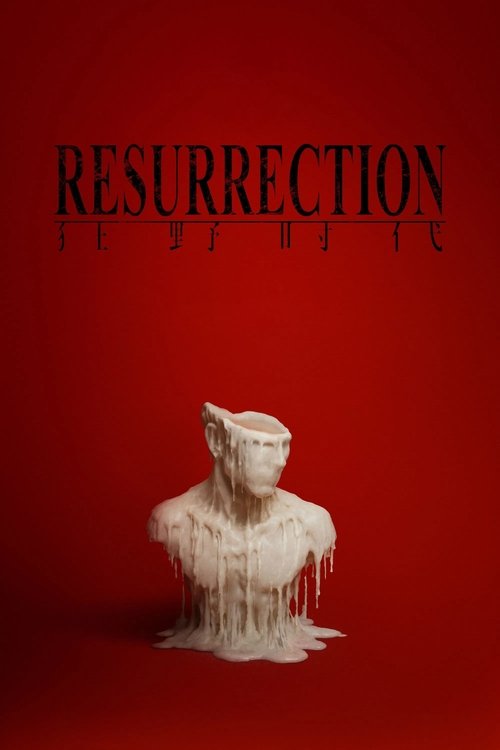
Resurrection
2025 · Bi Gan
Resurrection's Cannes special prize confirmed him as art cinema's great showman — the one whose hour-long 3D takes make cinephiles book flights. "Event cinema for the Letterboxd 4.5 crowd."
For a night when you want to surrender completely — lights off, phone away, and let a film wash over you like a dream you can't explain the next morning. This is challenge viewing, not comfort viewing, and it rewards the patient.
What it's about
In a future where humanity has given up dreaming in exchange for immortality, dreams survive only in rare aberrant beings — and one dying outcast who still dreams plunges through a century of them. What follows is a journey across nested dream-worlds, each with its own texture and logic, as he is pursued through visions that are by turns nightmarish and ravishing. It's an epic built out of illusion: a hundred years of human memory relived from the inside.
The experience
Intoxicating and disorienting in roughly equal measure — you stop trying to track the plot and start floating on the images, which shift style and era under your feet. It's long, slow-building, and genuinely hypnotic; less a story you follow than a state you enter.
The craft
Bi Gan stages each dream as a tour through a different age of moviemaking, recreating the look and feel of successive cinematic eras — from flickering early-film textures to saturated, neon-drenched reverie — with a formal ambition that won a one-off Special Award at Cannes. It is emphatically a big-screen film: the images are the argument, and the sound design does as much dreaming as the visuals.
Why it matters
The Prix Spécial at Cannes 2025 confirmed Bi Gan's leap from intimate provincial reveries to full-scale epic, and marked him as one of the boldest formal imaginations working anywhere.
Snapshot
Resurrection (狂野时代, literally "Wild Times") is the third feature by the Chinese director Bi Gan, and his most expansive: a 159-minute, China–France co-production that premiered in the main competition of the 78th Cannes Film Festival on 22 May 2025 and won the Prix Spécial, a one-off Special Award conferred by Juliette Binoche's jury. Where Bi's earlier features were intimate provincial reveries, Resurrection is conceived as an epic in dialogue with the whole history of cinema. Its premise is openly allegorical: in a future where humankind has traded the capacity to dream for effective immortality, dreaming survives only in aberrant beings, and a dying "Deliriant" (sometimes rendered "Fantasmer") relives roughly a hundred years of human and cinematic time across a series of dreams nested inside a film projector, pursued and shepherded by a woman who wields the "lost techniques" of moviemaking. The film is structured into six chapters mapped onto the six senses of Buddhist cognition — sight, hearing, taste, smell, touch, and mind — with each dream rendered in the idiom of a different era and genre of film history, from silent expressionism to neon-soaked millennial romance. It is at once a science-fiction conceit, an essay on perception, and a self-conscious act of cinephile devotion.
Industry & production
Resurrection is a co-production between China and France, a financing structure that has become characteristic of ambitious Chinese auteur cinema seeking festival exposure outside the domestic system. The Chinese partners are Huace Pictures and Bi Gan's own Dangmai Films — "Dangmai" (荡麦) being the invented place-name that recurs across his work as a personal mythological territory. The French side brings Charles Gillibert's CG Cinéma (a producer long associated with Olivier Assayas and Mia Hansen-Løve), Arte France Cinéma, and Obluda Films; Gillibert is credited as a producer alongside Shan Zuolong and Yang Lele. The language is Mandarin.
This is a marked scaling-up from Bi's earlier productions, which were celebrated partly for doing extraordinary things on modest means. The starry, predominantly mainland cast — led by Jackson Yee (Yi Yangqianxi), one of China's biggest young screen and pop stars, and the veteran Shu Qi — signals a budget and commercial ambition well beyond Kaili Blues or even Long Day's Journey Into Night. The film opened theatrically in China on 22 November 2025 and in France on 10 December 2025. International distribution placed it firmly within the art-house prestige circuit: Janus Films acquired North American rights out of Cannes, with a limited December 2025 release, and the title was slated for the Criterion Collection's streaming channel by April 2026. A reported global box-office figure of roughly US$28 million has circulated; given the film's recency, such commercial figures should be treated as provisional rather than settled.
Technology
The film's technological identity is a deliberate paradox: it deploys contemporary digital capture in the service of antique and analog-looking effects. Cinematographer Dong Jingsong shot on the DJI Ronin 4D, a compact integrated cinema camera-and-gimbal system whose stabilization is central to Bi's signature roving long takes. Against that modern backbone, the production layers a vocabulary of early-cinema and pre-digital trickery — stop-motion, reverse motion, double exposure, time-lapse — so that the image often reads as hand-made even when it is not. The opening silent chapter is built explicitly out of the "cinematic language" of the early twentieth century, invoking the in-camera illusionism of Georges Méliès and the expressionist staging of F.W. Murnau. The result is a film that uses the newest tools to counterfeit the oldest ones, consistent with its thematic argument that cinema's power lies less in fidelity than in illusion.
Technique
Cinematography
Dong Jingsong, who was among the cinematographers on Long Day's Journey Into Night, is the visual author here alongside Bi. The film's most discussed set piece is its closing chapter, set on New Year's Eve 1999 in a port city: a roughly half-hour unbroken take that moves fluidly from rain-slicked, streetlamp-lit alleys into crowded nightclubs, with the palette swinging between red-tinged warmth and moody blue. The sequence has drawn comparison to the neon romanticism of Wong Kar-wai and Christopher Doyle, and extends the single-take ambition that defined Bi's previous feature into a new register. Across the six chapters the cinematography is chameleonic by design — the high-contrast monochrome and iris effects of silent expressionism, the chiaroscuro of noir, the earthy naturalism of the historical sections — making the camera itself the film's protagonist as much as any character.
Editing
Bi Gan cut the film with Bai Xue. The editing's central task is structural rather than rhythmic: it must articulate a frame narrative (the dying Deliriant) against six discrete stylistic worlds, each obeying the cutting grammar of a different period — the rapid, intertitle-punctuated assembly of silent cinema giving way, finally, to the near-absence of editing in the unbroken millennial long take. That trajectory, from heavy montage toward a single continuous shot, is itself a compressed history of how film has organized time, and a reprise of Bi's recurring interest in dissolving the cut altogether.
Mise-en-scène / staging
Staging is where Resurrection most flamboyantly performs its cinephilia. The silent-era passages adopt expressionist sets and gestural, period-accurate performance; later chapters reconstruct mid-century monastic spaces, the textures of the Cultural Revolution era, and the grubby commercial energy of late-1990s capitalism. Recurring props — a coded suitcase, a theremin, a Buddha statue, playing cards — function as talismans threading the dreams together. Bi has described prioritizing the inspiration of imagination over authenticity, and the staging accordingly leans toward the oneiric and emblematic rather than the strictly historical.
Sound
The score is by M83, the French project of Anthony Gonzalez — a notable departure, since Bi's earlier features were scored by the Taiwanese musician Lim Giong. The choice aligns the film's sonic world with M83's lush, synth-driven romanticism, and the soundtrack is integral to the shifts between eras. The first chapter's silent-film conceit foregrounds sound by its pointed absence: intertitles styled after the silent era carry the narration, including a much-quoted line comparing people who no longer dream to "candles that do not burn." A theremin features diegetically, knitting the film's interest in early electronic sound into its plot.
Performance
Jackson Yee anchors the film in a demanding multiple role, embodying the Deliriant across successive incarnations — a musician's companion, a former monk, a con artist, the hoodlum "Apollo" — and thus across the distinct performance styles each era demands, from the broad pantomime of silent cinema to millennial naturalism. Yee has spoken of the physical ordeal of the closing long take, reportedly shot nightly across roughly half a month, one usable take per night. Shu Qi plays the woman who hunts the Deliriant — variously framed as the "Big Other," a maternal figure, and the film's voice-over — and reportedly studied period acting technique for the silent passages. The ensemble includes Mark Chao, Li Gengxi, Huang Jue, and Chen Yongzhong.
Narrative & dramatic mode
The dramatic mode is dream-logic anthology bound by an allegorical frame. Rather than a continuous plot, Resurrection proceeds by metamorphosis: a dying being relives a century in nested dreams, each a self-contained genre exercise, the whole organized by the conceptual scaffold of the six Buddhist senses. This is narration by resonance and recurrence rather than cause and effect — props, faces, and motifs migrate between chapters, accruing meaning associatively. Some critics found the architecture exhilarating and others found it opaque; the film does not resolve its premise so much as dilate it. Bi himself has framed the project as an attempt to "raise questions instead of answers," and the dramatic experience is closer to a guided reverie or essay-film than to conventional storytelling.
Genre & cycle
Nominally science fiction and drama, Resurrection belongs more truly to the cycle of cinema-about-cinema — the reflexive art film that takes film history as its subject, a lineage running through works as varied as Godard's Histoire(s) du cinéma and the more elegiac strain of festival auteur filmmaking. Its science-fictional frame (immortality bought at the price of dreaming) is a device for staging that meditation rather than a genre commitment in the hardware sense. Within the chapters it cycles deliberately through genre history itself: expressionist horror, film noir, the Buddhist parable, a neorealist-flavored con narrative, and a vampire romance. It thus sits at the confluence of the international art film and a distinctly Chinese strand of poetic, memory-haunted cinema.
Authorship & method
Bi Gan (b. 1989, Kaili, Guizhou) is among the most distinctive auteurs to emerge from China in the 2010s, and Resurrection is unmistakably a personal work: he directs, co-writes (with Zhai Xiaohui), and co-edits. His method here extends preoccupations visible since Kaili Blues — the long take as a way of fusing memory, dream, and present time; a regional, folkloric sensibility; the porousness between waking and dreaming. By his own account, the team began without a fixed idea for "a film about the future" and pivoted instead to exploring cinema's past — "how film evolved." He cites Murnau and Méliès as touchstones of filmic language, early Shanghai cinema for its historical texture, and Chinese literary and folk traditions, singling out Pu Songling's Strange Tales from a Chinese Studio (Liaozhai zhiyi). He describes perspective as "the most fundamental, simple yet mysterious technique in filmmaking," and the film's shifting points of view — beginning with the audience watching itself — as a deliberate meditation on spectatorship.
The key collaborators reinforce this authorship. Cinematographer Dong Jingsong carries over from Long Day's Journey Into Night and is co-architect of the film's roving camerawork. Co-editor Bai Xue helps manage its polyphonic structure. Composer M83 (Anthony Gonzalez) marks a new sonic direction away from longtime collaborator Lim Giong. Co-writer Zhai Xiaohui shares the screenplay credit, and producer Charles Gillibert anchors the French co-production. With the children in the cast, Bi has said his only directing strategy was "to become their friend."
Movement / national cinema
Bi belongs to the most recent wave of Chinese arthouse auteurs working at the festival-oriented margins of a vast commercial industry, heirs in spirit to the Sixth Generation's independence while pursuing a more lyrical, less social-realist project. His lineage runs through the slow-cinema poetics of Hou Hsiao-hsien and Apichatpong Weerasethakul and the spiritual durational cinema of Tarkovsky, filtered through a specifically Guizhou provinciality. Resurrection both belongs to this national cinema and self-consciously historicizes it: its chapters move through early Shanghai cinema, the Cultural Revolution, and the boom years of Chinese capitalism, narrating China's twentieth century alongside cinema's. The French co-financing, meanwhile, situates it within the transnational art-film economy on which such Chinese auteur work depends.
Era / period
The film is a product of, and a commentary on, the mid-2020s — a moment of anxiety about immortality, technological enhancement, and the displacement of human dreaming, here literalized into its premise. It arrives as Chinese auteur cinema continues to negotiate between domestic commercial scale (a major pop-star lead, a substantial budget) and international prestige. Its internal periods, however, reach across the long twentieth century, treating the century of film as coextensive with a century of Chinese modernity.
Themes
The governing theme is dreaming as the irreducible core of being human — and cinema as the last refuge of dreams. The science-fictional bargain (immortality for the surrender of dreaming) frames cinema itself as a form of mortal, necessary illusion: to dream is to burn, and not to dream is to be a candle that does not burn. From this flow the film's secondary concerns: perception and the six senses as the gateways of experience; memory, reincarnation, and Buddhist cycles of suffering and release; the relationship between authenticity and imagination, which Bi resolves firmly in favor of the imagined; and a sustained reflection on spectatorship, the audience implicated in its own watching. Cinema history becomes a vehicle for all of these — each genre a different way the medium has taught humanity to dream.
Reception, canon & influence
Backward — influences on the film. The film wears its sources openly. Bi explicitly invokes German Expressionist horror, naming The Cabinet of Dr. Caligari (1920) and Nosferatu (1922), and the foundational figures of Murnau and Méliès. Beyond these, critics and the director identify early Shanghai cinema, the neon romanticism associated with Wong Kar-wai and Christopher Doyle (most legible in the final chapter), the durational metaphysics of Tarkovsky, and the slow-cinema lineage of Hou Hsiao-hsien — alongside Pu Songling's classical tales and Chinese folk tradition. The film is also in conversation with Bi's own prior work, extending the single-take experiment of Long Day's Journey Into Night (whose celebrated final movement was a long, immersive take) into a wholly new structure.
Reception. Critical response was strongly favorable. The film was widely praised for its visual invention and ambition, with aggregator scores reported in the high range (Rotten Tomatoes around 90%, Metacritic around 87), and the New Year's Eve long take singled out for acclaim; dissenting notices centered on the narrative's opacity and demands on the viewer. Its Cannes Prix Spécial — a distinction created specifically for it — formally marked its arrival as a major work, and acquisition by Janus and the Criterion Collection signaled its anticipated canonical standing within art cinema.
Forward — what it may shape. As a very recent release, Resurrection's legacy is necessarily unwritten, and any claim about its long-term influence would be speculative. What can be said is that it consolidates Bi Gan's position as a leading auteur of his generation and advances the reflexive, cinema-historical art film as a viable mode at the largest festival scale. Its fusion of digital capture with analog illusionism, and its anthology-by-genre architecture, offer a template other filmmakers may draw on; whether it becomes a durable reference point will only be clear with time. On the present record, it stands as the most ambitious statement to date from one of contemporary cinema's most singular voices.
A Deleuzian reading
An intertitle floats up, styled like something struck from a 1922 print: people who no longer dream are "candles that do not burn." That single card holds the whole of Bi Gan's film.
The full Deleuzian reading of Resurrection →
Reception
It split Cannes 2025 down the middle — ecstatic raves against baffled shrugs — until Juliette Binoche's jury literally invented a Special Prize just to honor it; within a year it had gone from festival curio to the arthouse event of the season.
How Resurrection was received, from release to now →
How to watch Resurrection: what to notice on a first viewing
- Notice the cutting slow down as the film goes on. The editing moves from rapid, intertitle-punctuated cutting in the silent-era chapter toward a nearly unbroken take by the final chapter. Movement itself starts carrying meaning, with less and less need for a cut.
- Track a single object that reappears in different eras. A coded suitcase, a theremin, a Buddha statue, and playing cards keep resurfacing across chapters set decades apart from each other. These eras sit as regions you move through rather than a line you follow.
- Notice how different each chapter's visual style looks. One chapter is shot like silent-era monochrome with iris effects, another like film noir, another like neon-soaked millennial romance. One chapter's shadow work makes matter itself feel alive and threatening, closer to old horror than to modern gloss.
- Listen for the theremin used inside the story itself. Rather than sitting only on the score, the theremin appears as an instrument the characters themselves are using, tying old electronic sound directly into the plot. The film's interest in early sound technology becomes something you watch someone actually play.
- Watch the same actor play several different people. Jackson Yee embodies a musician's companion, a monk, a con artist, and a hoodlum across the film's chapters, shifting acting style along with each era. One performer carries the whole century, changing shape as completely as the film around him does.
The whole guide to watching Resurrection, with the keys for a rewatch →
Influences: the films it descends from and the films it influenced
- The Cabinet of Dr. Caligari (1920) — Painted, distorted forced-perspective sets and the framing of the whole story as a madman's dream supply Resurrection's expressionist staging and its dream-anthology architecture, a film Bi names directly.
- Nosferatu (1922) — Its vampiric monster carved out of chiaroscuro and cast-shadow effects gives Bi the silent-horror grammar — intertitles, stark key light — for the film's monster chapter.
- A Trip to the Moon (1902) — Méliès's substitution-splice and theatrical in-camera illusionism is the analog 'trickery' Bi revives and weds to DJI Ronin digital capture.
- Sunrise: A Song of Two Humans (1927) — The 'unchained camera' gliding unbroken through built-up false-perspective sets is the direct precedent for Bi's roving, set-traversing long takes.
- Mirror (1975) — Durational memory-montage in which time is experienced rather than plotted models the metaphysical, non-causal logic binding Resurrection's episodes.
- In the Mood for Love (2000) — Christopher Doyle's saturated neon romanticism and step-printed smeared motion is the explicit visual texture Bi quotes in the final chapter.
- Flowers of Shanghai (1998) — Slow-cinema long takes drifting through lamplit interiors establish the durational, plan-séquence ethic Bi inherits from Hou's slow-cinema lineage.
- Russian Ark (2002) — The feature-length single unbroken Steadicam take as a guided tour through history and art is the bravura-continuity precedent behind Bi's set-piece long takes.
- Kaili Blues (2015) — Bi's own debut long-take dream-poem fusing memory, folklore and present time is the method-seed that Resurrection scales up.
- Long Day's Journey Into Night (2018) — Its celebrated hour-long immersive final take — shot with the same DP, Dong Jingsong — is the single-take experiment Resurrection expands into a whole anthology.
- Street Angel (1937) — Early Shanghai cinema's fusion of song, urban melodrama and street texture is the period-texture register Bi cites and reanimates for the film's historical layers.
- Goodbye, Dragon Inn (2003) — A cinema-about-cinema elegy for the dying movie palace that foregrounds spectatorship, kin to Bi's 'audience watching itself' opening conceit.
- Uncle Boonmee Who Can Recall His Past Lives (2010) — A folkloric reincarnation anthology in which each register is shot in a different filmic style, paralleling Bi's six-senses chapter-by-chapter shifts of mode.
- Holy Motors (2012) — An episodic odyssey through distinct cinematic genres with a single performer in multiple roles, mirroring Resurrection's multiple-role, genre-per-chapter design.
- Birdman or (The Unexpected Virtue of Ignorance) (2014) — Hidden-cut editing that disguises montage as one continuous take, plus a reflexive obsession with performance, shares Bi's montage-to-single-take craft.
- 1917 (2019) — Roger Deakins's elaborately choreographed 'one-shot' stitched from concealed digital seams is the same constructed-continuity technique Bi deploys.
- The Assassin (2015) — Painterly elliptical narration built from stillness and held composition extends the Chinese-arthouse-auteur formal rigor Bi works within.
Similar films
- Long Day's Journey Into Night (2018) — influence & lineage
- The Assassin (2015) — influence & lineage
- Uncle Boonmee Who Can Recall His Past Lives (2010) — influence & lineage
- The Cabinet of Dr. Caligari (1920) — influence & lineage · often watched together
- In the Mood for Love (2000) — influence & lineage · often watched together
- Dune: Part Two (2024) — often watched together
- Ne Zha 2 (2025) — often watched together
- Kaili Blues (2016) — shared sensibility
All the films related to Resurrection →
Watch it with: curated runs of related films
- Dream Logic, Made by Hand — A run for when you want films where imagination doesn't just appear onscreen but rebuilds the world — stories nested inside stories, daydreams that leak into daylight, realities that quietly dissolve.