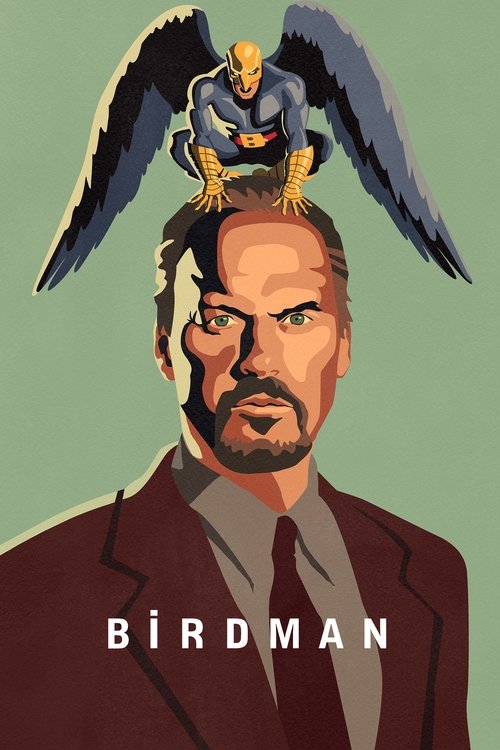
Birdman or (The Unexpected Virtue of Ignorance)
2014 · Alejandro G. Iñárritu
For when you want something electric and showoffy that still has a bruised heart — a film to argue about over drinks afterward. Energizing rather than relaxing; great when you're wide awake and want to be dazzled.
What it's about
Riggan Thomson was a movie star once — famous for playing a winged superhero — and now he's betting his savings, his family, and whatever's left of his sanity on writing, directing, and starring in a serious Broadway play. As opening night bears down, he juggles a volatile co-star, a daughter fresh out of rehab, brutal critics, and the mocking superhero voice in his own head, all inside the pressure cooker of a Times Square theater.
The experience
Frenetic, funny, and anxious in the best way — the camera never seems to stop moving, the drum score keeps jabbing at you, and the whole thing plays like a two-hour adrenaline spike shot through with midlife melancholy. You laugh a lot and squirm a little.
Performances
Michael Keaton, himself a former screen superhero, gives the comeback performance of his career — raw, funny, and painfully exposed — and Edward Norton is riotous as a brilliant, insufferable stage actor. Emma Stone's coiled, furious turn as Riggan's daughter delivers some of the film's sharpest scenes.
The craft
The whole film is stitched to look like one continuous unbroken shot, gliding through backstage corridors, dressing rooms, and out into neon-lit Times Square — a technical high-wire act by cinematographer Emmanuel Lubezki that turns filmmaking bravado into the story's own nervous energy. The improvised-feeling jazz drum score drives the pace like a heartbeat. It rewards a big screen and loud speakers.
Why it matters
It swept the top Oscars, including Best Picture and Director, resurrected Michael Keaton's career in a stroke of perfect casting, and became the reference point for the modern long-take spectacle — arriving right as Hollywood's superhero era hit full saturation, which gave its satire real teeth.
Snapshot
Birdman or (The Unexpected Virtue of Ignorance) is a backstage tragicomedy about Riggan Thomson (Michael Keaton), a washed-up movie star once famous for playing a winged superhero, who stakes his savings, sanity, and last claim to relevance on writing, directing, and starring in a Broadway adaptation of Raymond Carver's "What We Talk About When We Talk About Love." The film's central conceit is formal as much as dramatic: it is constructed and edited to appear as a single, unbroken take that glides through the corridors, dressing rooms, and stage of the St. James Theatre and out into the neon canyon of Times Square. Iñárritu, working with cinematographer Emmanuel Lubezki, turned the long-take aesthetic from an occasional bravura device into the governing logic of an entire feature, marrying it to a self-lacerating comedy about ego, the superhero economy, and the anxious border between high art and mass entertainment. Released by Fox Searchlight in the autumn of 2014, the film became a critical and awards phenomenon, winning the Academy Award for Best Picture and earning Iñárritu Oscars for directing and (shared) writing, alongside Lubezki's cinematography award. It marked a sharp tonal pivot for a director previously identified with grave, fractured multi-strand dramas, and it became one of the defining "one-shot" films of the 2010s.
Industry & production
Birdman sits at the intersection of two industrial currents of the early 2010s: the consolidation of the superhero franchise as Hollywood's dominant commercial form, and the persistence of mid-budget, prestige-driven independent filmmaking under the wing of studio specialty divisions. The project was produced for a reported budget in the range of $16–22 million — modest by studio standards but substantial for a dialogue-driven chamber piece — and distributed by Fox Searchlight Pictures, the specialty label whose business model depended precisely on the kind of awards-season auteur work Birdman represented. New Regency Productions and Iñárritu's own outfit were among the production entities; the screenplay was co-written by Iñárritu with Nicolás Giacobone, Alexander Dinelards Aranda — I should be careful here: the credited co-writers are Nicolás Giacobone, Alexander Dinelaris Jr., and Armando Bo, alongside Iñárritu.
The casting carried a layer of metatextual commentary that was central to the film's reception and, plausibly, to its financing appeal. Michael Keaton, who had played Batman in Tim Burton's 1989 and 1992 films before largely receding from leading-man status, was cast as a fading actor defined by an old superhero role — a resonance the film exploits without ever literally naming Keaton's history. The ensemble drew on actors with their own franchise and stage associations: Edward Norton (himself a one-time screen Hulk) as a volatile Method stage star, Emma Stone, Naomi Watts, Andrea Riseborough, Zach Galifianakis, and Amy Ryan. Shot largely on location and on built sets approximating the backstage geography of a Broadway house, the production demanded an unusually rehearsal-intensive, theatrically disciplined process driven by the long-take strategy described below.
Technology
Technologically, Birdman is a film of the digital-cinematography era pushed toward a specific expressive end. It was shot digitally, predominantly on the Arri Alexa, whose sensitivity and dynamic range were essential to a film that moves continuously between dim backstage corridors, the hot pools of stage lighting, and the saturated electric glare of Times Square at night — transitions a single continuous camera move could not survive without a sensor capable of holding detail across that exposure range. The "single take" illusion is fundamentally a product of digital tools: invisible stitching of takes relies on the controllability of digital image data, motion-matched dissolves, and extensive but unobtrusive visual-effects and compositing work to hide the joins where one shot becomes another. The film's modest superhero-fantasy interludes — Riggan's telekinetic outbursts, a brief flying sequence over Manhattan, an apocalyptic Birdman vision — required conventional VFX, but the more demanding "technology" of the film is its seamless concealment of cuts, a craft achievement that depended equally on choreography, lighting continuity, and digital post-production.
Technique
Cinematography
Lubezki's camerawork is the film's signature and its most influential single element. The camera is almost never still; it tracks, cranes, pivots, and threads through doorways in long fluid movements that bind characters and spaces into a continuous present. The choreography required actors, camera operators, focus pullers, lighting, and sound to hit precise marks across minutes-long uninterrupted runs, with handoffs between Steadicam, dolly, and handheld operation. Lubezki favored a wide-ish lens vocabulary that keeps figures embedded in their environment, and he exploited practical and motivated light sources — dressing-room bulbs, stage instruments, street signage — to justify the constantly shifting exposure. Time is compressed elliptically within the apparent continuity: a push past a window or a dissolve over the sleeping Riggan lets hours or days pass while the take seems never to break. The result won Lubezki his second consecutive Academy Award for Cinematography (following Gravity), and helped cement a 2010s vogue for the immersive long take.
Editing
The editing, credited to Douglas Crise and Stephen Mirrione, is paradoxical: a film engineered to look unedited is in fact one of the most intricately constructed cutting jobs of its year. The editors' task was to locate and disguise the seams between takes — matching motion, light, and screen direction so that a whip past a dark wall, a pan across a doorway, or a swing behind a pillar conceals a cut. The rhythm of the film is therefore generated less by visible cutting than by camera movement, performance tempo, and the pulse of Antonio Sánchez's drum score. The few overt cuts — notably the framing device at the opening and the film's closing passages — gain force precisely because the grammar of continuity has trained the viewer to expect none.
Mise-en-scène / staging
Spatially, Birdman is a film about a building. The labyrinth of the theater — narrow corridors, the stage seen from wings and house, dressing rooms, the roof, the alley, the bar across the street — becomes a psychological map of Riggan's confinement and his porous border between performance and life. The staging is essentially theatrical: blocking is designed in long continuous beats, with entrances and exits motivated by the architecture, and the camera functions as a roving spectator with privileged access. Costume and production design reinforce character — Norton's preening stagecraft, Stone's recovering-addict edginess, the recurring Birdman costume as a literalized superego. The collapse of the line between the play-within-the-film and the film itself is achieved largely through staging that refuses to mark where rehearsal ends and reality begins.
Sound
Sound is unusually load-bearing. Antonio Sánchez's score is built primarily around solo jazz drums — propulsive, improvisatory, syncopated — that supply the film's nervous tempo and double as a kind of diegetic prank: at moments a drummer is glimpsed playing in a corridor, folding the score into the world. (The drum score was, notably, ruled ineligible for the Best Original Score Oscar because of the amount of pre-existing classical music also used, a point worth flagging as an industry footnote rather than a value judgment.) Beyond the drums, the sound design carries the constant ambient life of a working theater and the roar of Times Square, and it renders Riggan's interior crisis audible through the gravelly voice of Birdman and bursts of orchestral/superhero sound that erupt when his fantasy intrudes. The seamless soundscape is as essential to the unbroken-take illusion as the image.
Performance
Performance is both subject and method. Because scenes play out in long unbroken takes, the actors had to sustain stage-length runs of dialogue and movement, a discipline closer to theater than to the fragmented coverage of conventional filmmaking. Keaton's Riggan is a study in exhaustion, vanity, and flickering hope, his self-mockery sharpened by the role's nearness to his own career arc. Norton weaponizes the cliché of the "serious" Method actor into something both ridiculous and genuinely dangerous on stage. Stone, Watts, Riseborough, and Ryan fill out a world of people orbiting a collapsing star. The film's comedy and pathos depend on the actors' ability to modulate within a take rather than between cuts.
Narrative & dramatic mode
The dramatic mode braids backstage farce, family melodrama, and a strain of magical realism that the film never fully adjudicates. The spine is a classic unity-of-time-and-place structure — the days of previews leading to a Broadway opening night — compressed into the film's near-continuous flow. Onto this realist armature Iñárritu grafts the unreliable interior: Riggan apparently moves objects with his mind, levitates, and flies over the city, while the film withholds confirmation of whether any of it is "real." The ambiguity is thematic, not merely teasing: it dramatizes the seductive lie of ego, the fantasy of transcendence that both fuels and threatens the artist. The Carver play-within-the-film supplies a counter-text about love, recognition, and worth ("What We Talk About When We Talk About Love"), and the recurrent question — what gives a life or a performance value — is asked across the registers of farce, confession, and hallucination. The famously ambiguous final image refuses closure, leaving Riggan's "flight" suspended between suicide, transcendence, and his daughter's upward gaze.
Genre & cycle
Birdman belongs to the durable genre of the backstage drama — the show-business story about putting on a show — while functioning simultaneously as a satire of the superhero blockbuster cycle then ascendant in Hollywood. It arrived amid the dominance of Marvel and DC tentpoles, and its comedy is sharpened by that context: Riggan's contempt for, and envy of, the cape-and-cowl economy is the film's running cultural argument, voiced bluntly in a scene where he denounces a culture that mistakes spectacle for meaning. It also participates in a smaller, recognizable cycle of films about creative crisis and the artist's ego — works that stage the agon of making art as existential combat. Its blend of comedy and drama, and its formal audacity, made it hard to file under a single genre label, which is part of why it read as a "prestige" object distinct from the franchises it critiques.
Authorship & method
The film is a clear authorial statement, but a deeply collaborative one. For Iñárritu, it represented a deliberate break: where Amores Perros (2000), 21 Grams (2003), Babel (2006), and Biutiful (2010) were somber, mortality-haunted, often fractured ensemble dramas (the first three associated with screenwriter Guillermo Arriaga), Birdman embraced comedy, continuity, and self-reflexive play. He co-wrote the screenplay with Nicolás Giacobone, Alexander Dinelaris Jr., and Armando Bo, a writing collaboration that won the Best Original Screenplay Oscar.
The decisive creative partnership is with cinematographer Emmanuel "Chivo" Lubezki, whose pursuit of immersive, naturally lit long takes across his work with Iñárritu, Alfonso Cuarón, and Terrence Malick reaches an apex here; Birdman won him the second of three consecutive cinematography Oscars. Composer Antonio Sánchez, a jazz drummer rather than a conventional film composer, supplied the unconventional percussion score that defines the film's pulse. Editors Douglas Crise and Stephen Mirrione (the latter a longtime Iñárritu collaborator) executed the invisible architecture of cuts. The method — exhaustive rehearsal, meticulous choreography, scenes built as multi-minute continuous performances — was as much theatrical as cinematic, and it subordinated every department to the discipline of the unbroken take.
Movement / national cinema
Iñárritu is a central figure of the so-called "Three Amigos" of contemporary Mexican cinema — alongside Alfonso Cuarón and Guillermo del Toro — a generation of Mexican-born directors who achieved sustained prominence in international and Hollywood filmmaking from the early 2000s onward. Though Birdman is an English-language, New York–set American production with no overt Mexican subject matter, it is part of this broader story of Mexican auteurs reshaping prestige Hollywood, a narrative underscored when Iñárritu, Cuarón, and Lubezki dominated the cinematography and directing Oscars across the mid-2010s. The film is not a work of national cinema in any thematic sense; its significance to that frame is industrial and biographical — evidence of the global mobility and authority these filmmakers commanded.
Era / period
Birdman is acutely a film of its moment, the mid-2010s. It registers the cultural anxiety of an entertainment landscape reorganized around superhero franchises, the precarity of "legitimate" acting and theater against that backdrop, and the new media ecology in which a viral video or a Twitter following can manufacture or destroy relevance overnight — a theme literalized in subplots about social media and online notoriety. It is also a product of the digital-cinema maturity of the period, when sensor technology and post-production had advanced enough to make a feature-length illusion of continuity feasible. Its preoccupations — authenticity versus spectacle, the artist's value in an attention economy, aging and obsolescence — are the preoccupations of its decade.
Themes
The film's governing theme is the ego and its fictions: Riggan's craving for significance, externalized as the mocking, grandiose voice of Birdman, is the engine of both his art and his self-destruction. Around it cluster the others. The opposition of high art and mass entertainment — Broadway against the blockbuster, "important" theater against spandex — is staged as comedy but felt as genuine cultural grief. Authenticity and performance bleed into each other until the distinction collapses, the unbroken take itself arguing that life is unbroken performance. Love and recognition, refracted through the Carver source, ask whether to be loved is to be admired or simply to be seen. Aging, irrelevance, and the fear of leaving no mark drive the late-career desperation at the film's core. And a thread of family — Riggan's fraught bond with his daughter Sam (Stone) — grounds the metaphysics in the ordinary stakes of connection. The subtitle's "unexpected virtue of ignorance" gestures, ironically, at the idea that not knowing better — recklessness, delusion, the refusal to be sensible — is what makes both flight and art possible.
Reception, canon & influence
Critically, Birdman was met with strong, though not unanimous, acclaim, with particular praise for its formal daring, Keaton's and Norton's performances, Lubezki's cinematography, and Sánchez's score; some dissent found the film's virtuosity self-congratulatory or its satire of "serious" art and criticism glib (a celebrated scene pits Riggan against a hostile theater critic, which some read as the film settling scores). It was a major awards success, winning the Academy Award for Best Picture along with Oscars for Iñárritu's direction, the co-written screenplay, and Lubezki's cinematography, and it accumulated significant guild and critics' honors across the 2014–15 season.
Looking backward, the film's influences are legible. Its single-take ambition descends from a lineage of long-take cinema — the prowling Steadicam tradition and, most pointedly, Alfred Hitchcock's Rope (1948), the canonical experiment in disguising cuts to feign a continuous film; the immersive virtuosity also extends Lubezki and Iñárritu's own contemporary work, including Children of Men and Gravity. Its backstage-show DNA and its theater-of-ego concerns echo a long tradition of show-business films from All About Eve onward. Its literary anchor is Raymond Carver, and its self-reflexive treatment of the artist's crisis recalls the European art-cinema lineage of films about filmmaking and making art.
Looking forward, Birdman helped reignite a 2010s appetite for the conspicuous long take and the "one-shot" feature, an aesthetic that recurs in subsequent prestige filmmaking (Iñárritu and Lubezki's own The Revenant the following year pushed the immersive long take into the wilderness, and the gambit echoes through later one-take-styled features). It revived Michael Keaton's career as a respected leading actor and reinforced Iñárritu's standing as a major auteur — he would win consecutive Best Director Oscars for Birdman and The Revenant. As a Best Picture winner that openly interrogated Hollywood's superhero turn, it also became a reference point in the ongoing cultural argument about spectacle and art that has only intensified since. Where the historical record on its precise production economics and the granular accounting of its editing seams is thin or proprietary, that uncertainty should be acknowledged rather than filled in; what is firmly established is the film's status as one of the defining formal and cultural statements of its decade.
A Deleuzian reading
Start with Riggan alone in his dressing room, hovering a few inches off the floor with his legs folded, while a voice like gravel and old thunder — Birdman, the role that made him and won't let him go — tells him he is better than all this.
The full Deleuzian reading of Birdman or (The Unexpected Virtue of Ignorance) →
Reception
It swept the 2015 Oscars — Best Picture, Director, Screenplay, Cinematography — as an instant prestige darling; a decade on it's the winner people relitigate, forever shadowed by the film it beat.
How Birdman or (The Unexpected Virtue of Ignorance) was received, from release to now →
Influences: the films it descends from and the films it influenced
- Rope (1948) — The foundational experiment in disguising cuts behind pans and bodies to fake a single continuous take — the exact illusion Birdman scales up across a feature.
- Touch of Evil (1958) — Its bravura choreographed crane-and-tracking opening models the multi-minute, blocking-intensive long take in which camera, actors, and environment are timed as one performance.
- All About Eve (1950) — The backstage theater-of-ego template — aging vanity, ingénue rivalry, and the poisonous theater critic — that Birdman directly inherits and updates.
- Sweet Smell of Success (1957) — Crystallizes the critic-as-destroyer dynamic — the writer who can kill a career with a notice — that powers Riggan's confrontation with the Times critic.
- 8½ (1963) — The European art-cinema model of the blocked artist whose interior fantasy bleeds into reality, supplying Birdman's magical-realist self-reflexivity about making art.
- The Player (1992) — Opens with a celebrated unbroken tracking shot through a studio lot, marrying the conspicuous long take to insider show-business satire exactly as Birdman does.
- Opening Night (1977) — An aging stage actress unraveling during a theatrical run, with apparitions and rehearsal-room realism — the backstage psychological-breakdown spine Birdman rebuilds.
- Children of Men (2006) — Lubezki's prowling, immersive choreographed long takes that hide their seams and put the camera inside the action — the same cinematographer's method Birdman pushes to feature length.
- Russian Ark (2002) — The literal single-Steadicam-take feature that proved an entire film could be conceived as one continuous spatial journey through a labyrinthine interior.
- Gravity (2013) — Lubezki and Iñárritu's circle perfecting digital-era unbroken takes on the ARRI Alexa, fusing virtual camera moves with continuous performance the year before Birdman.
- The Revenant (2015) — Iñárritu and Lubezki immediately carry the immersive, natural-light long take out of the theater and into the wilderness, extending the unbroken-performance discipline.
- 1917 (2019) — Engineers an entire war film as one apparent continuous shot via hidden stitching, the prestige 'one-take feature' aesthetic Birdman reignited.
- Victoria (2015) — Pushes the one-shot ambition to its literal endpoint as a genuine single unbroken take, riding the post-Birdman appetite for continuous-time cinema.
- Black Swan (2010) — A performer's hallucinatory breakdown rendered as magical realism, where stardom and self dissolve — the same fusion of psychological collapse and the body of the performer.
- The Wrestler (2008) — Builds its drama on metatextual casting — a faded star playing a version of his own career and comeback — exactly the Keaton/Birdman gambit of actor-as-self.
- Synecdoche, New York (2008) — Theater-within-life metafiction staged in labyrinthine, ever-expanding space, dramatizing the artist consumed by his own magnum opus.
- Whiplash (2014) — Uses an aggressive jazz-drum pulse as the film's structural engine, the same percussion-driven momentum Antonio Sánchez supplies as Birdman's diegetic spine.
- Resurrection (2025) — Hidden-cut editing that disguises montage as one continuous take, plus a reflexive obsession with performance, shares Bi's montage-to-single-take craft.
- Blue Moon (2025) — A backstage theatrical drama staged as continuous long takes through practical-lit interiors, extending the single-building, near-real-time conceit to a working playhouse.
Similar films
- Synecdoche, New York (2008) — influence & lineage
- Resurrection (2025) — influence & lineage
- The Dark Knight Rises (2012) — same viewing thread
- The Dark Knight (2008) — same viewing thread
- Batman Begins (2005) — same viewing thread
- Superman (2025) — same viewing thread
- The Avengers (2012) — same viewing thread
- Spider-Man 2 (2004) — same viewing thread
All the films related to Birdman or (The Unexpected Virtue of Ignorance) →
Watch it with: curated runs of related films
- The Superhero Movie Grows Up — Watch these as one arc — Raimi's warmth into Nolan's gravity into Logan's elegy and The Batman's rain-soaked noir — the two decades the comic-book film reached for real weight.