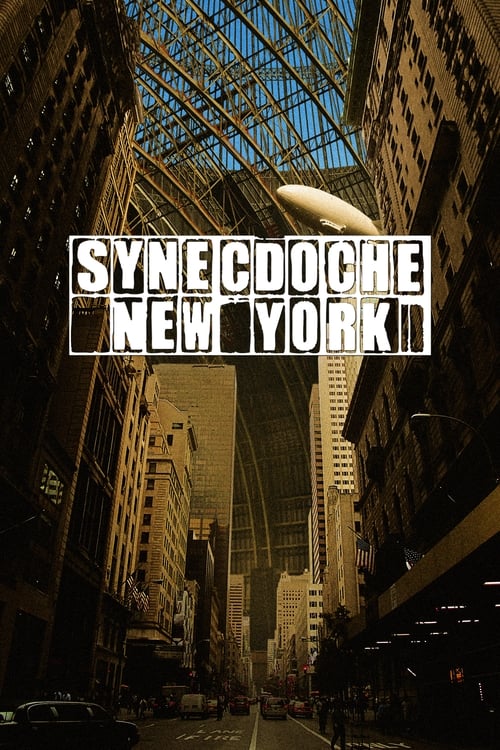
Synecdoche, New York
2008 · Charlie Kaufman
For when you want a film to chew on for days — something huge and sad about time, love, and mortality. This is challenge viewing, not comfort; save it for when you're ready to be wrecked a little.
What it's about
Caden Cotard, a theater director in upstate New York, is convinced his body is failing him while his marriage to a painter quietly comes apart. Handed a huge grant, he moves into a vast warehouse and begins building a life-size replica of the city — and of his own life — casting actors to play himself and everyone he knows, then actors to play those actors. The project swallows decades, and the line between the rehearsal and the life keeps dissolving.
The experience
Overwhelming in a way few films attempt: funny and bleak in the same breath, dreamlike, and increasingly devastating as the years pile up. It's the kind of film that confuses you in the theater and then won't leave you alone for weeks.
Performances
Philip Seymour Hoffman carries the entire enterprise, aging decades on screen and making a hypochondriac dreamer both exasperating and heartbreaking, with Catherine Keener, Samantha Morton, and Michelle Williams giving the women in his orbit real, wounded life.
The craft
Charlie Kaufman's first film as director takes the nested-realities games of his screenplays and pushes them as far as they'll go: sets within sets, doubles playing doubles, a house that's quietly on fire. The production design turns a warehouse into a universe, and the film rewards — almost demands — a second viewing.
Why it matters
Divisive on release and steadily canonized since, it's become a touchstone of ambitious American filmmaking — the movie people point to when they argue cinema can hold a whole life, and it set the template for Kaufman's directing career.
Snapshot
Synecdoche, New York is Charlie Kaufman's directorial debut, the first feature he both wrote and directed after a decade as the most celebrated screenwriter of the American "smart film" — Being John Malkovich, Adaptation., Eternal Sunshine of the Spotless Mind. It follows Caden Cotard (Philip Seymour Hoffman), a regional theater director in Schenectady whose body is failing in mysterious ways and whose marriage to painter Adele Lack (Catherine Keener) is dissolving. Awarded a MacArthur-style "genius" grant, Caden retreats into a warehouse in Manhattan to build an ever-expanding, life-size replica of the city and of his own life, casting actors to play himself and the people around him, then casting actors to play those actors, in a recursion that consumes decades and never opens to an audience. The film is a sustained meditation on mortality, the passage of time, and the impossibility of art ever containing the life it tries to represent. It premiered in competition at Cannes in 2008 and divided critics sharply on release before settling into a reputation as one of the defining ambitious failures-of-the-protagonist and successes-of-the-filmmaker of its decade.
Industry & production
The project grew out of a commission that inverted its eventual form: Kaufman and his frequent collaborator Spike Jonze were approached to write a horror film, and Kaufman's contribution drifted away from genre toward the existential dread of ordinary decline and death. Jonze ultimately moved on to direct Where the Wild Things Are, and Kaufman, who had long resisted directing, took the chair himself, partly on the encouragement of collaborators who felt his scripts were being diluted in others' hands.
The film was produced through Anthony Bregman's Likely Story alongside Sidney Kimmel Entertainment, with Jonze and Kimmel among the producers. It was an independent production of considerable ambition for its means: a reported budget in the low tens of millions had to underwrite a vast, aging warehouse set, decades-spanning makeup, and a large ensemble of name actors. (Precise budget and gross figures circulate in several versions and should be treated with caution; what is not in dispute is that the film was a commercial disappointment, recovering only a fraction of its cost theatrically.) Sony Pictures Classics handled the U.S. release following the Cannes premiere. The combination of a first-time director, a deliberately uncommercial structure, and a downbeat subject made the film a hard sell, and its modest theatrical performance was widely noted at the time as evidence of how far Kaufman had pushed past even his own earlier work in difficulty.
Technology
Synecdoche, New York was shot photochemically on 35mm, consistent with the textured, grain-bearing naturalism its cinematographer favored. The film's most demanding technical problem was not optical but durational and physical: it had to depict the slow aging of its principals across what the narrative treats as decades, and it had to construct a set — the warehouse "New York" — that itself ages, accretes, and decays as the story proceeds. This was accomplished primarily through practical means: prosthetic and cosmetic aging makeup on the cast, and progressively dressed, distressed physical sets rather than digital environments. The film largely eschews showy visual effects; its uncanniness is built into production design and continuity rather than added in post. The recurring image of Hazel's house — a home that is perpetually, gently on fire, which she buys and lives in until she dies of smoke inhalation — is the clearest instance of the film realizing a surreal premise through stubbornly practical staging rather than effects spectacle.
Technique
Cinematography
The film was photographed by Frederick Elmes, whose career links him to two great American sensibilities of strangeness: he shot David Lynch's Eraserhead and Blue Velvet and later worked extensively with Jim Jarmusch. Elmes brings to Kaufman's material a restrained, observational naturalism rather than overt expressionism, which is precisely what makes the film's reality so destabilizing — the camera treats impossible events (a daughter's tattoos fading as she dies, the seamless slide from house to stage set) with the same even, unhurried attention it gives to a kitchen-sink morning. The palette favors muted, autumnal interiors and the gray light of an upstate winter, and as the warehouse world expands the imagery grows more crepuscular and cluttered. The visual grammar is deliberately undemonstrative, refusing to flag which images are "real," which keeps the viewer inside Caden's collapsing sense of the boundary between life and its replica.
Editing
Robert Frazen edited the film, and the cut is the engine of its temporal vertigo. Time in Synecdoche is radically elastic and almost never signposted: a single scene may leapfrog months or years between shots; mail piles up; a child grows; seasons and presidencies pass in the background of a conversation. The editing withholds the conventional markers — dissolves, titles, establishing beats — that would let a viewer measure elapsed time, so that the film's decades arrive as an accumulating disorientation rather than a sequence of dated chapters. This is the structural correlate of the film's theme: time is felt as loss precisely because it cannot be located or held.
Mise-en-scène / staging
Production designer Mark Friedberg's work is, in a real sense, the film's subject. The warehouse set is a city inside a building inside the city, rebuilt and nested until a second warehouse appears inside the first and a second Caden directs a second company. The film stages a continuous slippage between location and set: doorways open from "real" apartments into the constructed world, and actors playing the principals appear alongside the principals themselves. Mise-en-scène here is not decoration but argument — the more completely Caden tries to reproduce his life at full scale, the more the reproduction crowds out the life, until the distinction is no longer available to him or to us. The image of the 1:1 model that grows as large as the thing it models is the film's governing visual idea.
Sound
Jon Brion composed the score, continuing a body of work that includes Eternal Sunshine of the Spotless Mind, Punch-Drunk Love, and Magnolia. The most memorable musical element is the diegetic song "Little Person," a fragile, plain ballad sung within the film, which threads its melody into Brion's underscore. The score is melancholic and chamber-scaled rather than grand, suited to a film about diminishment. Sound design throughout favors the ambient and the domestic — the hum of the warehouse, the crackle of Hazel's ever-burning house — grounding the surreal architecture in mundane texture.
Performance
The film rests on Philip Seymour Hoffman, who carries Caden from harried middle age into ravaged old age in a performance of extraordinary, unglamorous commitment, registering decline as much in posture and breath as in makeup. Around him Kaufman assembles one of the deepest ensembles of the period: Samantha Morton as Hazel, the box-office clerk who loves Caden across the whole film from her burning house; Catherine Keener as the fleeing wife Adele; Michelle Williams as the actress Claire whom Caden marries; Emily Watson as Tammy, cast to play Hazel; Jennifer Jason Leigh; Hope Davis; and Tom Noonan as Sammy, the man hired to play Caden who has watched him for twenty years. The film's late master-stroke is Dianne Wiest as Ellen/Millicent Weems, who finally takes over directing Caden's life, feeding him his actions through an earpiece — a performance that turns the film's metaphysics into something tender and devastating.
Narrative & dramatic mode
The film operates in a mode of literalized metaphor and recursive metafiction. Its premise — an artist building a full-scale, ongoing reenactment of his own existence — is taken with absolute seriousness and followed to its logical, vertiginous ends, so that representation and reality fold into each other (the "synecdoche" of the title: the part standing for the whole, the model standing for the world). Dramatically it is a tragedy of a man who tries to defeat death and the unknowability of others by total documentation, and who discovers that the attempt only multiplies the unfinished and the unlovable. The naming is allegorical without being a puzzle to be solved: Caden Cotard carries the name of Cotard's delusion, the conviction that one is already dead; Adele Lack embodies absence; the title puns on Schenectady. The film resists plot in the ordinary sense, advancing instead by accumulation, repetition, and the steady erosion of its protagonist.
Genre & cycle
Nominally a drama, Synecdoche, New York belongs to the cycle of American postmodern metafiction associated with Kaufman and his director-collaborators Jonze and Michel Gondry — films built on a self-aware, often anguished play between art and life. It also sits within a long lineage of "film about the artist's creative crisis," and within an art-cinema tradition of the surreal-realist allegory. More than any of Kaufman's prior scripts, though, it pushes toward the philosophical essay-film, subordinating comedy (still present, bone-dry) to a sustained confrontation with mortality that aligns it as much with literary modernism as with any film genre.
Authorship & method
This is the purest expression of Kaufman's authorship, the first time his vision reached the screen without an intervening director, and it duly amplifies the obsessions of his earlier work — identity, doubling, the porousness of the self, the terror of time — to their furthest point. As writer-director he assembled collaborators whose sensibilities reinforced his own: cinematographer Frederick Elmes, bringing Lynchian deadpan-uncanny naturalism; production designer Mark Friedberg, whose nested sets make the film's central conceit physically real; editor Robert Frazen, whose elisions produce its lived sense of time; and composer Jon Brion, a returning Kaufman-world collaborator whose intimate scoring keeps the cosmic material human. Kaufman's method here is to literalize an idea and refuse to blink, allowing tonal control and ensemble performance to hold together a structure that on paper should fly apart.
Movement / national cinema
The film is a product of American independent cinema at the high-water mark of the 2000s "smart cinema," produced outside the studios but with studio-grade talent, and released by a specialty distributor. It is national in a pointed way — set in upstate New York and Manhattan, preoccupied with American scale and the American impulse to build bigger — while drawing its intellectual lineage from European art film and from literature. It can be read as the culmination of a strain of millennial U.S. metafiction running from the Kaufman-Jonze-Gondry films toward the more openly philosophical work that followed.
Era / period
Made and released in 2008, the film carries the texture of its moment — its mundane reality is recognizably mid-2000s — even as its internal chronology spirals across decades in defiance of any fixed period. It belongs to the last years of predominantly photochemical, practically-built American filmmaking before digital capture and effects became the default, and its handcrafted decay is partly a function of that craft tradition. Its themes of decline and accumulation read, in retrospect, as eerily attuned to the anxious cultural mood of the year of the financial crisis, though the film makes no topical claim.
Themes
Death is the film's first and last subject: not death as event but as the condition of being alive in time, the slow somatic failure that Caden's mysterious symptoms make literal. Adjacent to it run the impossibility of fully knowing another person; the solipsism and grandiosity of the artist who would master life by reproducing it; the gap between representation and the real (the model that can never be finished because the life it copies keeps happening); and the democratic insistence, voiced in the film's closing movement, that everyone is the lead in their own vanishing story — that there are no extras. The burning house stands for the choice to love and dwell within one's own slow catastrophe; the earpiece-directed finale relocates agency outside the self and reframes a life as something received rather than authored.
Reception, canon & influence
On release the film polarized critics: detractors found it airless, self-indulgent, and punishingly abstract, while admirers regarded it as a major and possibly great work. Its most influential champion was Roger Ebert, who reviewed it with unusual passion and subsequently named it the best film of its decade, a verdict that did much to cement its standing as it migrated from theatrical disappointment to critical touchstone, recurring on best-of-decade lists. The reception history is thus a textbook case of a difficult film outliving its box office through sustained critical advocacy.
Looking backward, the film's lineage is more literary and art-cinematic than commercial. Critics have consistently invoked Fellini's 8½ as a forerunner — the artist's crisis dramatized from inside — and Borges's parable of the map drawn to the exact scale of its territory as the precise figure for Caden's project; the recursive, mortality-haunted sensibility also recalls Kafka and the modernist novel more than any film cycle. (Direct lines of influence beyond the 8½ comparison are inferred from the work itself rather than from a full documentary record of Kaufman's stated sources, and should be read as critical resonance rather than confirmed citation.)
Looking forward, its legacy lies less in imitators — its form is nearly inimitable — than in the license it represents and in Kaufman's own subsequent trajectory toward the stop-motion Anomalisa and the recursive I'm Thinking of Ending Things, which extend the same preoccupations with loneliness, performance, and the unreliable self. For a generation of viewers and filmmakers it became shorthand for maximal authorial ambition in the service of the most intimate subject, mortality, and it endures as a film more often cited as a benchmark of seriousness than successfully copied.
A Deleuzian reading
She tours the house and notices it's on fire — not metaphorically, actually burning, smoke curling along the ceiling while the realtor talks up the closet space.
The full Deleuzian reading of Synecdoche, New York →
Reception
It flopped hard in 2008 — polarizing at Cannes, barely $4M at the box office — but Roger Ebert crowned it the best film of the decade, and it's since climbed into the canon, landing in the BBC's 2016 critics' poll of the century's greatest films.
How Synecdoche, New York was received, from release to now →
Influences: the films it descends from and the films it influenced
- 8½ (1963) — Establishes the template Kaufman literalizes: an artist's creative paralysis dramatized from inside his head, with memory, fantasy, and present collapsing into one continuous staged space he cannot finish or escape.
- Wild Strawberries (1957) — Mortality as a life-review in which the protagonist walks through restaged tableaux of his own past — the model for Caden directing actors to replay his life as he ages and dies inside the work.
- Persona (1966) — The porousness and merging of selves (Caden played by a hired double, identities bleeding into one another) descends from Bergman's face-fusing study of one person dissolving into another.
- Last Year at Marienbad (1961) — Elastic, non-cumulative time and frozen theatrical staging where events repeat and contradict — the formal grammar of editing time as unreliable that Robert Frazen's elisions extend.
- Eraserhead (1977) — Direct collaborator lineage: Frederick Elmes' deadpan-uncanny naturalistic photography, treating grotesque and surreal events with flat documentary calm, is the visual method he brings to Synecdoche.
- Blue Velvet (1986) — Elmes again — his lush-yet-clinical naturalism that lets the uncanny erupt without stylistic flagging, the deadpan observational register Kaufman recruits to keep a fantastical conceit literal.
- All That Jazz (1979) — The autobiographical artist who literalizes his own dying as an ongoing staged production, choreographing his mortality into the show itself — the same self-cannibalizing performance of death.
- F for Fake (1973) — The essay-film impulse and recursive meditation on authorship, illusion, and the maker folding himself into the artwork as both subject and unreliable narrator.
- Being John Malkovich (1999) — Kaufman's own foundational move — taking a metaphor about inhabiting another self and building it as a literal physical apparatus — which Synecdoche scales up into a full life-size warehouse.
- Adaptation (2002) — Recursive metafiction in which the act of making the work becomes the work's plot; the writer's self-doubling and infinite-regress structure directly precede Caden's play-within-the-city.
- Magnolia (1999) — Shares the Jon Brion scoring method married to a deep mosaic ensemble whose many lives are orchestrated as one interlocking organism — the collaborator and the large-ensemble craft Synecdoche inherits.
- Opening Night (1977) — Kaufman's nested theater-within-theater structure — actors playing actors playing their own lives — extends Opening Night's film-within-play grammar to its logical extreme, and the staging of mortality as production context directly inherits what Cassavetes demonstrated about cinema's capacity to hold death and performance in the same shot.
- Anomalisa (2015) — Kaufman extends the same authorship — loneliness and the unreliable self literalized through staging (here every other voice is one identical actor) — into the deliberate artifice of stop-motion puppets.
- I'm Thinking of Ending Things (2020) — Carries forward the recursive unreliable self and collapsed time, compressing a whole life and multiple identities into shifting, contradictory single scenes the way Synecdoche compresses decades.
- Birdman (2014) — An aging performer's mortality crisis staged inside a theater production whose boundary with his real life dissolves — the nested-performance-as-life conceit pushed into a single bravura continuous take.
- Atropia (2025) — Rebuilds life at 1:1 scale inside a set-within-a-set until performance and reality become formally indistinguishable — the meta-fictional engine behind Atropia's staging.
- Her (2013) — Kaufman directs his own script about a man who cannot inhabit his own life and builds an elaborate substitute for it; the narrative grammar of accumulating substitutions as a vehicle for displaced mourning is the structure Her applies specifically to digital intimacy.
- Everything Everywhere All at Once (2022) — Treating an ordinary person's middle-aged consciousness—its proliferating self-versions, paralytic awareness of mortality and inadequacy—as the legitimate site of cosmic-scale existential drama is the Kaufman operation EEAAO directly inherits and applies to immigrant interiority.
- Dream Scenario (2023) — The metaphysical-fable-as-life-allegory, an outsized conceit used to anatomize ego, neediness, and mortality from inside an unremarkable man.
- Falling in Love Like in Movies (2023) — Recursive theater-within-life in which the artwork swallows and mirrors its maker's mourning, pushing life-imitating-art into infinite regress.
- Ghostlight (2024) — Theater-making staged as a literal vehicle for processing mortality and grief, with the production itself operating as the film's central metaphor — kindred to Ghostlight's title-as-metaphor and play-within-a-film logic.
- Beau Is Afraid (2023) — Externalizes a protagonist's interior guilt as an ever-expanding built environment, the model Aster uses to turn Beau's psyche into a literal picaresque geography of set-pieces.
- Rental Family (2025) — Builds its drama on hiring actors to inhabit real people's roles until performed and authentic emotion become indistinguishable — the philosophical engine of the rental-family premise.
- Eternal Sunshine of the Spotless Mind (2004) — Shared collaborator method: Jon Brion's intimate, fragile scoring anchoring a high-concept metaphysical premise to human-scale heartbreak, the same tonal ballast he supplies Kaufman here.
- Holy Motors (2012) — A protagonist performing an endless succession of full life-size staged 'lives' with no exit, dramatizing existence as ceaseless role-playing — the same literalized theater-of-the-self device.
- Birdman or (The Unexpected Virtue of Ignorance) (2014) — Theater-within-life metafiction staged in labyrinthine, ever-expanding space, dramatizing the artist consumed by his own magnum opus.
- Dogville (2003) — Kaufman builds a life-sized theatrical replica of a town as an explicit stage-within-film, inheriting Dogville's proof that overt theatrical abstraction can sustain a feature-length narrative.
- The Belly of an Architect (1987) — Descendant in which an obsessive auteur-figure builds a monumental architectural project as a doomed bid against mortality, extending Belly's architecture-as-body, copy-and-original conceit.
- The Father (2020) — A theatrical set continually rebuilt and roles endlessly recast as the literal architecture of a disintegrating self — reconfiguring-set staging pushed to metaphysics.
- Asteroid City (2023) — A theater director builds an ever-nesting production that consumes his life while he fails to grasp what he's made — the play-within-a-play metafiction about authorial control taken to its recursive extreme.
Similar films
- Being John Malkovich (1999) — influence & lineage · often watched together
- Adaptation. (2002) — influence & lineage
- Eternal Sunshine of the Spotless Mind (2004) — influence & lineage
- Anomalisa (2015) — influence & lineage
- Wild Strawberries (1957) — influence & lineage · often watched together
- Blue Velvet (1986) — influence & lineage · often watched together
- Persona (1966) — influence & lineage · often watched together
- Eraserhead (1977) — influence & lineage · often watched together
All the films related to Synecdoche, New York →