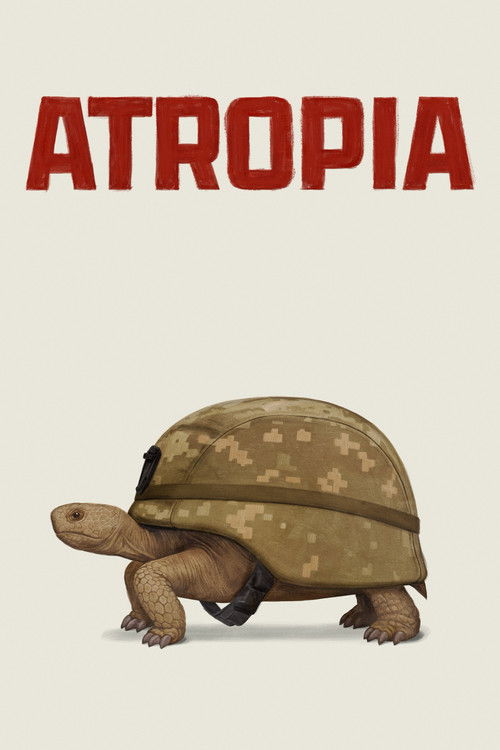
Atropia
2025 · Hailey Benton Gates
When you want a smart, strange comedy with teeth — something to laugh at in the moment and argue about afterward. More prickly than cozy.
What it's about
In a fake Middle Eastern village built in the California desert, the U.S. Army rehearses the Iraq War with paid role-players acting out ambushes, funerals, and market days. Fayruz, an aspiring actress who treats the gig as serious craft, falls for a soldier cast as an insurgent — and their real feelings start to break the script of the simulation.
The experience
Absurdist and funny in a way that keeps curdling into discomfort — you laugh at the fake country and then remember what it was rehearsing for. It plays as a romance and a satire at once, and it keeps you off balance about which one you're watching.
Performances
Alia Shawkat is the engine: her Fayruz commits to every ridiculous scenario with total actorly seriousness, which is both the joke and the heartbreak. Callum Turner gives the soldier a real ache underneath the role-play.
The craft
Hailey Benton Gates's debut builds its world from a real thing — 'Atropia' is an actual fictional nation the Army invented for training — and the production design leans into the hall-of-mirrors quality of a war staged before it's fought. The comedy comes from playing the simulation absolutely straight.
Why it matters
It joins the conversation about the war on terror's theater — how America rehearsed, performed, and outsourced its wars — and announced Gates as a distinctive new satirical voice.
Snapshot
Atropia is the feature directorial debut of Hailey Benton Gates, a comedy-drama set inside a U.S. Army "immersive training" facility — one of the mock Middle Eastern villages the military built in the California desert to rehearse soldiers for deployment to Iraq. Its title is borrowed directly from reality: "Atropia" is the name of a fictional adversary nation invented by the U.S. Army for its training scenarios, a placeholder country populated by paid role-players who act out insurgency, ambush, and civilian life so that troops can fail safely before they fail abroad. Into this hall of mirrors Gates places Fayruz (Alia Shawkat), an aspiring actress who treats the gig as a craft opportunity, and a soldier cast as an insurgent (Callum Turner) with whom she falls into an attachment that the script of the simulation cannot accommodate. The film premiered at the 2025 Sundance Film Festival in the U.S. Dramatic Competition, where it was among the most decorated titles of the edition. It expands the territory Gates first explored in her short Shako Mako (2019), and it arrives as a satire that is also, unmistakably, a love story about people whose job is to pretend. Beyond the festival premiere and core casting, granular production documentation remains thin at the time of writing, and several craft credits below are discussed by inference rather than from a settled public record.
Industry & production
Atropia belongs to the American independent ecosystem that orbits Sundance — modestly budgeted, festival-launched, auteur-driven, and dependent on the prestige machinery of producers who can attach name talent to a first-time director. The project's most reported industry fact is its producing pedigree: it carried backing associated with Luca Guadagnino, whose involvement signals the kind of cosmopolitan art-house imprimatur that helps a debut feature secure a competition slot and recognizable leads. The casting of Alia Shawkat and Callum Turner — both established, critically familiar performers rather than unknowns — is itself an industrial choice, lending a small film the legibility it needs to be acquired and discussed.
The film's development arc is unusually clear for a debut: it grows out of Gates's earlier short on the same subject, a common independent pathway in which a proof-of-concept short de-risks the feature and demonstrates the director's authority over difficult, logistics-heavy material (a film set inside a fake war requires building, or convincingly faking, a fake war). Precise figures — budget, shooting schedule, financing structure, and the distribution deal that followed the Sundance bow — are not part of the reliable public record I can cite here, and I will not invent them. What can be said is that the film is a product of the Sundance pipeline at its most characteristic: a personal, politically pointed comedy made possible by a coalition of independent financiers and a marquee producer, then validated by a competition premiere.
Technology
Nothing in the available record indicates that Atropia is a technologically experimental film in the sense of format innovation or novel capture tools; it reads as a contemporary digitally originated production, the default for independent features of its scale. The more interesting "technology" of the film is diegetic. Its subject is a military simulation apparatus — a built environment of mock villages, prosthetic wounds, pyrotechnics, controlled detonations, and role-play protocols engineered to manufacture the sensory texture of combat. The U.S. Army's training installations of the Iraq War era (the "box" at Fort Irwin and its constructed towns) were themselves an immersive-media technology, a kind of live-action virtual reality predating consumer VR. Atropia is, in effect, a film about an analog simulation engine, and its production design must reproduce that engine convincingly. Where specific tools — camera systems, lenses, post pipeline — are concerned, the public credits are not detailed enough for me to characterize them responsibly, so I flag that gap rather than fill it.
Technique
Cinematography
The film's central visual problem is one of registers: it must let the audience see both the fiction the soldiers are meant to believe and the banal, sunbaked reality surrounding it — the catering, the marks on the ground, the actors waiting between "attacks." A satire of simulation lives or dies on whether the camera can hold those two layers at once, framing a staged ambush so that we feel its theatricality without losing the human stakes inside it. The desert setting supplies a natural palette of glare, dust, and flat hard light that reads as both authentically Middle Eastern (the illusion) and authentically Californian (the truth), and the comedy depends on the seam between them. The specific cinematographer credit and stylistic approach are not something I can attribute from a verified source, so I describe the visual task the material imposes rather than assigning authorship.
Editing
Editing is where a film like this either finds its comic rhythm or doesn't. The structural joke of Atropia — performance interrupted by "real" feeling, and reality interrupted by performance — is fundamentally an editorial one: the cut that reveals a director yelling "again," the match that turns a tender moment into a scene being watched and judged. The reported tonal achievement of the film, a balance of broad satire with genuine romance, implies editing that can pivot quickly between the absurd and the sincere without whiplash. Precise editorial credits are not part of the record I can verify here.
Mise-en-scène / staging
This is the dimension the premise foregrounds most. The film's world is a set within a set: a fake village dressed to look lived-in, populated by performers in costume, surveilled and directed by military personnel acting as scene partners and stage managers. Gates's staging must therefore continually expose its own artifice — the prop blood, the scripted "civilian" reactions, the choreographed insurgency — while making the human relationships staged inside that artifice feel unscripted. The production design's job is doubled: it must build a convincing illusion and simultaneously let us see the scaffolding. The richness of the concept lies precisely in this layered staging, where every object is both a real thing and a theatrical sign.
Sound
Sound is dramatically central in a way the synopsis only implies. A combat simulation is an acoustic event — gunfire, explosions, shouted commands, the multilingual babble of role-players — and the film's irony depends on our hearing the constructedness of that soundscape: blanks rather than bullets, cues rather than chaos. The contrast between the manufactured din of "war" and the quiet of the actual emotional scenes (two people talking when no one is performing) is one of the film's likely primary expressive tools. Specific sound-design and music credits are not documented in a form I can cite, and I will not attribute them.
Performance
Performance is both the film's subject and its medium, giving the acting a reflexive charge unusual even among meta-cinema. Alia Shawkat, as an actress playing an actress, must perform several layers at once: Fayruz's in-simulation role, Fayruz's self-conscious "acting choices" within that role, and Fayruz the person whose real feelings leak through both. Shawkat's established gift for deadpan that conceals genuine ache is well-suited to this. Callum Turner, as a soldier cast against type as an insurgent, plays a man performing an enemy he is being trained to fight — a role within a role within an institution. The comedy and the romance both depend on the audience tracking when these characters are "in character" and when they are not, a distinction the film deliberately blurs.
Narrative & dramatic mode
The dramatic mode is romantic comedy-drama braided with institutional satire. Its engine is the oldest one in the theatrical book — actors who develop real feelings while playing scripted ones — relocated to the most incongruous possible stage, a war game. This is a meta-fiction: a film about performance that uses performance as its plot mechanism, in the lineage of backstage romances and films-within-films. The structuring irony is that "unsimulated emotion" becomes a threat not to a play but to a military readiness exercise, so the conventional rom-com obstacle (will the performance survive the feelings?) acquires geopolitical weight. The film operates in a register where the absurd and the sincere are not opposed but interdependent: the more ridiculous the apparatus, the more poignant the genuine connection that forms inside it.
Genre & cycle
Atropia sits at the intersection of three lineages. First, the war satire — the tradition of MASH (1970), Catch-22 (1970), and Three Kings (1999), films that treat the machinery of American war-making as fundamentally absurd. Second, the meta-fictional "making-of" comedy of performance, from The Producers to Tropic Thunder (2008), the latter especially relevant for its premise of actors who cannot tell simulated war from the real thing. Third, the post-9/11/Iraq War cycle of American cinema, but approached obliquely: rather than depicting combat, Atropia* depicts the rehearsal of combat, the domestic theater in which the war was pre-enacted. This obliqueness is the film's distinguishing move within the cycle — it finds the Iraq War not in Iraq but in the California desert, in the labor of the role-players hired to be the enemy.
Authorship & method
The clearest authorial fact about Atropia is its continuity with Hailey Benton Gates's own prior work. Gates came to directing from acting and from a body of nonfiction-inflected and short-form work, and her short Shako Mako (2019) already treated the world of military role-play training — making Atropia the feature realization of a long-held preoccupation rather than an assignment. This matters for authorship: the film is the product of a director returning to documented, researched material she has lived with, which lends the satire its specificity and its sympathy for the performers caught inside the apparatus. As writer-director, Gates controls both the conceptual architecture and its execution, the hallmark of the American independent auteur model.
The instruction to name key collaborators — cinematographer, composer, editor — runs up against the limits of the verifiable record for a film this recent; I do not have reliable attributions for those crafts and will not fabricate them. The collaboration that can be named with confidence is on the producing and performing side: the producing involvement associated with Luca Guadagnino, and the central performances of Shawkat and Turner, which are themselves a form of co-authorship in a film so dependent on performed nuance.
Movement / national cinema
This is firmly American independent cinema, of the Sundance variety — personal, issue-engaged, formally accessible, and reliant on the festival as both launchpad and validator. It belongs to a contemporary tendency in which younger American filmmakers approach the country's recent military history not through the war film proper but through its peripheries, its labor, and its absurd administrative realities. The Guadagnino-adjacent producing also locates it within a transnational art-house network, the kind of cross-pollination between American indie subject matter and European-inflected prestige financing that increasingly characterizes the upper tier of Sundance competition.
Era / period
Atropia is a film of the mid-2020s looking back at the mid-2000s. Its diegetic period is the height of the Iraq War, when the training apparatus it depicts was at full operational scale; its production period is two decades later, when that war has receded into a contested national memory. This temporal doubling is part of its meaning. Made in 2025, the film can treat the simulation infrastructure as a closed historical chapter, an object for satire and rueful reflection rather than urgent protest. It joins a wave of films revisiting the post-9/11 wars with the distance of hindsight, asking what the era's vast machinery of preparation and performance actually produced.
Themes
The governing theme is the collapse of the boundary between performance and reality — between playing a feeling and having one, playing an enemy and becoming one, rehearsing a war and conducting it. From this stem several others. There is the theme of labor: the film takes seriously the strange work of being paid to be the enemy, and the people (often immigrants and actors at the margins) who do it. There is the theme of empire as theater — the suggestion that American war-making is partly a matter of staging, scripting, and casting, that it rehearses its own narratives before exporting them. And there is the romantic-humanist theme that genuine feeling is anarchic, that it erupts where it is least convenient and refuses the scripts written for it. The comedy and the politics meet on this last point: the love story is itself an act of resistance against a system that demands everyone stay in character.
Reception, canon & influence
Atropia arrived at Sundance 2025 as a critically embraced debut and one of the edition's notable award-winners in the U.S. Dramatic Competition; it was discussed as a confident first feature that managed the difficult tonal feat of being both genuinely funny and genuinely moving about a charged subject. (Detailed critical consensus, specific reviews, and full awards particulars beyond the festival premiere are still consolidating, and I am characterizing the reception in general terms rather than quoting figures or notices I cannot verify.)
Looking backward, the influences on the film are legible: the war-as-absurdity tradition of MASH and Three Kings; the actors-can't-tell-the-difference premise of Tropic Thunder; the long meta-theatrical lineage of romances that bloom between performers; and, most directly, Gates's own documentary-minded short Shako Mako*, which supplied both subject and sensibility. The film's real-world grounding in the Army's "Atropia" scenarios and its constructed training villages gives it a nonfiction backbone that distinguishes it from purely satirical antecedents.
Looking forward, its legacy is necessarily speculative this soon after release. Its most likely influence is twofold: as a launch vehicle establishing Hailey Benton Gates as a feature director to watch, and as a model for how the next generation of American filmmakers might address the Iraq and Afghanistan wars — not through frontline combat but through the bureaucratic, performed, and domestic apparatuses that surrounded them. If a durable "post-war-on-terror" cycle of oblique, satirical, periphery-focused films coalesces, Atropia is positioned to be cited as an early and unusually inventive entry. Any stronger claim about its canonical standing would outrun the evidence available at the time of writing.
A Deleuzian reading
Start with the light.
The full Deleuzian reading of Atropia →
Reception
It won Sundance 2025's top prize — the U.S. Grand Jury Prize: Dramatic — out of a premiere that drew decidedly mixed reviews, and the gap never closed: by its December 2025 release (via Vertical) it had settled at a 41% on Rotten Tomatoes, making it that rare thing, a Grand Jury winner remembered more for the controversy of winning than for the win.
How Atropia was received, from release to now →
How to watch Atropia: what to notice on a first viewing
- Watch how the same hard desert light reads as two different places. The glare and dust could pass for Iraq to a trainee or for California to anyone holding a call sheet, and the film never picks one meaning over the other. One sun is lighting two countries at once, and the film wants you to notice that.
- Notice objects that are both a real thing and a stage cue. The prop blood, the marked ground, the scripted civilian reactions, each one is genuinely there and also standing in for something else at the same time. You are always watching two things layered into one object.
- Listen for the difference between staged gunfire and a quiet real scene. The combat noise is built from blanks and cues rather than chaos, and the film keeps cutting that constructed din against the plainer quiet of two people actually talking. The quiet scenes are the only sound in the film that isn't rehearsed.
- Watch Fayruz's face for the moment acting choices become real feeling. Alia Shawkat plays an actress playing a role and adjusting that performance, so at least two layers of pretending are visible on her at once, sometimes three. Tracking when she is in character and when she is not becomes the film's real suspense.
The whole guide to watching Atropia, with the keys for a rewatch →
Influences: the films it descends from and the films it influenced
- Shako Mako (2019) — Gates's own documentary-minded short first developed the military role-play-training milieu and the sympathetic-deadpan gaze on performers-inside-the-apparatus that Atropia expands to feature scale.
- M*A*S*H (1970) — Establishes the war-as-absurdity register through overlapping naturalistic dialogue and a diegetic PA-loudspeaker soundscape that frames the camp itself as a performed stage.
- Catch-22 (1970) — Models the military as a self-perpetuating bureaucratic machine whose logic is the joke, delivered in flat deadpan rather than broad farce.
- Day for Night (1973) — The template for romance blooming between performers on a working set, with the film-within-the-film continually exposing the labor and apparatus of making.
- Full Metal Jacket (1987) — Treats boot-camp drilling as performance and indoctrination, making the constructed training environment — not combat — the real subject.
- Wag the Dog (1997) — War as a fabricated, staged media production — the direct precursor to Atropia's empire-as-theater conceit where the conflict is something built and performed.
- The Truman Show (1998) — A full-scale constructed village operated as a total performed environment, anchoring the set-within-a-set / world-as-theater architecture.
- Three Kings (1999) — Supplies the bleached, processed desert-light palette and the rapid tonal pivots between farce and atrocity in a Gulf-War satirical key.
- Jarhead (2005) — Pioneers the war-on-terror of waiting, drilling and performing readiness with no combat payoff, in the same desert boredom-texture Atropia inhabits.
- Tropic Thunder (2008) — The actors-can't-tell-the-difference premise and reflexive meta-acting where a staged war set tips into the real battlefield.
- Synecdoche, New York (2008) — Rebuilds life at 1:1 scale inside a set-within-a-set until performance and reality become formally indistinguishable — the meta-fictional engine behind Atropia's staging.
- Fremont (2023) — Extends the same deadpan American-indie lens to war-on-terror labor on the home-front periphery, following an Afghan interpreter rather than any soldier.
- Kate Plays Christine (2016) — Stages an actor's research into a role as reflexive nonfiction, sharing Atropia's performance-vs-reality method and its interest in the worker behind the performance.
- War Dogs (2016) — Views the war-on-terror from its absurd capitalist periphery rather than the frontline, with comparable comedy-to-dread tonal pivots.
- War Machine (2017) — Deadpan satire aimed at the bureaucratic and PR apparatus surrounding the Afghan war instead of its combat, a near-contemporary of Atropia's oblique approach.
- Bisbee '17 (2018) — A town restages its own history with locals cast as performers, formalizing the constructed-reenactment-as-method that Atropia borrows from real Army 'Atropia' scenario villages.
- American Fiction (2023) — Meta-fictional satire in which a performer is forced to inhabit and sell the very representation he means to critique — the labor-of-performed-identity craft Atropia applies to military role-play.
Similar films
- Jarhead (2005) — influence & lineage
- Tatami (2024) — same viewing thread
- A House of Dynamite (2025) — same viewing thread
- Yes (2025) — same viewing thread
- Warfare (2025) — shared sensibility
- Companion (2025) — shared sensibility
- It Was Just an Accident (2025) — shared sensibility
- Beyond Utopia (2023) — shared sensibility
All the films related to Atropia →
Watch it with: curated runs of related films
- No Way to Say No — Watch these when you want to see individuals forced to perform for a state, an army, or a corporation — they rhyme on the impossible arithmetic of complicity and defiance.