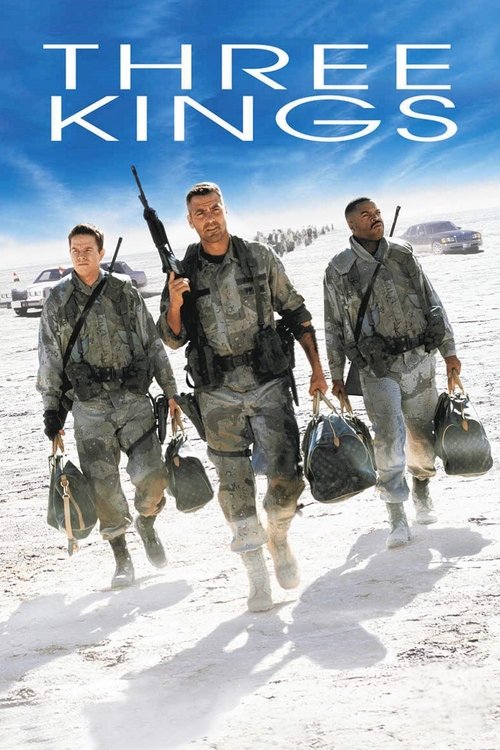
Three Kings
1999 · David O. Russell
For when you want action with a brain and a bite — entertaining enough for a Friday night but with real moral weight underneath. Not a comfort watch; it wants to unsettle you a little while it entertains you.
What it's about
The Gulf War has just ended, and four bored American soldiers in the Iraqi desert get hold of a map they believe leads to Kuwaiti gold looted by Saddam's forces. They set off on an unauthorized smash-and-grab expecting an easy score, and instead drive straight into the human wreckage of the war they thought was over — Iraqi civilians who rose up against Saddam and are now paying for it.
The experience
It whiplashes between laugh-out-loud absurdity and genuinely upsetting violence, sometimes in the same scene, and the jolts are the point. Fast, jittery, and angrier than it first lets on — a caper that keeps growing a conscience.
Performances
George Clooney found his big-screen groove here as the cynical officer who knows better, with Mark Wahlberg and Ice Cube grounding the mayhem and director Spike Jonze weirdly perfect as the crew's clueless liability.
The craft
The film looks like nothing else from its era — bleached, grainy, sun-scorched images that make the desert feel radioactive, plus infamous shots that follow a bullet's damage inside the body. David O. Russell stages war as chaos with a punchline, and the visual aggression rewards a big screen.
Why it matters
One of the first Hollywood films to look hard at what the Gulf War left behind, it anticipated a generation of Iraq-war cinema and marked Russell's leap from indie director to major filmmaker.
Snapshot
Three Kings is David O. Russell's third feature and his first large-budget studio film — a genre-scrambling war picture made for Warner Bros. that fuses the heist movie, the combat film, the buddy comedy, and the political satire into something that did not quite have a precedent in American cinema. Set in the final hours and immediate aftermath of the 1991 Gulf War, it follows four U.S. soldiers — Special Forces officer Archie Gates (George Clooney), reservists Troy Barlow (Mark Wahlberg) and Chief Elgin (Ice Cube), and the dim, racist private Conrad Vig (Spike Jonze) — who discover a map leading to a cache of Kuwaiti gold bullion that Saddam Hussein's forces looted during the occupation. What begins as a cynical treasure hunt becomes a reckoning when the men witness the slaughter of Iraqi civilians who had risen against Saddam at America's urging, only to be abandoned by the ceasefire. The film is at once a caper and an act of political dissent, and it remains one of the most formally aggressive studio releases of the late 1990s — a movie whose harsh, blown-out, color-bled images were as much an argument as its screenplay. It arrived a decade before the Iraq War would make its critique of American intervention seem prophetic, and it stands as the most overtly political and visually radical entry in Russell's filmography.
Industry & production
Three Kings was produced and distributed by Warner Bros., with producer Charles Roven among the producing team and Gregory Goodman as producer. The project originated in a spec screenplay by John Ridley — later the Oscar-winning writer of 12 Years a Slave — titled, by various accounts, Spoils of War. Warner Bros. brought David O. Russell aboard, and Russell substantially rewrote the material, reconceiving it as a politically charged story about the betrayal of the post-war Iraqi uprising rather than a straightforward heist. The resulting credit arrangement — screenplay by Russell, story by Ridley — became a point of friction, and Ridley publicly disputed the division of credit. The record on the precise contours of that dispute is partial, and it is fairer to say the authorship was contested than to assign blame.
The production is also notorious for on-set conflict, above all between Russell and George Clooney. Both men have spoken publicly, over the years, about clashes that reportedly escalated to a physical confrontation during filming in the Arizona and California desert locations that stood in for Iraq. The episode became part of Russell's enduring reputation for combustible sets. Clooney, then transitioning from television stardom on ER toward film leading-man status, took the role at a formative moment; Three Kings was an important early demonstration of his big-screen range. Casting Ice Cube and especially the music-video director Spike Jonze — who had not acted before and would release Being John Malkovich the same year — gave the ensemble an unusual, off-center texture. The film was a critical success and performed respectably commercially, though specific box-office figures should be verified against primary sources rather than asserted here.
Technology
The technological signature of Three Kings is photochemical, not digital, and it is central to the film's identity. Cinematographer Newton Thomas Sigel and Russell deliberately abused the medium to produce a degraded, sun-scorched, almost hallucinatory image. The key technique was a combination of unconventional stock choices and aggressive lab processing: portions of the film were shot on Ektachrome, a reversal (slide) film stock not normally used for motion pictures, which was then cross-processed — developed in chemistry intended for negative film — to produce extreme contrast, grain, and color shifts. The production also employed bleach-bypass (skip-bleach) processing, which retains silver in the emulsion to mute color and crush blacks, and varied film stocks and processing across sequences so that the look itself shifts with the dramatic register. The aim, as Sigel and Russell have described in interviews, was to evoke the texture of news photography and the disorienting glare of the desert rather than the polished sheen of a conventional war epic. This is a film whose meaning is partly carried by its chemistry: the instability of the image mirrors the instability of the mission and the moral ground beneath it.
Technique
Cinematography
Newton Thomas Sigel's camerawork is restless and exploratory, mixing handheld immediacy with carefully composed wide shots of the empty, overexposed desert. The palette is extreme — sickly greens, bleached yellows, blown-out whites — and the grain is pushed until the image seems to vibrate. Sigel uses the harshness expressively: the glare flattens the landscape into something abstract and forbidding, and the degraded color drains the war of any heroic gloss. The film alternates this scorched daylight look with murkier, desaturated interiors, so that the visual register tracks the shift from caper energy to moral horror. Sigel, who also shot The Usual Suspects (1995) and would become a frequent Bryan Singer collaborator, treats the Gulf as a place where vision itself is compromised — overexposed to the point of erasure.
Editing
Robert K. Lambert edited the film, and the cutting is brisk, associative, and willing to rupture conventional continuity. Three Kings frequently breaks its own realist surface for didactic or visceral inserts — most famously the so-called "bullet's-eye" sequences, in which the film cuts to a stylized, quasi-medical visualization of what a bullet does inside the body, showing the bile leaking into the chest cavity as Troy Barlow explains, and later experiences, the physiology of a gunshot wound. These interpolations are a deliberate Brechtian device: they puncture the action to force the viewer to register the bodily reality of violence that war films usually elide. The editing also handles the film's tonal whiplash — from comedy to atrocity, sometimes within a single scene — without smoothing the transitions, keeping the audience off balance.
Mise-en-scène / staging
The film stages the war as a landscape of detritus and absurdity: bunkers stuffed with looted consumer goods — cell phones, Cuisinarts, designer jeans, leather jackets — alongside the gold, a visual inventory of the war's entanglement with commerce and plunder. Russell repeatedly juxtaposes the surreal (a cow exploding on a landmine, a football used in interrogation, Rodney King invoked across a cultural and linguistic gulf) with documentary-style depictions of refugees and executions. The staging insists on the presence of Iraqi civilians as full human subjects rather than backdrop — a deliberate corrective to the genre's tendency to render the enemy and the local population as scenery. Interiors of the gold bunker and the torture chamber are claustrophobic and grimy, set against the vast emptiness of the desert exteriors.
Sound
Carter Burwell composed the score, layering Middle Eastern instrumentation and percussion against the film's bursts of Western pop and the diegetic music of the soldiers' world. The soundtrack pointedly deploys American popular music — including, memorably, a Beach Boys cue and other period and pop selections — to ironic effect, underscoring the dissonance between the soldiers' consumer-culture frame of reference and the catastrophe around them. Sound design renders violence with deliberate, uncomfortable specificity, and the film's use of language — the gaps and mistranslations between American soldiers and Iraqis, the recurring confusion over what the war was "about" — is itself a kind of sonic theme.
Performance
The ensemble work is sharp and tonally controlled. Clooney's Archie Gates is the film's pivot — a jaded careerist whose cynicism curdles into conscience — and the role helped establish the wry, morally serious leading-man persona he would refine over the following decade. Mark Wahlberg, as Troy Barlow, carries the film's most harrowing passages, including the interrogation and torture sequence, with a vulnerability that grounds the satire in real stakes. Ice Cube brings a watchful gravity as the religiously inclined Chief Elgin, and Spike Jonze, in a genuinely surprising debut, plays Conrad Vig as a pitiable, dangerously ignorant product of poverty and prejudice. The Iraqi roles — particularly Saïd Taghmaoui as the English-speaking interrogator Captain Said, whose own family was destroyed by American bombing — are written and performed with a complexity rare for the genre; Taghmaoui's scene with Wahlberg is the film's moral fulcrum.
Narrative & dramatic mode
Three Kings runs on the engine of the heist film — a map, a treasure, a crew, a plan that goes wrong — but bends that structure toward tragedy and political awakening. The dramatic mode is satirical and ironic at the outset, all swagger and acquisitive comedy, before the crew's encounter with the abandoned Shiite uprising converts the film into something closer to moral melodrama and protest. The turning point is ethical rather than mechanical: the men must choose between escaping with the gold and helping the refugees they have endangered. The narrative thus weaponizes genre expectation — we come for the caper and are made to stay for the atrocity — and its resolution trades the loot for an act of conscience, smuggling the refugees across the Iranian border. The tonal instability, lurching between farce and horror, is not a flaw but the film's central rhetorical strategy.
Genre & cycle
The film is a hybrid that resists clean categorization: simultaneously a Gulf War combat film, a heist movie, a service comedy, and an anti-war polemic. Within the war-film tradition it belongs to the revisionist, anti-heroic lineage running from Catch-22 (1970) and MASH (1970) through Apocalypse Now (1979) and Full Metal Jacket (1987) — films that treat war as absurd, corrupt, and dehumanizing. But its specific subject, the 1991 Gulf War, was almost untouched by Hollywood at the time, making Three Kings* a rare and early entry in what would later become a substantial cycle of post-9/11 Iraq films. Its genre-blending and ironic, media-savvy sensibility also align it with the post-Tarantino American cinema of the 1990s, even as its political seriousness sets it apart from that movement's frequent detachment.
Authorship & method
Three Kings is the work of David O. Russell at his most ambitious and least constrained — a director then known for the indie comedies Spanking the Monkey (1994) and Flirting with Disaster (1996), here scaling up to a studio canvas without abandoning his taste for discomfort and tonal risk. Russell's method is improvisational, confrontational, and willing to provoke both his collaborators and his audience; the reported on-set turbulence is of a piece with a filmmaking sensibility that courts friction. His key collaborators are essential to the achievement: cinematographer Newton Thomas Sigel, whose photochemical experiments gave the film its unmistakable surface; editor Robert K. Lambert, who realized the disruptive, essayistic cutting; composer Carter Burwell, the longtime Coen brothers collaborator whose cross-cultural score reinforces the film's themes; and writer John Ridley, whose original story supplied the premise that Russell transformed. The contested credit between Ridley and Russell is part of the film's authorship story and should be named rather than smoothed over.
Movement / national cinema
Three Kings is a product of late-1990s American studio cinema during a brief window when major distributors were willing to bankroll formally adventurous, politically pointed work from directors who had emerged from the independent sector. It belongs to that generation of 1990s American filmmakers — Russell alongside figures like Paul Thomas Anderson, Spike Jonze, Alexander Payne, and David Fincher — who brought an indie sensibility, a self-conscious relationship to genre, and a willingness to experiment into the studio system. It is firmly a work of Hollywood, but Hollywood operating at an unusual edge of risk, and its critical posture toward American foreign policy makes it a notable instance of dissent emerging from inside the mainstream entertainment apparatus.
Era / period
The film captures a specific historical and cultural moment from a position of hindsight: made in 1999, it looks back at the 1991 Gulf War — the first major American conflict narrated in real time by cable news, the war of "smart bombs" and Pentagon-managed imagery. Three Kings is acutely conscious of that mediation; it is preoccupied with how the war was packaged and sold, with the gap between televised triumph and ground-level reality. It belongs to the end-of-millennium American mood of prosperity and unease, and in retrospect it sits on a historical fault line: released two years before September 11, 2001, and four before the 2003 invasion of Iraq, it now reads as an uncanny anticipation of the consequences of unfinished American intervention in the region.
Themes
The film's central theme is betrayal — the abandonment of the Iraqi Shiites and Kurds who answered American calls to rise against Saddam and were then left to be massacred when the ceasefire held. From this flows a sustained critique of American foreign policy as cynical, short-sighted, and indifferent to the human cost borne by others. A second major theme is the entanglement of war and consumerism: the gold and the bunkers full of looted appliances literalize the idea that the conflict was, at bottom, about resources and acquisition, and the soldiers' greed mirrors the larger machinery they serve. The film also interrogates the media spectacle of war, embodied in the ambitious television reporter and the soldiers' own image-saturated worldview. Race threads throughout — among the American soldiers and in their encounters with Iraqis — as does the possibility of individual moral conversion against an immoral system. Finally, the film insists on the embodied reality of violence, refusing the bloodless abstraction of the televised war it critiques.
Reception, canon & influence
Three Kings was widely praised on release, with critics singling out its audacious visual style, its tonal daring, and the unusual seriousness of its politics for a studio action-comedy; it appeared on numerous year-end lists and has since been the subject of substantial academic attention as a key American film about the Gulf War. (Specific awards, rankings, and box-office figures should be checked against primary sources rather than asserted here.)
Looking backward, the film draws on the absurdist anti-war tradition of Catch-22 and MASH, the moral derangement of Apocalypse Now, and the heist-crew architecture of the caper genre; its degraded, experimental image-making has roots in war photojournalism and in the music-video and commercial aesthetics that Sigel and Russell repurposed. Looking forward, its influence is felt in the wave of Iraq War films that followed the 2003 invasion — works like Jarhead (2005) and The Hurt Locker (2008) inherited its skepticism, even if few matched its formal aggression — and its bleach-bypass, color-bled palette became part of the visual vocabulary of 2000s war and action cinema. For David O. Russell, it marked the high point of his early, overtly political phase before he turned toward the family dramas and character comedies (The Fighter, Silver Linings Playbook, American Hustle*) that defined his later career. The film endures as a singular object: a studio blockbuster that smuggled a genuine act of political dissent inside a treasure-hunt comedy, and one of the most visually inventive American films of its decade.
A Deleuzian reading
Troy Barlow lifts a finger and explains what a bullet does to a body.
The full Deleuzian reading of Three Kings →
Reception
Acclaimed by critics in 1999 but only a modest hit, it grew in stature as the Iraq War made its Gulf War cynicism look prophetic — now it's routinely name-checked in 'best of the legendary class of '99' conversations.
How Three Kings was received, from release to now →
Influences: the films it descends from and the films it influenced
- Kelly's Heroes (1970) — Supplied the core architecture Russell repurposes: soldiers abandoning the war effort to run a heist for hidden enemy gold, grafting caper-crew mechanics onto a combat film.
- M*A*S*H (1970) — Established the irreverent service-comedy register — anti-war contempt delivered through wisecracking insubordination — that licenses Three Kings' shifts from gag to atrocity.
- Catch-22 (1970) — Modeled the absurdist anti-war logic where bureaucratic and economic insanity, not the enemy, is the true antagonist.
- Apocalypse Now (1979) — Pioneered scoring carnage to incongruous music and pushing combat into hallucinatory moral derangement, a template for Russell's surreal juxtapositions.
- The Treasure of the Sierra Madre (1948) — The foundational gold-quest-as-moral-corrosion narrative, where greed for buried treasure decays a small crew of men.
- Dr. Strangelove (1964) — Demonstrated weaponizing studio comedy as genuine political dissent, smuggling savage critique inside an entertainment package.
- Saving Private Ryan (1998) — Kaminski's bleach-bypass, desaturated combat photography legitimized the silver-retention war-image one year before Sigel's photochemical experiments extended it.
- Natural Born Killers (1994) — Mainstreamed cross-processing and mixed film-stock media collage with Brechtian rupture, the experimental image-degradation grammar Sigel adapts.
- Good Morning, Vietnam (1987) — Carries forward the war film whose ironic pop source cues and wisecracking comedy curdle into moral horror, the tonal whiplash the seed normalized.
- The Dirty Dozen (1967) — Carries the Kelly's-Heroes-via-Aldrich strand of soldiers pursuing gold against their own institution, fusing the rogue-mission caper with anti-heroic irony.
- Jarhead (2005) — Inherited Three Kings' Gulf War subject and its imagery of soldiers stranded in a surreal, media-saturated desert with no clear enemy.
- The Hurt Locker (2008) — Extended the handheld, sun-blasted Iraq combat aesthetic and the moral skepticism Russell pioneered, swapping satire for documentary tension.
- City of God (2002) — Took the bleach-bypass-and-cross-processing palette into hyperkinetic, sun-bleached extremity, continuing Sigel's degraded-surface vocabulary.
- Black Hawk Down (2001) — Absorbed the desaturated, silver-retained combat palette into mainstream action, codifying the 2000s war-film visual look Three Kings helped launch.
- Syriana (2005) — Carried forward the cross-cultural, multi-thread treatment of American economic interests in the Middle East, naming the betrayal Three Kings dramatized.
- Atropia (2025) — Supplies the bleached, processed desert-light palette and the rapid tonal pivots between farce and atrocity in a Gulf-War satirical key.
- Pulp Fiction (1994) — Defined the post-90s mode of ironic pop needle-drops over violence and gleeful genre subversion that Three Kings inherits and politicizes.
- Run Lola Run (1998) — Shared the era's music-video-derived formal aggression — stock-switching, freeze-frame asides, and essayistic intrusions into a genre frame.
- Children of Men (2006) — Pushed the immersive, embedded-handheld combat-realism — chaos staged in unbroken proximity to the protagonist — that Sigel and Russell prototyped.
Similar films
- The Hurt Locker (2008) — influence & lineage
- Syriana (2005) — influence & lineage
- Jarhead (2005) — influence & lineage
- Kelly's Heroes (1970) — influence & lineage
- Pulp Fiction (1994) — influence & lineage
- O Brother, Where Art Thou? (2000) — shared sensibility
- Green Zone (2010) — shared sensibility
- The Big Lebowski (1998) — shared sensibility