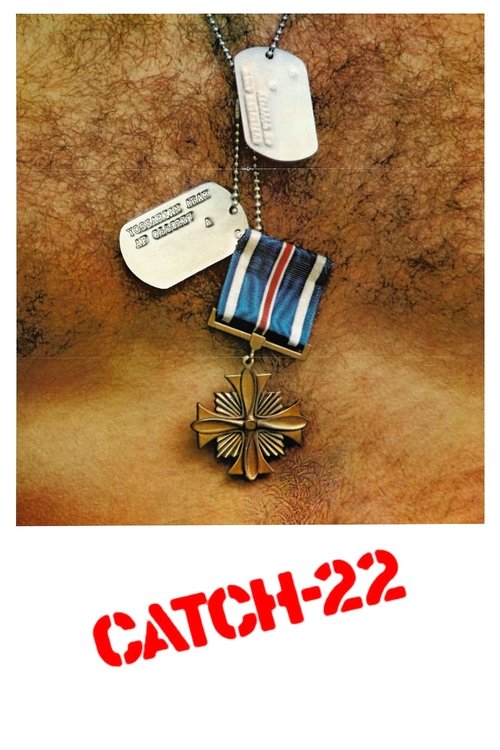
Catch-22
1970 · Mike Nichols
When you want satire with a body count — something funny that leaves a bruise. Not a comfort watch; it's for a night when you're ready to be unsettled by how absurd institutions can be.
What it's about
On a Mediterranean island airbase in World War II, an American bomber pilot named Yossarian wants one thing: to stop flying missions before they kill him. His plan is to be declared insane — but the rules state that anyone trying to get out of combat duty is obviously sane, and so must keep flying. Around him, the war grinds on as a machine of absurd logic, ambitious officers, and profiteering run amok.
The experience
Stranger and darker than a war comedy has any right to be — the jokes land, then curdle. It's deliberately disorienting, circling a memory it won't show you until it must, so the laughter keeps giving way to dread.
Performances
Alan Arkin anchors the madness as Yossarian, playing the one sane man in an insane system with mounting, wide-eyed desperation, surrounded by a deep ensemble of early-'70s talent.
The craft
Mike Nichols and screenwriter Buck Henry compress Joseph Heller's sprawling novel into looping, dreamlike structure — scenes recur and reveal more each time. The aerial sequences with real bombers are staged at genuine scale, and the film's cool, severe visual style makes the comedy feel eerie rather than zany. It rewards a big screen.
Why it matters
One of the most anticipated American films of 1970, famously overshadowed by a looser war comedy released months earlier — its reputation has grown since as a bold, uncompromising piece of studio filmmaking.
Snapshot
Mike Nichols's Catch-22 is the film adaptation of Joseph Heller's 1961 novel — a labor that ran for years, cost a fortune, and arrived in the summer of 1970 as one of the most anticipated American pictures of its moment, only to be overtaken almost immediately by a smaller, cheaper, looser war comedy released months earlier: Robert Altman's MASH. Nichols, fresh off the era-defining success of The Graduate (1967) and the prestige of Who's Afraid of Virginia Woolf? (1966), came to Heller's labyrinthine antiwar satire as the hottest director in Hollywood, armed with a Buck Henry screenplay and an ensemble cast deep enough to fill a repertory company. The result is a strange, ambitious, deliberately disorienting film: tonally severe where the novel is manic, structured around a single traumatic memory it withholds and finally delivers, and committed to a vision of war as bureaucratic madness rather than slapstick. It is a film more admired in retrospect than embraced on release — a high-water mark of the brief window when major studios bankrolled aggressively literary, formally adventurous adaptations and trusted star directors to make difficult films at scale.
Industry & production
Catch-22 was a Paramount Pictures production (with Filmways involvement), produced by John Calley and Martin Ransohoff, and it belongs squarely to the late-1960s moment when the New Hollywood and the old studio system briefly overlapped. Nichols's prior two features had made him bankable enough to command an enormous budget and near-total creative latitude, and Catch-22 was conceived on a correspondingly grand scale. The production is famous chiefly for its logistics: rather than rely heavily on miniatures or stock footage, the filmmakers built a functioning airfield in the desert near Guaymas, on the Gulf of California in Sonora, Mexico, and assembled a flyable fleet of restored B-25 Mitchell bombers. The widely repeated anecdote — that the unit's collection of airworthy B-25s briefly constituted one of the largest operational bomber forces in the world — is the kind of production legend that should be treated with caution, but the scale of the aviation operation is not in dispute; it was substantial and genuinely dangerous, requiring trained pilots flying period aircraft in close formation.
The budget ballooned, and the shoot was long and arduous. By the time the film reached theaters in June 1970, the cultural ground had shifted: MASH had opened earlier that year, capturing the irreverent, improvisational antiwar comedy that audiences associated with Vietnam-era disillusionment, and it became the surprise hit that Catch-22 had been expected to be. The comparison dogged Nichols's film and arguably shaped its reputation more than its own merits did. Exact financial figures vary across sources and are not reproduced here, but the consensus of the historical record is clear: the film was very expensive, did not recoup that investment with the ease of Nichols's earlier hits, and marked the end of his initial unbroken run of commercial triumph.
Technology
Technically, Catch-22 is a film of its transitional moment — shot photochemically on 35mm, presented in widescreen, and reliant on practical, in-camera spectacle rather than optical trickery. Its most significant "technology" is the restored aircraft themselves and the aerial cinematography built around them: real B-25s photographed in flight, on the ground, taking off and taxiing through desert heat haze. The famous opening — a long, near-silent dawn sequence in which the camera holds on the airfield as engines turn over and the bombers prepare to take off — depends entirely on the physical reality of those machines and the discipline of capturing them at first light. The film makes no notable use of the emerging optical or process techniques of its day; its commitment is to the tangible. This grounding in practical aviation is part of what makes the picture feel weighty and real even as its narrative spirals into absurdist abstraction.
Technique
Cinematography
The cinematographer was David Watkin, the British director of photography then known for his work with Richard Lester (and later celebrated for Chariots of Fire and an Academy Award for Out of Africa). Watkin brings a cool, controlled, often austere eye to the material. The film's signature visual idea is the long-held wide shot — the airfield at dawn, planes against an enormous flat sky — favoring stillness and composition over coverage. Watkin and Nichols use the desert light and the horizontal sprawl of the base to dwarf the human figures, reinforcing the sense of men trapped inside an impersonal machine. The aerial photography is genuinely impressive, and the recurring imagery of formation flight gives the film a documentary solidity that offsets its surreal structure. Throughout, the camera is patient and frequently static or slow-moving, a deliberate counterweight to the chaos of the screenplay.
Editing
Editing was by Sam O'Steen, Nichols's regular collaborator (he had cut Virginia Woolf and The Graduate and would work with Nichols repeatedly across his career). O'Steen's work here is central to the film's identity, because Catch-22 is built as a fractured, non-linear narrative organized around the gradual revelation of a single event: the death of the gunner Snowden during a mission. The film returns to this memory again and again, each time advancing it a little further, withholding the full horror until the climax. This structure — trauma disclosed in escalating fragments — places enormous weight on the editing to manage time, repetition, and dread without losing the audience. The cutting also handles the film's abrupt tonal shifts between farce and atrocity, a juxtaposition that is the engine of Heller's satire.
Mise-en-scène / staging
Nichols stages much of the film in stark, geometric arrangements: the flat expanse of the airfield, the cramped interiors of the bombers, the absurd order of military offices and tents. The production design emphasizes the contrast between the bureaucracy's tidy logic and the irrationality it produces. Set-piece sequences — Milo Minderbinder's grotesque commercial empire, the chaotic hospital, the bombing runs — are staged to render institutional madness as something almost orderly and routine, which is precisely the point. The final stretch, in which Yossarian wanders a nightmarish, ruined Rome, shifts the staging from desert clarity to expressionistic disorder, the visual register collapsing along with the protagonist's grip on the system's rationale.
Sound
The most discussed formal choice in Catch-22 is its near-total absence of a musical score. Nichols elected to forgo conventional underscoring, leaving long stretches carried only by aircraft engines, ambient noise, dialogue, and silence. The decision is bold and consequential: it strips the film of the emotional cushioning that scoring usually provides, leaving the comedy drier and the violence more shocking. The drone of the bombers becomes the film's dominant sonic motif, and the silences — particularly around the Snowden material — are used for unease rather than comfort. It is an austere, almost confrontational sound strategy entirely in keeping with the film's refusal to make its horrors palatable.
Performance
The cast is one of the deepest ensembles of its era, and the performances are pitched in a deliberately deadpan, anti-comic key. Alan Arkin anchors the film as Captain Yossarian, the bombardier desperate to be declared insane so he can stop flying — and trapped by the regulation that anyone sane enough to want out is therefore sane enough to keep flying. Arkin plays him not as a wisecracker but as a man being driven into genuine dread and dissociation, and the performance carries the film's darkening arc. Around him is an extraordinary supporting roster: Jon Voight as the entrepreneurial Milo Minderbinder, Bob Newhart as Major Major, Anthony Perkins as the chaplain, Martin Balsam as Colonel Cathcart, Jack Gilford as Doc Daneeka, Buck Henry (also the screenwriter) as Colonel Korn, Richard Benjamin, Art Garfunkel, Charles Grodin, Bob Balaban, Martin Sheen, Paula Prentiss, and Orson Welles as General Dreedle. The strategy of casting recognizable faces in small, sharply drawn roles reinforces the novel's sense of a vast institutional cast of grotesques, each absurd in his own bureaucratic niche.
Narrative & dramatic mode
Catch-22 operates in a satirical-absurdist mode, but Nichols pushes it toward something closer to nightmare than comedy. The dramatic architecture is its boldest feature: rather than telling Heller's story linearly, the film loops, doubles back, and embeds flashbacks within flashbacks, refusing stable chronology much as the novel does. The organizing principle is the deferred trauma of Snowden's death, which the film circles compulsively and reveals only in its final movement, recontextualizing everything that came before. This is a structure of repression and return — the comedy of bureaucratic absurdity functioning as a defense against an atrocity the film will eventually force the viewer to confront in full. The mode is therefore less "war comedy" than tragic farce, in which laughter and horror are not alternated for relief but fused until they become indistinguishable.
Genre & cycle
The film sits within the antiwar comedy cycle that crested around 1970, alongside MASH and, more broadly, the wave of Vietnam-era films that used earlier wars (here, World War II) as displaced commentary on contemporary disillusionment. Heller's novel, published in 1961, had already become a touchstone of countercultural skepticism toward institutions and authority, and the phrase "catch-22" had entered the language as shorthand for a self-cancelling, no-win bureaucratic trap. The film belongs to that lineage of literary antiwar satire — the absurdist tradition that runs from earlier black comedies through Stanley Kubrick's Dr. Strangelove (1964). Yet Catch-22 is markedly less ingratiating than its cycle-mates: where MASH offered loose, anarchic fun, Nichols delivered something colder and more formally severe, which partly explains why it fit less comfortably into the genre's popular reception.
Authorship & method
Catch-22 is a director's film in the fullest New Hollywood sense, but it is also the product of a tight circle of recurring collaborators. Mike Nichols — a theater and improv-comedy veteran (of the Nichols and May partnership) turned acclaimed director — approached the material with a stage-trained sensibility for performance and a willingness to take large structural risks. His method here was to honor the novel's difficulty rather than smooth it, accepting the commercial gamble of a non-linear, score-less, tonally forbidding film. Buck Henry, who had co-written The Graduate, wrote the screenplay and appears on screen, and his job — compressing Heller's sprawling, recursive novel into filmable shape — was formidable; the screenplay's solution of organizing the material around the Snowden revelation is the adaptation's key structural decision. David Watkin (cinematography), Sam O'Steen (editing), and the choice to use no composer complete the authorial signature: a film defined as much by what it withholds — music, comfort, chronological clarity — as by what it shows. The collaboration of Nichols, Henry, and O'Steen carried forward the working relationships established on The Graduate, making Catch-22 the more difficult, less rewarded sibling of that earlier triumph.
Movement / national cinema
The film is a product of American New Hollywood, the period in which studios, uncertain how to reach younger audiences, handed unusual creative power to a generation of director-auteurs. Catch-22 exemplifies both the ambition and the risk of that moment: a major studio financing a formally radical, expensive, literary adaptation on the strength of a director's reputation. At the same time, its key creative personnel reflect the era's transatlantic crosscurrents — most notably the British cinematographer David Watkin, whose sensibility had been shaped in the visually inventive milieu of 1960s British cinema. The film thus stands at the intersection of American studio capital, New Hollywood auteurism, and the wider Anglo-American art-film exchange of the late 1960s.
Era / period
Released in June 1970, Catch-22 is a quintessential artifact of the Vietnam-era American screen, using World War II as a scrim through which to examine the senselessness of war and the perversity of institutions — themes that resonated powerfully with audiences living through Vietnam and the collapse of postwar consensus. It arrived at the cusp of the decade that would define New Hollywood, in the same window as MASH, Five Easy Pieces, and the broader turn toward darker, more skeptical American filmmaking. Its very difficulty marks it as a film of that transitional period — when the old machinery of the studio epic was being turned, sometimes awkwardly, to the service of a new, disenchanted sensibility.
Themes
At its center is the title concept itself: the catch-22, the rule that makes escape from an irrational system logically impossible, because the very act of seeking escape proves you fit to remain. From this paradox the film extracts its governing themes — the lethal absurdity of bureaucracy, the way institutions convert human lives into accounting, and the madness required to survive a system that defines sanity as compliance with insanity. Milo Minderbinder's syndicate, which turns the war itself into a profit-making enterprise that bombs its own side, dramatizes the theme of capitalism's amoral logic colliding with military slaughter. Beneath the satire runs a deeper meditation on trauma and mortality: the Snowden flashback, withheld and finally exposed, insists that under all the institutional comedy lies a young man dying in an airplane, his death the irreducible reality the system exists to obscure. The film's coldness is itself thematic — a refusal to let the audience laugh its way past the horror.
Reception, canon & influence
On release, Catch-22 received decidedly mixed reviews and underperformed relative to its enormous cost and expectations. Critics admired its ambition, its cast, and individual sequences, but many found it airless, overlong, or emotionally remote — and the comparison with the warmer, more commercially successful MASH was nearly universal and rarely favorable to Nichols's film. It is widely regarded as the picture that broke Nichols's early winning streak, and its reputation has historically been shadowed by the perception that it was a noble, expensive near-miss.
The influences on the film are clear: Heller's landmark 1961 novel above all, and behind it the broader tradition of literary antiwar absurdism; the black-comic register of films like Dr. Strangelove; and Nichols's own theatrical and improv background. Its legacy forward is more diffuse but real. Catch-22 stands as a key example of the high-risk literary adaptation of the New Hollywood era and a frequent point of reference in discussions of unadaptable novels brought to the screen. Its structural daring — particularly the use of a withheld, fragmentary traumatic memory as an organizing device — anticipates later films built on deferred revelation. The phrase "catch-22" remains embedded in the language, and the property's enduring cultural standing was reaffirmed by the 2019 television miniseries adaptation, evidence that Heller's paradox continues to demand new screen treatments. Critical reappraisal over the decades has been kinder than the initial reception, with many viewers now valuing precisely the austerity and formal nerve that alienated 1970 audiences. Where the historical record on its finances and production legends is uncertain, this account has flagged that uncertainty rather than resolve it — but the film's place is secure as one of the most ambitious, divisive, and intellectually serious war films of its era.
A Deleuzian reading
A dawn airfield, held in near-silence.
The full Deleuzian reading of Catch-22 →
Reception
One of 1970's most anticipated films — Mike Nichols hot off The Graduate, adapting the era's sacred novel — it landed as an expensive disappointment when Altman's scrappier MASH stole the antiwar-comedy crown that same year. It's since been steadily reclaimed as ambitious, strange, and gorgeous, a favorite candidate for 'actually, it's great' revisionism.
How Catch-22 was received, from release to now →
Influences: the films it descends from and the films it influenced
- Dr. Strangelove (1964) — Established the deadpan-straight performance of military-bureaucratic absurdity — apocalyptic stakes played as procedural farce — that Catch-22 adopts as its anti-comic register.
- The Graduate (1967) — Same Nichols–Henry–O'Steen team; Catch-22 carries forward Sam O'Steen's elliptical comic cutting and Buck Henry's method of compressing a difficult novel into deadpan staged set-pieces.
- Paths of Glory (1957) — Renders the chain of command as an absurd machine that condemns the individual, observed in cool wide compositions — the institutional-cruelty framing Catch-22 inherits.
- Citizen Kane (1941) — Pioneered the fragmented nonlinear film organized around a single withheld revelation, the deferred-disclosure architecture Catch-22 rebuilds around Snowden.
- Hiroshima mon amour (1959) — Intercuts present action with involuntary, fragmentary flashes of buried trauma — the precise editing model for Catch-22's recurring, escalating Snowden flashbacks.
- 8½ (1963) — Interpolates memory and surreal fantasy into a realistic frame, structuring the film by association rather than chronology — the dream-logic license Catch-22 takes with its mess-tent and hospital interludes.
- The Blue Max (1966) — Built large-scale aerial sequences from real vintage aircraft flown for the camera, the practical-aviation cinematography Catch-22 extends with its squadron of airworthy B-25s and David Watkin's aerial work.
- Twelve O'Clock High (1949) — Made the bomber crew's psychological attrition the true subject, reducing combat to a tally of missions flown — the mission-count bureaucracy Catch-22 turns into its central paradox.
- King of Hearts (1966) — Inverts institutional sanity and madness as gentle absurdist farce, a tonal template for treating the war's official logic as the actual insanity.
- Dr. Strangelove or: How I Learned to Stop Worrying and Love the Bomb (1964) — Nichols adapted Heller's novel using Strangelove's structural logic of military bureaucracy as self-perpetuating comedy — non-linear sequencing where institutional absurdity accumulates rather than resolves, with discrete satirical set-pieces (the Milo Minderbinder scenes) functioning as the War Room exchanges' structural equivalent.
- Full Metal Jacket (1987) — Antiwar satire that refuses heroic catharsis and scoring in favor of deadpan institutional absurdity, splitting into discrete movements rather than a continuous dramatic arc.
- Jacob's Ladder (1990) — Structures an entire film around a soldier's withheld, fragmentary traumatic memory disclosed only at the climax — deferred-trauma revelation as the whole architecture, Snowden writ large.
- Memento (2000) — Engineers the narrative around a withheld traumatic core released in timed fragments — the deferred-revelation editing logic Catch-22 helped legitimize made into the film's organizing principle.
- Jarhead (2005) — A war film built on absurd boredom and anticlimax instead of combat catharsis, sustaining the tragic-farce, no-redemptive-arc register of antiwar satire.
- Atropia (2025) — Models the military as a self-perpetuating bureaucratic machine whose logic is the joke, delivered in flat deadpan rather than broad farce.
- Three Kings (1999) — Modeled the absurdist anti-war logic where bureaucratic and economic insanity, not the enemy, is the true antagonist.
- Lord of War (2005) — Milo Minderbinder's war-profiteering syndicate literalizes the commodification of war as a market, the satirical lineage of the businessman who sells to all sides that Yuri inherits directly.
- The Death of Stalin (2017) — Dramatizes the bureaucratization of atrocity as the film's core theme — institutional logic that processes mass death through absurd paperwork and self-protective procedure.
- Pretty Village, Pretty Flame (1996) — Its non-linear crosscutting between present horror and remembered fragments turns war into absurd circular tragedy, the fractured time-scheme Pretty Village builds from the trapped-in-the-tunnel present.
- MASH (1970) — The contemporaneous antiwar military satire with an overlapping anti-heroic star ensemble and episodic structure — the direct point of comparison that organizes the same craft toward looser, improvisational ends.
- Slaughterhouse-Five (1972) — Another 'unadaptable' antiwar novel filmed through time-fragmented editing built around a withheld atrocity (Dresden) — the closest formal kin to the Snowden deferred-revelation device.
- Carnal Knowledge (1971) — Nichols extends the score-less austerity and long-held wide two-shots, staging performances with deadpan theatrical precision and withholding musical comfort.
- Kelly's Heroes (1970) — Dramatizes war-as-business through Milo's syndicate, the same profit-over-duty absurdism that drives Kelly's soldiers to rob a bank instead of fight.
- Johnny Got His Gun (1971) — Structures its absurdist anti-war argument as a fragmented, nonlinear circling back toward a single withheld traumatic wound, a sibling strategy of narrative deferral around unbearable injury.
Similar films
- Full Metal Jacket (1987) — influence & lineage · same viewing thread
- M*A*S*H (1970) — influence & lineage
- The Graduate (1967) — influence & lineage
- Slaughterhouse-Five (1972) — influence & lineage
- Carnal Knowledge (1971) — influence & lineage
- One Flew Over the Cuckoo's Nest (1975) — same viewing thread
- The Caine Mutiny (1954) — same viewing thread
- The Trial (1962) — same viewing thread
All the films related to Catch-22 →
Watch it with: curated runs of related films
- Discipline and Defiance — A run of men pitted against total institutions — prisons, wards, camps, the state — where the only freedom left is refusing to break.