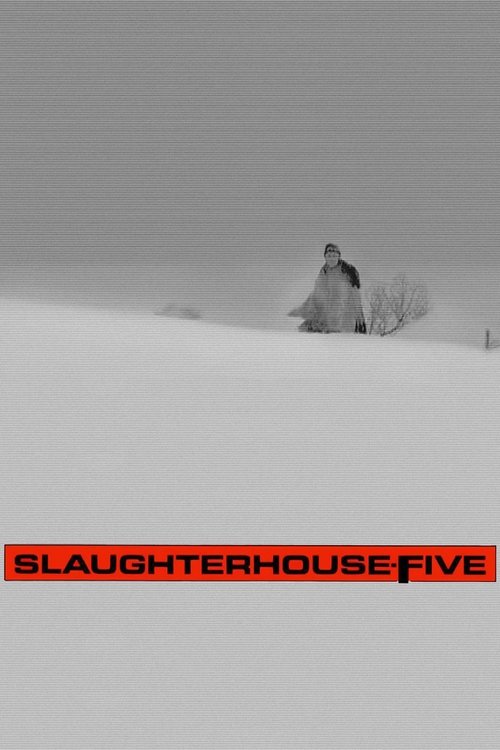
Slaughterhouse-Five
1972 · George Roy Hill
When you want a film to chew on for days — something formally daring and philosophically sad rather than comforting. Right for a thoughtful solo evening when you're up for a story that refuses to move in a straight line.
What it's about
Billy Pilgrim has come 'unstuck in time.' Without warning he slides between his boyhood, his comfortable but hollow postwar life as a suburban optometrist, his ordeal as a young American POW in Dresden as the firebombing approaches, and his strange captivity on a distant planet called Tralfamadore, where he's exhibited alongside a movie starlet. Adapted from Kurt Vonnegut's novel, it's a war story, a science-fiction fable, and a portrait of one bewildered man's whole life happening all at once.
The experience
Disorienting in a way that becomes hypnotic — droll, melancholy, and quietly devastating, with the horror of Dresden gathering underneath the deadpan comedy. It asks you to hold laughter and grief in the same hand, and it lingers.
Performances
Michael Sacks plays Billy with a perfect passive bewilderment — a man carried by his life rather than steering it — and Valerie Perrine brings unexpected warmth to Montana Wildhack.
The craft
The editing is the star: instead of signposted flashbacks, the film cuts between decades on matched movements, sounds, and glances, so Billy's time-slips feel like the natural weather of his mind. Glenn Gould's Bach on the soundtrack gives the whole thing a cool, sorrowful grace. It's one of the boldest structural experiments a Hollywood studio ever backed.
Why it matters
George Roy Hill made it between Butch Cassidy and The Sting, spending his clout on a book widely called unfilmable — and it became a touchstone for how cinema can render nonlinear time, honored at Cannes and treasured by Vonnegut himself.
Snapshot
Slaughterhouse-Five is George Roy Hill's adaptation of Kurt Vonnegut's 1969 novel, a film that attempts one of the most difficult translations in American cinema of its era: to render in images a book whose entire formal premise is the refusal of linear time. Its protagonist, Billy Pilgrim (Michael Sacks), has become "unstuck in time," sliding without warning between his boyhood, his unhappy postwar life as a prosperous optometrist in suburban Ilium, New York, his ordeal as a bewildered American prisoner of war during the Allied firebombing of Dresden, and his abduction to the planet Tralfamadore, where he is exhibited in a zoo alongside the film starlet Montana Wildhack (Valerie Perrine). The film made the audacious decision to dramatize this scattered chronology not through flashback convention but through continuous, associative cutting, so that the screen itself becomes unstuck along with Billy. Arriving between Hill's two largest commercial triumphs — Butch Cassidy and the Sundance Kid (1969) and The Sting (1973) — it is the strangest and least characteristic film of his career, a sober, formally adventurous work that won the Jury Prize at the 1972 Cannes Film Festival and earned, unusually, the enthusiastic blessing of its notoriously hard-to-please source author. If it has never attained the popular standing of Hill's caper pictures, it remains a singular experiment in adapting an "unadaptable" novel and one of the more thoughtful antiwar films of the New Hollywood period.
Industry & production
The film was a Universal Pictures production, produced by Paul Monash with Jennings Lang as executive producer, from a screenplay by Stephen Geller. Its making belongs to the moment, around the turn of the 1970s, when the major studios — chastened by the collapse of the old roadshow model and casting about for the youth audience that The Graduate and Easy Rider had revealed — were willing to underwrite literate, formally unconventional projects by directors who had earned commercial credit. George Roy Hill had earned exactly that credit with Butch Cassidy and the Sundance Kid, and Slaughterhouse-Five can be understood as the difficult personal picture a studio permits a bankable director between surefire commercial assignments.
Vonnegut's novel had been a literary sensation, a Vietnam-era touchstone that fused the author's own traumatic experience as a Dresden POW with science fiction and black comedy. Adapting it was widely considered close to impossible, precisely because its meaning is inseparable from its fractured narration. The choice of Hill — a former Marine pilot who had flown in both the Second World War and Korea, and who therefore brought firsthand knowledge of war to the material — proved apt. Casting ran heavily to unknowns and newcomers, which suited the film's deliberately ordinary, un-starry texture: Michael Sacks made his screen debut as Billy Pilgrim, and Perry King his as Billy's son Robert. Around them Hill placed sharper, more theatrical presences — Ron Leibman as the vengeful, paranoid Paul Lazzaro, Eugene Roche as the decent, doomed schoolteacher Edgar Derby, Valerie Perrine as Montana Wildhack, and Sharon Gans as Billy's gluttonous wife Valencia.
Production used European locations to stand in for wartime Germany; the Dresden and POW sequences were shot in Czechoslovakia, principally in and around Prague, whose surviving period architecture supplied the Old World gravity the story required, while the American material was shot in Minnesota. The contrast of real European stone against the bland prosperity of American suburbia is built into the film's geography.
Technology
Slaughterhouse-Five is a conventionally photographed 35mm production, and its ambitions are formal rather than technological; it pursues its effects through editing, framing, and music rather than through optical novelty or special effects. The Tralfamadore sequences — which a lesser film might have used as a pretext for elaborate science-fiction spectacle — are handled with conspicuous restraint, the alien zoo rendered as a simple geodesic-dome enclosure furnished with incongruously banal earthly furniture, the Tralfamadorians themselves kept largely unseen. This was an aesthetic decision as much as a budgetary one, consistent with Vonnegut's deadpan, anti-spectacular science fiction. The film's genuine "technology" is the cut: its means of representing Billy's temporal dislocation is the oldest tool in cinema, the edit, deployed with unusual rigor. The record gives no indication of unusual camera or effects apparatus, and it would be invention to claim otherwise.
Technique
Cinematography
The cinematography is by Miroslav Ondříček, the distinguished Czech cinematographer associated with the Czechoslovak New Wave and with Miloš Forman, and later with Lindsay Anderson's If.... and O Lucky Man!. Ondříček gives the film a clean, unfussy, naturalistic surface that is essential to its strategy: because the time-jumps are so radical, the photographic register must remain steady and plausible, grounding even the Tralfamadore scenes in the same matter-of-fact light as the Ilium kitchen. He distinguishes the worlds chiefly through environment and palette rather than through showy stylization — the cold stone and snow of the European war sequences, the wood-panelled comfort of American affluence, the sterile dome of the alien zoo — trusting the editing to carry the temporal disorientation. The Dresden material in particular is photographed with a restraint that lets the horror of the firebombing register through implication and aftermath rather than through pyrotechnic display.
Editing
The editing, by the great Dede Allen — one of the most important American editors of her generation, whose work on Bonnie and Clyde had helped redefine the rhythm of New Hollywood — is the film's true authorial signature and the mechanism by which Vonnegut's central conceit reaches the screen. Rather than signposting time-shifts with dissolves or titles, the film cuts directly and often on a graphic or aural match: a sound, a gesture, a compositional rhyme in one era hooks straight into another, so that Billy's slippage feels involuntary and seamless, exactly as the novel describes it. The celebrated effect is that the audience, like Billy, is never permitted to settle; the past, present, future, and the extraterrestrial coexist on a single plane of attention. This associative montage is the film's great formal achievement, and it is what most critics single out — an attempt to make editing itself enact a philosophy of time in which all moments exist simultaneously and permanently.
Mise-en-scène / staging
Hill's staging organizes the film around sharp tonal contrasts between its strata of reality. The Dresden sequences carry documentary weight and the dignity of real architecture; the suburban American scenes are staged as domestic satire, broad and faintly grotesque, with Billy's marriage and his social-climbing milieu played for queasy comedy. The Tralfamadore zoo is staged as deliberate kitsch — the captured human and the starlet furnished with a parody of a model American home, a sly joke about voyeurism and the manufactured domestic ideal. Costume and production design map these worlds precisely, from POW rags to optometrist's-office prosperity. Throughout, Billy himself is staged as a passive, faintly absurd figure — bespectacled, mild, perpetually out of step — a man to whom things happen rather than an agent, which is the point.
Sound
The film's most distinctive element after its editing is its music, and the two are deeply intertwined. The score draws on the music of Johann Sebastian Bach as performed by the pianist Glenn Gould — the first of only two feature films to which Gould lent his playing. The choice is inspired and thematically pointed: Bach's keyboard counterpoint, with its sense of a structure in which every voice is simultaneously present and mathematically eternal, is the perfect aural analog for Tralfamadorian time, in which all moments exist at once. Gould's cool, crystalline articulation lends the time-jumps a paradoxical serenity, refusing easy pathos and instead framing Billy's predicament with a kind of cosmic equanimity. The sound design otherwise favors naturalism, and the restraint of the Dresden sequences — the absence of bombastic scoring over catastrophe — is among the film's most effective sonic decisions.
Performance
Performance in Slaughterhouse-Five is calibrated to the film's deadpan tone. Michael Sacks plays Billy Pilgrim as a study in mild bewilderment — passive, gentle, almost affectless — a performance whose very blankness is the design: Billy is a vessel through whom time flows, not a hero who resists it, and Sacks resists the temptation to editorialize his suffering. Around this still center, the supporting players supply heat and color. Ron Leibman's Paul Lazzaro is a coil of petty, homicidal resentment, the human embodiment of the vengeful logic the film's fatalism rejects. Eugene Roche's Edgar Derby is the film's moral anchor, a fundamentally decent man whose fate delivers the story's bitterest irony. Valerie Perrine brings an unembarrassed warmth to Montana Wildhack, and Sharon Gans makes Valencia a figure of broad domestic satire. The ensemble's mixture of underplayed lead and vivid character work suits a film that is at once tragic and absurd.
Narrative & dramatic mode
The film's dramatic mode is the great problem and the great achievement of the project. Vonnegut's novel is anti-narrative by design: it has no suspense in the conventional sense, because Billy already knows the future — including the moment of his own death — and accepts it with Tralfamadorian fatalism, the attitude condensed in the novel's refrain "So it goes." The film honors this by abandoning linear causality and assembling itself as a mosaic of simultaneous times, so that the experience is less of a story advancing than of a single life apprehended all at once. This is risky: a film without conventional forward momentum, whose protagonist neither struggles nor changes, can read as inert. Slaughterhouse-Five mitigates the risk through the propulsion of its editing and the gathering gravity of the Dresden material, toward which all the time-threads quietly converge. The mode is finally elegiac and ironic rather than dramatic in the Aristotelian sense — a contemplation of war, mortality, and consolation, structured as recurrence rather than as climax.
Genre & cycle
Slaughterhouse-Five is a genuine hybrid, drawing on at least three genres without belonging wholly to any. It is an antiwar film, joining the Vietnam-era cycle of pictures that used earlier conflicts to interrogate American violence — a cohort that includes Catch-22 (1970), Mike Nichols's adaptation of Joseph Heller, with which it is most often paired, both being absurdist literary war novels brought to the screen at the turn of the 1970s. It is simultaneously a work of literary science fiction, deploying alien abduction and time travel not for spectacle but as philosophical apparatus, in the Vonnegut manner that treats SF tropes as instruments of satire and metaphysics. And it is, in its Ilium scenes, a domestic satire of American affluence and conformity. The film's refusal to resolve these registers into a single genre is part of its identity, and aligns it with the New Hollywood appetite for tonal mixture and generic subversion.
Authorship & method
Authorship of Slaughterhouse-Five is unusually distributed. George Roy Hill is the credited director, and the film bears his intelligence and craftsmanship, but it is markedly atypical of a filmmaker better known for handsome, audience-pleasing entertainments; its experimental structure makes it the outlier in his body of work, and it is tempting to read it as the project in which Hill's wartime experience as a military pilot found its most personal expression. Crucially, the film is also a faithful act of literary adaptation, and Vonnegut's authorship presides over it — uncommonly, the novelist publicly and lavishly praised the result, calling it a faithful rendering of his book, a rare endorsement from an author whose work had been ill-served elsewhere. Screenwriter Stephen Geller performed the essential structural labor of converting the novel's prose discontinuities into dramatizable scenes.
Among collaborators, three are decisive. Editor Dede Allen translated the novel's temporal philosophy into cinematic grammar; her associative cutting is arguably the film's primary creative act. Cinematographer Miroslav Ondříček supplied the steady, naturalistic surface that makes the discontinuities legible rather than chaotic. And the use of Glenn Gould's Bach performances furnishes the film's metaphysical tone, marrying baroque counterpoint to a story about the simultaneity of all time. The film is best understood as the product of this convergence — director, novelist, screenwriter, editor, cinematographer, and a musical sensibility — rather than as the expression of a single auteur.
Movement / national cinema
Slaughterhouse-Five is an American studio film of the New Hollywood period, made within Universal yet exhibiting the formal daring that the era's loosened conventions permitted. At the same time it carries a distinct transnational charge through its principal craftsmen: the Czech cinematographer Miroslav Ondříček brought the sensibility of the Czechoslovak New Wave and of European art cinema to bear on an American subject, and the film's production in Czechoslovakia roots its war scenes in a Central European reality unavailable on a backlot. The result sits at the intersection of American New Hollywood ambition and European art-film technique — an American antiwar picture inflected by the visual culture of the continent on which its central atrocity occurred.
Era / period
The film is doubly a period artifact. Diegetically it ranges across the mid-twentieth-century American century — the Second World War and the Dresden firebombing of February 1945, the postwar suburban prosperity of the 1950s and 1960s, and an imagined future — but it is also unmistakably a product of its 1972 moment. Released near the height of American disillusionment with the Vietnam War, it belongs to the wave of antiwar art that used historical conflicts to speak to the present, and its fatalism, its suspicion of institutional violence, and its black comic temper are squarely of the New Hollywood early 1970s. Vonnegut's novel had become a counterculture text, and the film inherits that countercultural skepticism toward authority, militarism, and the official narratives of heroism.
Themes
The film's governing theme is time and human powerlessness before it. Through the Tralfamadorian view — that all moments exist permanently and that death is merely one condition among others — it advances a fatalism that is at once consoling and disturbing, a refusal of the demand that suffering be redeemed by meaning. Closely bound to this is its antiwar argument: the firebombing of Dresden, an Allied act, stands as an emblem of war's indiscriminate cruelty, and the film withholds any framework of military glory or moral compensation. The bitter, arbitrary fate of the gentle Edgar Derby is the sharp point of this theme — the senselessness of who lives and who dies. Trauma is everywhere implicit; Billy's involuntary time-travel reads persuasively as a figure for the dissociation of a traumatized mind, the past erupting unbidden into the present, decades before such language was common in popular culture. Against these dark currents the film sets fantasies of escape and consolation — Tralfamadore, Montana Wildhack, the serene equanimity of "So it goes" — leaving deliberately ambiguous whether such consolation is wisdom or merely the mind's defense against unbearable memory.
Reception, canon & influence
Slaughterhouse-Five was received as a serious and respected, if commercially modest, adaptation. Its most prestigious recognition came at the 1972 Cannes Film Festival, where it won the Jury Prize, and it was honored within the science-fiction community, taking the Hugo Award for Best Dramatic Presentation. The single most consequential endorsement was Kurt Vonnegut's own: the author, who had little reason to trust Hollywood with his work, praised the film warmly as a faithful realization of his novel, an unusual and durable seal of approval that has shaped its reputation ever since. Critical opinion has generally admired the audacity of its structure and the elegance of its editing and music, while some viewers have found its deliberate passivity and emotional coolness keeping the film at a distance — a tension inherent in adapting so anti-dramatic a source.
Influences on the film run first and most obviously to Vonnegut's novel and, through it, to the author's real experience of Dresden; to the broader tradition of literary modernism's fractured chronologies; and, in the immediate cinematic context, to the contemporaneous cycle of absurdist literary war adaptations exemplified by Catch-22. The associative editing inherits the innovations of 1960s art cinema and of New Hollywood montage, of which Dede Allen herself had been a leading practitioner. The use of Bach as a structural metaphor draws on a long tradition of the music's association with mathematical and cosmic order.
Its influence forward is felt less in direct imitation than in its standing as a reference point for the problem of representing nonlinear time and traumatic memory on screen — a touchstone invoked whenever filmmakers attempt to dramatize a consciousness unmoored from chronology, from later time-fractured narratives to cinematic treatments of post-traumatic experience. It remains the definitive screen Vonnegut and a key example of how associative editing can carry a philosophical idea. For George Roy Hill it stands as the singular experiment of an otherwise mainstream career, and for the study of literary adaptation it endures as a case study in translating an ostensibly unfilmable book — one of the rare instances in which author, structure, and cinematic form were brought into genuine accord.
A Deleuzian reading
The first thing to know about Billy Pilgrim is that he never decides anything.
The full Deleuzian reading of Slaughterhouse-Five →
Reception
A modest box-office performer in 1972 despite winning the Jury Prize at Cannes, it slipped into the shadow of Hill's Butch Cassidy and The Sting — and is now quietly reappraised as one of the rare 'unfilmable novel' adaptations that actually works.
How Slaughterhouse-Five was received, from release to now →
Influences: the films it descends from and the films it influenced
- Hiroshima mon amour (1959) — Pioneered the involuntary-memory match cut — splicing a present lover's hand to a remembered dead one — the same grammar Dede Allen uses to throw Billy Pilgrim between Dresden and Ilium on a gesture or graphic rhyme.
- Last Year at Marienbad (1961) — Detached editing from chronological causation so that all moments read as co-present, the formal precondition for dramatizing the Tralfamadorian claim that past, present and future exist simultaneously.
- La Jetée (1962) — Built a time-travel story around a man helplessly looping back to witness one remembered death, the structural template for Billy returning again and again to the Dresden firestorm.
- The Pawnbroker (1964) — Introduced subliminal flash-frame intrusions of concentration-camp trauma erupting into the present, the associative-cut vocabulary of post-traumatic memory the film inherits wholesale.
- Wild Strawberries (1957) — Staged the protagonist physically stepping from the present into fully dramatized memories through seamless spatial continuity rather than dissolves, the device Hill uses for Billy's unmoored transits.
- Petulia (1968) — Shuffled a story into nonlinear shards using flash-forwards and flashbacks as a New Hollywood editing strategy, modeling associative fragmentation of an ostensibly conventional narrative.
- Bonnie and Clyde (1967) — Dede Allen's rhythmic, elliptical associative cutting here established the New Hollywood montage technique she then turned to philosophical ends as Slaughterhouse-Five's editor.
- The Loves of a Blonde (1965) — Established cinematographer Miroslav Ondříček's steady, naturalistic Czech New Wave surface, the unforced photographic register that makes the film's temporal discontinuities legible rather than chaotic.
- Closely Watched Trains (1966) — Modeled the Czech New Wave's deadpan, affectless tone toward wartime death — the same emotional coolness behind the film's performance of blankness.
- Don't Look Now (1973) — Extended associative match-cut montage that collapses premonition, past and present into one field, carrying forward the idea that editing itself can dramatize a consciousness outside linear time.
- Jacob's Ladder (1990) — Renders combat PTSD as intrusive, time-fractured flashback erupting without warning into the present, descending directly from the film's trauma-as-temporal-dislocation editing.
- Watchmen (2009) — Dr. Manhattan's simultaneous experience of all moments of his life is a direct adaptation of the Tralfamadorian/Billy Pilgrim consciousness the film first put on screen.
- Arrival (2016) — Builds its entire structure on a protagonist learning to experience her life nonlinearly, the simultaneity-of-time premise edited as associative anticipation rather than flashback — Vonnegut's 'unstuck in time' made narrative architecture.
- Memento (2000) — Encodes a damaged consciousness directly into nonchronological editing structure, extending the film's premise that temporal disorder of the cut can embody a mind's relation to time.
- The Tree of Life (2011) — Uses associative, non-narrative montage married to classical-music structure to carry a cosmic metaphysical idea, the same marriage of Glenn Gould's Bach to a philosophy of time-as-order.
- Catch-22 (1970) — The contemporaneous absurdist literary war adaptation built on progressive return to a single traumatic death (Snowden), the immediate cycle-mate Vonnegut's adaptation is explicitly measured against.
- If.... (1968) — Ondříček's other key work, fusing naturalistic observation with abrupt reality-fantasy slippages, a parallel experiment in using a calm surface to absorb ruptures of register.
- Johnny Got His Gun (1971) — A contemporaneous New Hollywood anti-war adaptation whose editing dissolves chronology entirely, using nonlinear time-braiding to render war trauma as a mind unstuck in time.
Similar films
- Catch-22 (1970) — influence & lineage
- The Thin Red Line (1998) — shared sensibility
- Hitler: A Film from Germany (1978) — shared sensibility
- Sound of Falling (2025) — shared sensibility
- Naked Lunch (1991) — shared sensibility
- Apocalypse Now (1979) — shared sensibility
- M*A*S*H (1970) — shared sensibility
- Solaris (1972) — shared sensibility