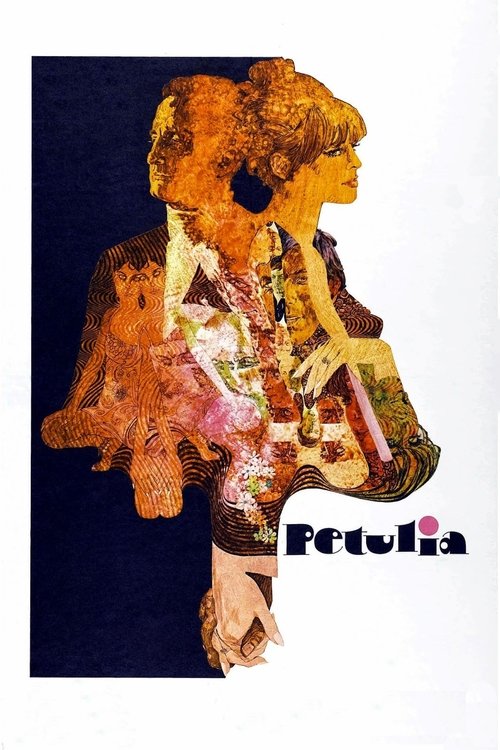
Petulia
1968 · Richard Lester
When you want heartbreak with an edge — something stylish, grown-up and a little bruising to chew on, not a cozy love story.
What it's about
A recently divorced San Francisco surgeon is singled out at a charity ball by Petulia, a young married socialite whose brittle playfulness hides a violent husband from a powerful family. Their almost-affair plays out against the neon of the late-'60s city — but the film keeps splintering time, flashing forward and back, so you assemble the romance and its damage yourself.
The experience
Jagged and melancholy under a bright pop surface; the fractured cutting keeps you slightly off-balance, and the sadness arrives sideways. It feels less like watching a romance than remembering one.
Performances
Julie Christie makes Petulia's gaiety read as a distress signal, George C. Scott is a marvel of weary, underplayed decency, and Richard Chamberlain is chilling cast against type as the husband.
The craft
Nicolas Roeg's camerawork and Antony Gibbs's editing shatter the story into gleaming shards, cutting the lovers against gadgets, hospitals and hotel-room consumer spectacle. It's also a time capsule: San Francisco in 1967, shot as it happened, with real bands of the moment playing onstage.
Why it matters
One of the most formally daring American studio films of the late 1960s, its scrambled chronology anticipated the style Roeg would carry into his own directing career; it has since become a cult touchstone of the era.
Snapshot
A fractured, anti-romantic elegy set in late-1960s San Francisco, Petulia follows the thwarted affair between a recently divorced surgeon, Archie Bollen, and a battered young socialite who pursues him with desperate gaiety. The film's distinction lies less in its love story than in how it tells it: through a radically disjointed chronology that scrambles cause and effect, juxtaposes characters against garish consumer spectacle, and renders human connection as perpetually just out of reach. Shot by Nicolas Roeg and cut by Antony Gibbs during the Summer of Love, it arrived in 1968 as one of the most stylistically adventurous studio films in American cinema, a British director's autopsy of the California Dream performed in real time.
Industry & Production
Petulia was a Warner Bros.–Seven Arts production, part of that studio's brief, turbulent creative opening in the late 1960s that would also yield Bonnie and Clyde (1967) and The Wild Bunch (1969). The project originated from John Haase's 1966 novel Me and the Arch Kook Petulia, adapted for the screen by Lawrence B. Marcus. Richard Lester, fresh from How I Won the War (1967)—his anti-heroic World War II film starring John Lennon—was brought in to direct; he had maintained a transatlantic production profile since the mid-1960s and was not yet permanently identified with any single national industry.
The film was shot almost entirely on location in San Francisco over the latter half of 1967, placing the production inside the gravitational field of the Summer of Love even as it declined to celebrate that moment. The Grateful Dead appear briefly in a charity benefit sequence; Big Brother and the Holding Company's presence in the city's social fabric registers in the ambient soundscape. This embeddedness in documented historical place and moment gives the film an almost ethnographic texture alongside its formal experiments. The budget and production correspondence records, held in part by studio archives, confirm a relatively modest production that nonetheless attracted major casting: Julie Christie, coming off her Oscar for Darling (1965) and her role in Doctor Zhivago (1965), and George C. Scott, five years before his Oscar win for Patton. Richard Chamberlain plays David Danner, Petulia's abusive husband; Joseph Cotten appears as David's wealthy, enabling father. Shirley Knight has a significant supporting role as Archie's accommodating ex-wife Polo.
Technology
The film was shot in Technicolor on 35mm, and its visual richness owes much to Nicolas Roeg's choices in stock and glass. Roeg favored long telephoto lenses and pushed contrast in a way that made San Francisco's corporate interiors—hotel lobbies, shopping malls, the Hilton ballroom—feel simultaneously lurid and sterile. The handheld camera, used selectively rather than as a blanket stylistic tic, imparts an observational instability to certain sequences without tipping into the kind of self-conscious vérité that would date it. The Panavision anamorphic frame allowed Lester and Roeg to compose for lateral isolation—figures stranded at the edge of wide shots, walled off from each other by negative space.
Editing technology of the period worked with optical printing for effects such as freeze-frames and the densely overlapping flash-cuts that punctuate the film's pivotal sequences. Antony Gibbs's assembly relied on methods that were laborious by later standards; the film's intricate chronological structure required meticulous planning at the script and shooting stages rather than anything that could be reorganized in a digital timeline.
Technique
Cinematography
Roeg's work on Petulia is now recognized as a transitional document in his biography: the sensibility that would produce Walkabout (1971) and Don't Look Now (1973) is fully visible here, though constrained to a collaborative context. His palette is cold and high-key for the hospital and hotel environments, warmer and more saturated for scenes involving memory or desire, but the distinction is never schematic. Telephoto compression flattens depth of field so that characters in conversation seem to float in front of painted backdrops—a shopping mall, a billboard, a marching band—rather than inhabit legible space. This defamiliarization of the quotidian environment aligns cinematography directly with theme: the world these people occupy has no genuine depth.
Editing
Antony Gibbs's editing is the film's most radical formal gesture. The narrative does not proceed in linear time; it moves associatively, inserting flash-forwards of events the viewer cannot yet contextualize and flash-backs that complicate apparently resolved scenes. A violent act is revealed incrementally across the film's length, each glimpse adding information without providing the cathartic clarity of a fully staged scene. This technique—clearly indebted to Alain Resnais but applied to mainstream genre material—prevents the viewer from settling into conventional identification. We know more than the characters at certain moments, less than they do at others, and the emotional grammar of the film remains deliberately unsettled throughout.
Mise-en-scène / Staging
Lester's staging has always displayed an eye for satirical environmental detail, and Petulia amplifies this into sustained critique. The film's San Francisco is a city of charity galas, hospital corridors, modernist apartment buildings, and RV lots—a consumer landscape in which even intimacy is decorated by brand signage or institutional furniture. Lester frequently places his actors within this setting without letting them fully command it; they are observed from behind glass, across lobbies, through doorways. The abode of the Danners—expensive, cold, architecturally impressive—functions as a particularly precise mise-en-scène for their marriage: everything on display, nothing livable.
Sound
John Barry composed the film's score, which sits in tonal tension with the diegetic music (rock, brass band, Muzak) flooding San Francisco's social spaces. Barry's contribution is relatively spare and elegiac—strings that underscore the romantic pathos without ironizing it, a counterpoint to the satirical visual register. The film's broader sound design, mixing the ambient noise of location shooting with studio-clean dialogue, reinforces the sense of documentary intrusion into fictional space.
Performance
George C. Scott's performance as Archie is deliberately internalized—a man experiencing strong emotions in a setting that offers no vocabulary for them. His reactions are frequently captured in fragment, mid-thought, off-balance. Julie Christie brings to Petulia a quality of manic forward momentum barely covering paralysis; her character's impulsive self-staging (showing up unannounced, stealing a tuba, pursuing a married man's acquaintance into obsession) reads simultaneously as free-spirited and as an attempt to stay one step ahead of her fear. Christie makes the subtext visible without ever explaining it. Chamberlain's David is more schematic—handsome, hollow, dangerous—but serves the film's structural purpose precisely.
Narrative & Dramatic Mode
Petulia refuses the satisfactions of the romantic drama it superficially resembles. The central couple never consummates their affair in any sustained way; Archie retreats, Petulia returns to her abuser, and the film ends not in resolution but in a kind of rueful stasis. Dramatically, the film belongs to a mode that was then largely European—the anti-melodrama, in which emotional potential is deployed precisely to mark its own impossibility. The disjointed chronology denies both characters and viewers the forward momentum that might convert longing into action. What is dramatized, ultimately, is impasse: social, emotional, temporal.
The film's treatment of domestic violence is striking for its period. It does not aestheticize or sensationalize; the abuse is presented in fragments that are disturbing precisely because they are never fully assembled into a coherent scene of confrontation. The institutional and social structures that protect David Danner—his father's wealth, his own respectability—are implicitly indicted without ever being explicitly argued. This restraint gives the film's political content a diffuse, uncomfortable register.
Genre & Cycle
Petulia sits at the intersection of the Hollywood romantic drama and the European art film, representing a hybridization that the late 1960s made briefly possible within studio distribution. It belongs, more broadly, to a cycle of disenchantment films produced in the window between the commercial certainties of classical Hollywood and the establishment of New Hollywood's own conventions: The Graduate (1967), Rachel, Rachel (1968), Medium Cool (1969), Five Easy Pieces (1970). What distinguishes Petulia from its American contemporaries in this cycle is its structural influence from Resnais rather than from the more visceral, character-driven American tradition.
Authorship & Method
Richard Lester arrived at Petulia with a distinctive formal vocabulary developed through the Beatles films and The Knack (1965): rapid montage, refusal of conventional narrative grammar, satirical deployment of pop culture as environmental context. Petulia applies this vocabulary to heavier material, and the result is a film whose playfulness feels haunted—where the formal tricks that produced delight in A Hard Day's Night now produce unease.
The collaboration with Nicolas Roeg was decisive. Roeg's compositional intelligence gave Lester's instincts a visual rigor that some of the Beatles films lack; their working relationship on Petulia appears to have been generative rather than hierarchical, though the specific terms of their creative dynamic are not extensively documented in the published record. Antony Gibbs, who had edited The Knack, brought continuity to Lester's editorial approach. Lawrence B. Marcus's screenplay retained the novel's San Francisco setting and the triangular emotional structure; the degree to which the non-linear chronology was scripted versus assembled in editing is not fully documented, though Lester's working method generally allowed for significant post-production reconceptualization.
Movement / National Cinema
Petulia occupies an anomalous position: a British director's Hollywood-financed film set in America, shot by a cinematographer who would himself become a major auteur, deploying formal strategies identified primarily with the French New Wave. It is neither a British New Wave film nor a straightforwardly American one. It is best understood as part of the transatlantic creative exchange of the late 1960s, when British filmmakers—Lester, John Schlesinger, Karel Reisz—were working extensively in America, cross-fertilizing Hollywood genre with European formal concerns. The film's relationship to Hollywood Renaissance cinema is real but asymmetrical: it shares the period's disillusionment without its energy, its stylistic ambition without its countercultural optimism.
Era / Period
The film was made in and explicitly addresses 1967 San Francisco, but its sensibility is retrospective and valedictory rather than celebratory. The Summer of Love appears in the film's margins—as location texture, as the social occasion of charity galas attended by people wearing beads alongside evening gowns—but Petulia does not believe in the counterculture as liberation. The freedom on offer in this San Francisco is merely a change of décor; the social structures (money, violence, institutional medicine, bourgeois marriage) remain intact. In this sense the film anticipates the disillusionment of 1968–1969 rather than embodying 1967's mood.
Themes
The film's central preoccupation is with the failure of connection in conditions of affluence. Archie and Petulia are both, in different ways, incapable of the sustained vulnerability that intimacy requires; they reach toward each other across a landscape specifically designed to make reaching feel absurd. The abusive marriage is not a dramatic exception to the social world around it but an intensification of its logic—control, display, the management of surfaces.
Time is both theme and formal substance. The fragmented chronology is not merely stylistic; it enacts the film's argument that memory and anticipation are more vivid than the present moment, and that relationships founder precisely in that gap. Consumerism functions as a persistent ironic frame: characters move through spaces devoted to acquisition and display, and the film systematically refuses to let this environment become invisible background.
Reception, Canon & Influence
Petulia received divided notices on release in 1968. Pauline Kael was among its significant early champions, situating it within the emerging critical vocabulary for what serious American cinema might look like; her engagement with the film was part of her broader advocacy for the New Hollywood sensibility. Other critics found the fragmented structure willfully obscure or too obviously derived from European models. The film did not perform strongly at the box office—the specific figures are not reliably retrievable in the sources I can draw on—and for some years it occupied a critically respected but commercially marginal position.
Its canonical standing has grown substantially over subsequent decades, particularly as its formal strategies became better understood in the context of European art cinema and as the period's social concerns (domestic violence, institutional complicity, the limits of the counterculture) became more legible rather than less. Nicolas Roeg's subsequent directorial career drew significant retrospective attention back to Petulia as a site of apprenticeship: the thematic concerns of Don't Look Now—time's non-linearity, love's inability to prevent loss, the body's vulnerability—are prefigured here with remarkable clarity.
Looking backward, Petulia's formal debts are to Resnais (Hiroshima mon amour, 1959; Last Year at Marienbad, 1961) and, through Lester's own prior work, to the rapid-cut satirical energies of the British New Wave. The film's use of San Francisco as a de-romanticized location also connects it to the observational sociology of cinema vérité, though it maintains fictional distance throughout.
Looking forward, its influence on American cinema of the 1970s is difficult to trace with precision—the film's formal strategies were absorbed into a wider stream—but its treatment of domestic violence as structural rather than episodic, and its refusal of romantic resolution, both participated in a shift in what American drama could address and how. For Roeg specifically, the film is foundational: the visual grammar, the temporal fragmentation, and the interest in romantic devastation across class lines all pass directly into his directorial signature.
A Deleuzian reading
Julie Christie hauls a stolen tuba into a hotel lobby.
The full Deleuzian reading of Petulia →
Reception
In 1968 plenty of critics wrote it off as modish, fragmented trend-chasing — though Roger Ebert famously championed it — and it has since been thoroughly reappraised as Lester's masterpiece and one of the great American films of its decade.
How Petulia was received, from release to now →
Influences: the films it descends from and the films it influenced
- Hiroshima mon amour (1959) — Resnais's flash-cut intrusive memory structure — involuntary fragments colliding with present action, refusing resolution into continuous time — is the direct formal model for Lester and Roeg's temporal fragmentation in Petulia; both films use disruptive intercutting not to clarify backstory but to show how traumatic knowledge cannot be assimilated into ordinary chronology.
- Last Year at Marienbad (1961) — Marienbad's refusal to anchor flashback sequences in verifiable past or present — time loops without confirming whether repetitions are memory, fantasy, or rerun reality — establishes the grammar Petulia borrows for its hospital flashbacks, where the violence scenes recur with shifted framing rather than new information, denying the spectator narrative resolution through accumulation.
- A Hard Day's Night (1964) — Lester's own prior film establishes the rapid-cut satirical montage that Petulia inherits and darkens: consumer spectacle (screaming fans, press conferences, television) deployed as environmental noise rather than background, a technique Lester transports intact to San Francisco's charity fundraisers and hotel lobbies, but strips of comic release so the same formal energy produces unease instead of exhilaration.
- The Knack...and How to Get It (1965) — Editor Antony Gibbs's fragmented, associative cutting method — sequences that jump within scenes, withhold establishing shots, and use insert imagery to satirize social environments — passes directly from The Knack into Petulia; the specific editorial grammar of both films shares a refusal of conventional coverage, building scenes from discontinuous angles that produce spatial disorientation as a social critique.
- Two for the Road (1967) — Frederic Raphael's screenplay structures the deterioration of a marriage through multiple non-linear time periods distinguished by costume, vehicle, and travel companion rather than explicit caption or narration — the same editorial grammar Petulia uses to locate its flashback fragments — making both films concurrent experiments in using clothing and setting as chronological indicators within fragmented romantic anti-melodrama.
- Performance (1970) — Roeg's co-directorial debut carries Petulia's optical printing vocabulary into psychedelic genre territory, using the same superimposition and in-camera fragmentation techniques he developed as Petulia's cinematographer to render spatial and temporal instability; the disorienting match cuts between Chas's gangland world and Turner's mansion directly extend the editorial method he helped develop with Lester.
- Walkabout (1971) — Roeg's handheld anamorphic compositions developed on Petulia — figures placed asymmetrically within a widescreen frame that reads consumer or natural environments as alien — become his directorial signature here; the telephoto compressions of Sydney's corporate architecture in the opening sequences replicate Petulia's San Francisco framings, establishing the same visual logic that consumer civilization and wilderness are equally inhospitable.
- Klute (1971) — Gordon Willis's telephoto surveillance framing — figures observed from distance through environmental obstruction, the camera positioned as a watching instrument — inherits Petulia's observational aesthetic; Jane Fonda's Method internalization, playing concealment and exposure simultaneously within a single scene, extends the register of internalized realism that Julie Christie established in Petulia for female performance under institutional threat.
- McCabe & Mrs. Miller (1971) — Vilmos Zsigmond's zoom telephoto grammar — the lens pulled back to observe characters within environments they cannot fully read, consumer and social spectacle framing figures as unconscious participants — extends Petulia's visual sociology; Altman's multilayer overlapping diegetic sound, where ambient noise and conversation compete without hierarchy, develops the diegetic/nondiegetic tension Petulia used to make San Francisco feel simultaneously present and alienating.
- Don't Look Now (1973) — The film's foundational formal device — intercutting the love scene with the couple dressing for dinner, collapsing different temporal moments into a single emotional unit — is a direct extension of Petulia's methodology, which Roeg had practiced as cinematographer; the film's thematic concerns (time's non-linearity, love's inability to prevent loss, the body's vulnerability) are prefigured in Petulia with such precision that Don't Look Now reads as Roeg's directorial consolidation of material he first helped visualize for Lester.
- The Long Goodbye (1973) — Vilmos Zsigmond's persistent slow-zoom lens movement — the camera constantly adjusting focus and framing within shots, refusing to fix the spectator's attention — translates Petulia's telephoto estrangement into kinetic form; sun-bleached Los Angeles consumer spectacle deployed as the same kind of disorienting environmental backdrop Roeg built in San Francisco, making a genre film's setting produce social critique through visual excess rather than plot commentary.
- Jesus' Son (2000) — Earliest model for the associative, chronology-scrambling cut that splices past and future fragments into the present to mimic the slippage of unreliable memory.
- The Limey (1999) — Splinters a present-tense drama with unsignaled flash-forwards and flashbacks (shot by Nicolas Roeg), demonstrating that fractured assembly could deepen character interiority rather than just signal trauma.
- Slaughterhouse-Five (1972) — Shuffled a story into nonlinear shards using flash-forwards and flashbacks as a New Hollywood editing strategy, modeling associative fragmentation of an ostensibly conventional narrative.
- Lenny (1974) — Antony Gibbs's anti-chronological cutting, which drops fragments of past and future into a scene without warning and lets the viewer assemble causality retroactively, is the structural precedent for Lenny's refusal to date its own flashbacks.
- Choose Me (1984) — Antony Gibbs's associative cutting — fragments of past and future spliced into the present by rhyme rather than chronology, with pop music carrying the splice — is the editing logic behind Choose Me's music-bridged, non-sequential transitions between the three strands.
- Blow-Up (1966) — Carlo Di Palma's deployment of Panavision telephoto lenses to flatten London consumer spectacle into decorative surface — the fashion shoot sequences as aestheticized commodity — runs parallel to Roeg's San Francisco work; both cinematographers use the anamorphic frame's horizontal expanse to arrange figures within consumer environments as objects among objects, making the frame's beauty a formal indictment.
- Point Blank (1967) — Released in the same transitional moment, Point Blank uses optical printing and flash-structure to collapse its protagonist's subjective time — scenes recur with shifted duration, suggesting trauma rather than plot — deploying the same Hollywood-art-film hybrid strategy as Petulia; both films treat the American genre film as a container for Resnais-derived temporal experimentation.
- The Graduate (1967) — Robert Surtees's persistent use of long telephoto lenses compresses California consumer environments — suburban pools, hotel lobbies, church pews — into suffocating spectacle, a strategy identical to Roeg's in Petulia; both films use the telephoto's flattened depth-of-field to make consumer architecture feel inescapable, trapping performers against backgrounds that refuse recession.
- Faces (1968) — Cassavetes's handheld observational grammar — close-proximity camera, available or near-available light, performance allowed to run beyond conventional dramatic beats — creates internalized realism in the American domestic register that runs directly parallel to Petulia's approach to performance; both films treat bourgeois domestic violence as institutional rather than episodic, refusing melodrama's containment of that violence within a single exceptional incident.
- Darling (1965) — Lester pushes Darling's fractured, time-scrambling montage further, building character through flash-forward and flashback fragments rather than linear scenes.
- They Shoot Horses, Don't They? (1969) — Fractured flash-forward/flash-back temporal montage in a New Hollywood register (shot by Nicolas Roeg), the same nonlinear scrambling of chronology used to foreshadow catastrophe.
- The Swimmer (1968) — Lester dissects affluent American unhappiness with zoom-lens location shooting and elliptical cutting that scrambles chronology mid-scene — the identical 1968 toolkit, and the same wager that a fracture in the cut can carry information the scene withholds.
Similar films
- Faces (1968) — influence & lineage
- Don't Look Now (1973) — influence & lineage
- Performance (1970) — influence & lineage
- Last Year at Marienbad (1961) — influence & lineage
- Blow-Up (1966) — influence & lineage
- Possession (1981) — shared sensibility
- Pierrot le Fou (1965) — shared sensibility
- Gertrud (1964) — shared sensibility