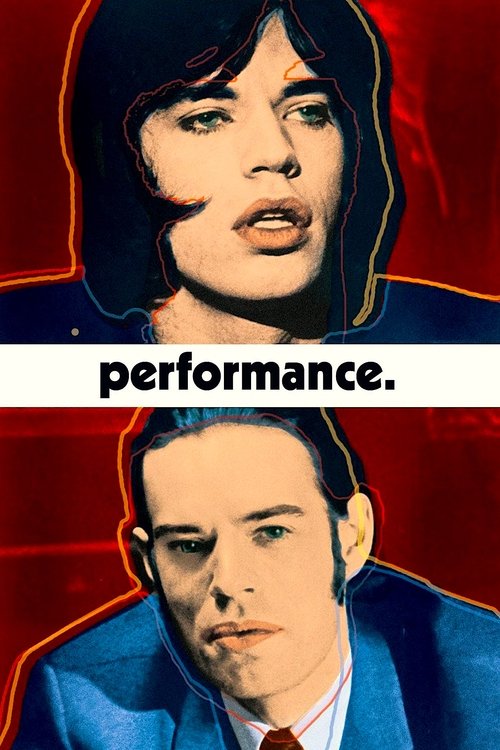
Performance
1970 · Nicolas Roeg
For a late night when you want something genuinely strange and transgressive — a head-trip with teeth, not a tidy thriller. Firmly on the challenge end of the dial; approach it curious rather than tired.
What it's about
Chas is a London gangster who's very good at his job — violence and intimidation delivered with tailored menace — until he crosses his own firm and needs a place to disappear. He lands in the Notting Hill basement of Turner, a reclusive rock star who's lost his creative spark, and in that hothouse of drugs, mirrors, and shifting identities, the hard man and the burnt-out idol start to blur into each other.
The experience
The first half is a brutal, stylish crime picture; the second is a hallucinatory chamber piece — and the collision is the point. It's disorienting, druggy, dangerous-feeling viewing, edited like a mind coming apart, and it leaves you pleasantly unsure of what you just watched.
Performances
James Fox is frightening and then fascinatingly unmoored as Chas — a role so intense he stepped away from acting for years afterward — while Mick Jagger, in his one great screen performance, plays Turner's decadent charisma like he was born to it, including a musical sequence that stops the film cold in the best way.
The craft
Co-created by writer-director Donald Cammell and cinematographer-turned-director Nicolas Roeg, it's cut with a fractured, time-jumbling boldness that was years ahead of its moment, and shot with a lurid, mirror-heavy beauty. The sound and music — rock, blues, and Moog experiments — are inseparable from the trip.
Why it matters
Shot in 1968 and shelved by its horrified studio for two years, it became a defining British cult film: it launched Roeg's directing career, defined Cammell's, and captured the exact moment the swinging sixties curdled into something darker.
Snapshot
Performance is one of the most notorious and consequential debuts in British cinema — though the singular "dir. Nicolas Roeg" credit flattens a more complicated truth. The film was co-directed by Donald Cammell and Nicolas Roeg, and the historical record consistently treats it as a genuine collaboration: Cammell wrote the screenplay and supplied the film's literary and occult sensibility, while Roeg, then one of Britain's most accomplished cinematographers, shot the picture and shaped its visual grammar. It is the film that opened Roeg's directorial career and effectively defined Cammell's. A gangster on the run from his own firm takes refuge in the Notting Hill house of a burnt-out rock recluse, and over the back half of the film their identities bleed into one another through drugs, sex, and role-play. Shot in 1968, shelved by a horrified Warner Bros. for roughly two years, and finally released in 1970, Performance fused the British crime thriller with psychedelic counterculture and a Borgesian metaphysics of the double. Its reputation as a transgressive landmark — and as a key text in the development of fragmented, associative editing — has only grown.
Industry & production
The film was produced by Sanford Lieberson and (as associate/co-producer) David Cammell under the Goodtimes Enterprises banner, and financed and distributed by Warner Bros. The original conception was, on paper, a marketable property: a film with Mick Jagger at the height of the Rolling Stones' fame, pitched to Warner as a kind of Swinging London vehicle. What Cammell and Roeg delivered was something far darker and more explicit than the studio expected — saturated with violence, drug use, androgyny, and sexuality — and the studio's reaction has become part of film legend.
The well-attested core of that story is that Warner executives were appalled by the first cut, that the film was substantially recut, and that its release was delayed for roughly two years. The more colorful anecdotes that cling to the production — the oft-repeated tale of a studio executive's wife reportedly being sickened at a screening — circulate as industry lore and should be treated with caution rather than as documented fact. What is solid is the outcome: a feature shot in 1968 did not reach screens until 1970, and arrived trailing a reputation for difficulty.
Production conditions were intimate and bohemian. Much of the second half was filmed in a house on Powis Square in Notting Hill, and the shoot drew on the real countercultural and criminal milieus the film depicts. Two of its principals came from outside conventional acting: Jagger as Turner and Anita Pallenberg — then Keith Richards's partner — as Pherber, alongside Michèle Breton as Lucy. The closeness of those relationships generated persistent rumor (notably about the nature of scenes between Jagger and Pallenberg) and reportedly real friction within the Rolling Stones' circle; the specifics here belong to gossip and memoir rather than to anything verifiable, and are best flagged as such.
Technology
Performance was shot on 35mm in color. Its technological signature lies less in any novel apparatus than in how aggressively conventional tools were pushed: handheld camerawork, mirrors and reflective surfaces used to fracture the image, distorting lenses and filters, and an editing approach that treated the celluloid as raw material to be cut against itself. The film also incorporates a small-gauge, home-movie texture in places, part of its interest in surfaces, recording, and self-documentation. In an era before video, the film's preoccupation with performance-as-recording is expressed through the camera apparatus itself — the act of looking and being looked at is built into the shooting style.
Technique
Cinematography
This is where Roeg's contribution is most legible. Coming off work as cinematographer on Roger Corman's The Masque of the Red Death, Truffaut's Fahrenheit 451, Schlesinger's Far from the Madding Crowd, and Richard Lester's Petulia, Roeg brought a fully formed visual intelligence to his first film as director. Performance is full of mirrors, reflections, and frames-within-frames; bodies are fragmented, doubled, and recombined. Color is deployed expressively — the cold, hard palette of the gangster world giving way to the warm, drugged, claustrophobic interiors of Turner's house. The camera is restless and subjective, frequently collapsing the distance between viewer and image, and the compositions repeatedly stage the theme of merged identity through visual rhyme.
Editing
The film's editing is arguably its most influential feature. The credited cutting was handled by Antony Gibbs (with Brian Smedley-Aston), and the radical re-edit that gave the film its final, fractured form is widely associated with the American editor Frank Mazzola, who is credited with reworking the picture into its released shape. The result is an associative, anticipatory montage: scenes are intercut across time and space so that one action comments on or predicts another — sex cut against violence, the gangster world cut against the bohemian one. This editing logic — image rhymes that leap across the chronology of the story — is the seed of the method Roeg would carry into Walkabout and, most famously, Don't Look Now. The bravura opening, which intercuts a speeding Rolls-Royce and an erotic scene, announces the strategy immediately.
Mise-en-scène / staging
Two worlds are staged in deliberate contrast. The first half's London underworld is hard-edged, masculine, and territorial; Harry Flowers's "firm" operates with the ritualized menace of a corporation. The second half retreats into the cluttered, sensual, candlelit interior of Turner's house — a den of cushions, mirrors, drugs, and bodies where boundaries dissolve. The production design makes the house a labyrinth of the self, and the staging repeatedly places characters in mirrors or in costume, foregrounding role-play (Pherber dressing and "performing" Chas; Turner trying on the gangster persona). The famous "Memo from Turner" sequence, in which Jagger imagines himself as the boss presiding over the firm, is the film's set-piece staging of identity exchange.
Sound
The soundtrack is integral rather than decorative. Jack Nitzsche is credited with the music, and the film assembled a striking range of contributions: Ry Cooder's slide guitar threads through the score, and the songbook draws on Randy Newman, Buffy Sainte-Marie (whose "The Hashishin" accompanies a key sequence), Merry Clayton, and the incendiary spoken-word of the Last Poets. The centerpiece is "Memo from Turner," performed by Jagger, which functions as both musical number and dramatic hinge. Sound design and music are used to bridge the film's two halves and to underscore the dissolution of the protagonist's stable identity.
Performance
James Fox as Chas Devlin gives the film its dramatic spine, and the role is famous beyond the screen: the immersive, dislocating experience of playing Chas is generally cited as a factor in Fox's subsequent withdrawal from acting for much of the 1970s and his turn toward evangelical Christianity — a biographical fact that is well documented, even if the precise causal weight assigned to the film varies by account. Mick Jagger as Turner is less a conventional performance than a calculated deployment of his own star persona, languid and ambiguous. Anita Pallenberg (Pherber) and Michèle Breton (Lucy) complete the household, and Johnny Shannon is memorable as the gang boss Harry Flowers. The acting register deliberately mixes trained naturalism (Fox) with non-actor presence (Jagger, Breton), reinforcing the film's theme that personality itself is a performance.
Narrative & dramatic mode
Performance is built as a diptych. The first movement is a relatively legible crime narrative: Chas is an enforcer who enjoys his work, oversteps by pursuing a personal vendetta against Joey Maddocks, kills him, and is marked for death by his own firm. Forced to disappear, he takes a room in Turner's house under a false identity. The second movement abandons conventional plot for a psychological and metaphysical drift, as drugs, sex, and Pherber's manipulations erode the wall between Chas and Turner. The dramatic mode shifts from kinetic thriller to hallucinatory chamber piece, and the climax — Chas shooting Turner — is staged so ambiguously (culminating in an image associated with Jorge Luis Borges) that it reads less as a literal murder than as a fusion or transfer of selves. The film resists closure: the final shot leaves the question of who, exactly, gets into the car deliberately unresolved.
Genre & cycle
The film sits at the collision point of two cycles. On one side is the British crime film of the late 1960s, with its hard, ritualized gangland world — a lineage that runs alongside (and just ahead of) Get Carter (1971) and connects to the real iconography of London firms. On the other is the international "head film" / counterculture cinema of the period, concerned with drugs, identity, and the dissolution of the bourgeois self. Performance is one of the few works to weld these convincingly, and in doing so it became a foundational text for the British art-crime hybrid — the strand of crime cinema that treats gangsterism as a stage for metaphysics rather than mere genre mechanics.
Authorship & method
The authorship of Performance is genuinely dual, and any account that credits Roeg alone is incomplete. Donald Cammell — painter, son of the writer Charles Richard Cammell (a biographer of Aleister Crowley), and a figure steeped in occult and literary milieus — wrote the screenplay and is generally regarded as the film's conceptual author, the source of its Borgesian doubling, its occult undercurrents, and its theme of identity as performance. Nicolas Roeg brought the cinematographer's eye and the editing sensibility that translated Cammell's ideas into the film's distinctive form; Performance launched Roeg into a directing career (Walkabout, Don't Look Now, The Man Who Fell to Earth) that would extend its fractured-montage method. Key collaborators include editor Frank Mazzola, whose re-cut shaped the released film; composer Jack Nitzsche; and the musicians, Cooder chief among them, who built its sonic identity. Cammell's later directing career was sparse and troubled — White of the Eye, Wild Side — and he died by suicide in 1996; Performance remains his defining work.
Movement / national cinema
The film is a product of late-1960s British cinema at the moment when Swinging London's optimism was curdling. It belongs to no formal movement but draws on the energies of the British New Wave's grit, the international art cinema's formal experimentation, and the transatlantic rock counterculture. Roeg's subsequent run of films effectively constitutes a personal idiom within British cinema — elliptical, eroticized, structurally daring — for which Performance is the origin point.
Era / period
Made in 1968 and released in 1970, Performance straddles the decade's hinge. It captures the comedown after the 1960s' utopian phase: the violence beneath the love-and-peace surface, the exhaustion of the rock idol, the gangster as a parallel "performer." Its delayed release means it arrived as both a period artifact of 1968 and a harbinger of the harder, more disillusioned 1970s — a transitional document in every sense.
Themes
Identity and its instability are the film's master theme: the title's "performance" names both criminal violence ("a performer" in underworld slang) and stagecraft, collapsing the gangster and the rock star into mirror images of the same impulse. From this flow the film's obsessions with doubles and merger, with masks and role-play, with the porousness of the self under drugs and desire. Borges presides over the whole — the literature of labyrinths, mirrors, and dissolved authorship — and the film shares his interest in the moment one identity becomes another. Violence and eroticism are treated as continuous, both forms of intimacy and domination. Underneath runs a current of the occult and the magical, traceable to Cammell's background, in which transformation is less psychological than metaphysical.
Reception, canon & influence
On release Performance was divisive and, by the standards of its studio backers, a difficult and unwelcome object; its two-year shelving and the hostility it provoked are central to its history. Critical opinion was sharply split between those who found it pretentious or repellent and those who recognized a major work, and over the following decades the second view prevailed decisively. It is now firmly canonized as one of the great British films and a landmark of 1970 cinema, routinely cited in critical surveys of the period.
Looking backward, the film's influences are unusually legible: Jorge Luis Borges (explicitly invoked in the climax and pervasive in its structure), the occult tradition associated with the Cammell family's milieu, the real London underworld of the Kray era, and Roeg's own apprenticeship under directors as varied as Corman, Truffaut, Schlesinger, and Lester. Looking forward, its legacy is twofold. As a formal influence, its associative, time-fracturing editing fed directly into Roeg's subsequent films and, through them, into a broader vocabulary of elliptical montage adopted by later filmmakers. As a cultural touchstone, it became the template for the art-house British gangster film — the idea that the crime picture could carry metaphysical and psychosexual weight — and a persistent reference point for directors and musicians drawn to its imagery of doubling, decadence, and the dissolving self. Its standing as a "difficult" film that was vindicated by time has itself become part of its mystique, and it endures as one of the essential films of its era.
A Deleuzian reading
Pherber holds a mirror to Chas's naked body and slides it until his half merges with hers, with Turner's, until you can't say whose flesh you're looking at.
The full Deleuzian reading of Performance →
Reception
Warner Bros expected a swinging-London Stones vehicle, got something so disturbing they shelved it for two years and forced re-edits before its 1970 release to bafflement and hostility. It's since climbed all the way to consensus status as one of the greatest British films ever made, a fixture of BFI and Time Out all-time lists.
How Performance was received, from release to now →
Influences: the films it descends from and the films it influenced
- The Lady from Shanghai (1947) — Its hall-of-mirrors climax — fractured identity rendered through multiplying reflections and shattered glass — is the precedent for Performance's reflective surfaces dissolving the boundary between Chas and Turner.
- Vertigo (1958) — Establishes the double and identity-as-remade-performance bound to saturated, symbolic color, the same psychosexual-doubling-through-expressive-palette grammar Roeg deploys.
- Last Year at Marienbad (1961) — Its associative, anti-chronological montage — cutting on memory and supposition rather than story logic — is the editing principle Mazzola and Roeg push into Performance's time-fracturing assembly.
- Scorpio Rising (1963) — Pioneers cutting imagery in associative rhythm against pop records while soaked in occult iconography — directly feeding both Performance's montage-to-music method and its Crowley-adjacent milieu.
- Persona (1966) — Its merging of two faces into one composite identity, achieved through superimposition and mirrored framing, is the formal template for Performance's intercut fusion of Chas and Turner.
- Blow-Up (1966) — Maps the Swinging London demimonde and its ambiguous, unresolved ending onto art-cinema form, the milieu and refusal-of-closure Performance inherits and turns toward comedown.
- Point Blank (1967) — Imports elliptical, fragmented art-film editing into the crime picture, the precise hybrid — gangster narrative carried by associative montage — that Performance radicalizes.
- Petulia (1968) — Roeg's co-directorial debut carries Petulia's optical printing vocabulary into psychedelic genre territory, using the same superimposition and in-camera fragmentation techniques he developed as Petulia's cinematographer to render spatial and temporal instability; the disorienting match cuts between Chas's gangland world and Turner's mansion directly extend the editorial method he helped develop with Lester.
- The Servant (1963) — Roeg and Cammell stage a reversal of dominant and servile identities inside a single London house, saturated with mirrors and fractured reflections that literalize the merging Losey suggests.
- The Strange Ones (1950) — Stages doubling and the merging of identities inside a claustrophobic enclosed flat, extending the dual-role/doubling craft into psychedelic montage.
- Walkabout (1971) — Roeg's first solo film carries forward Performance's expressive color and associative cross-cutting of disparate spaces into lyrical, premonitory montage.
- Don't Look Now (1973) — Extends the associative editing into a system of premonition — flash-cuts of red and water linking past, present and future — perfecting Performance's montage method.
- The Man Who Fell to Earth (1976) — Repeats the Jagger gambit by casting rock star David Bowie as a non-actor whose star persona supplies the character, alongside the same fractured-time assembly.
- Bad Timing (1980) — Builds an entire narrative from non-chronological associative cutting, the most extreme distillation of the editing logic Performance introduced.
- White of the Eye (1987) — Cammell's own continuation of his Performance concerns — doubling and psychosexual identity — rendered through delirious reflective imagery and disjunctive montage.
- Lost Highway (1997) — Structures the film as a two-panel diptych in which one identity transforms into another at the hinge, the same diptych-of-the-double architecture Performance pioneered.
- The Limey (1999) — Tells a revenge-crime story through overtly Roeg-derived elliptical editing, scattering and recombining moments out of sequence as memory and premonition.
- Sexy Beast (2000) — Inherits Performance's template of the art-house British gangster film — crime carrying metaphysical and psychosexual weight — via surreal interludes and music-video-honed imagery.
- Being John Malkovich (1999) — Roeg and Cammell's editing technique — jump cuts and superimpositions that make identity-colonization visible as a formal operation rather than a narrative event — is the structural precedent for BJM's literalization of celebrity-as-vessel; both films treat selfhood as a space another consciousness can physically enter and rearrange from the inside.
- Trainspotting (1996) — Roeg's cross-cutting between objective and subjective reality to render drug-altered perception—walls that breathe, identities that dissolve across cuts—established the British cinema vocabulary for filming intoxication as spatial disorientation that Boyle inherits for Renton's hallucinations and the withdrawal-room sequences.
- Fear and Loathing in Las Vegas (1998) — Roeg uses superimposition, in-camera color manipulation, and multiple-exposure printing to externalize drug-induced identity dissolution as consistent cinematic grammar rather than isolated effect — the principle that Pecorini's hallucination sequences directly inherit: altered consciousness expressed through the film's baseline optical register, not exceptional departures from it.
- The Doors (1991) — Roeg and Cammell's treatment of the rock star's performance space as a zone where identity dissolves and psychedelia erupts through optical superimposition and layered in-camera effects directly established the visual grammar Stone and Richardson use for Morrison's onstage hallucinations, including the conceit that performance itself is an altered state rather than mere entertainment.
- Get Carter (1971) — Shares Performance's 1970 British-gangster-comedown register, treating the underworld with chilled realism rather than glamour as the New Wave crime film hardened.
- A Clockwork Orange (1971) — Produced simultaneously in Britain, the film deploys rock music (Mick Jagger, Randy Newman) as an alienating counterpoint to violence and identity dissolution at the same moment ACO uses Rossini and Beethoven against the same materials; Roeg's fragmented, destabilizing cinematography serves the same function as Alcott's wide-angle distortion — externalizing a subjective state rather than observing it.
- Angel Heart (1987) — Pioneers the British art-cinema identity-merger between two men through disorienting montage and mirror imagery — a direct precedent for the Angel/Cyphre doubling and Rourke's disintegration of self.
- Funeral Parade of Roses (1969) — Dissolves stable identity through fragmented, mirror-laden montage and gender-fluid casting, pursuing the face/mask theme via the same disjunctive editing register.
Similar films
- Blow-Up (1966) — influence & lineage
- Get Carter (1971) — influence & lineage
- Point Blank (1967) — influence & lineage
- A Clockwork Orange (1971) — shared sensibility
- Pink Floyd: The Wall (1982) — shared sensibility
- Carnal Knowledge (1971) — shared sensibility
- Taxi Driver (1976) — shared sensibility
- Trainspotting (1996) — shared sensibility
All the films related to Performance →